Andrew Haskell, MD Approved by PAMF IRB Palo Alto Medical - - PowerPoint PPT Presentation

andrew haskell md
SMART_READER_LITE
LIVE PREVIEW

Andrew Haskell, MD Approved by PAMF IRB Palo Alto Medical - - PowerPoint PPT Presentation

5/10/2013 Novel Ankle Fusion Technique Novel Ankle Fusion Technique Through Medial Malleolar Through Medial Malleolar Nonunion Nonunion I have no conflicts for this presentation Andrew Haskell, MD Approved by PAMF IRB Palo Alto Medical


slide-1
SLIDE 1

5/10/2013 1

Palo Alto Medical Foundation / UCSF Peninsula Orthopaedic Ankle Surgeons

Novel Ankle Fusion Technique Through Medial Malleolar Nonunion

Andrew Haskell, MD

Palo Alto Medical Foundation / UCSF Peninsula Orthopaedic Ankle Surgeons

Novel Ankle Fusion Technique Through Medial Malleolar Nonunion

I have no conflicts for this presentation Approved by PAMF IRB

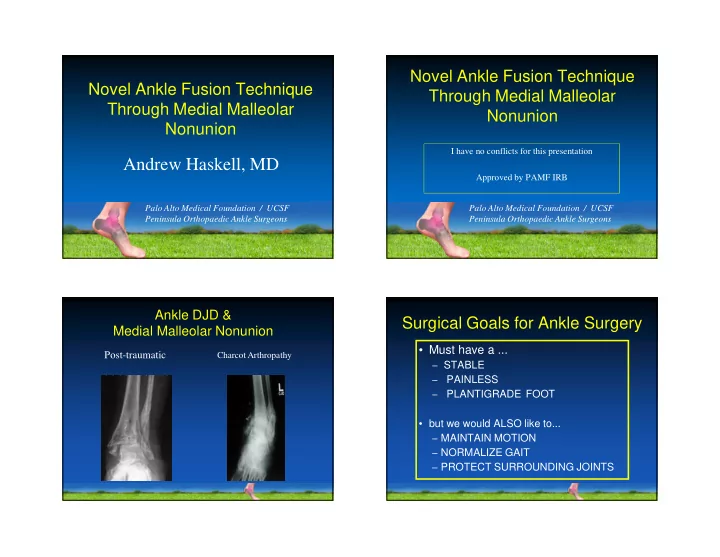
Ankle DJD & Medial Malleolar Nonunion

Post-traumatic

Charcot Arthropathy

Surgical Goals for Ankle Surgery

  • Must have a ...

– STABLE –

PAINLESS

PLANTIGRADE FOOT

  • but we would ALSO like to...

– MAINTAIN MOTION – NORMALIZE GAIT – PROTECT SURROUNDING JOINTS

slide-2
SLIDE 2

5/10/2013 2

Why Are Medial Malleolar Non-unions a Problem?

  • Standard screw techniques rely on intact

medial buttress for stability

Good Bad

Why Are Medial Malleolar Non-unions a Problem?

  • Retrocalcaneal nail sacrifices the subtalar joint
  • Total ankle replacement needs intact medial malleolus

Why a Medial Based Approach?

  • Approach via the nonunion
  • Does not rely on medial

buttress

  • Preserves the subtalar joint
  • Can use bone for graft
  • Retrospective chart review
  • 42 sequential ankle/hindfoot fusion cases
  • January 2006 - December 2008
  • Inclusion
  • intention to fuse ankle through a medial approach
  • Data collection
  • Demographics
  • Success of fusion
  • Subjective improvement & motion
  • Need for further surgery

Methods

slide-3
SLIDE 3

5/10/2013 3

Technique

  • Medial approach
  • Joint preparation
  • Wire in center of talus
  • wire parallel to plantigrade foot
  • use plate as guide
  • Impact blade into talus
  • Compress if possible
  • Secure plate to tibia

Results

  • 4 fusions using a medial approach identified
  • 4 male
  • Average age 61
  • Etiology
  • 3 Charcot
  • 1 post-traumatic

Results

  • 4 (100%) of 4 fused using medial approach
  • 2 ICBG
  • 1 required conversion to tib-talo-calcaneal fusion after

intraoperative talus fracture Case 1: Post-traumatic nonunion

Results

  • Average time to ambulation 3.3 months
  • Charcot braced 6+ months
  • No additional procedures required

Case 2: Charcot ankle fracture

slide-4
SLIDE 4

5/10/2013 4

Results

  • 4 of 4 report improvement in pain & stability
  • 2 of 4 require walking aid
  • Subtalar joint motion rated fair to normal

Case 3: Charcot ankle nonunion

Literature - Ankle Fusion

Study Method # Pts F/U Fusion Rate Outcome Mann 1996 Open 81 1-6 yr 88% AOFAS 41 -> 74 Myerson 1996 Mini-open 15 1 yr 100% AOFAS 43-> 82 Winson 2005 Scope 118 5 yr 92% 79% good/exc Ferkel 2005 Scope 35 6 yr 97% 74% good/exc

Literature - Medial Approach

  • Medial malleolar osteotomy
  • Union 12 (92%) of 13

Schuberth, J Foot Ankle Surg, 2005

Future Directions

  • Locked Plates

Anterior Medial

slide-5
SLIDE 5

5/10/2013 5

Future Directions

  • Primary Fusion?

Palo Alto Medical Foundation / UCSF Peninsula Orthopaedic Ankle Surgeons

Thank You