and Vendor Counsel Leveraging Agreements to Improve Supplier - - PowerPoint PPT Presentation

and vendor counsel
SMART_READER_LITE
LIVE PREVIEW

and Vendor Counsel Leveraging Agreements to Improve Supplier - - PowerPoint PPT Presentation

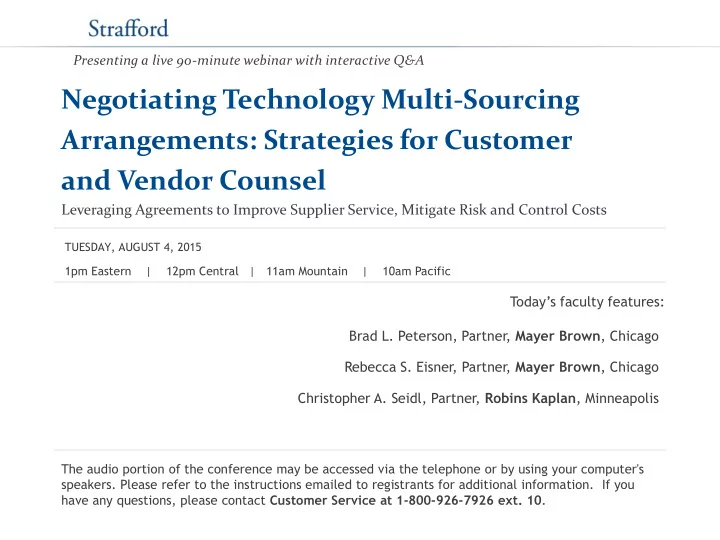
Presenting a live 90-minute webinar with interactive Q&A Negotiating Technology Multi-Sourcing Arrangements: Strategies for Customer and Vendor Counsel Leveraging Agreements to Improve Supplier Service, Mitigate Risk and Control Costs


slide-1
SLIDE 1

The audio portion of the conference may be accessed via the telephone or by using your computer's

  • speakers. Please refer to the instructions emailed to registrants for additional information. If you

have any questions, please contact Customer Service at 1-800-926-7926 ext. 10.

Presenting a live 90-minute webinar with interactive Q&A

Negotiating Technology Multi-Sourcing Arrangements: Strategies for Customer and Vendor Counsel

Leveraging Agreements to Improve Supplier Service, Mitigate Risk and Control Costs

Today’s faculty features:

TUESDAY, AUGUST 4, 2015

Brad L. Peterson, Partner, Mayer Brown, Chicago Rebecca S. Eisner , Partner, Mayer Brown, Chicago Christopher A. Seidl, Partner, Robins Kaplan, Minneapolis

1pm Eastern | 12pm Central | 11am Mountain | 10am Pacific

slide-2
SLIDE 2

Tips for Optimal Quality

Sound Quality If you are listening via your computer speakers, please note that the quality

  • f your sound will vary depending on the speed and quality of your internet

connection. If the sound quality is not satisfactory, you may listen via the phone: dial 1-866-961-8499 and enter your PIN when prompted. Otherwise, please send us a chat or e-mail sound@straffordpub.com immediately so we can address the problem. If you dialed in and have any difficulties during the call, press *0 for assistance. Viewing Quality To maximize your screen, press the F11 key on your keyboard. To exit full screen, press the F11 key again.

FOR LIVE EVENT ONLY

slide-3
SLIDE 3

Continuing Education Credits

In order for us to process your continuing education credit, you must confirm your participation in this webinar by completing and submitting the Attendance Affirmation/Evaluation after the webinar. A link to the Attendance Affirmation/Evaluation will be in the thank you email that you will receive immediately following the program. For additional information about CLE credit processing call us at 1-800-926-7926

  • ext. 35.

FOR LIVE EVENT ONLY

slide-4
SLIDE 4

Program Materials

If you have not printed the conference materials for this program, please complete the following steps:

  • Click on the ^ symbol next to “Conference Materials” in the middle of the left-

hand column on your screen.

  • Click on the tab labeled “Handouts” that appears, and there you will see a

PDF of the slides for today's program.

  • Double click on the PDF and a separate page will open.
  • Print the slides by clicking on the printer icon.

FOR LIVE EVENT ONLY

slide-5
SLIDE 5

Negotiating Technology Multisourcing Arrangements: Strategies for Customer and Vendor Counsel

August 4, 2015 Brad L. Peterson, Partner Mayer Brown, Chicago Rebecca S. Eisner, Partner Mayer Brown, Chicago Christopher A. Seidl, Partner Robins Kaplan, Minneapolis

slide-6
SLIDE 6

6

  • Multisourcing trends in the Digital Age
  • New benefits and risks of multi-sourcing in the Digital Age
  • Considerations for counsel in multi-sourcing agreements from

the customer and supplier perspective

– However, multisourcing is primarily a customer decision and challenge and thus we will focus

  • n the customer considerations

Agenda

slide-7
SLIDE 7

7

Mayer Brown Business & Technology Sourcing Practice

"An excellent team of people for

  • utsourcing agreements globally -

pragmatic in their approach, with a wealth of experts they can call on.“ –Chambers Global 2014 “Mayer Brown is universally regarded as a leading player in the technology and outsourcing arena, with market commentators commending the ease with which its lawyers integrate with clients, delivering business-focused advice and guidance.” – Chambers Global 2013 “Their knowledge in this area is

  • tremendous. They know us so well

they blend into our deal teams and become a natural extension to our in-house team.” – Chambers USA 2014

  • More than 50 lawyers around the world focused on

helping clients improve their business operations by sourcing services and technology

  • Advised on more than 300 significant outsourcing

transactions valued at an aggregate of more than $100 billion Recognized Market Leader

“Band 1” ranking in IT/Outsourcing for ten consecutive years (Chambers 2004-2014) Named “MTT Outsourcing Team of the Year” in 2014 and ranked in the top tier from 2010 thru 2014 Ranked as one of the top law firms in 2009 thru 2014 on The World’s Best Outsourcing Advisors list for The Global Outsourcing 100™

“They're very practical in terms of trying to identify solutions and giving very good advice on areas where it's reasonable for us to compromise or, alternatively, where to hold our ground.” – Chambers Global 2015

slide-8
SLIDE 8

8

Mayer Brown Speakers

Brad Peterson co-leads Mayer Brown’s Business & Technology Sourcing practice

  • globally. His practice is focused on helping leading companies work more

effectively with suppliers. He has over 20 years of experience helping clients implement multi-supplier sourcing strategies, including cloud computing, information technology outsourcing, business process outsourcing, privacy and security, enterprise system licensing and implementation. Peterson is ranked as a Band 1 lawyer by Chambers and by Legal 500. Rebecca Eisner focuses her practice on complex technology and business process outsourcing and sourcing, information technology transactions, cloud computing, IoT, data protection, privacy, and cybersecurity. She has represented multi-national clients in major cloud computing transactions, addressing legal, compliance and data protection aspects of those matters. She also advises re-structuring and re-negotiating outsourcing transactions, and

  • ther strategic sourcing relationships. Eisner is ranked as a Band 1 lawyer by

Chambers and by Legal 500. Eisner was named the top Technology Attorney in Chicago in 2015.

slide-9
SLIDE 9

9

Robins Kaplan Litigation and Dispute Resolution Practice

“ “

  • More than 220 attorneys in seven major cities
  • Firm clients include—as both plaintiffs and

defendants—numerous Fortune 500 corporations, emerging-markets companies, entrepreneurs, and individuals

  • Firm recognition includes:

Top Rankings in Chambers USA Named to the “A-List” by The American Lawyer Named to the inaugural list of “America’s Elite Trial Lawyers” by The National Law Journal

“Acts for both plaintiffs and defendants in a wide variety of contentious matters,” and clients describe the practice as "extremely professional, very experienced and very talented.” –Chambers USA 2015 “Exemplary, cutting-edge work” – National Law Journal 2014 “Known for taking on cases deemed unwinnable by others” – National Law Journal 2014 Robins Kaplan has a “track record for litigating and negotiating complex cases resulting in verdicts and settlements worth hundreds of millions or even billions of dollars…..” – National Law Journal 2014

slide-10
SLIDE 10

10

Robins Kaplan Speaker

Chris Seidl leads Robins Kaplan's Global Business and Technology Sourcing dispute resolution practice. He is a 2015 BTI Client Service All-Star, and was recently recognized by Law360 as being among the “cream of the crop litigators” in the country. He was noted for being “very good at bringing a business understanding, as well as a technical understanding, and then meshing those two areas together for clients.” Chris has handled disputes involving a broad variety of sourcing arrangements, including Information Technology Outsourcing (ITO), Business Process Outsourcing (BPO), Finance & Accounting, Application Development and Management (ADM), Enterprise Resource Planning (ERP), call centers, and software development and

  • implementation. He has represented both customers and vendors in sourcing

disputes, and he helps clients avoid disputes and helps resolve disputes when they arise.

slide-11
SLIDE 11

MULTI-SOURCING TRENDS

11

slide-12
SLIDE 12

12

Governing contracts

  • Inconsistent
  • Built for monosourcing

Many governance

  • rganizations

Work Silos

  • Best-of-breed suppliers
  • Deal-focused teams
  • Lack of shared knowledge
  • Lack of internal alignment
  • Varying governance principles
  • Varying process maturity

Phase I: Parallel Multisourcing

ITO ADM Net ERP PC Etc

slide-13
SLIDE 13

13

Centralized governance can allow:

  • Consistency
  • Specialization
  • Organizational learning
  • Greater resource efficiency

Phase II: Centralized Multisourcing

ITO ADM Net ERP PC Etc

slide-14
SLIDE 14

14

Supplier portfolio managed through a center of excellence with contracts built for efficient delivery in a multisourced environment. Contracts establish boundaries and require suppliers to cooperate. Common contract terms provide consistency and comparability in governance.

Phase III: Integrated Multisourcing

ITO ADM Net ERP PC Etc

slide-15
SLIDE 15

15

Suppliers compete for work across multiple towers, like species in nature. Contracts work to establish rules, create fair competition, reward symbiotic behavior over predatory behavior and pick winners based on value delivered to the end customer. First-tier suppliers provide work for the next tier of suppliers.

Phase IV: Ecosystem Multisourcing

ITO ADM Net ERP PC Etc

slide-16
SLIDE 16

16

  • IT infrastructure outsourcing
  • Business process outsourcing
  • Network outsourcing
  • Applications outsourcing
  • Software licensing
  • Software integration
  • Call center services
  • Desktop support outsourcing
  • HR outsourcing
  • Facilities management
  • utsourcing

Phase V: Multisourcing in the Digital Age Examples of Well Established Services

slide-17
SLIDE 17

17

Phase V: Multisourcing in the Digital Age Disruptive Technologies

  • Disruptive Interface Technologies

– Social media – Mobile computing – Internet of Things (IoT)

  • Disruptive Computing Technologies

– “Big Data” analytics – Private and public cloud – Software as a Service (SaaS) – Autonomics / Robotics – X as a Service (XaaS)

slide-18
SLIDE 18

18

“Occasionally, however, disruptive technologies emerge: innovations that result in worse product performance, at least in the near term. . . . Products based on disruptive technologies are generally cheaper, simpler, smaller and, frequently, more convenient to use.”

The Innovators Dilemma, by Clayton M. Christianson, Harvard Business School Press, 1997

What is a Disruptive Technology?

slide-19
SLIDE 19

19

  • Flexibility on volumes
  • Low fees / no investment
  • Ability to terminate on short

notice without fees

  • Exciting new capabilities
  • Easy access via Internet
  • Targeted solution to specific

problem

  • Requires fewer people

Digital Disrupters May Be Additions Or Replacements Typical Benefits Typical Problems

  • Inflexible service offerings
  • “AS IS” terms / web terms
  • Supplier may change or

terminate services

  • Missing critical capabilities
  • Cybersecurity risk
  • Inability to integrate with
  • ther providers
  • Redundancy of people
slide-20
SLIDE 20

20

Example: ITO in the Digital Age

ITO

Public cloud for public web site Private cloud for sensitive data Cloud integrator Managed service for infrastructure Colocated data center Data warehouse / analytics engine Interfaces to social, mobile, IoT and other Digital Age platforms Security as a Service

slide-21
SLIDE 21

21

  • Inflexible service offerings
  • “AS IS” terms / web terms
  • Supplier may change or

terminate services

  • Missing critical capabilities
  • Cybersecurity risk
  • Inability to integrate with
  • ther providers

Digital Disrupters May Bring More Risk, and Disputes Typical Problems Potential Risks/Disputes

  • Misaligned expectations
  • Contractual disputes
  • Service gaps/Allegations of

breach

  • Misaligned expectations
  • Security breach
  • Lack of communication

and accountability

slide-22
SLIDE 22

NEW BENEFITS AND RISKS OF MULTISOURCING IN THE DIGITAL AGE

22

slide-23
SLIDE 23

23

  • Reduces overall risk through diversification and alternatives
  • Reduces customer capital investment
  • Deals may be faster and less risky due to shorter term

commitment (no longer making a 7-10 year commitment)

  • Access to most advanced technology (less concern about
  • bsolescence, and market pressure assures competitive offerings)
  • Provides flexibility
  • Customer does not have to build technical skill sets in non-core

but critical capability areas (like security) that can now be point- sourced

  • Greater scalability using multiple suppliers

Multisourcing in the Digital Age: Benefits for Customers

slide-24
SLIDE 24

24

  • More suppliers to select

– Need new, more flexible selection processes – “Apples to apples” comparisons will cease to be the norm – More due diligence to complete – Bad blood?

  • More suppliers to integrate

– More points of integration and more points of failure – Need for integrators with expertise in complex technology ecosystems – More customer oversight of integration points and more communication (impact to business case)

  • More suppliers to manage

– Complexity of the supplier ecosystem – New models of relationship management and governance

Multisourcing in the Digital Age: Risks for Customers (1 of 2)

slide-25
SLIDE 25

25

  • Less Standardization

– Fewer standard operating procedures – Greater differences in risk and risk mitigation – Varying rights and remedies – Variety of contracting forms – Higher overall transaction costs

  • Greater skill requirements

for customers

– Managing more types of contracts – Working around inflexible elements – Handling increasingly rapid change – Dealing with inter-vendor miscommunication and conflict

Multisourcing in the Digital Age: Risks for Customers (2 of 2)

slide-26
SLIDE 26

26

  • Customer willingness to move away from traditional “tier one” suppliers,

valuing innovation over established solutions

  • Suppliers of digital age services can more easily win new accounts, with a

shorter sale cycle (less due diligence)

  • Flexible contract terms (e.g., URL’s) allow for rapid adaptation to market

forces and legal and compliance changes

  • Less risk of being trapped in unprofitable long-term contracts
  • Less customized investment for customers
  • Use of compliant services to gain competitive market advantage
  • Opportunity to take a new “service integrator” role

Multisourcing in the Digital Age: Benefits for Suppliers

slide-27
SLIDE 27

27

  • Likely reduction in revenue per deal
  • Increased use of standards and certifications to fill due diligence gaps
  • More suppliers after same market, with varying maturity levels, leading to less

awareness of how to bid

  • Greater reliance on subcontractors
  • Greater threat to existing relationships – new market entrants, new services, new

intermediaries (resellers)

  • Less ability to pass through costs for aspects of service that are expected (e.g,

investment in security)

  • More time and energy spent educating customers on differences between “legacy”

systems and Digital Age services

  • Dependence on customer’s third party ecosystem may distort end users view of

value and performance of the services

Multisourcing in the Digital Age: Risks for Suppliers

slide-28
SLIDE 28

CONSIDERATIONS FOR COUNSEL

28

slide-29
SLIDE 29

29

  • Dependence on prescriptive RFP models that assume

customization that is increasingly not available

  • Expectation that traditional, standard contract terms will be

used, versus newer flexible, risk-based contracting models

  • Lack of process for obtaining stakeholder input

and ensuring appropriate risk review

  • Selection process relies on RFP response, not on outside

data such as certifications under industry standards

  • Innovative service and pricing models prevent

“apples to apples” comparisons

  • Difficult to assess innovation capability

Most Customers Are Not Prepared for Supplier Selection in a Multisourced Digital Age

slide-30
SLIDE 30

30

  • More standardized service offerings and platforms create

the need for more integration points in technology systems

  • More integration points introduce more potential points of failure,

and more potential for service interruptions and security failures

  • More need for operational risk mitigation strategies (e.g., parallel

cloud platforms with different providers)

  • Customers lack the skill sets to properly recognize the dependencies

and points of integration between supplier systems

  • Change management will be increasingly complex across the

multi-supplier ecosystem (e.g., a change in an operating system creates the need for changes in API’s, user apps and database organization)

  • Service levels and service support models will vary greatly

Most Customers Are Not Prepared for Supplier Integration in a Multisourced Digital Age

slide-31
SLIDE 31

31

  • Standardized service platforms do not allow for customized

vendor management

– Designated governance teams and committees are generally not within the cost model for digital age services – Inter-supplier operating level agreements will only be available for the most bespoke inter-related outsourcing arrangements

  • Business users will have little connection with suppliers
  • Customer governance teams are not currently staffed to be

educating the business about supplier services and choices Most Customers Are Not Prepared for Supplier Governance in a Multisourced Digital Age

slide-32
SLIDE 32

32

  • Inadequate due diligence on suppliers
  • Rogue contracting via web terms and with credit cards by company early

adopters

  • Contracting on one-sided supplier forms, and failing to appropriately

understand and mitigate risks

  • Failure to understand “hidden” costs of integration and filling in service

gaps – eroding actual savings

  • Customer/vendor management functions that are barely able to keep up

with increased volume, leading to little to no actual vendor monitoring and management

  • Inadequate management of customer risks (see prior slides)

Negative Results for Customers Who Are Not Prepared

slide-33
SLIDE 33

33

  • Develop a new Digital Age sourcing model
  • Capture required elements in assessment tools used

to evaluate varying supplier solutions:

– Customer conducted gap analysis to measure supplier offerings against customer minimum requirements for compliance, legal, security, risk mitigation, governance

  • Map integration points among various sourced

functions to produce the result-oriented outcome

  • Implement policies to thwart rogue contracting
  • Ensure business cases consider hidden costs of

solutions

  • Prepare risk memos with potential risk mitigations

to be taken by the business

To Achieve the Benefits of a Multisourced Environment in the Digital Age, Customers Must:

slide-34
SLIDE 34

34

To Avoid the Pitfalls That Lead to Disputes in a Multisourced Environment, Customers Should:

  • Create a strong foundation with internal expertise
  • Diversify your options during the selection process and

don’t avoid due diligence

  • Clearly define each vendor’s responsibilities and

accountability

  • Promote cooperation and collaboration between vendors
  • Evaluate performance and accountability

34

slide-35
SLIDE 35

35

Considerations for Customer Counsel Preparation and Selection of Vendors

  • Preparation (before selection):

– Learn the new technologies and the new issues/potential risks – Understand your client’s IT roadmap – Create a strong foundation with internal expertise and organizational maturity

  • Identify and recruit
  • Get “buy in”

– Obtain additional resources to contract with more providers for more types of services under more contract forms with new regulatory risks

  • Base legal investment on risk, not on anticipated payments
  • Investment on the first contract reduces cost on the next

– Invest in new policies, such as a Cloud Computing Policy, to simplify and govern basic decisions on risks

  • Leverage industry standards where adequate
slide-36
SLIDE 36

36

Considerations for Customer Counsel Preparation and Selection of Vendors

  • During selection:

– Diversify your options

  • Consider size, expertise and agility
  • Investigate, investigate, investigate
  • Explore the cooperation question

– Conduct adequate due diligence

  • Most customers want flexibility, which means faster due diligence
  • DO NOT give up adequate due diligence in favor of flexibility
slide-37
SLIDE 37

37

  • Preferred contracting terms constructed in a way that can

be used across many types of suppliers

  • Terms in simple, reasonable and plain English where possible,

to smooth negotiations

  • “Fall back” positions that are acceptable
  • Process for escalating supplier positions that fall below the

minimum acceptable mark for risk review and for the business to sign off on the risk if it desires to proceed

  • Service support templates within the customer organization

that determine who will “own” responsibility for operational issues, and where are the integration points

  • Templates for identifying, sizing and defining risks for stakeholders

Considerations for Customer Counsel Tools and Templates

slide-38
SLIDE 38

38

Service descriptions

  • Standardized
  • Subject to change

Assurance of service quality

  • Service levels and service level credits (less

value in digital age contracts)

  • Roadmap visibility
  • Warranties

QA and Internal Controls

  • SSAE 16 or ISAE 3402
  • ISO 27001 certification

Use of customer IP and data Adequate notice of changes

Considerations for Customer Counsel New Takes on Standard Provisions

Innovation

  • Market pressures force innovation
  • Rights to use alpha and beta services

Data Protection, Security and Privacy

  • Breach notification, damages
  • Multi-national transfer provisions
  • Commitments to adequate technical and
  • perational procedures

Disengagement Rights

  • Time to transition – continued use of service
  • Data portability

Excused performance -- notice Governance and Incident Management Procedures

slide-39
SLIDE 39

39

  • Understand your client’s product offering and technology
  • For Digital Age providers:

– Develop form contracts assuming that many customers will sign regardless of terms to achieve savings or obtain unique benefits – Develop a list of provisions that cannot change without modifications to your system or product – Develop a list of “fall back provisions” – Focus on helping customers to solve their compliance problems

  • Seek to minimize cost of working with other providers
  • Focus on preventing other providers from benefiting from

your IP, confidential information or marketing efforts

Considerations for Supplier Counsel Preparation, Tools and Templates

slide-40
SLIDE 40

40

  • Integration is a key responsibility to allocate in the contracts
  • Current experience points to customer as best integrator,

but this may change as multi-supplier ecosystems expand

– Customer remains ultimately responsible – Greater control over incentives

  • Supplier can still serve an integrator role with the right contract

– Prime supplier with subcontractors and managed third parties – Supplier providing oversight and assistance in managing other suppliers

Considerations for Customer Counsel Integration Across Suppliers

slide-41
SLIDE 41

41

  • Leverage competition among solutions to the same problem

(even if the products differ widely)

  • Negotiate the negotiable – don’t waste time seeking

to vary core terms of the supplier’s business model

  • Clearly define responsibilities and lines of demarcation and

advise stakeholders on gaps that they will need to manage

  • Consider actions that customer may take to mitigate the risk
  • f inflexible supplier terms (e.g., customer may encrypt data
  • n a platform where supplier liability for breaches is limited)
  • Master the art of comparing apples and oranges to assess

the value of the commitments, options and incentives

  • ffered by each provider

Considerations for Customer Counsel Negotiations

slide-42
SLIDE 42

42

  • For disruptive providers:
  • If possible, educate the customer early and often on your business model
  • Seek to frame the negotiations based on standards applicable

to the largest, lowest-priced and most unique cloud providers

  • Stress the ability to walk away as a key remedy
  • Propose that customer mitigate risk through its own actions

with other suppliers

  • Recognize that customers may have little time

to negotiate and thus starting at an unreasonable point may mean not having a negotiation at all Considerations for Supplier Counsel Negotiations

slide-43
SLIDE 43

43

Considerations for Customer and Supplier Counsel 10 Key Provisions for Dispute Avoidance

  • #1 – Service Definitions

– Perhaps the most important component of any sourcing agreement – Clarity helps avoid conflict later – Must clearly define roles and responsibilities, so there is no confusion over which provider is responsible for service or remediation

slide-44
SLIDE 44

44

Considerations for Customer and Supplier Counsel 10 Key Provisions for Dispute Avoidance

  • #2 – Pricing Model

– Pricing is obviously an important component of any agreement – Perhaps more important than the direct cost is that each party is properly incentivized to make the relationship work

slide-45
SLIDE 45

45

Considerations for Customer and Supplier Counsel 10 Key Provisions for Dispute Avoidance

  • #3 – Data Security and Privacy Compliance

– Security provisions are an important component of any sourcing agreement – Compliance with industry best practices such as ISO 27001 and ISO 27002, PCI Data Security Standard; breach reporting requirements; auditing and penetration testing; and provisions for cyber security insurance are all terms that could be critical should a breach occur

slide-46
SLIDE 46

46

Considerations for Customer and Supplier Counsel 10 Key Provisions for Dispute Avoidance

  • #4 – IP Ownership

– Disputes often arise when it comes to untangling who owns intellectual property – Clearly lay out who owns what and when

slide-47
SLIDE 47

47

Considerations for Customer and Supplier Counsel 10 Key Provisions for Dispute Avoidance

  • #5 – Service Levels

– Component of defining objective measures of performance – Awareness that Digital Age providers may be inflexible on SLAs

slide-48
SLIDE 48

48

Considerations for Customer and Supplier Counsel 10 Key Provisions for Dispute Avoidance

  • #6 – Governance and Cooperation

– Parties should seek oversight authority and transparency but without creating oversight that is either unworkable or unnecessarily creates animosity between the parties – Consider “cooperation agreements” or “operating level agreements” that require providers to interact and work together

slide-49
SLIDE 49

49

Considerations for Customer and Supplier Counsel 10 Key Provisions for Dispute Avoidance

  • #7 – Data Provisions

– Data security

  • Location, notification, encryption and deletion

– Data availability

  • Backup and recovery
  • Removal

– Data portability

  • Termination and transition

– Data ownership

slide-50
SLIDE 50

50

Considerations for Customer and Supplier Counsel 10 Key Provisions for Dispute Avoidance

  • #8 – Bankruptcy and other contingencies

– The outsourcing industry is as competitive as ever – Risk of a potential bankruptcy complicating or prematurely ending a sourcing relationship is real – Need clarity in data ownership and accessibility in case of insolvency or other contingencies

slide-51
SLIDE 51

51

Considerations for Customer and Supplier Counsel 10 Key Provisions for Dispute Avoidance

  • #9 – Dispute Resolution

– Accountability among multiple providers is key – Planning for inevitable problems on the frontend can help ensure that if problems do arise, the parties can constructively address each without allowing any to spiral

  • ut of control
  • Internal dispute review
  • ADR
  • Claim assessment
slide-52
SLIDE 52

52

Considerations for Customer and Supplier Counsel 10 Key Provisions for Dispute Avoidance

  • #10 – Exit/Termination

– Despite the parties’ best intentions, relationships still may end. Clearly define what happens if it does – Pay attention to term of the contract, termination charges, data portability obligations, and transition assistance – Address what happens when one vendor leaves and who will step in to minimize disruption

slide-53
SLIDE 53

53

  • Reexamine existing sourcing arrangements and renegotiate,

retrofit or resource as needed to fit within your new multisupplier ecosystem

– Yesterday’s contract may not meet today’s needs – Suppliers now see renegotiation early in a long-term contract as common because of the level of disruptive change – Out-of-date contracts create affirmative risk in, for example, not covering data security risks

  • Negotiate master agreements to allow your clients to

consolidate work with suppliers to achieve adequate scale Considerations for Customer Counsel Ecosystem Management

slide-54
SLIDE 54

54

  • Move from tactical to strategic

– Clear corporate objectives in support of business will ensure a deliberate approach and require investment to support overall strategy

  • Using a deliberate Digital Age strategy

– The sourcing and contracting process is a critical part of the strategy and should not be an ad hoc process

  • Early focus on management and governance

– Financial and organizational impact can be significant and after-the-fact approaches are less effective and more costly

Summary: Critical Success Factors

slide-55
SLIDE 55

QUESTIONS

Brad L. Peterson, Partner Mayer Brown, Chicago +1 312 701 8568 bpeterson@mayerbrown.com Rebecca S. Eisner, Partner Mayer Brown, Chicago +1 312 701 8577 reisner@mayerbrown.com Christopher A. Seidl, Partner Robins Kaplan, Minneapolis +1 612 349 8468 cseidl@robinskaplan.com

55

slide-56
SLIDE 56 Mayer Brown is a global legal services provider comprising legal practices that are separate entities (the "Mayer Brown Practices"). The Mayer Brown Practices are: Mayer Brown LLP and Mayer Brown Europe–Brussels LLP, both limited liability partnerships established in Illinois USA; Mayer Brown International LLP, a limited liability partnership incorporated in England and Wales (authorized and regulated by the Solicitors Regulation Authority and registered in England and Wales number OC 303359); Mayer Brown, a SELAS established in France; Mayer Brown JSM, a Hong Kong partnership and its associated legal practices in Asia; and Tauil & Chequer Advogados, a Brazilian law partnership with which Mayer Brown is associated. Mayer Brown Consulting (Singapore) Pte. Ltd and its subsidiary, which are affiliated with Mayer Brown, provide customs and trade advisory and consultancy services, not legal services. "Mayer Brown" and the Mayer Brown logo are the trademarks of the Mayer Brown Practices in their respective jurisdictions.

56