and Persuading the Examiner Strategies for Overcoming Challenges - - PowerPoint PPT Presentation

and persuading the examiner
SMART_READER_LITE
LIVE PREVIEW

and Persuading the Examiner Strategies for Overcoming Challenges - - PowerPoint PPT Presentation

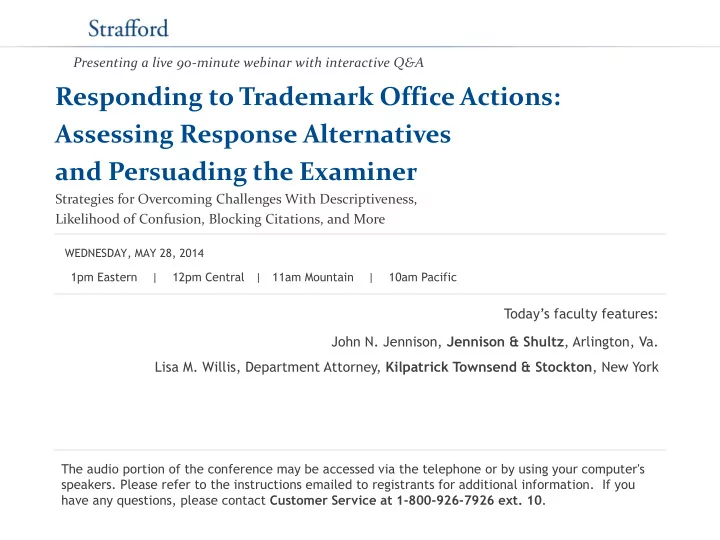
Presenting a live 90-minute webinar with interactive Q&A Responding to Trademark Office Actions: Assessing Response Alternatives and Persuading the Examiner Strategies for Overcoming Challenges With Descriptiveness, Likelihood of Confusion,


slide-1
SLIDE 1

Responding to Trademark Office Actions: Assessing Response Alternatives and Persuading the Examiner

Strategies for Overcoming Challenges With Descriptiveness, Likelihood of Confusion, Blocking Citations, and More Today’s faculty features:

1pm Eastern | 12pm Central | 11am Mountain | 10am Pacific

The audio portion of the conference may be accessed via the telephone or by using your computer's

  • speakers. Please refer to the instructions emailed to registrants for additional information. If you

have any questions, please contact Customer Service at 1-800-926-7926 ext. 10.

WEDNESDAY, MAY 28, 2014

Presenting a live 90-minute webinar with interactive Q&A John N. Jennison, Jennison & Shultz, Arlington, Va. Lisa M. Willis, Department Attorney, Kilpatrick Townsend & Stockton, New York

slide-2
SLIDE 2

Sound Quality If you are listening via your computer speakers, please note that the quality

  • f your sound will vary depending on the speed and quality of your internet

connection. If the sound quality is not satisfactory, you may listen via the phone: dial 1-888-601-3873 and enter your PIN when prompted. Otherwise, please send us a chat or e-mail sound@straffordpub.com immediately so we can address the problem. If you dialed in and have any difficulties during the call, press *0 for assistance. Viewing Quality To maximize your screen, press the F11 key on your keyboard. To exit full screen, press the F11 key again.

FOR LIVE EVENT ONLY

slide-3
SLIDE 3

For CLE purposes, please let us know how many people are listening at your location by completing each of the following steps:

  • In the chat box, type (1) your company name and (2) the number of

attendees at your location

  • Click the word balloon button to send

FOR LIVE EVENT ONLY

slide-4
SLIDE 4

Responding To Trademark Office Actions: Assessing Response Alternatives And Persuading The Examiner

John N. Jennison Jennison & Shultz, P.C. john@jennisonlaw.com Lisa M. Willis Kilpatrick Townsend & Stockton LLP LWillis@kilpatricktownsend.com

slide-5
SLIDE 5

Actions to Take Upon Receipt of a USPTO Action

  • Pull & Review the File
  • Docket the Response Deadline
  • Carefully Review the Action and Determine All of the Issues Raised
  • Determine if Issues Raised Were Expected.
  • Prepare to Respond to All Issues Raised by Trademark Examining Attorney
  • Understand what Examining Attorney Needs to Approve the Mark. Her Actions

will be Reviewed. Examining attorneys work at home and cannot be reached in normal working hours. Some informal matters (e.g., identifications) may be "word-smithed" through informal email exchanges or telephone discussions.

  • Review Your Correspondence with Your Client
  • Advise Client of Action in Accordance with Previous Instructions

5

slide-6
SLIDE 6

Informal Issues

“No conflicting marks have been found" but other issues are raised:

  • Disclaimer
  • Prior ownership claim or related claims
  • Signature
  • Drawing
  • Specimen
  • Identification of goods or services and/or classification

References: Trademark Rules 2.61-2.65, 2.71-2.72

6

slide-7
SLIDE 7

Refusals

  • Surname
  • Descriptiveness
  • Geographic Descriptiveness
  • Deceptiveness
  • Ornamental

7

slide-8
SLIDE 8

Surname Refusals

Refusal:

  • Public likely to perceive the mark as a surname.

Response:

  • Mark has acquired secondary meaning. The public has recognized that the mark

in connection with the goods or services to an exclusive source. Establish long term (e.g., five years) exclusive usage and perception by the public (survey.) ‒ FORD for vehicles ‒ McDonalds for restaurants ‒ DUPONT for chemicals and paints Citation: E.I. Du Pont de Nemours & Co. v. Societe S.T. DuPont, 161 USPQ 489 (TTAB 1969)

8

slide-9
SLIDE 9

Descriptiveness Refusals

Refusal:

  • Applied for mark "merely describes a feature, characteristic, purpose and

function of applicant's goods or services. A term is descriptive if it conveys an immediate idea of the ingredients, qualities or characteristics of the goods or services. Response:

  • Mark does not "merely" describe applicant's goods or services. Mark may be
  • suggestive. If one must exercise "mature thought or follow a multi-stage

reasoning process" to determine attributes of the product or service, the term is suggestive, not descriptive. Citation: In re Tennis in the Round, Inc., 199 USPQ 496 (TTAB 1978) Two Pesos, Inc. v. Taco Cabana, Inc., 505 U.S. 763, 23 USPQ2nd 1081 (1992)

9

slide-10
SLIDE 10

Geographic Descriptiveness Refusals

Refusal:

  • Applied for mark "primarily geographically descriptive of the origin of applicant's

goods/services." 1) The primary significance of the mark is a generally known geographic place or location. 2) The goods/services originate in the geographic place identified in the mark. 3) Purchasers would be likely to make a goods/place or services/place association; purchasers would be likely to believe that the goods/services originate in the geographic place identified in the mark Response:

  • Mark is not "primarily geographically descriptive" of the origin of the applicant's goods/services.

Provide evidence that mark has other meanings.

  • Do goods/services originate in the named geographic location?
  • Mark has acquired a secondary meaning, that it no longer causes the public to associate goods

with geographic location.

  • WALTHAM for watches
  • Mark is used in arbitrary manner, secondary meaning not required.
  • ARCTIC for ice cream

Citation: American Waltham Watch Co. v. United States Watch Co., 173 Mass. 85, 53 N.E. 141 (1899)

10

slide-11
SLIDE 11

Deceptiveness Refusals

Refusal:

  • Applied for mark is deceptive if it presents the appearance of greater quality than

exists, likely to materially affect the purchasing decision.

  • SILKEASE for polyester women's blouses.
  • SUPERSILK for shirts not made of silk.

Response:

  • The deception is innocent, harmless or negligible.
  • SWEDEN for artificial kidney machines.

Citation: In re Sweden Freezer Manufacturing Co., 159 USPQ 246 (TTAB 1968)

11

slide-12
SLIDE 12

Ornamental Refusals

Refusal:

  • Applied for mark is solely or merely ornamental, lacks trademark significance,

no identifying or distinguishing the source.

  • Red, white and blue panels on basketball.
  • One strip design on shoes.

Response:

  • Evidence that design is used in such a size, location and manner that customers

recognize the source of origin. Secondary meaning with survey evidence.

  • Nike swoosh design.
  • Red shoe sole design.

Citation: Wal-Mart Stores, Inc. v. Samara Bros., Inc., 529 U.S. 205, 120 S. Ct. 1339. 54 USPQ 2nd 1065 (2000)

12

slide-13
SLIDE 13

Likelihood of Confusion

13

TMEP §1207.03: “[A]pplicant’s mark, as used on or in connection with the specified goods or services, so resembles a registered mark as to be likely to cause confusion.”

slide-14
SLIDE 14

Pre-Filing Considerations

― Clearance ― Client’s budget ― Infringement actions ― Conservative Examiners

14

slide-15
SLIDE 15

Initial Steps

  • Check status of cited registration(s)

― Have the requisite maintenance documents been filed ― Is the registration incontestable ― Does the registrant have priority ― Does the registrant own other registrations/applications for similar marks ― What is the registrant’s enforcement history regarding this mark

  • Search for evidence of use of cited mark

― Online ― Specimen of use ― Independent investigation

15

slide-16
SLIDE 16

Initial Steps

Review Examiner’s evidence ― Examiner must show evidence of relatedness ― TMEP §1207.01(a)(vi)) ― Third party registrations/use ― Are the third party goods and services the same as those at issue ― Do the third party registrations show that the parties’ goods emanate from the same source ― In re White Rock Distilleries Inc., 92 USPQ2d 1282, 1285 (TTAB 2009) (Examiner did not establish that wine and vodka infused with caffeine are related goods because there was no evidence that vodka and wine emanate from a single source under a single mark or that such goods are complementary products that would be bought and used together).

16

slide-17
SLIDE 17

Initial steps

― Are the goods and services sold by a mass retailer ― Morgan Creek Prods., Inc. v. Foria Int’l, Inc., 91 U.S.P.Q.2d 1134, 1142 (T.T.A.B. 2009) (“It has long been held that the mere fact that two different items can be found in a supermarket, department store, drugstore or mass merchandiser store is not a sufficient basis for a finding that the goods are related.”); ― In re Hoist Fitness Systems, Inc., Serial No. 76428061 (March 30, 2005); ― Recot Inc. v. M.C. Becton, 54 U.S.P.Q.2d 1894, 1899 (Fed. Cir. 2000); ― Federated Foods, Inc. v. Fort Howard Paper Co., 544 F.2d 1098, 192 USPQ 24, 29 (CCPA 1976)

17

slide-18
SLIDE 18

Preparing the Response

Relevant Factors

  • DuPont Factors - In re E.I. du Pont de Nemours & Co., 476 F

.2d 1357, 177 USPQ 563 (CCPA 1973) Most Important Considerations

  • Similarities between the parties marks
  • Relatedness of the goods and/or services

18

slide-19
SLIDE 19

Similarities of Marks

Similarities in appearance, sound, meaning, and commercial impression.

  • Is the common element diluted or descriptive?

― Safer, Inc. v. OMS Invs., Inc., 94 USPQ2d 1031, 1044-45 (TTAB 2010) (DEER-B-GON for deer and other animal repellant not confusingly similar to DEER AWAY and DEER AWAY PROFESSIONAL for similar goods)

  • Is there a distinctive design element or stylization in either party’s mark?

― TMEP §1207.01(c)(ii) (“The comparison of composite marks must be done on a case- by-case basis, without reliance on mechanical rules of construction.”) ― In re Electrolyte Labs. Inc., 929 F.2d 645, 647, 16 USPQ2d 1239, 1240 (Fed. Cir. 1990) (“[t]here is no general rule as to whether letters or designs will dominate in composite marks; nor is the dominance of letters or design dispositive of the issue.” ― Syndicat Des Proprietaires Viticulteurs De Chateauneuf-Du-Pape v. Pasquier DesVignes, 107 USPQ2d 1930, 1940 (TTAB 2013) (“the design is prominently displayed in the center of the mark, is proportionally larger than the wording, and is very distinctive, inasmuch as it uses highly symbolic and well-known regalia relating to the Pope and the Catholic church.”)

19

slide-20
SLIDE 20

Similarities of marks

  • Connotative differences between Marks

― Sears, Roebuck & Co., 2 USPQ2d 1312, 1314 (TTAB 1987) (CROSS-OVER for bras not confusingly similar to CROSSOVER for ladies’ sportswear)

20

slide-21
SLIDE 21

Relatedness of Goods/Services

  • Argument must focus on goods/services as identified
  • Extrinsic evidence cannot be used to narrow scope of either party’s

goods/services.

  • Extrinsic evidence is permissible to shed light on ambiguous/technical

descriptions ― In re Trackmobile Inc., 15 USPQ2d 1152, 1154 (TTAB 1990) (“When the description of goods for a cited registration is somewhat unclear,…it is improper to simply consider that description in a vacuum and attach all possible interpretations to it when the applicant has presented extrinsic evidence showing that the description of goods has a specific meaning to members of the trade.”) ― In re Edwards Life Sciences, 94 USPQ2d 1399 (TTAB 2010) ― In re Radius Health, Inc., Serial No. 78797031 (October 27, 2009)

21

slide-22
SLIDE 22

Relatedness of Goods/Services

  • Goods/services not necessarily related simply because they fall under same

broad category ― Edwards Lifesciences Corporation v. VigiLanz Corporation, 94 USPQ2d 1399 (TTAB 2010) (VIGILANZ and VIGILANCE not confusingly similar although both marks were used in connection with patient monitoring devices in hospital settings. The Board stated that the relatedness of the goods inquiry “is not based on whether a general term or

  • verarching relationship can be found to encompass them both.”)

22

slide-23
SLIDE 23

Coexistence of third party marks

  • Narrow scope of protection

― The shared element is so common or descriptive that not likely to be perceived as a source indicator ― TMEP 1207.01(d)(iii) (“If the evidence establishes that the consuming public is exposed to third-party use of similar marks on similar goods, it is relevant to show that a mark is relatively weak and entitled to only a narrow scope of protection.”)

  • Examiners are not bound by prior decisions
  • Ensure that third party references cover the same goods that are at issue

23

slide-24
SLIDE 24

Other Strategies

  • Narrow your goods/services

― May hamper enforcement

  • Seek consent from registrant

― Puts registrant on notice ― Use priority as leverage ― May have to pay for consent ― Cannot be a naked consent

24

slide-25
SLIDE 25

Other Strategies

Petition to cancel under Section 14

  • Must be filed within 5 years of registration unless basis is abandonment,

fraud, generic, functional, geographically deceptive

  • Application will be suspended pending disposition of cancellation

25

slide-26
SLIDE 26

Other Strategies

Petition to cancel under Section 18

  • Useful when cited registration covers broad goods/services

― In re N.A.D. Inc., 57 USPQ2d 1872, 1874 (TTAB 2000) (“While we are sympathetic to applicant's concern about the scope of protection being given to the cited registrations, applicant is not without remedies . . . Applicant may…seek a restriction under Section 18 of the Trademark Act, 15 USC §1068.”)

  • Elements:

― proposed restriction will avoid a likelihood of confusion ― respondent is not using the mark on the goods/services being deleted or effectively excluded from the registration. See Eurostar Inc. v. “Euro-Star” Reitmoden GmbH & Co., 34 USPQ2d 1266, 1271 (TTAB 1994)

  • IdeasOne, Inc. v. Nationwide Better Health, Inc., 89 USPQ2d 1952 (TTAB 2009)

― Registration for WELLCORP for "consulting services in the field of health" cited against application for WELLCORPS INTERNATIONAL for “dietary supplements.” ― Applicant petitioned to cancel to restrict registration to "consulting services in the field of health offered to employers not including the provisions [sic] of dietary supplements.”

26

slide-27
SLIDE 27

Other Strategies

  • Acquire cited registration
  • Use without registration

27

slide-28
SLIDE 28

Caution

― Responses to Office Actions are public filings ― Arguing that the common element is weak or descriptive can prove problematic later ― Be sure to include evidence for appeal

28