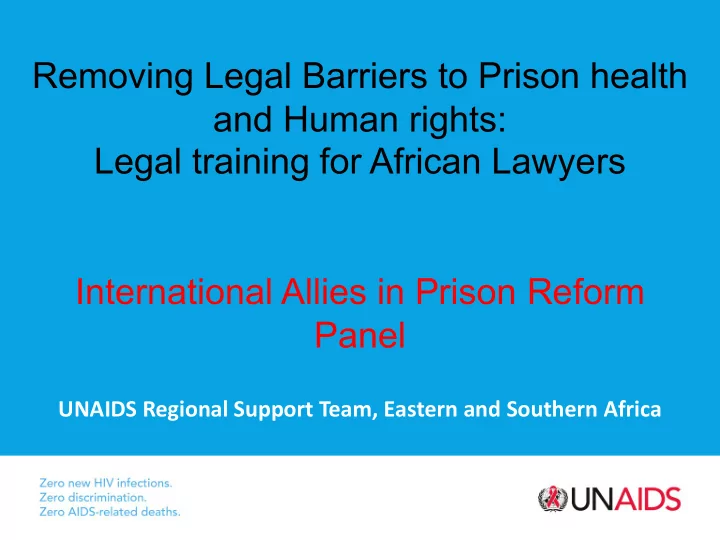
and Human rights: Legal training for African Lawyers International - - PowerPoint PPT Presentation

and human rights
SMART_READER_LITE
LIVE PREVIEW

and Human rights: Legal training for African Lawyers International - - PowerPoint PPT Presentation

Removing Legal Barriers to Prison health and Human rights: Legal training for African Lawyers International Allies in Prison Reform Panel UNAIDS Regional Support Team, Eastern and Southern Africa Closing the Gap Ensure prisoners access


slide-1
SLIDE 1

Removing Legal Barriers to Prison health and Human rights: Legal training for African Lawyers International Allies in Prison Reform Panel

UNAIDS Regional Support Team, Eastern and Southern Africa

slide-2
SLIDE 2

Closing the Gap

  • Ensure prisoners’ access to the health services available

without discrimination

  • Adopt protective laws, policies and programs that are

adequately resourced, monitored and enforced

  • Introduce a comprehensive package of interventions for HIV

prevention, treatment and care in prisons and other closed settings

  • Provision of the full range of HIV services as part of prisons

health services.

  • Peer support programs run by long-term prisoners/ex-

prisoners.

  • After-release programs—establish links with prevention and

care programs in the community.

slide-3
SLIDE 3

What Interventions?

  • Availability of condoms, sterile syringe and needles and skin piercing

equipment and promotion of consistent and correct use of condoms.

  • Access to drug treatment programs, especially drug substitution

treatment, with adequate protection of confidentiality.

  • Access to HIV counselling and testing, antiretroviral and tuberculosis

treatment and care and quality sexually transmitted infection treatment.

  • Review of drug control laws; provision of alternatives to

imprisonment for minor drug-related offences; offer treatment for drug users instead of imprisonment.

  • Structural interventions to reduce overcrowding, pre-trial detention

period and speedy trial and sentencing reform.

  • Separate accommodation and facilities for young prisoners.
slide-4
SLIDE 4

What Interventions? (continued)

  • Providing condoms and water-based lubricants in prisons and closed

settings, including in countries in which same-sex activity is criminalized

  • Adopting policies and strategies for the prevention, detection and

elimination of all forms of violence

  • Offering harm-reduction programs, including opioid substitution

therapy and needle and syringe programs

  • Reforming laws to ensure that people who are dependent on drugs,

engage in sex work or have same-sex relations are not criminalized

  • Ensuring that people who are dependent on drugs can access voluntary

treatment as an alternative to incarceration

  • Improving access to legal representation for people who have been

detained and increasing the availability of non-custodial alternatives, including community service and bail