And how to avoid them Presented by: Neale Grearson , Partner and - - PowerPoint PPT Presentation

and how to avoid them
SMART_READER_LITE
LIVE PREVIEW

And how to avoid them Presented by: Neale Grearson , Partner and - - PowerPoint PPT Presentation

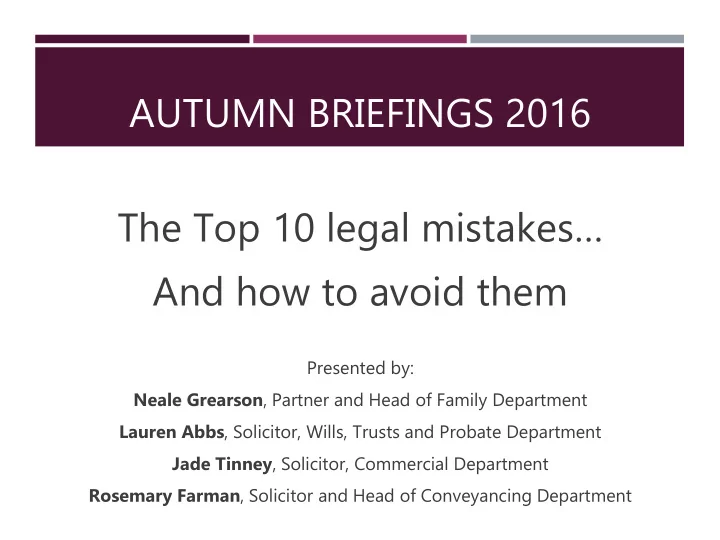
AUTUMN BRIEFINGS 2016 The Top 10 legal mistakes And how to avoid them Presented by: Neale Grearson , Partner and Head of Family Department Lauren Abbs , Solicitor, Wills, Trusts and Probate Department Jade Tinney , Solicitor, Commercial


slide-1
SLIDE 1

AUTUMN BRIEFINGS 2016 The Top 10 legal mistakes… And how to avoid them

Presented by: Neale Grearson, Partner and Head of Family Department Lauren Abbs, Solicitor, Wills, Trusts and Probate Department Jade Tinney, Solicitor, Commercial Department Rosemary Farman, Solicitor and Head of Conveyancing Department

slide-2
SLIDE 2

NEALE GREARSON

Partner and Head of Family Department

slide-3
SLIDE 3

‘‘Anyone who has never made a mistake has never tried anything new’’

  • Albert Einstein
slide-4
SLIDE 4

‘‘If you get it wrong you’ll get it right next time’’

  • Gerald ''Gerry'' Rafferty
slide-5
SLIDE 5

MILLIONAIRE TYCOON’S EX WIFE AWARDED £300,000 PAY-OUT 10th June 2016

slide-6
SLIDE 6

SHOULD I STAY OR SHOULD I GO?

slide-7
SLIDE 7

CASE STUDY – ‘‘SLIDING DOORS’’

slide-8
SLIDE 8

MEET GWEN

Gwen woke up on Saturday morning and realised she was very unhappy with her marriage. She had been married for 20 years and if she was being honest to herself would accept that she had not been happy for the last 10 years although had stayed with her husband Chris for the sake of their two children. They were now grown up. Gwen and Chris are financially comfortable. They own a property in their joint names and the mortgage is almost paid off. Both have good jobs and private pensions. Should she go or should she stay? Should they have a “conscious uncoupling”?

slide-9
SLIDE 9

And then Gwen received a telephone call from the hospital to tell her that her mother had died overnight. Her father had died 10 years previously. Her parents had been wealthy and on her mother’s death she was likely to inherit from the estate about a million pounds. Once she had come to terms with the loss of her mother she then had to decide would that affect her decision about her future with Chris.

slide-10
SLIDE 10

WHAT IF? ………

Gwen stayed with Chris. She is not happy but it was easier to stay together. She also had to deal with the grief surrounding the recent loss of her mother. All was not good and the relationship did not improve. 10 years later Gwen found out that Chris was having an affair and they split up resulting in a Divorce. 10 years after receiving the £1 million that money had been included in the monies that Gwen and Chris had. They had bought a larger property. They had made investments in their joint names. As part of the Divorce Gwen argued that the £1 million should be “ring fenced” and excluded from the Divorce settlement but she did not succeed. By that time they had been married for 30 years and the Court ruled that all of the assets should be divided equally.

slide-11
SLIDE 11

OR…

Having tried to deal with the loss of her mother Gwen decided now was the time to split from Chris. She initiated a separation and a Divorce. As the inheritance by that time had not yet been received and was going to be received at the end of the relationship the Court agreed that it should not be included in the division of assets. It was effectively “ring fenced”. The matrimonial home and pensions were divided equally but Gwen retained her full inheritance.

slide-12
SLIDE 12

OR…

Gwen and Chris could have stayed together and lived happily ever after – but statistics suggest not!

slide-13
SLIDE 13

LESSONS TO BE LEARNED

  • 1. No certainty about the way inherited wealth is taken into account in a Divorce

settlement.

  • 2. Delaying difficult decisions can be costly.
  • 3. Sometimes being unmarried can be a financial advantage than being married.
  • 4. Risks of a Court decision: What is fair?
  • 5. Could a Post-Nuptial Agreement help Gwen (and Chris)?
  • 6. Can husbands and wives expect that on Divorce their spouse will do the “right

thing”

  • 7. How to protect non-matrimonial assets such as inherited wealth or monies held

before marriage.

  • 8. Emotional or financial decisions.
slide-14
SLIDE 14

LAUREN ABBS

Solicitor Wills, Trusts and Probate Department

slide-15
SLIDE 15

CASE STUDY 1

slide-16
SLIDE 16

MEET DAVID IAN YATES

 David Ian Yates considers himself to be a sensible guy with a

straightforward family.

 He is married and has two adult daughters – Sarah and Laura. He

wants to make a few gifts in his will and divide everything else equally between his children – EASY!

 He has personal possessions, owns his home and has some savings in

bank and building society accounts. He is comfortable, but his estate won’t be subject to inheritance tax.

slide-17
SLIDE 17

DAVID’S WILL

David doesn’t like “wasting money” and loves a bit of DIY.

He drafts his own Will using a “professional” template he downloaded from the internet.

His Will gifts his piano to his nephew, Peter, as this is a passion which they

  • share. He has taught Peter to play the piano and, for a 5 year old, Peter is

getting really very good.

David has three nephews and would like to make some provision for them. He has £5,000 in an account with Barclays and would like that money to be divided between his nephews.

Everything else will pass to his wife if she survives him or, if she dies before him, everything else will be divided equally between Sarah and Laura.

slide-18
SLIDE 18

DAVID’S STORY

David’s wife dies 

David meets a new partner, Ellie, and they have a son named George 

David decides to replace his tatty old piano. The new piano costs £25,000. Peter is becoming very good at playing the piano and this is something which David totally supports 

David doesn’t review his Will …

slide-19
SLIDE 19

DAVID’S STORY

David’s health deteriorates, he needs to move into care and, after some time, loses capacity to deal with his property and finances 

David had appointed his daughters as his attorney’s so they can assist with his property and finances which means that, when he runs out of savings, they are able to sell his house to pay for his care reasonably easily 

David dies in 2016 

The value of David’s estate at the date of his death is £300,000.

slide-20
SLIDE 20

Who will receive what in accordance with David’s Will?

slide-21
SLIDE 21

What if David married Ellie?

slide-22
SLIDE 22

THE LESSON? Even a STRAIGHTFORWARD Will for a STRAIGHTFORWARD guy can be a DISASTER

slide-23
SLIDE 23

CASE STUDY 2

slide-24
SLIDE 24

MEET HOWARD AND HILDA

Howard and Hilda are married with two children. They own their home and have some savings.

They are a loving family unit and always want to look after each other.

Howard and Hilda have worked hard their whole life, paid off their mortgage, and it is very important to them that they provide an inheritance for their children.

slide-25
SLIDE 25

HOWARD AND HILDA’S WILL

Option 1 - They provide for each other in their Wills and, when the second of them dies, everything must be divided equally between their children.

Option 2 – They own their home jointly as “tenants in common”, provide

  • ne another with a “life interest” in the half share of the home belonging

to the first of them to die and gift everything else to the survivor outright. Upon the survivor’s death, the half share of the property belonging to the first of them to die is divided equally between their children. Everything

  • wned by the survivor is divided equally between the children.
slide-26
SLIDE 26

HOWARD AND HILDA’S STORY

Howard dies very suddenly 

Hilda is lost without Howard, her health deteriorates and she moves into long term care 

Hilda’s health improves and she lives for another 20 years 

Option 1 - Upon Hilda’s death she has very little money to leave to the children

Option 2 – Upon Hilda’s death, although Hilda has very little money left herself, Howard’s half share of the proceeds of sale of their home has been protected, and can pass to their children

slide-27
SLIDE 27

THE LESSON? It is a personal choice which option is better… But it could be a costly mistake to not obtain advice in respect of the clever ways Wills can be drafted to protect certain family members.

slide-28
SLIDE 28

MEET ROSS AND RACHEL

Ross and Rachel are in a relationship and have a child together, Emma.

Ross has a son from a previous relationship, Ben.

Rachel is totally devoted to Ross, Emma and Ben and says she will always look after them all.

The biggest asset they own, by far, is their house.

slide-29
SLIDE 29

ROSS AND RACHEL’S WILLS

Option 1 – Ross and Rachel leave everything to each other outright. When the second of them dies, their estate is divided equally between Emma and Ben.

Option 2 – Ross and Rachel own their biggest asset, their home, as “tenants in common” and provide one another with a “life interest” in the half share of the home belonging to the first of them to die. They gift everything else to the survivor of them outright. Upon the survivor’s death, the half share of the property belonging to the first of them to die is divided equally between Emma and Ben. Everything owned by the survivor is divided equally between the Emma and Ben.

slide-30
SLIDE 30

ROSS AND RACHEL’S STORY

Ross and Rachel have a happy 40 year marriage 

Ross dies 

Rachel meets a much younger man 

Ben is not happy about Rachel forming a relationship with the younger man and they fall out 

Rachel changes her Will so that her estate is divided equally between her younger man and Emma.

Rachel dies 

slide-31
SLIDE 31

Option 1 – Ben does not inherit anything

Option 2 – Ben inherits ¼ of the proceeds of sale of the property which Ross owned at the date of his death, whilst Rachel had the security of being able to live in the home for the rest of her life

slide-32
SLIDE 32

THE LESSON?

This is a very basic example of how Wills can be drafted to provide protection for a certain individual. It is likely to be a big mistake for a blended family to not seek professional advice in connection with their Wills and estate planning.

slide-33
SLIDE 33

JADE TINNEY

Solicitor Commercial Department

slide-34
SLIDE 34

MEET STEVE MOBS, JILL GATES AND MARK COOKERBERG

Steve, Jill and Mark are in partnership together and run a software development business which also occasionally involves them developing hardware for onwards sale to their software users.

The partnership trades as an LLP and has done since the business started five years ago.

The business has gone from strength to strength and it now produces a significant profit which is split equally between the partners pursuant to the terms of their partnership agreement.

slide-35
SLIDE 35

Historically the partnership has traded from Steve’s garage, but as business is booming the partners decide that they want to take on some employees and therefore need new premises.

A few options are identified but the partners agree on a unit located in a new, up and coming tech hot spot in Norwich.

The unit is large enough for them to bring on numerous employees and also offers parking, meeting room facilities and a table tennis table! Perfect!

The lease offered is on an FRI basis for six years, with a three year tenant break, at a rent starting at £15,000 per annum.

The decision is made that this is where the business needs to be and the lease is signed.

slide-36
SLIDE 36

However things take a turn for the tech world and the sector sees a drop in turnover which has put some strain on the business and caused some cash flow difficulties with payment of rent and wages.

To add to this, the partners quickly realise that most of their client interaction is via email or skype and not in face to face meetings.

The decision is made to downsize and to utilise their three year break

  • ption in the lease.

They fire off an email to their landlord’s agent giving notice that they will be leaving the premises in three months’ time, on the 3rd anniversary.

They get a read receipt but receive no response and start making plans for the office move.

slide-37
SLIDE 37

On the last day of their notice period, Jill takes a call from the painter and decorator who says that some decorative works at the property are running over and he will need the weekend to finish things up.

Toward the end of that day Jill goes to the agent’s office to hand one set

  • f keys back and explains that the decorator will drop the second set of

keys through the letterbox on Sunday evening.

The agent says he will hold the keys but before he can agree that the lease has been terminated he has to take his client’s instructions. Jill is a little concerned by this and asks for confirmation in writing ASAP.

slide-38
SLIDE 38

The following Monday Jill, Steve and Mark each receive a letter at home from their landlord’s solicitor saying that their break notice was invalid and the lease is continuing for a further three years.

The three of them come to see us and ask if there is anything they can do to push back on the landlord’s decision.

We ask for a copy of the lease and the notice and quickly identify the first

  • f a few problems...
slide-39
SLIDE 39

Tenants must ensure there is:

Proper service of the break notice – who, where and when?

Compliance with the break conditions e.g. tenant covenants, vacant possession.

slide-40
SLIDE 40

Fast forward five years and business has picked up again, in fact it’s

  • expanding. There are now more than 20 employees and the business is

really making a name for itself when it comes to software development.

The LLP’s accountant advises them that it might be a good time to start trading the business using a limited company vehicle. It also gives Jill, Mark and Steve the opportunity to consider employee share schemes, so that they can incentivise members of staff to stay by buying into the business.

The transition to a company is completed quickly with Jill, Mark and Steve (now directors and shareholders) taking the opportunity to update their brand which includes an overhaul of their website, office literature (such as business cards) and logo.

They write to each of their existing customers, suppliers and their landlord’s agent to inform them about the new company.
slide-41
SLIDE 41

Cracks start to show in the relationship between Jill, Mark and Steve.

Steve thinks that there isn’t enough effort being put into the hardware manufacturing side of the business.

Jill and Mark are admittedly more focused on software development which has historically proven to provide the biggest share of turnover.

One day Steve walks out of the office in frustration and texts his co- directors/shareholders that evening to inform them that he won’t be coming back.

Jill and Mark come to see us to ask about what happens next…

slide-42
SLIDE 42

In our meeting they produced a copy of their partnership deed which placed a number of restrictive covenants on each of them should there ever be a departure from the business.

It turns out that in getting caught up in all the hectic business of rebranding, Jill, Mark and Steve never got round to signing a shareholders’

  • agreement. Nor did any of them sign directors’ service agreements.

Jill and Mark’s concerns are realised and there is nothing to stop Steve from leaving the company and setting up in direct competition with the business, taking key customers and suppliers with him.

slide-43
SLIDE 43

Do you have the right documents in place? Consider:

Asset Purchase Agreements

Shareholders’ Agreements

Directors’ Service Agreements

Lease assignments

Articles of Association

slide-44
SLIDE 44

Lessons to be learned?

slide-45
SLIDE 45

ROSEMARY FARMAN

Solicitor and Head of Conveyancing Department

slide-46
SLIDE 46

MEET CHARLOTTE

Charlotte is just about to finish her Psychology degree and looking at a Masters & PHD in Clinical Psychology at the University of Birmingham. This would require relocation for the next 3 years.

Charlotte is now 22 and has managed to save a deposit with assistance from a Help to Buy ISA which gives a 25% bonus on maximum monthly payments in of £200.

The parents of Charlotte are keen for her not to have to continue paying rent to a

  • landlord. They could use the savings that they have squirrelled away over the years and

also drawdown on their pension freedom lump sums to assist with her deposit.

Charlotte is not currently in a stable relationship but her parents are concerned that they might not approve of a future partner.

slide-47
SLIDE 47

THE OPTIONS

The options available to Charlotte's parents are the following: 1. An outright gift 2. Become a guarantor for a mortgage 3. Become a party to a mortgage 4. A loan which may be secured on the property 5. Loan the money and ensure Charlotte makes a declaration of trust

slide-48
SLIDE 48

AN OUTRIGHT GIFT

No trigger for higher rates of Stamp Duty Land Tax

A gift should be considered carefully so as to avoid the gifting party being liable for IHT. Not that you will be planning your departure date but a person making a gift will need to live for 7 years after the date of the gift for it to be exempt of IHT.

There is an annual allowance of £3,000 per year and this can be carried forward for a year also, meaning Charlotte's parents together can gift £12,000 without IHT implications.

There is no control for Charlotte's parents if they don't like the future partner!

No ability to reclaim the money back if it is needed

slide-49
SLIDE 49

BECOME A GUARANTOR FOR A MORTGAGE

No trigger for higher rates of Stamp Duty Land Tax

By acting as a guarantor, control is lost of any money contributed

The guarantor can be liable for the whole of the debt

slide-50
SLIDE 50

BECOME A PARTY TO A MORTGAGE

The investment is secured

Involved in any dealing with the property

Named on the title for the property which would trigger higher rates of Stamp Duty Land Tax if a main residence is already owned by Charlotte’s parents, in the case of a £200,000 property, this would be £7,500.00 rather than £1,500.00 (and that is Charlotte's savings going to the tax man!)

Possible Capital Gains Tax liability on the parent’s share in the property when the property is sold because it is not their principal private residence

slide-51
SLIDE 51

A LOAN

The investment may be secured

Potentially, the property can be disposed of without consent/ repayment

  • f the loan if it is unsecured

The loan may be for a fixed sum repayable on a specified event, either a future date or an event such as a sale

A water-tight loan agreement would be advisable to regulate the arrangement and the agreement could be set up for monthly instalments repayments with or without interest

slide-52
SLIDE 52

A LOAN

If there is a mortgage lender they would need to approve the second charge as any repayments under a loan agreement would reduce affordability under the main mortgage

If there is a first lender then the first mortgage could make provision for further advances which would eat into the investment but a clause could be added to prevent further drawdowns under the main mortgage without consent

There is uncertainty as to whether or not a non-commercial legal charge would trigger higher rates of Stamp Duty Land Tax

slide-53
SLIDE 53

GIVE THE MONEY TO CHARLOTTE AND ENSURE SHE MAKES A DECLARATION OF TRUST

A declaration of trust will set out the amount contributed and how the property is held

This is a great tool for documenting the ownership structure of the property, what happens in the event of a sale and can also contain bespoke clauses for example: options to purchase a larger share in the property; ability to request a sale or who pays the insurance

It can be teamed up with a restriction on the title of the property preventing a sale without the consent of the parties named in the declaration

Protection of the contribution in the event of the undesirable S O ("significant other")

The higher rate of Stamp Duty Land Tax may kick in if the parents own their own house

Capital Gains Tax liability on parent’s share

slide-54
SLIDE 54

COMMON THEMES:

  • 1. Plan ahead
  • 2. Don’t leave difficult decisions
  • 3. Protect
  • 4. Get advice as to your options
slide-55
SLIDE 55

?

QUESTIONS….

slide-56
SLIDE 56

FORTHCOMING BRIEFINGS 2017

 Charities Briefing  Contested Probate Briefing  Spring Briefings

slide-57
SLIDE 57

THANK YOU

01603 693500 info@clapham-collinge.co.uk www.clapham-collinge.co.uk