AND AREA Presentation for the Select Committee January 13, 2014 - - PDF document

and area
SMART_READER_LITE
LIVE PREVIEW

AND AREA Presentation for the Select Committee January 13, 2014 - - PDF document

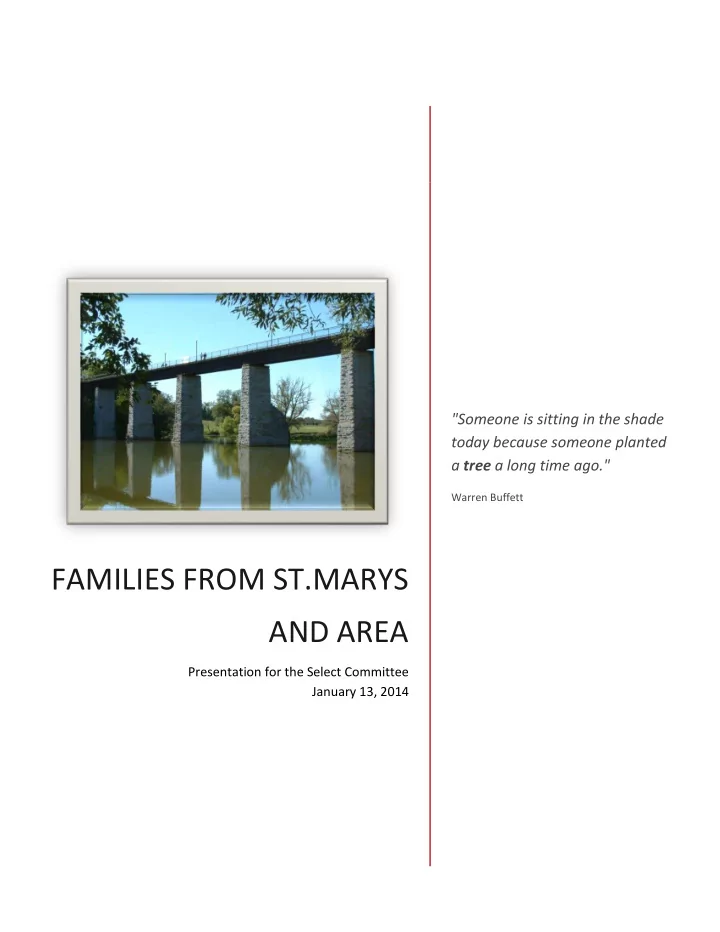
"Someone is sitting in the shade today because someone planted a tree a long time ago." Warren Buffett FAMILIES FROM ST.MARYS AND AREA Presentation for the Select Committee January 13, 2014 Families from the St.Marys and Area

slide-1
SLIDE 1

FAMILIES FROM ST.MARYS AND AREA

Presentation for the Select Committee January 13, 2014

"Someone is sitting in the shade today because someone planted a tree a long time ago."

Warren Buffett

slide-2
SLIDE 2

Families from the St.Marys and Area Community Select Committee Presentation January 13, 2014

1

slide-3
SLIDE 3

Families from the St.Marys and Area Community Select Committee Presentation January 13, 2014

2

Good morning. I am Vickie Logan and this is Harold Holland. It is an honour to represent families from the St. Marys area. We, the families, have met to discuss the challenges we see in the developmental services sector as it is functioning at this time. I am the mother of a beautiful 29 year old, her name is Robynne, who at the age

  • f 3 was the 38th diagnosed case with her particular developmental delay. There

are currently 70 people known with this delay. We were told she would never walk, never talk and would invariably fall behind but if we wanted to try and teach her, to go ahead, blaze a trail and that is exactly what we did. She walks, talks, sings, can read & spell a bit, can do simple math using a calculator and is a known & loved volunteer in 5 communities. Many of the things families take as common place now, we fought for. They were new and extreme for the time but we were able to enlist the help of people along the way who saw the potential that sparkles from Robynne’s eyes. Robynne lives at home with her dad and me. She was granted a lump sum of money when the Passport program was established. It was not based on a support budget and does not come close to meeting the actual support that would enable her to fully realize her dreams and meet the established goals. Still, we do the best we can with what we have trusting that

  • ne day there will be a change in the system. I am also the accountant at

Community Living St.Marys and Area. Our agency provides individualized support, creates individual budgets and produces individual income statements each

  • month. When I speak to you today, it is backed by being the parent of someone

receiving support and having worked for the agency providing that support for 20 years. Hello my name is Harold Holland. My wife and I have adopted two children. One at eleven months old, Aimee, and then three years later we adopted a one month old boy, Thomas. As the years went on, it turned out that both had special

  • needs. Aimee, is now 27, with borderline personality disorder, living in a group

home in Exeter. Thomas is now 23. His diagnosis include: Autism, Tourette`s, Developmental Delay, Anxiety Disorder. He has full time support, 24/7. My wife didn`t work once Thomas arrived. She spent most of her time, running the children to appointments, seeing specialists and therapists, school meetings and advocating for supports.

slide-4
SLIDE 4

Families from the St.Marys and Area Community Select Committee Presentation January 13, 2014

3

We are one of the lucky families who have received funding and supports from Community Living St. Marys and Area, Family Services, CPRI, RSA, The Crest Centre and numerous professional

  • specialists. All of this coming through crisis,

emergency, intervention. The monies spent to get Thomas to where he is now is mind boggling, but all worth it. He is a happy guy and for the most part he is a lot of fun to be around. But how do we get to this end without the crisis part? I know of several families, that are raising their children (some now adults), at home thinking that it will all work out. As the parents age, and the children become more difficult to handle, and there is no routine once school is completed, it takes a physical and mental toll on the supportive parents, staff and the child. What happens when the caregiver cannot give anymore? Is it then a crisis? They are all time bombs waiting to go off. The concerns raised by the families in St. Marys include the acceptance of waiting lists as being the norm, no affordable housing options, young people being placed in nursing homes, the cut to Special Services at Home at 18 and the increasing disconnect between ‘the system’ and the people it is established to support. Families are in crisis. The current system is deficit based and we believe that a more positive system based on potential, the hopes, dreams, goals and achievements would be far more valuable to the people using support services. A deficit based system drives down the perceived value of people and creates the impression of a ‘hand out’ rather than a ‘hand up’. Imagine how you would feel if every day of your life you were made to think negatively of your child, to see all that is ‘wrong’ with them in

  • rder to secure the supports they need to connect to their communities.

Communities where they could make friends, have jobs, make real contributions to society and teach those around them about respect and acceptance. Current access to funded developmental services is through the DSO and involves a long application and assessment. We spent 6 hours doing a SIS assessment and

slide-5
SLIDE 5

Families from the St.Marys and Area Community Select Committee Presentation January 13, 2014

4

received a useless multi page document that provides no important information about Robynne. It sits in a file drawer in our home and a copy is housed in the DSO computer system. There is nowhere for it to go since there is no funding entity as part of our transformed system and no hope of securing the funding to

  • btain support. We are waitlisted.

Some of us are asked to have our children get further psychological testing to determine eligibility. This does not make sense for many people who have been identified with a lifelong disability. There is a huge cost, both to families and to

  • government. For the Ballantyne family, they have had to make numerous

inquiries and arrangements for testing their son Mac when even the DSO assessor knows he is eligible. This has added huge amounts of stress to an already very stressful situation. Mac is turning 18 in August and the funding received now for his support will not be available once he turns 18. Added to the threat of no support, Mac has just endured another surgery related to his physical disability due to his cerebral palsy. His parents aren’t here today because they’re at the hospital. Waitlists contribute to the feeling of scarcity and hopelessness. There are very real crises among aging parents with adult children still living at home. No one would argue the point that these situations must be addressed immediately. However, in cutting off SSAH funding at 18, the system has now created a greater base of crisis situations. Often overlooked is the group of parents who are not in the ‘aging’ category. We’re in our 40’s & 50’s but our daily stresses are the same as everyone else’s plus we fear for the future of our children and we know that we limit their ability to connect to community. We can’t work, be parents and be the support workers for our children. We also have elderly parents who are often our support network and provide the breaks we need to get through another year. Some of us are the ‘sandwich’ generation in that we have elderly parents to support and adult children to support. Matthew lives outside of St.Marys on the farm with his

  • parents. They provide for all but a few hours per week of Matthew’s support and

they provide a home and support for his 90 year old grandma. There is no other family in the area. Matthew’s parents are tired.

slide-6
SLIDE 6

Families from the St.Marys and Area Community Select Committee Presentation January 13, 2014

5

There are few alternatives for families. If there is no support in community, some people are forced to look at the health system. A number of young adults have spent months in Perth County hospitals not because of health related issues but because they had nowhere else to go. As well, young adults are being placed into nursing homes. This is horrific. They will live out their days with no connection to their communities at all and while their base needs will be attended to, they will not have full lives. Once again we are limiting their potential and neglecting all that they can contribute to society. There is a cost associated with young people living in nursing homes. Why can’t this money be used to support them in their community? Families are also turning to police services to support them in crisis. Often crisis could be avoided if adequate supports were in place for families. The Dunseith family feel little hope for their future and for their 36 year old son who lives at

  • home. Until some secure funding for support is made available to their family,

they fear for their safety. Planning for life, including times of crisis, is key to supporting our children to live full and contributing lives in community. Person directed planning and the facilitation and funding needed to implement those plans will prove to be a smart

  • investment. Our children, young or adult, and our families want to expand

possibilities in community. But we need help. New legislation allows for person- directed planning but this service in not in our funded system at this time. It needs to be. A person’s life does not need to be divided into funding categories. If we’re able to get some funding, as a family, we end up trying to keep track of the different

  • pots. This is confusing. A life is a life, whatever support a person requires to live it

in a dignified manner and to achieve their goals. As parents, we’re not looking to abuse the system by getting our hands on unreasonable support dollars. We all know what it’s like to be sitting on a waiting list and how it feels to have no hope. We do not wish this on anyone. Providing lump sums of money, not based on a real support plan does not solve the issue. You need to trust that we will use funding as efficiently and as effectively as possible. We will do what we know is right for our children and continue to be creative and progressive.

slide-7
SLIDE 7

Families from the St.Marys and Area Community Select Committee Presentation January 13, 2014

6

By investing in potential of people, helping them to be in their community living, working, volunteering or joining groups, we provide them with the skills they

  • need. We help them to realize the importance of rising to what is acceptable

behaviour, appearance, the rules of society. We give them the skills they need to live as independently as they possibly can so when it is time for them to move from their family home, they have already established the connections and skills they can build on to grow. They have people around them who already know them and care about them so the transition is eased. Robynne showed a window of time which would have been ideal for her to move out on her

  • wn but we could not act on it

so she remains at home. With each passing day that window closes more because she becomes more comfortable and she is losing that drive for independence from us. But what happens if she is still at home when my husband dies from the number of life threatening physical problems he has? What happens when I die? Robynne’s home will be sold out from under her. Her family will be gone. She will lose everything and have to try to begin a life during the very time she is grieving for all she has lost and trying to understand something none of us is good at

  • understanding. And as her parents we fear that day because we know there is no

money to provide the support she will need. It is our hope that you will truly hear what we are trying to tell you today and that real systemic change will result from the time we have all taken. Thank you

slide-8
SLIDE 8

Families from the St.Marys and Area Community Select Committee Presentation January 13, 2014

7

Matthew’s Story - Waitlisted Matthew is a 36 year old energetic man who has lived on a farm

  • utside of the small town of

Thorndale, Ontario. He lives with his parents and his elderly grandmother lives in a granny flat within the family home. Matthew is one of three children. Both his siblings have attended university, married and started having their own children. Matthew receives a quilt of support that came as a response from a request for services 15 years ago when he left high school at 21 years of age. Matthew received 21 hours of community support and 8 hours of daytime support per

  • week. His parents also receive a few respite opportunities per year.

In 2010 Matthew and his family went through the Supports Intensity Scale assessment with Developmental Services Ontario. At that time his family indicated they may be able to continue to support Matthew for 2-4 more years in their home. It is now three years since the Supports Intensity Scale was

  • completed. Matthew’s need for support has increased and he remains on the

waitlist with no indication of when or if he will receive the resources needed to live in the community. Matthew and his family are open to exploring different support options and looking into living with another person who also uses services. However, in the absence of developmental services funding and a mechanism to search out others looking for something similar Matthew and his family seem to be held to the mercy of a system that waits for people to die to find resources.

slide-9
SLIDE 9

Families from the St.Marys and Area Community Select Committee Presentation January 13, 2014

8

Currently, Matthew has developed a pattern of being very stubborn during times

  • f transition. Although he wants to leave the house this is a difficult process. He

requires physical assistance just to leave his home. As you can imagine this can be an exhausting process for his parents. Unfortunately, Matthew and his parents could not be here today as one of them has a health related issue preventing their attendance. This leaves one parent supporting Matthew, the spouse and elderly grandparent. Mackenzie’s Story – Battling to prove Eligibility August 1st is Mackenzie’s 18th

  • birthday. He lives with his parents in

the town of St.Marys, Ontario. In preparation for his birthday his parents are preparing for changes in the system and are hoping services will continue. Mackenzie receives resources from the Family and Home Support Program. He has support when he is not in school and while his father works. This enables his father to remain employed. His mother is unable to provide the physical support Mackenzie requires due to an injury. To prepare for Mackenzie’s birthday his parents were told by the Developmental Services Ontario staff in 2011 to call when he is 17 ½ years old and at that time provide written proof of eligibility. This began a hunt for documentation to prove eligibility. Archived records from Thames Valley Children’s Centre, where Mackenzie has been seen since he was an infant, were requested. These documents were deemed to be too dated and not

slide-10
SLIDE 10

Families from the St.Marys and Area Community Select Committee Presentation January 13, 2014

9

complete enough for the Developmental Services Ontario requirements. This, even though the DSO staff have stated they are aware Mackenzie clearly qualifies for the adult system they still require the paperwork. The search for eligibility then continued. The records kept by the school board revealed a formal assessment was never completed within the board. Mackenzie has been placed in the segregated developmental classroom since early on. A classroom teacher explained formal testing was never deemed necessary for Mackenzie’s learning and placement within the school, therefore never completed. Thames Valley Children’s Centre attempted formal testing years ago and this resulted in Mackenzie being labelled as ‘not testable’ at that time. This document was not enough to prove eligibility to Developmental Services Ontario. Mackenzie’s mother called the Thames Valley Children’s Centre and explained the situation; she needs written documentation to prove her son has a developmental disability. It is not enough that as Mackenzie’s parents, family, doctor, teachers, and service providers already know this. As Mackenzie is an existing client they agreed to help. Testing was completed in November. However, due to system changes and staff cutback at Thames Valley Children’s Centre, Mackenzie has not received the document he needs. A phone call to Developmental Services Ontario revealed they would not start any process of intake until written proof of eligibility was provided. Unfortunately, Mackenzie and his parents couldn’t be here today. Mackenzie had a major hip surgery on Tuesday. His parents are by his side at the hospital, taking shifts sleeping so someone is always with him. Continued communication with Specialists, nurses, Occupational Therapist, Physical Therapists and other Service Providers in order for Mackenzie to return home have been consuming their time at the hospital as well. Having to prove eligibility to continue to receive services is stressful. Will the government of Ontario give Mackenzie and his parents a spot on the waitlist or service for his 18th birthday?

slide-11
SLIDE 11

Families from the St.Marys and Area Community Select Committee Presentation January 13, 2014

10

Our Recommendations

  • 1. Believe in people with disabilities, their families and their communities.

Believe in their potential and their capacity to grow and learn

  • 2. Reconsider the lengthy application and assessment process. The collection
  • f some of this information could be achieved in less costly ways. Some of it

is already being collected by other government bodies

  • 3. Reconsider evidence required to determine eligibility for funded

developmental services

  • 4. Make the transition from children services to adult services seamless
  • 5. Do not cut off needed SSAH supports at 18 years of age unless adult

supports are in place

  • 6. Support schools to be inclusive and involved in communities
  • 7. Consider the cost to Ministry of Health services that are used as a default.

Find a way to redirect that funding for people to receive appropriate community supports

  • 8. Fund person directed planning and facilitation as a service available for

children and adults

  • 9. Provide funding for people, not in artificial funding streams that present

barriers and challenges to individual support designs 10. Allow flexibility in funding to facilitate creativity in families and communities 11. Support housing initiatives that will enhance opportunities for more affordable and accessible housing 12. Value the relationships developed in communities between people with disabilities, families, neighbours and community based organizations