Analysis of the Relative Locations of the Ion Convection in Polar - - PowerPoint PPT Presentation

analysis of the relative locations of the ion convection
SMART_READER_LITE
LIVE PREVIEW

Analysis of the Relative Locations of the Ion Convection in Polar - - PowerPoint PPT Presentation

Analysis of the Relative Locations of the Ion Convection in Polar Regions using DMSP Satellite Measurements Phoebe Tengdin High Altitude Observatory Mentors: Barbara Emery, Astrid Maute, Delores Knipp, Liam Kilcommons Objectives The goal


slide-1
SLIDE 1

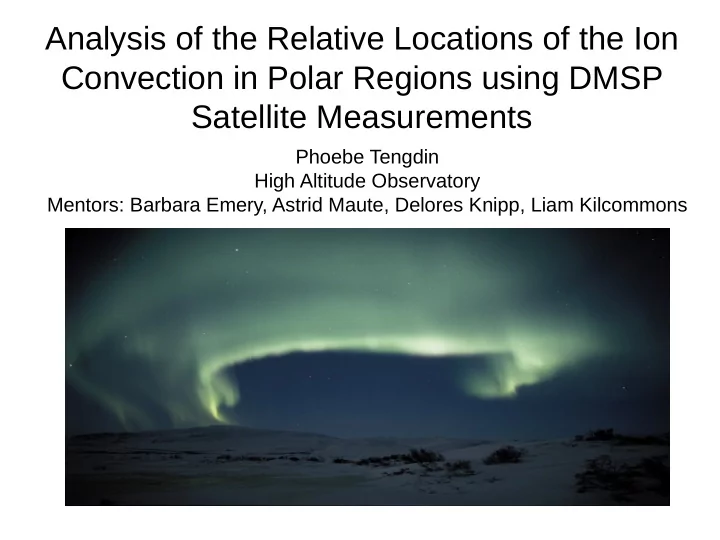
Analysis of the Relative Locations of the Ion Convection in Polar Regions using DMSP Satellite Measurements

Phoebe Tengdin High Altitude Observatory Mentors: Barbara Emery, Astrid Maute, Delores Knipp, Liam Kilcommons

slide-2
SLIDE 2

Objectives

  • The goal of this research is to use DMSP

(Defense Meteorological Satellite Program) data to find the location of the convection- reversal boundary in the polar regions of earth's ionosphere and to see how this location is affected by conditions such as varying IMF and earth's seasons.

  • Finding this boundary will help us to analyze

current models of the ionosphere and develop better future models.

slide-3
SLIDE 3

Background

  • The polar regions of the earth can give us

information about earth's entire magnetosphere because all of the field lines converge at the poles

slide-4
SLIDE 4

Background

  • My research is looking at passes where the z-

component of the IMF (Interplanetary Magnetic Field) is southward (aka negative)

  • When Bz is negative, the IMF and the earth's

magnetic field lines are anti parallel and magnetic reconnection can occur:

slide-5
SLIDE 5

Background

  • This is a dynamic

process leading to the circulation of the field lines in the magnetosphere

slide-6
SLIDE 6

What I'm looking at:

  • Convection Patterns in the high-latitude polar

regions

slide-7
SLIDE 7

Plots that I'm working on:

slide-8
SLIDE 8

Future Plans

  • Once we have finished the algorithm for

determining the zero crossings on each pass we hope to complete a larger scale (10-15 years) statistical study

  • Binning by IMF conditions (Bz, By, avg)
  • Binning by seasonal effects
  • Comparison with the Weimer 2001 and 2005

models to determine which model is more accurate

slide-9
SLIDE 9

Credits

  • Images taken from Stefan Eriksson and P. A.

Delamere's slide show presentations

  • Thanks to all my mentors: Barbara Emery,

Astrid Maute, Delores Knipp, Liam Kilcommons