An Introduction to Aquaponics Adam Cochran Beta vulgaris Channel - - PowerPoint PPT Presentation

an introduction to aquaponics
SMART_READER_LITE
LIVE PREVIEW

An Introduction to Aquaponics Adam Cochran Beta vulgaris Channel - - PowerPoint PPT Presentation

An Introduction to Aquaponics Adam Cochran Beta vulgaris Channel Catfish Ictalurus punctatus Nitrobacter sp. A little about me. Lead Faculty for the Sciences - Columbia Southern University Adjunct Biology Instructor - Mountain


slide-1
SLIDE 1

An Introduction to Aquaponics

Adam Cochran

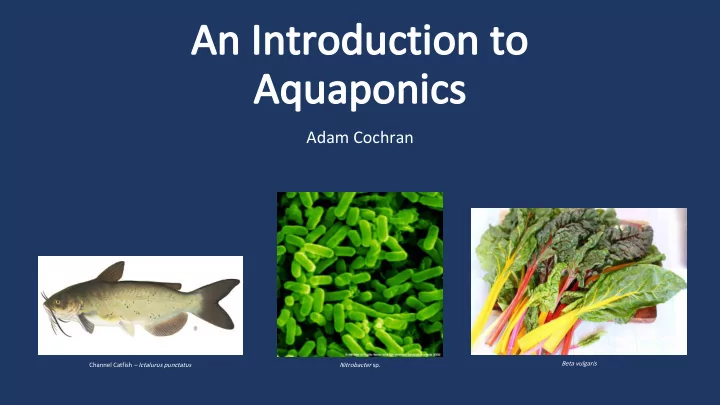
Channel Catfish – Ictalurus punctatus Nitrobacter sp. Beta vulgaris
slide-2
SLIDE 2

A little about me….

  • Lead Faculty for the Sciences -

Columbia Southern University

  • Adjunct Biology Instructor -

Mountain View College

  • M.A. in Ecology – University of

North Texas

  • North Texas Master Naturalist
  • Gardening since the late 90s –

Container, Soil, Hydroponics, Aquaponics

slide-3
SLIDE 3

Growing Food Crops

  • Soil - ”in ground” farming, using the native soil
  • Containers/Raised beds – Pots or raised structures using non-native soil

medium

  • Hydroponics – Water culture: growing plants in oxygenated water +

nutrients, largely sterile

  • Aquaponics – Water culture: raising fish* and plants together,

nitrogenous fish waste fertilizes, dependent on microbes

* May include other organisms

slide-4
SLIDE 4

Soil (Outdoors)

Pros

  • Relatively inexpensive
  • Excellent yields
  • Soil is somewhat “forgiving”
  • Good water retention
  • “Terroir” – if you’re inclined to believe
  • Fertilizer options are many

Cons

  • Considerable space needed; plants need

space

  • Greater need for pesticides/herbicides
  • At the mercy of the elements, every year is a

surprise

  • Irrigation/water needs heavy
slide-5
SLIDE 5

Containers - Raised Beds

Pros

  • Easier to maintain that in ground gardening
  • Tend to be neater and more organized
  • Weeds often less of an issue

Cons

  • Tend to dry out
  • Can be difficult to maintain microbial activity (organic

gardening)

  • Build up of fertilizers salts or other dissolved solids
  • Can be overtaken by underground roots (raised beds)
slide-6
SLIDE 6

Hydroponics

Pros

  • Concentrated production
  • Far less space needed than soil
  • Outdoor and Indoor
  • Variety of techniques
  • Excellent yield
  • ~70% less water needed than soil

Cons

  • Expensive – fertilizers, grow medium, pH buffers
  • Maintaining pH can be a problem
  • More difficult to maintain outdoors
  • Nutrient concentrations must be maintained
  • Not practical for some crops
slide-7
SLIDE 7

Aquaponics

Pros

  • Concentrated production
  • Less space needed than soil
  • Outdoor and Indoor
  • Variety of techniques
  • Excellent yield
  • ~70% less water needed than soil
  • pH problems fewer than hydroponics once

system established Cons

  • Somewhat expensive to start
  • More difficult to maintain outdoors
  • Nutrient concentrations must be maintained
  • Not practical for some crops
  • System size a factor, depending on climate

This Photo by Unknown Author is licensed under CC BY-SA

slide-8
SLIDE 8

Techniques

A Little Background

This Photo by Unknown Author is licensed under CC BY-NC-ND

slide-9
SLIDE 9

Hydroponic Techniques

Nutrient Film Technique or “NFT”

slide-10
SLIDE 10

Nutrient Film Technique or “NFT”

This Photo by Unknown Author is licensed under CC BY-SA

slide-11
SLIDE 11

Nutrient Film Technique or “NFT”

slide-12
SLIDE 12

Hydroponic Techniques

Deep Water Culture or “DWC”

slide-13
SLIDE 13

Deep Water Culture or “DWC”

This Photo by Unknown Author is licensed under CC BY-SA-NC

slide-14
SLIDE 14

Hydroponic Techniques

Constant Flow / Ebb and Flow

slide-15
SLIDE 15

Constant Flow / Ebb and Flow

slide-16
SLIDE 16

Constant Flow / Ebb and Flow Grow Media Options

  • Gravel – cheap, very heavy, can cause pH problems
  • Expanded Clay - “Hydroton” – expensive, light, excellent grow

medium!

  • Expanded Shale – heavy, relatively cheap and easy to find
  • Pumice – volcanic rock, can be used for filler, heavy, cheap
  • Grow stone – “puffed” glass – light, excellent grow medium ,

expensive

slide-17
SLIDE 17

Wicking Bed

slide-18
SLIDE 18

Aquaponics – How Does It Work?

  • Nitrobacter sp.
  • Nitrococcus sp.

Nitrifying Bacteria

Ammonia -> Nitrites -> Nitrates (Fertilizer)

slide-19
SLIDE 19

Establishing a “Cycle” – Making Microbes Happy and Abundant

  • Dechlorination/Dechloramination – Time, Vitamin C Tablets

With Fish or Fishless

  • With Fish – a few fish are introduced to system, may die, dead fish provide

ammonia as they decompose

  • Fishless – Pure ammonia is added to system before fish are put in
  • Ammonia levels are checked using a testing kit
  • As ammonia levels drop, nitrites are tested
  • Once nitrite levels quickly drop to ‘0’, system is ready for fish
  • May take weeks to establish
  • ’Slime’ on surfaces coincides with established cycle
slide-20
SLIDE 20

It’s Grow Time – What to Raise/Grow?

Animals

  • Fish (tilapia, catfish, trout, goldfish, sunfish, bass, carp)
  • Crayfish
  • Freshwater mussels
  • Snails
  • Worms (vermiponics)
  • Do we need animals at all?

Vegetables

  • Will depend on type of system
  • Leafy vegetables tend to be the best choice for aquaponics
slide-21
SLIDE 21

Crops Successful in MVC Systems

  • Basil
  • Chard
  • Lettuce (all varieties)
  • Parsely
  • Cucumbers (need pollination)
  • Melons (need pollination)
  • Okra (HUGE)
  • Edible Gourds
  • Squash
  • Tomatoes (to an extent)
slide-22
SLIDE 22

Fish in MVC Systems

  • Goldfish
  • Catfish
  • Plecostomus (algae eaters)
  • Tilapia
slide-23
SLIDE 23

Challenges

  • Fire Ants
  • Rodents
  • Aphids
  • Hairy Crab Weed - Fatoua villosa, Basil?
  • Nostoc – colonial photosynthetic bacteria
  • Pumps breaking
  • Fish disease
  • Mysterious Disappearing Water
  • Large Fish Damaging Pipes
slide-24
SLIDE 24

Thank You Are There Any Questions?