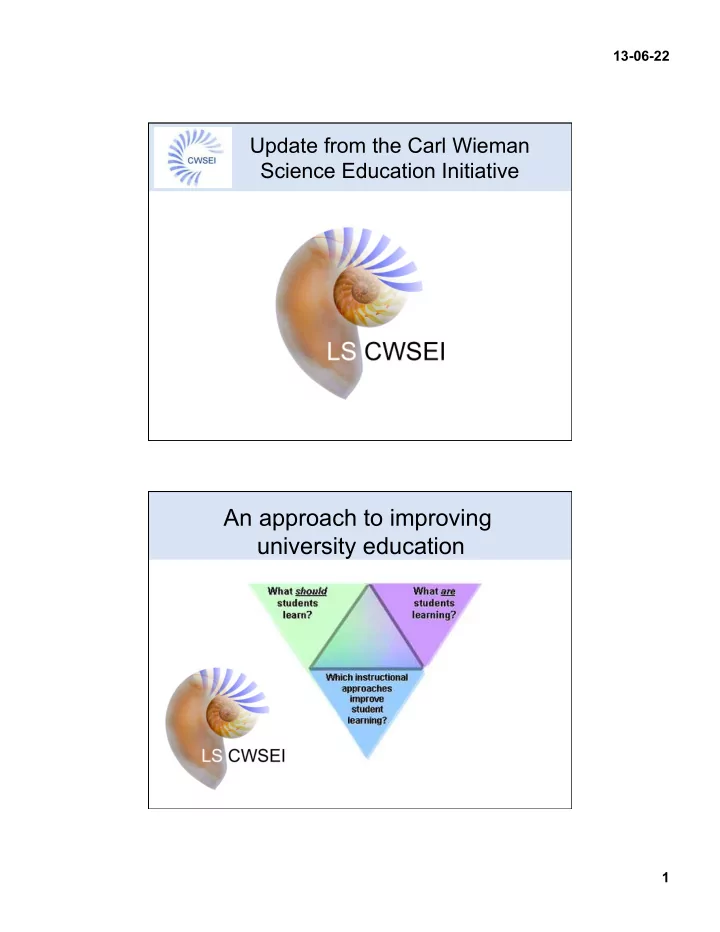
An approach to improving university education 1 13-06-22 The - - PDF document
13-06-22 Update from the Carl Wieman Science Education Initiative An approach to improving university education 1 13-06-22 The LS-CWSEI team Dr. Bridgette Dr. Malin Clarkston Hansen Dr. Laura Dr. Lisa Weir McDonnell Dr. Megan Barker
13-06-22 2
- Dr. Malin
Hansen
- Dr. Lisa
McDonnell
- Dr. Mandy
Banet
- Dr. Bridgette
Clarkston
- Dr. Laura
Weir
The LS-CWSEI team
- Dr. Megan Barker
The roles of an STLF
- 1. Help identify and
implement best practices for teaching in Biology courses at UBC
- 2. Perform pedagogical
research to obtain data to support evidence-based teaching practices
13-06-22 3
- Dr. Malin
Hansen
- Dr. Lisa
McDonnell
- Dr. Mandy
Banet
- Dr. Bridgette
Clarkston
- Dr. Laura
Weir
Implementing best practices
- Dr. Megan Barker
BIOL 230 BIOL 234 BIOL 260, 361 BIOL 336 BIOL 204, 209 BIOL 112, 200, 201
Implementing best practices
- 1. Learning objectives
- 2. Pre-reading assignments
- 3. Clicker questions
- 4. Worksheets
- 5. Tutorial activities
13-06-22 4
UBC Biology curriculum
First year Biology courses Cell biology Genetics Physiology Ecology 2 organismal diversity courses with lab Evolution Statistics 2 Biology lab courses (any topic) Biology Electives Biology Electives 1st year 2nd year 3rd year 4th year
UBC Biology curriculum
First year Biology courses Cell biology Genetics Physiology Ecology 2 organismal diversity courses with lab Evolution Statistics 2 Biology lab courses (any topic) Biology Electives Biology Electives 1st year 2nd year 3rd year 4th year
13-06-22 5
Fostering active learning in lecture
Clicker questions Staged worksheets and in-class problems Invention activities Group exams Pre-readings
The roles of an STLF
- 1. Help identify and
implement best practices for teaching in Biology courses at UBC
- 2. Perform pedagogical
research to obtain data to support evidence-based teaching practices
13-06-22 6
Malin Hansen
- 1. Concept inventory for
population dynamics
- 2. How to use analogies for
effective learning
- 3. Changes in student
attitudes to biology across the program
Sample Survey Questions:
Student attitudes survey
- Survey administered to Biology students in
1st and 4th year
- Do students respond as would an “expert”
biologist?
- Knowledge in biology consists of many
disconnected topics
- Reasoning skills used to understand
biology can be helpful to my everyday life.
- To learn biology, I only need to memorize
facts and definitions
- Mathematical skills are important for
understanding biology
13-06-22 7
Student attitudes survey
Percent expert-like 1st year 4th year
Bridgette Clarkston
- Identifying common
misconceptions in genetics (comparison
- f UBC students vs.
students in a MOOC)
- Confronting
teleological thinking in evolutionary biology
- Utility of group exams
13-06-22 8
2-stage (group) exams
- Students complete an exam
individually and hand in
- Get together in groups of four
and work on the same exam
- Hand in
- Mark is a combination of
individual score (75%) and group score (25%)
“The group exams give you a chance to go over your answers to the exam while you still care about the questions.”
Result: Greater learning gains when students tested in groups
13-06-22 9
Lisa McDonnell
- Misconceptions in genetics
(and comparison of UBC students vs. students in a MOOC)
- Retention of conceptual
knowledge vs. procedural skills in genetics
- Characteristics of expert vs.
novice problem solving behavior in genetics
Laura Weir
- Characterizing student
challenges with constructing logical arguments in Biology
- Efficacy of interventions
targeting study skills
- Integrating treatment of
phylogenetics concepts across cources
13-06-22 10
Mandy Banet
- Utility of targeted pre-
reading assignments
- Characterizing student
challenges with constructing logical arguments in Biology
Pre-‑reading ¡
- Most ¡students ¡do ¡not ¡prepare ¡by ¡reading ¡the ¡
textbook ¡before ¡coming ¡to ¡class ¡
- Ac9ve ¡learning ¡strategies ¡work ¡best ¡when ¡
students ¡are ¡prepared ¡and ¡already ¡familiar ¡ with ¡the ¡basics ¡of ¡the ¡material ¡
- How ¡can ¡we ¡get ¡students ¡to ¡read ¡before ¡
coming ¡to ¡class? ¡
- Use a targeted approach
13-06-22 11
Student ¡survey ¡data: ¡pre-‑readings ¡
98% ¡of ¡the ¡students ¡report ¡ taking ¡the ¡quiz ¡on ¡a ¡regular ¡ basis ¡
82% of the students report reading the textbook on a regular basis
When you did the pre-reading assignments, what MOTIVATED you to do so?
Student ¡mo@va@on ¡for ¡pre-‑reading ¡
“I ¡learn ¡be)er ¡in ¡class ¡if ¡I ¡have ¡previous ¡knowledge ¡of ¡the ¡topic. ¡I ¡ find ¡that ¡I ¡pay ¡more ¡a)en<on ¡and ¡my ¡brain ¡can ¡make ¡more ¡ connec<ons ¡and ¡build ¡on ¡previous ¡knowledge.” ¡ “It's ¡for ¡marks ¡and ¡... ¡it ¡helps ¡me ¡to ¡dis<nguish ¡what ¡I ¡know ¡and ¡ what ¡I ¡have ¡troubles ¡with ¡so ¡I ¡can ¡be ¡all ¡ears ¡in ¡the ¡parts ¡where ¡I ¡am ¡ struggling ¡with ¡in ¡class.” ¡ “…so ¡if ¡I ¡have ¡any ¡ques<ons, ¡they ¡would ¡be ¡knowledgeable ¡and ¡well-‑ founded ¡ques<ons.” ¡
13-06-22 12
Megan Barker
- Effectiveness of “flipped
classroom” and “blended learning” strategies
- Dr. Malin
Hansen
- Dr. Lisa
McDonnell
- Dr. Mandy
Banet
- Dr. Bridgette
Clarkston
- Dr. Laura
Weir
Group project – curriculum mapping
- Dr. Megan Barker