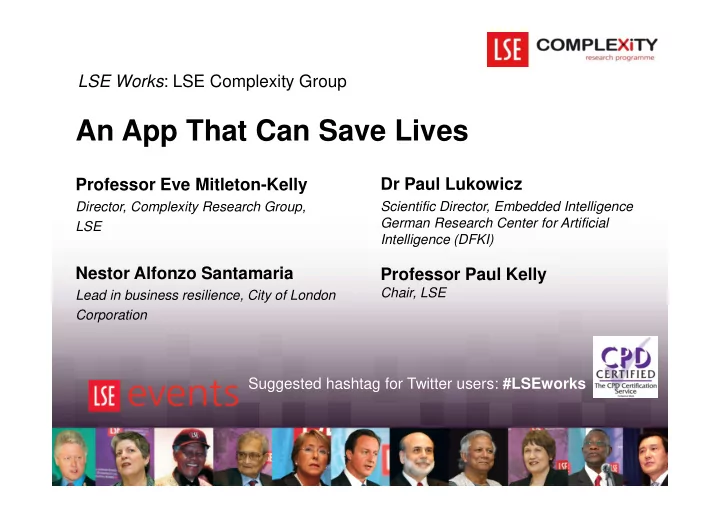
An App That Can Save Lives Dr Paul Lukowicz Professor Eve - - PowerPoint PPT Presentation

an app that can save lives
SMART_READER_LITE
LIVE PREVIEW

An App That Can Save Lives Dr Paul Lukowicz Professor Eve - - PowerPoint PPT Presentation

LSE Works : LSE Complexity Group An App That Can Save Lives Dr Paul Lukowicz Professor Eve Mitleton-Kelly Director, Complexity Research Group, Scientific Director, Embedded Intelligence German Research Center for Artificial LSE Intelligence


slide-1
SLIDE 1

An App That Can Save Lives

LSE Works: LSE Complexity Group

Suggested hashtag for Twitter users: #LSEworks

Professor Eve Mitleton-Kelly

Director, Complexity Research Group, LSE

Nestor Alfonzo Santamaria

Lead in business resilience, City of London Corporation

Dr Paul Lukowicz

Scientific Director, Embedded Intelligence German Research Center for Artificial Intelligence (DFKI)

Professor Paul Kelly

Chair, LSE

slide-2
SLIDE 2
  • LSE Works Seminar

24 January 2013 at LSE

An App That Can Save Lives

Eve Mitleton-Kelly Director Complexity Research Group London School of Economics

slide-3
SLIDE 3
  • Outline of SOCIONICAL EU FP7 project

LSE contribution & research – EMK The science behind the app – PL A policy maker’s perspective – NAS Q & A

slide-4
SLIDE 4
  • A 4-year EU project - 2009-2013

Funded by FET 14 Partners 10 Countries Looking at evacuation following an emergency Traffic flows AmI technology to facilitate evacuation and traffic Underpinned by complexity theory

slide-5
SLIDE 5
  • !"#$

Developed a theory of complex social systems An integrated methodology using both qualitative

& quantitative approaches (e.g. ABM)

To address apparently intractable problems By identifying the multi-dimensional problem

space

(social, cultural, political, economic, technical,

physical, etc. dimensions)

& creating endogenous enabling environments

that co-evolve with a changing exogenous external environment

Based on analysis using the principles of

complexity

slide-6
SLIDE 6
  • Theories

Natural sciences Dissipative structures chemistry-physics (Prigogine) Autocatalytic sets evolutionary biology (Kauffman) Autopoiesis (self-generation) biology/cognition (Maturana) Chaos theory Social sciences Increasing returns economics (B. Arthur) self-organisation emergence connectivity interdependence feedback far from equilibrium space of possibilities co-evolution historicity & time path-dependence

creation of new order

Generic characteristics

  • f complex

co-evolving systems

slide-7
SLIDE 7
  • !#$%$

Primarily work with policy makers in the UK and other

countries (e.g. Malta, Germany & Italy, Spain (training))

Set of face to face interviews with policy makers to

understand their challenges when preparing and implementing contingency plans

Meetings & workshops with:

Cabinet Office Home Office London Ambulance Service, London Fire Brigade City of London & Metropolitan Police, British Transport Police Transport for London, London Underground LOCOG Greater London Authority, City of London Corporation Westminster Borough Council Pageant Master, and others

slide-8
SLIDE 8
  • !#$%$

Analysed 7/7 documents and looked at 9/11 literature

contribution to papers on trust and decision making

Attended exercises by the LFB & a Local Authority Organised trials of the Socionical app during:

the Lord Mayor’s Show in London, 2011 & 2012

  • Control Centre at Guildhall in 2012

during the 2012 Olympics within the City of Westminster West End Live Festival, 2012

Development of City of London Police app

for the City business community with special warn & inform feature to be activated in case of

emergency (future seminar)

slide-9
SLIDE 9
  • scenario boundary conditions

sensing, information processing and spread impact on human decision making and social dynamics impact on physical dynamics (evacuation or traffic)

WP 11

slide-10
SLIDE 10
  • &'()%
  • 1. Seminars for policy makers:

@ LSE in 2010 @ City Hall, jointly with GLA, 2012 @ Brussels jointly with Smartcare, Italy, 2012 @ Munich jointly with TUM, Germany, 2012

  • 2. Set of Guidelines & Recommendations for Policy

Makers

+ Organised and edited volume to be published by

Springer in Spring 2013

slide-11
SLIDE 11
  • For iPhones in 2011 & for Androids in 2012

App provides the user with information about the event,

e.g. Lord Mayor’s Show

Transport advice on how to reach the location* Information on the floats* On historic buildings in the immediate location Location of loos and St John’s Ambulance

Sends location-based information seen as a heat map

superimposed on a Google map that shows the density, movement & direction of a crowd

In an emergency or just serious overcrowding,

emergency personnel can send a location-specific message to users

slide-12
SLIDE 12
  • &

Only active during the day of the event & only within a geographic boundary around

the event

Clear explanation of the purpose of the app

and how the data would be used

Anonymous with no access to individual

users’ identity

All data were amalgamated Observed European Commission regulations

and cleared by SOCIONICAL Ethics Cttee

slide-13
SLIDE 13
  • Organised the trials and were part of the Control

Centre during both LMS trials

Discussed impact with policy makers & conducted

face to face/telephone, semi-structured, 1.5 hour interviews

Designed a survey for LMS app users Conducted anonymous telephone interviews (73 in

2012)

slide-14
SLIDE 14
  • &*+%!!*

Purpose of crowd monitoring:

To provide information on the density and movement of a

crowd

Use info to enhance security and safety Aid the appropriate deployment of resources Identify abnormal patterns in movement or density that may

become critical The LMS-app provided the following features of value to PMs:

Provided an overview, not available by usual means of crowd

monitoring

Better overview than CCTV Can cover larger area at any one time, for longer and is

cheaper than an helicopter

slide-15
SLIDE 15
  • &*+%!!*

Especially valuable during the Fireworks display, at night,

when CCTV cameras are not effective

Helicopters do have thermal imagery technology, but they are

expensive and need highly trained personnel to fly them and on the ground

The feature found to be most useful was the geographically

targeted messaging service – to warn and advise app users in a very specific location

A potential problem can be detected quickly and corrective

action could be taken immediately

It can be used to plan position of barriers, ambulance stations,

loos, etc. more accurately

slide-16
SLIDE 16
  • &*+%!!*

Using the heatmap was intuitive and did not need any

training

but it would need a trained officer to identify

potential critical issues and take appropriate action

“One of those pieces of kit that you do not realise its true potential until you use it” Weaknesses:

It does not provide actual numbers The heatmap only reflects the number of users and

  • nly those with an active app
slide-17
SLIDE 17
  • &,&*!-.

$)!/).

70% would consult iPhone app for

advice during an emergency

If they were running for their lives it

would depend on:

Type of emergency Whether official personnel were present

slide-18
SLIDE 18
  • &*!-.

$)!/).

Would take that advice if:

It came from an authoritative source they could trust

(e.g. the police or emergency services)

The information was reliable and consistent with what

they were experiencing

The technology was robust

30% specified that they would prefer to follow

instructions from figures of authority who were present rather than from a mobile phone

slide-19
SLIDE 19
  • &*!-.

$)!/).

Would communicate the information to others

Face to face with those in the vicinity Using twitter and other social media for those further afield

Crowd Behaviour

Overcrowding at exit periods, e.g. after the fireworks, combined

with physical barriers, led to crowd frustration and potentially risky situation

Insight:

Visualisation not enough to establish position of barriers Need additional information of context and understanding of

crowd behaviour

Provided through telephone interviews

slide-20
SLIDE 20
  • )..!*,

!0

Malta: Island-wide – major incidents e.g. flooding Munich: Event based emergency planning London 1: City-scale mass evacuation London 2: City transport infrastructure emergency

slide-21
SLIDE 21
  • *,&+&*&

Objective:

Save lives, property and the environment, in that

  • rder of priority

Challenges:

Gathering of up-to-date data when preparing for

earthquakes

Need to know about current building materials

and how they react to stress

Demographics and mobility of those who may be

affected

slide-22
SLIDE 22
  • *,&+&*&

Challenges: Flash floods happen very quickly and there is no time to warn citizens

Malta Met Office studying how flash floods develop

Preparation:

Work on modular design of common elements e.g. a

bomb threat or an earthquake would involve the collapse of buildings or structural failure

Table top and practical scenario exercises with actors

slide-23
SLIDE 23
  • *$,)1&!

Challenges

Safety of those attending an event Not standard formula but need to take a

combination of factors into account

e.g. not just numbers but also type of event (at classical

concert can have higher numbers without same risk), and what else is happening at the event (e.g. fireworks, etc)

Distribution, density and location of participants and

potential pressure points (e.g. front of stage at concerts)

Communication between Fire Brigade and

Organisers or between the different Emergency Services

slide-24
SLIDE 24
  • *$,)1&!

Challenges

To avoid panic

Exits visible and not obstructed Communication (may need to leave a different

way to the way they came in)

Need good overview, especially when open air (e.g.

Oktoberfest)

Pictures from Policy helicopter not just-in-time Communication with organisers, participants,

  • ther services, etc
slide-25
SLIDE 25
  • &2,!+*)$

Context

Support the 33 Local Authority in pan-London emergencies Evacuation following an emergency affecting more than 100,000 people and involving all emergency agencies – not event planning

e.g. tidal flooding

slide-26
SLIDE 26
  • &2,!+*)$

Challenges Accepting the need for a mass evacuation and preparing comprehensive plans

Understanding the risk What and who would need evacuation & why? Within what timeframe?

Evacuation usually associated with an event

Events have worked out systems of evacuation from a

single location

Mass evacuation would involve several locations and may

have an element of randomness as to who would be affected

slide-27
SLIDE 27
  • &2,!+*)$

Communication

With public: warn & inform Biggest difficulty would be getting the public to comprehend that risk and that imminent threat to life

Primarily through radio & television Alerting tools (apps, emails, messaging, etc) have

not been taken up widely by the public – they do not see the risk

Opt-out rather than opt-in system using telephone

landlines – can alert people within a postcode at risk

Increasing use of social media

slide-28
SLIDE 28
  • &2,!+*)$

With other emergency agencies

Airwave Face-to-face at strategic level through Strategic

Coordination Group

+ email, telephone etc at operational levels

Convincing policy makers to make the resources available, for a relatively rare albeit catastrophic event, especially in a climate of financial constraint

Not just capital investment, but also cultural

investment (how many Twitter followers would a Borough Council have?)

slide-29
SLIDE 29
  • !3$$!

London-wide overview on transport

Tube, buses, DLR, rail, etc. Working with the Police and all emergency services + Local

Authorities during an emergency

City transport infrastructures are highly interdependent and a breakdown in one will impact others

e.g. if there is an emergency at an underground (tube) station,

then it will impact bus operations, traffic, pedestrians, National Rail, etc. etc.

Therefore need integrated plans to minimise the domino

effect and to absorb the impact

slide-30
SLIDE 30
  • !3$$!

Need to both understand the risk and how to mitigate it,

when risks are at multiple levels and of different types

e.g. societal, industrial, environmental (e.g. flooding, bad

weather) risks London Resilience Partnership – all agencies involved in an emergency – produce a London Strategic Emergency Plan for mass evacuation Provides a framework for more detailed local plans for transport, by Local Authorities

Need to allow for self organisation and exploration of the

space of possibilities by citizens during an evacuation

slide-31
SLIDE 31
  • !3$$!

Challenges Understand the overall picture of the event & coordinate

What are the emergency services, local authorities,

businesses, etc. doing?

What is the size, scope and likely length of the event

(hours, days, longer)?

Get factual information quickly out to the public

What messages is the community receiving via the media? Use technology and social networks to full effect Send out info via Twitter, Facebook, SMS texting, email,

websites, hard copy maps, etc.

slide-32
SLIDE 32
  • !3$$!

Accurate predictions on weather, when Met Office & Environment Agency are risk averse

Repeated false alerts

Decide what needs to be done to provide a service and then return to normality Before an incident:

A challenge is to encourage people to think about the future Understand the likely impact and the associated risks What can and cannot be done Understand how people are likely to respond – talk to them Learn from other incidents what works and what does not work –

use experiential learning techniques

Need process for passing on knowledge and experience before

people with expertise retire

slide-33
SLIDE 33
  • $

The challenges are multi-dimensional (physical,

cultural, organisational, technical, power structures, etc.)

One is common in all contexts: effective & timely

communication

The Socionical app could contribute as part of a tool

kit, by sending immediate and location targeted information & advice

  • a. to the public
  • b. as an additional channel between the emergency

services

Research continuing on overcoming current

problems with the comms infrastructure being

  • verstretched or collapsing during an emergency
slide-34
SLIDE 34
  • !"#

)*+4!

$%&'(%!)%#" ***%%!)%#"+),-.

slide-35
SLIDE 35

An App That Can Save Lives

LSE Works: LSE Complexity Group

Suggested hashtag for Twitter users: #LSEworks

Professor Eve Mitleton-Kelly

Director, Complexity Research Group, LSE

Nestor Alfonzo Santamaria

Lead in business resilience, City of London Corporation

Dr Paul Lukowicz

Scientific Director, Embedded Intelligence German Research Center for Artificial Intelligence (DFKI)

Professor Paul Kelly

Chair, LSE