AMPLITUDES AND CROSS SECTIONS AT THE LHC Errol Gotsman Tel Aviv - - PowerPoint PPT Presentation

amplitudes and cross sections at the lhc
SMART_READER_LITE
LIVE PREVIEW

AMPLITUDES AND CROSS SECTIONS AT THE LHC Errol Gotsman Tel Aviv - - PowerPoint PPT Presentation

AMPLITUDES AND CROSS SECTIONS AT THE LHC Errol Gotsman Tel Aviv University (work done with Genya Levin and Uri Maor) Background The classical Regge pole model a la Donnachie and Landshoff provides a good description of soft hadron-hadron


slide-1
SLIDE 1

AMPLITUDES AND CROSS SECTIONS AT THE LHC

Errol Gotsman Tel Aviv University (work done with Genya Levin and Uri Maor)

Background

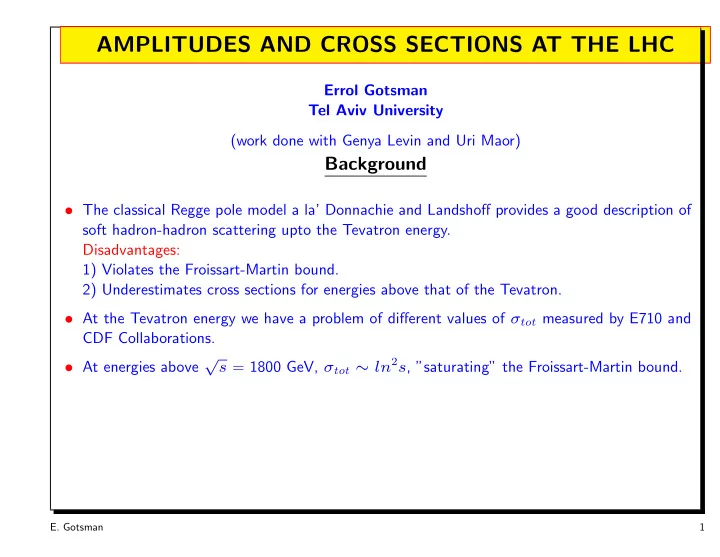
  • The classical Regge pole model a la’ Donnachie and Landshoff provides a good description of

soft hadron-hadron scattering upto the Tevatron energy. Disadvantages: 1) Violates the Froissart-Martin bound. 2) Underestimates cross sections for energies above that of the Tevatron.

  • At the Tevatron energy we have a problem of different values of σtot measured by E710 and

CDF Collaborations.

  • At energies above √s = 1800 GeV, σtot ∼ ln2s, ”saturating” the Froissart-Martin bound.
  • E. Gotsman

1

slide-2
SLIDE 2

Introduction

There are two types of models on the market today attempting to describe soft hadron-hadron scattering: A Models that work within a theoretical framework and calculate Elastic as well as Diffractive cross sections. B Models that assume a ln2s behaviour for σtot and for σinel, and determine the strength of this term and other non-leading terms by comparing to data. Usually these are one channel models unable to calculate Diffractive cross sections.

  • Prior to the publication of the LHC data, most model predictions for σtot at √s = 1800 GeV,

were close to the E710 value of 72.1 ± 3.3 mb

  • Following the publication of LHC data, revised models favour the CDF value of 80.03 ± 2.24

mb.

  • In this talk I will concentrate on the GLM model and other models in group A.
  • E. Gotsman

2

slide-3
SLIDE 3

Importance of Diffraction at the LHC

  • E. Gotsman

3

slide-4
SLIDE 4

Good-Walker Formalism The Good-Walker (G-W) formalism, considers the diffractively produced hadrons as a single hadronic state described by the wave function ΨD, which is

  • rthonormal to the wave function Ψh of the incoming hadron (proton in the

case of interest) i.e. < Ψh|ΨD >= 0. One introduces two wave functions ψ1 and ψ2 that diagonalize the 2x2 interaction matrix T Ai,k =< ψi ψk|T|ψi′ ψk′ >= Ai,k δi,i′ δk,k′. In this representation the observed states are written in the form ψh = α ψ1 + β ψ2 , ψD = −β ψ1 + α ψ2 where, α2 + β2 = 1

  • E. Gotsman

4

slide-5
SLIDE 5

Good-Walker Formalism-2 The s-channel Unitarity constraints for (i,k) are analogous to the single channel equation: Im Ai,k (s, b) = |Ai,k (s, b) |2 + Gin

i,k(s, b),

Gin

i,k is the summed probability for all non-G-W inelastic processes, including

non-G-W ”high mass diffraction” induced by multi-I P interactions. A simple solution to the above equation is: Ai,k(s, b) = i

  • 1 − exp
  • −Ωi,k(s, b)

2

  • , Gin

i,k(s, b) = 1 − exp (−Ωi,k(s, b)) .

The opacities Ωi,k are real, determined by the Born input.

  • E. Gotsman

5

slide-6
SLIDE 6

Good-Walker Formalism-3 Amplitudes in two channel formalism are: Ael(s, b) = i{α4A1,1 + 2α2β2A1,2 + β4A2,2}, Asd(s, b) = iαβ{−α2A1,1 + (α2 − β2)A1,2 + β2A2,2}, Add(s, b) = iα2β2{A1,1 − 2A1,2 + A2,2}. With the G-W mechanism σel , σsd and σdd occur due to elastic scattering

  • f ψ1 and ψ2, the correct degrees of freedom.

Since Ael(s, b) = [1 − e−Ω(s,b)/2] the Opacity Ωel(s, b) = −2ln[1 − Ael(s, b)]

  • E. Gotsman

6

slide-7
SLIDE 7

Examples of Pomeron diagrams leading to diffraction NOT included in G-W mechanism

Y Y1 Y Y1 Y ′

1

Y ′

2

a) b) c)

Examples

  • f

the Pomeron diagrams that lead to a different source of the diffractive dissociation that cannot be described in the framework of the G-W mechanism. (a) is the simplest diagram that describes the process of diffraction in the region of large mass Y − Y1 = ln(M2/s0). (b) and (c) are examples of more complicated diagrams in the region of large mass. The dashed line shows the cut Pomeron, which describes the production of hadrons.

  • E. Gotsman

7

slide-8
SLIDE 8

Example of enhanced and semi-enhanced diagram

a) b)

Different contributions to the Pomeron Green’s function a) examples of enhanced diagrams ; (occur in the renormalisation of the Pomeron propagator) b) examples of semi-enhanced diagrams (occur in the renormalisation of the I P -p vertex ) Multi-Pomeron interactions are crucial for the production of LARGE MASS DIFFRACTION

  • E. Gotsman

8

slide-9
SLIDE 9

Our Formalism 1

The input opacity Ωi,k(s, b) corresponds to an exchange of a single bare Pomeron. Ωi,k(s, b) = gi(b) gk(b) P (s). P (s) = s∆I

P and gi(b) is the Pomeron-hadron vertex parameterized in the form:

gi (b) = gi Si(b) = gi 4π m3

i b K1 (mib) .

Si(b) is the Fourier transform of

1 (1+q2/m2 i )2, where, q is the transverse momentum carried by

the Pomeron. The Pomeron’s Green function that includes all enhanced diagrams is approximated using the MPSI procedure, in which a multi Pomeron interaction (taking into account only triple Pomeron vertices) is approximated by large Pomeron loops of rapidity size of ln s. The Pomeron’s Green Function is given by GI

P (Y ) = 1 − exp

  • 1

T (Y )

  • 1

T (Y ) Γ

  • 0,

1 T (Y )

  • ,

where T (Y ) = γ e∆I

P Y and Γ (0, 1/T ) is the incomplete gamma function.

  • E. Gotsman

9

slide-10
SLIDE 10

Fits to the Data

The parameters of our first fit GLM1 [EPJ C71,1553 (2011)] (prior to LHC) were determined by fitting to data 20 ≤ W ≤ 1800 GeV. We had 58 data points and obtained a χ2/d.f. ≈ 0.86. This fit yields a value of σtot = 91.2 mb at W = 7 TeV. Problem is that most data is at lower energies (W ≤ 500 GeV) and these have small errors, and hence have a dominant influence on the determination of the parameters. To circumvent this we made another fit GLM2 [Phys.Rev. D85, 094007 (2012)] to data for energies W > 500 GeV (including LHC), to determine the Pomeron parameters. We included 35 data points. For the present version in addition we tuned the values of ∆I

P, γ the Pomeron-proton vertex

and the G3I

P coupling, to give smooth cross sections over the complete energy range

20 ≤ W ≤7000 GeV.

  • E. Gotsman

10

slide-11
SLIDE 11

Values of Parameters for our updated version

∆I

P

β α′

I P (GeV −2)

g1 (GeV −1) g2 (GeV −1) m1 ( GeV) m2 (GeV) 0.23 0.46 0.028 1.89 61.99 5.045 1.71 ∆I

R

γ α′

I R (GeV −2)

gI

R 1 (GeV −1)

gI

R 2 (GeV −1)

R2

0,1 (GeV −1)

G3I

P (GeV −1)

  • 0.47

0.0045 0.4 13.5 800 4.0 0.03

  • g1(b) and g2(b) describe the vertices of interaction of the Pomeron with state

1 and state 2

  • The Pomeron trajectory is 1 + ∆I

P + α

I Pt

  • γ denotes the low energy amplitude of the dipole-target interaction
  • β denotes the mixing angle between the wave functions
  • G3I

P denotes the triple Pomeron coupling

  • E. Gotsman

11

slide-12
SLIDE 12

Results of GLM model

√s TeV 1.8 7 8 σtot mb 79.2 98.6 101. σel mb 18.5 24.6 25.2 σsd(M ≤ M0) mb 10.7 + (2.8)nGW 10.9 + (2.89)nGW σsd(M2 < 0.05s)mb 9.2+ (1.95)nGW 10.7 + (4.18)nGW 10.9 + (4.3)nGW σdd mb 5.12 + (0.38)nGW 6.2 + (1.166)nGW 6.32 + (1.29)nGW Bel GeV −2 17.4 20.2 20.4 BGW

sd

GeV −2 6.36 8.01 8.15 σinel mb 60.7 74. 75.6

dσ dt |t=0 mb/GeV 2

326.34 506.4 530.7 √s TeV 13 14 57 σtot mb 108.0 109.0 130.0 σel mb 27.5 27.9 34.8 σsd(M2 < 0.05s) mb 11.4 +(5.56)nGW 11.5 +(5.81)nGW 13.0 + (8.68)nGW σdd mb 6.73 + (1.47)nGW 6.78 + (1.59)nGW 7.95 + (5.19)nGW Bel GeV −2 21.5 21.6 24.6 σinel mb 80.7 81.1 95.2

dσ dt |t=0 mb/GeV 2

597.6 608.11 879.2 Predictions of our model for different energies W . M0 is taken to be equal to 200GeV as ALICE measured the cross section of the diffraction production with this restriction.

  • E. Gotsman

12

slide-13
SLIDE 13

Comparison of the Energy Dependence of GLM and Experimental Data

σtot(s)(mb)

log10(s/s0)

30 40 50 60 70 80 90 100 3 4 5 6 7

σel(s)(mb)

log10(s/s0)

5 7.5 10 12.5 15 17.5 20 22.5 25 3 4 5 6 7

σsd(s)(mb)

log(s/1GeV2)

2 4 6 8 10 12 14 16 3 4 5 6 7

σdd(s)(mb)

log10(s/s0)

2 3 4 5 6 7 8 9 5.5 5.75 6 6.25 6.5 6.75 7 7.25 7.5 7.75

Bel ( GeV-2 )

log10(s/s0)

8 10 12 14 16 18 20 3 4 5 6 7

σin(s)(mb)

log10(s/s0)

30 35 40 45 50 55 60 65 70 75 5.5 5.75 6 6.25 6.5 6.75 7 7.25 7.5 7.75

  • E. Gotsman

13

slide-14
SLIDE 14

GLM Differential cross section and Experimental Data at 1.8 and 7 TeV

dσel/dt(mb/GeV2)

LHC(8 TeV) × 0.1 LHC(7 TeV) × 0.1 LHC(14 TeV) × 0.01 Tevatron(1.8 TeV) t (GeV2)

10

  • 4

10

  • 3

10

  • 2

10

  • 1

1 10 10 2 0.1 0.2 0.3 0.4 0.5

dσel/dt versus |t| at Tevatron (blue curve and data)) and LHC ( black curve and data) energies (W = 1.8 T eV , 8 T eV and 7 T eV respectively) The solid line without data shows our prediction for W = 14 T eV .

  • E. Gotsman

14

slide-15
SLIDE 15

Comparison of the Impact Parameter Dependence of GLM Amplitudes

b in fm

Ai k W = 1.8 TeV

A22 A12 A11

0.2 0.4 0.6 0.8 1 1.2 0.5 1 1.5 2 2.5 3

b in fm

Ai k W = 7 TeV

A22 A12 A11

0.2 0.4 0.6 0.8 1 1.2 0.5 1 1.5 2 2.5 3

b in fm

Ai k W = 14 TeV

A22 A12 A11

0.2 0.4 0.6 0.8 1 1.2 0.5 1 1.5 2 2.5 3

b in fm

Ai k W = 57 TeV

A22 A12 A11

0.2 0.4 0.6 0.8 1 1.2 0.5 1 1.5 2 2.5 3

The solid lines are associated with GLM2 while the dotted lines with GLM1

  • E. Gotsman

15

slide-16
SLIDE 16

Comparison of the Impact Parameter Dependence of GLM Ael, Asd, Add and Ωel

  • E. Gotsman

16

slide-17
SLIDE 17

From Ciesielski and Goulianos ”MBR MC Simulation” arXiv:1205.1446 The σp±p

tot (s) cross sections at a pp center-of-mass-energy √s are calculated as

follows: σp±p

tot =

   16.79s0.104 + 60.81s−0.32 ∓ 31.68s−0.54 for √s < 1.8 TeV, σCDF

tot

+ π

s0

  • ln s

sF

2 −

  • ln sCDF

sF

2 for √s ≥ 1.8 TeV, The energy at which ”saturation ” occurs √sF = 22 GeV, and s0 = 3.7 ± 1.5 GeV 2. Their ”event generator” follows Dino’s ”renormalized Regge-theory” model, and their numbers are based on the MBR-enhanced PYTHIA8 simulation.

  • E. Gotsman

17

slide-18
SLIDE 18

From Alan Martin’s talk Trento Sept 2011 arXiv:1202.4966 and KMR Eur.Phys.J. C72(2012) 1937

KMR model KMR 3-ch eikonal energy σtot σel σSD

lowM

σDD

lowM

σtot σel Bel σSD

lowM

σDD

lowM

1.8 72.7 16.6 4.8 0.4 79.3 17.9 18.0 5.9 0.7 7 87.9 21.8 6.1 0.6 97.4 23.8 20.3 7.3 0.9 14 96.5 24.7 7.8 0.8 107.5 27.2 21.6 8.1 1.1 100 122.3 33.5 9.0 1.3 138.8 38.1 25.8 10.4 1.6

Some results of the complete KMR model prior to the LHC data (left-hand Table), and results obtained from a simpler approach, based on a 3-channel eikonal description of all elastic (and quasi-elastic) pp and p¯ p data, including the TOTEM LHC data (right-half of the Table). σtot, σel and σSD,DD

lowM

are the total, elastic and low-mass single and double dissociation cross sections (in mb) respectively. The cross section σSD is the sum of the dissociations of both the ‘beam’ and ‘target’ protons. Bel is the mean elastic slope (in GeV −2), dσel/dt = eBelt, in the region |t| < 0.2 GeV 2. The collider energies are given in TeV. The former (latter) analysis fit to the CERN-ISR observations that σSD

lowM=2(3) mb at √s = 53 GeV, with low mass defined to be

M < 2.5(3) GeV.

  • E. Gotsman

18

slide-19
SLIDE 19

KMR Eur.Phys.J. C72 (2012) 1937

Have attempted to extract the form of the Elastic Opacity directly from data: Assuming that the Real part of the scattering amplitude is small: ImA(b) = dσel dt 16π 1 + ρ2 J0(qtb) qtdqt 4π , where qt =

  • |t| and ρ ≡ ReA/ImA

The proton opacity Ω(b) determined directly from the pp dσel/dt data at 546 GeV , 1.8 TeV and 7 TeV data. The uncertainty on the LHC value at b = 0 is indicated by a dashed red line.

  • E. Gotsman

19

slide-20
SLIDE 20

Comparison with Kohara, Ferreira and Kodama EPJC

  • E. Gotsman

20

slide-21
SLIDE 21

Comparison of results obtained in GLM, Ostapchenko, K-P and KMR models

Ostapchenko (Phys.Rev.D81,114028(2010)) [pre LHC] has made a comprehensive calculation in the framework of Reggeon Field Theory based on the resummation of both enhanced and semi-enhanced Pomeron diagrams. To fit the total and diffractive cross sections he assumes TWO POMERONS: (for SET C) ”SOFT POMERON” αSoft = 1.14 + 0.14t ”HARD POMERON” αHard = 1.31 + 0.085t The Durham Group (Khoze, Martin and Ryskin),(Eur.Phys.J.,C72(2012), 1937), to be consistent with the Totem result, have a model, based on a 3-channel eikonal description, with 3 diffractive eigenstates of different sizes, but with ONLY ONE POMERON. ∆I

P = 0.14; α ′ I P = 0.1 GeV −2

Kaidalov-Poghosyan have a model which is based on Reggeon calculus, they attempt to describe data on soft diffraction taking into account all possible non-enhanced absorptive corrections to 3 Reggeon vertices and loop diagrams. It is a single I P model and with secondary Regge poles, they have ∆I

P = 0.12; α ′ I P = 0.22GeV −2.

  • E. Gotsman

21

slide-22
SLIDE 22

Comparison of results of various models

W = 1.8 TeV GLM KMR2 Ostap(C) BMR∗ KP σtot(mb) 79.2 79.3 73.0 81.03 75.0 σel(mb) 18.5 17.9 16.8 19.97 16.5 σSD(mb) 11.27 5.9(LM) 9.2 10.22 10.1 σDD(mb) 5.51 0.7(LM) 5.2 7.67 5.8 Bel(GeV −2) 17.4 18.0 17.8 W = 7 TeV GLM KMR2 Ostap(C) BMR KP σtot(mb) 98.6 97.4 93.3 98.3 96.4 σel(mb) 24.6 23.8 23.6 27.2 24.8 σSD(mb) 14.88 7.3(LM) 10.3 10.91 12.9 σDD(mb) 7.45 0.9(LM) 6.5 8.82 6.1 Bel(GeV −2) 20.2 20.3 19.0 19.0 W = 14 TeV GLM KMR2 Ostap(C) BMR KP σtot(mb) 109.0 107.5 105. 109.5 108. σel(mb) 27.9 27.2 28.2 32.1 29.5 σSD(mb) 17.41 8.1(LM) 11.0 11.26 14.3 σDD(mb) 8.38 1.1(LM) 7.1 9.47 6.4 Bel(GeV −2) 21.6 21.6 21.4 20.5

  • E. Gotsman

22

slide-23
SLIDE 23
  • E. Gotsman

23

slide-24
SLIDE 24

Totem 8 TeV Data

  • E. Gotsman

24

slide-25
SLIDE 25

Conclusions

  • We have succeded in building a model for soft interactions at high energy,

which provides a very good description all high energy data, including the LHC measurements. This model is based on the Pomeron with a large intercept (∆I

P = 0.23) and

very small slope (α′

I P =0.028).

  • We find no need to introduce two Pomerons: i.e. a soft and a hard one.

The Pomeron in our model provides a natural matching with the hard Pomeron in processes that occur at short distances.

  • Amplitudes provide useful information but are NOT unique.
  • The qualitative features of our model are close to what one expects from N=4

SYM, which is the only theory that is able to treat long distance physics on a solid theoretical basis.

  • E. Gotsman

25

slide-26
SLIDE 26

Comparison of the results of GLM model and data at 7 and 57 TeV

W σmodel

tot

(mb) σexp

tot (mb)

σmodel

el

(mb) σexp

el

(mb) 7 TeV 98.6 TOTEM: 98.6 ±2.2 24.6 TOTEM: 25.4±1.1 W σmodel

in

(mb) σexp

in (mb)

Bmodel

el

(GeV −2) Bexp

el

(GeV −2) 7 TeV 74.0 CMS: 68.0±2syst ± 2.4lumi ± 4extrap 20.2 TOTEM: 19.9±0. ATLAS: 69.4±2.4exp ± 6.9extrap ALICE: 73.2 (+2./ − 4.6)model ± 2.6lumi TOTEM: 73.5 ±0.6stat ± 1.8syst W σmodel

sd

(mb) σexp

sd (mb)

σmodel

dd

(mb) σexp

dd (mb)

7 TeV 10.7GW + 4.18nGW ALICE : 14.9(+3.4/-5.9) 6.21GW + 1.24nGW ALICE: 9.0 ± 2.6 W σmodel

tot

(mb) σexp

tot (mb)

57 TeV 130 AUGER*: 133 ±13stat ± 17sys ± 16Glauber σmodel

inel

(mb) σexp

inel(mb)

95.2 AUGER*: 92 ±7stat ± 11syst ± 7Glauber *AUGER collaboration Phys.Rev.Lett.109,062002 (2012)

  • E. Gotsman

26

slide-27
SLIDE 27

From Donnachie and Landshoff arXiv:1112.2485

D and L use an EIKONALIZED Regge pole model with Pomerons and Reggeons: The values of the parameters are determined by making a simultaneous fit to pp scattering data and to DIS lepton scattering for low x. Their results can be summarized: SOFT POMERON HARD POMERON αI

P S = 1.093 + 0.25t

αI

P H= 1.362 + 0.1t

Coupling strength: X1 = 243.5 X0 =1.2 At 7 TeV σtot(soft) = 91 mb σtot(hard + soft) = 98 mb

  • E. Gotsman

27

slide-28
SLIDE 28

From Donnachie and Landshoff arXiv:1112.2485 ONLY SOFT POMERON (SOFT + HARD ) POMERON

  • E. Gotsman

28

slide-29
SLIDE 29

Block and Halzen’s Parametrization of σtot and σinel

Bloch and Halzen (P.R.L. 107,212002 (2011) and arXiv:1205.5514) claim that the experimental data from LHC (at 7 Tev) and Auger (at 57 Tev), ”saturate” the Froissart bound of ln2s. By ”saturation” they mean that σtot ≈ ln2s. Using Analyticity constraints and in the spirit of FESR’s they propose the following parametrization for the pp and p¯ p cross sections: σtot = 37.1( ν

m)−0.5 + 37.2 − 1.44ln( ν m) + 0.2817ln2( ν m)

σinel = 62.59( ν

m)−0.5 + 24.09 + 0.1604ln( ν m) + 0.1433ln2( ν m)

where ν denotes the lab energy, and at high energies ν = s/(2m

W (Tev) 7 8 14 57 σtot mb 95.1 ± 1.1 97.6 ± 1.1 107.3 ± 1.2 134.8 ± 1.5 σinel mb 69.0 ± 1.3 70.3 ± 1.3 76.3 ± 1.4 92.9 ± 1.6

  • E. Gotsman

29

slide-30
SLIDE 30

Diffractive Processes in our Formalism

2

a)

Y Ym

G3P

Q(Y − Y ; ...)

m

Q(Y ; ...)

m

Q(Y ; ...)

m

2

b)

Y Y1

1

Q(Y − Y ; ...)

m

Q(Y ; ...)

m

e e

For diffraction production we introduce an additional contribution due to the Pomeron enhanced mechanism which is non GW. As shown in fig-a, for (single diffraction) we have one cut Pomeron, and in fig-b, for (double diffraction) we have two cut Pomerons we express the cut Pomerons through a Pomeron without a cut, using the AGK cutting rules.

  • E. Gotsman

30

slide-31
SLIDE 31

Fits to 57 TeV Data

(Proton-Proton) [mb]

inel

σ 30 40 50 60 70 80 90 100 110 [GeV] s

3

10

4

10

5

10 ATLAS 2011 CMS 2011 ALICE 2011 TOTEM 2011 UA5 CDF/E710 This work (Glauber) QGSJet01 QGSJetII.3 Sibyll2.1 Epos1.99 Pythia 6.115 Phojet

Block and Halzen parameterization Auger Monte Carlo Fits

  • E. Gotsman

31

slide-32
SLIDE 32

Guiding criteria for GLM Model

  • The model should be built using Pomerons and Reggeons.
  • The intercept of the Pomeron should be relatively large. In AdS/CFT correspondence we

expect ∆I

P = αI P(0) − 1 = 1 − 2/

√ λ ≈ 0.11 to 0.33. The estimate for λ from the cross section for multiparticle production as well as from DIS at HERA is λ = 5 to 9;

  • α′

I P(0) = 0;

  • A large Good-Walker component is expected, as in the AdS/CFT approach the main

contribution to shadowing corrections comes from elastic scattering and diffractive production.

  • The Pomeron self-interaction should be small (of the order of 2/

√ λ in AdS/CFT correspondence), and much smaller than the vertex of interaction of the Pomeron with a hadron, which is of the order of λ;

  • E. Gotsman

32

slide-33
SLIDE 33

Diffraction

For double diffraction we have (see Fig.1b): Add

i,k

=

  • d2b′ 4 gi
  • b −

b′, mi

  • ggk
  • b′, mk
  • ×

Q

  • gi, mi,

b − b′, Y − Y1

  • e2∆ δY Q
  • gk, mk,

b′, Y1 − δY

  • .

This equation is illustrated in fig-b, which displays all ingredients of the equation. We express each of two cut Pomerons through the Pomeron without a cut, using the AGK cutting rules. For single diffraction, Y = ln

  • M 2/s0
  • , where, M is the SD mass. For double diffraction,

Y − Y1 = ln

  • M 2

1/s0

  • and Y1 − δY = ln
  • M 2

2/s0

  • , where M1 and M2 are the masses of

two bunches of hadrons produced in double diffraction. The integrated cross section of the SD channel is written as a sum of two terms: the GW term, which is equal to σGW

sd

=

  • d2b
  • αβ{−α2 A1,1 + (α2 − β2) A1,2 + β2 A2,2}
  • 2

.

  • E. Gotsman

33

slide-34
SLIDE 34

Diffraction 2

The second term describes diffraction production due to non GW mechanism: σnGW

sd

= 2

  • dYm
  • d2b
  • α6 Asd

1;1,1 e−Ω1,1(Y ;b) + α2β4Asd 1;2,2 e−Ω1,2(Y ;b) + 2 α4 β2 Asd 1;1,2 e−1 2(Ω1,1(Y ;b)+Ω1,2(Y ;b))

+ β2 α4 Asd

2;1,1 e−Ω1,2(Y ;b) + 2 β4α2 Asd 2;1,2 e−1 2(Ω1,2(Y ;b)+Ω2,2(Y ;b)) + β6 Asd 2;2,2 e−Ω2,2(

The cross section of the double diffractive production is also a sum of the GW contribution, σGW

dd

=

  • d2b α2 β2
  • A1,1 − 2 A1,2 + A2,2
  • 2

, to which we add the term which is determined by the non GW contribution, σnGW

dd

=

  • d2b
  • α4 Add

1,1 e−Ω1,1(Y ;b) + 2α2 β2Add 1,2 e−Ω1,2(Y ;b) + β4 Add 2,2 e−Ω2,2(Y ;b)

. In our model the GW sector can contribute to both low and high diffracted mass, as we do not know the value of the typical mass for this mechanism, on the other hand, the non GW sector contributes only to high mass diffraction (M nGW ≥ 20 GeV).

  • E. Gotsman

34