AMPL Hands-On Session Robert Fourer Department of Industrial - - PDF document

ampl hands on session
SMART_READER_LITE
LIVE PREVIEW

AMPL Hands-On Session Robert Fourer Department of Industrial - - PDF document

R. Fourer, AMPL Hands-On Session AMPL Hands-On Session Robert Fourer Department of Industrial Engineering & Management Sciences Northwestern University Institute for Mathematics and Its Applications Annual Program:


slide-1
SLIDE 1
  • R. Fourer,

AMPL “Hands-On” Session Institute for Matehmatics and Its Applications, University of Minnesota Optimization Year, Supply Chair and Logistics Tutorials, September 9, 2002

Robert Fourer, IMA Tutorials, 9 Sept 2002: AMPL “Hands-On” Session

AMPL “Hands-On” Session

Robert Fourer

Department of Industrial Engineering & Management Sciences Northwestern University Institute for Mathematics and Its Applications Annual Program: Optimization Supply Chain and Logistics Optimization Tutorial September 9-13, 2002

Robert Fourer, IMA Tutorials, 9 Sept 2002: AMPL “Hands-On” Session

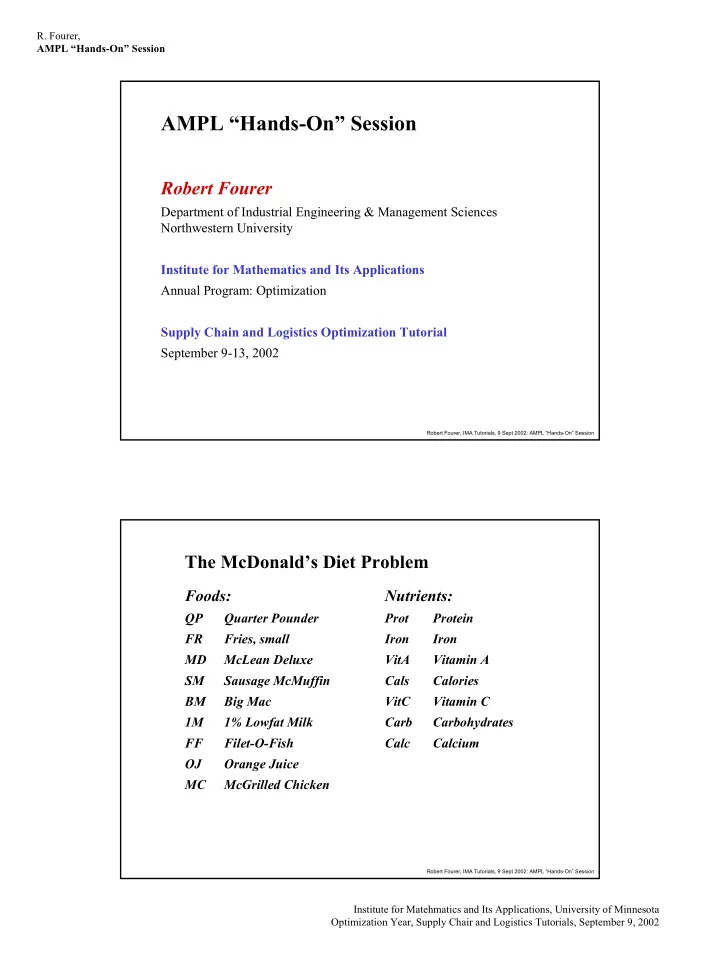
The McDonald’s Diet Problem

Foods:

QP Quarter Pounder FR Fries, small MD McLean Deluxe SM Sausage McMuffin BM Big Mac 1M 1% Lowfat Milk FF Filet-O-Fish OJ Orange Juice MC McGrilled Chicken

Nutrients:

Prot Protein Iron Iron VitA Vitamin A Cals Calories VitC Vitamin C Carb Carbohydrates Calc Calcium

slide-2
SLIDE 2
  • R. Fourer,

AMPL “Hands-On” Session Institute for Matehmatics and Its Applications, University of Minnesota Optimization Year, Supply Chair and Logistics Tutorials, September 9, 2002

Robert Fourer, IMA Tutorials, 9 Sept 2002: AMPL “Hands-On” Session

QP MD BM FF MC FR SM 1M OJ Cost 1.8 2.2 1.8 1.4 2.3 0.8 1.3 0.6 0.7 Need: Protein 28 24 25 14 31 3 15 9 1 55 Vitamin A 15 15 6 2 8 4 10 2 100 Vitamin C 6 10 2 15 15 4 120 100 Calcium 30 20 25 15 15 20 30 2 100 Iron 20 20 20 10 8 2 15 2 100 Calories 510 370 500 370 400 220 345 110 80 2000 Carbo 34 35 42 38 42 26 27 12 20 350

McDonald’s Diet Problem Data

Robert Fourer, IMA Tutorials, 9 Sept 2002: AMPL “Hands-On” Session

Formulation: Too General

Minimize cx Subject to Ax = b x ≥ 0

slide-3
SLIDE 3
  • R. Fourer,

AMPL “Hands-On” Session Institute for Matehmatics and Its Applications, University of Minnesota Optimization Year, Supply Chair and Logistics Tutorials, September 9, 2002

Robert Fourer, IMA Tutorials, 9 Sept 2002: AMPL “Hands-On” Session

Formulation: Too Specific

Minimize 1.84 xQP + 2.19 xMD + 1.84 xBM + 1.44 xFF + 2.29 xMC + 0.77 xFR + 1.29 xSM + 0.60 x1M + 0.72 xOJ Subject to 28 xQP + 24 xMD + 25 xBM + 14 xFF + 31 xMC + 3 xFR + 15 xSM + 9 x1M + 1 xOJ ≥ 55 15 xQP + 15 xMD + 6 xBM + 2 xFF + 8 xMC + 0 xFR + 4 xSM + 10 x1M + 2 xOJ ≥ 100 6 xQP + 10 xMD + 2 xBM + 0 xFF + 15 xMC + 15 xFR + 0 xSM + 4 x1M + 120 xOJ ≥ 100 30 xQP + 20 xMD + 25 xBM + 15 xFF + 15 xMC + 0 xFR + 20 xSM + 30 x1M + 2 xOJ ≥ 100 20 xQP + 20 xMD + 20 xBM + 10 xFF + 8 xMC + 2 xFR + 15 xSM + 0 x1M + 2 xOJ ≥ 100 510 xQP + 370 xMD + 500 xBM + 370 xFF + 400 xMC + 220 xFR + 345 xSM + 110 x1M + 80 xOJ ≥ 2000 34 xQP + 35 xMD + 42 xBM + 38 xFF + 42 xMC + 26 xFR + 27 xSM + 12 x1M + 20 xOJ ≥ 350

Robert Fourer, IMA Tutorials, 9 Sept 2002: AMPL “Hands-On” Session

Algebraic Model

Given F, a set of foods N, a set of nutrients and aij ≥ 0, the units of nutrient i in one serving of food j, for each i ∈ N and j ∈ F bi > 0, the units of nutrient i required, for each i ∈ N cj > 0, the cost per serving of food j, for each j ∈ F Define xj ≥ 0, the number of servings of food j to be purchased, for each j ∈ F Minimize Σj∈F cj xj Subject to Σj∈F aij xj ≥ bi, for each i ∈ N

slide-4
SLIDE 4
  • R. Fourer,

AMPL “Hands-On” Session Institute for Matehmatics and Its Applications, University of Minnesota Optimization Year, Supply Chair and Logistics Tutorials, September 9, 2002

Robert Fourer, IMA Tutorials, 9 Sept 2002: AMPL “Hands-On” Session

Algebraic Model in AMPL

set NUTR; # nutrients set FOOD; # foods param amt {NUTR,FOOD} >= 0; # amount of nutrient in each food param nutrLow {NUTR} >= 0; # lower bound on nutrients in diet param cost {FOOD} >= 0; # cost of foods var Buy {FOOD} >= 0 integer; # amounts of foods to be purchased minimize TotalCost: sum {j in FOOD} cost[j] * Buy[j]; subject to Need {i in NUTR}: sum {j in FOOD} amt[i,j] * Buy[j] >= nutrLow[i];

Robert Fourer, IMA Tutorials, 9 Sept 2002: AMPL “Hands-On” Session

Data for the AMPL Model

param: FOOD: cost := "Quarter Pounder" 1.84 "Fries, small" .77 "McLean Deluxe" 2.19 "Sausage McMuffin" 1.29 "Big Mac" 1.84 "1% Lowfat Milk" .60 "Filet-O-Fish" 1.44 "Orange Juice" .72 "McGrilled Chicken" 2.29 ; param: NUTR: nutrLow := Prot 55 VitA 100 VitC 100 Calc 100 Iron 100 Cals 2000 Carb 350 ; param amt (tr): Cals Carb Prot VitA VitC Calc Iron := "Quarter Pounder" 510 34 28 15 6 30 20 "McLean Deluxe" 370 35 24 15 10 20 20 "Big Mac" 500 42 25 6 2 25 20 "Filet-O-Fish" 370 38 14 2 0 15 10 "McGrilled Chicken" 400 42 31 8 15 15 8 "Fries, small" 220 26 3 0 15 0 2 "Sausage McMuffin" 345 27 15 4 0 20 15 "1% Lowfat Milk" 110 12 9 10 4 30 0 "Orange Juice" 80 20 1 2 120 2 2 ;

slide-5
SLIDE 5
  • R. Fourer,

AMPL “Hands-On” Session Institute for Matehmatics and Its Applications, University of Minnesota Optimization Year, Supply Chair and Logistics Tutorials, September 9, 2002

Robert Fourer, IMA Tutorials, 9 Sept 2002: AMPL “Hands-On” Session

Continuous-Variable Solution

ampl: model mcdiet1.mod; ampl: data mcdiet1.dat; ampl: solve; MINOS 5.5: ignoring integrality of 9 variables MINOS 5.5: optimal solution found. 7 iterations, objective 14.8557377 ampl: display Buy; Buy [*] := 1% Lowfat Milk 3.42213 Big Mac Filet-O-Fish 0 Fries, small 6.14754 McGrilled Chicken McLean Deluxe Orange Juice Quarter Pounder 4.38525 Sausage McMuffin

Robert Fourer, IMA Tutorials, 9 Sept 2002: AMPL “Hands-On” Session

Integer-Variable Solution

ampl: option solver cplex; ampl: solve; CPLEX 7.0.0: optimal integer solution; objective 15.05 41 MIP simplex iterations 23 branch-and-bound nodes ampl: display Buy; Buy [*] := 1% Lowfat Milk 4 Big Mac Filet-O-Fish 1 Fries, small 5 McGrilled Chicken McLean Deluxe Orange Juice Quarter Pounder 4 Sausage McMuffin

slide-6
SLIDE 6
  • R. Fourer,

AMPL “Hands-On” Session Institute for Matehmatics and Its Applications, University of Minnesota Optimization Year, Supply Chair and Logistics Tutorials, September 9, 2002

Robert Fourer, IMA Tutorials, 9 Sept 2002: AMPL “Hands-On” Session

Same for 63 Foods, 12 Nutrients

ampl: reset data; ampl: data mcdiet2.dat; ampl: option solver minos; ampl: solve; MINOS 5.5: ignoring integrality of 63 variables MINOS 5.5: optimal solution found. 16 iterations, objective -1.786806582e-14 ampl: option omit_zero_rows 1; ampl: display Buy; Buy [*] := Bacon Bits 55 Barbeque Sauce 50 Hot Mustard Sauce 50

Robert Fourer, IMA Tutorials, 9 Sept 2002: AMPL “Hands-On” Session

Essential Modeling Language Features

Sets and indexing

Simple sets Compound sets Computed sets

Objectives and constraints

Linear, piecewise-linear Nonlinear Integer, network

. . . and many more features

Express problems the various way that people do Support varied solvers

slide-7
SLIDE 7
  • R. Fourer,

AMPL “Hands-On” Session Institute for Matehmatics and Its Applications, University of Minnesota Optimization Year, Supply Chair and Logistics Tutorials, September 9, 2002

Robert Fourer, IMA Tutorials, 9 Sept 2002: AMPL “Hands-On” Session

Sets and Indexing

Features

Simple sets

Sets of objects Sets of numbers Ordered sets

Compound sets

Sets of pairs Sets of n-tuples Indexed collections of sets

Computing sets

By enumerating set members By operating on sets: union, intersection, . . .

Robert Fourer, IMA Tutorials, 9 Sept 2002: AMPL “Hands-On” Session

Sets of Objects

Sets & Indexing

set ORIG; # origins set DEST; # destinations param supply {ORIG} >= 0; # at origins param demand {DEST} >= 0; # at destinations check: sum {i in ORIG} supply[i] = sum {j in DEST} demand[j]; param cost {ORIG,DEST} >= 0; # ship cost/unit var Trans {ORIG,DEST} >= 0; # units shipped minimize total_cost: sum {i in ORIG, j in DEST} cost[i,j] * Trans[i,j]; subject to Supply {i in ORIG}: sum {j in DEST} Trans[i,j] = supply[i]; subject to Demand {j in DEST}: sum {i in ORIG} Trans[i,j] = demand[j];

Transportation

slide-8
SLIDE 8
  • R. Fourer,

AMPL “Hands-On” Session Institute for Matehmatics and Its Applications, University of Minnesota Optimization Year, Supply Chair and Logistics Tutorials, September 9, 2002

Robert Fourer, IMA Tutorials, 9 Sept 2002: AMPL “Hands-On” Session

set PROD; # products param T > 0; # number of weeks param rate {PROD} > 0; param inv0 {PROD} >= 0; param avail {1..T} >= 0; param market {PROD,1..T} >= 0; param prodcost {PROD} >= 0; param invcost {PROD} >= 0; param revenue {PROD,1..T} >= 0; var Make {PROD,1..T} >= 0; var Inv {PROD,0..T} >= 0; var Sell {p in PROD, t in 1..T} >= 0, <= market[p,t]; maximize Total_Profit: sum {p in PROD, t in 1..T} (revenue[p,t] * Sell[p,t]

  • prodcost[p] * Make[p,t] - invcost[p] * Inv[p,t]);

subj to Time {t in 1..T}: sum {p in PROD} (1/rate[p]) * Make[p,t] <= avail[t]; subj to Initial {p in PROD}: Inv[p,0] = inv0[p]; subj to Balance {p in PROD, t in 1..T}: Make[p,t] + Inv[p,t-1] = Sell[p,t] + Inv[p,t];

Multi-period production

Sets of Numbers

Sets & Indexing

Robert Fourer, IMA Tutorials, 9 Sept 2002: AMPL “Hands-On” Session

set FOOD; # foods param cost {FOOD} > 0; param f_min {FOOD} >= 0; param f_max {j in FOOD} >= f_min[j]; set NUTR; # nutrients set MINREQ within NUTR; # nutrients with minimum requirements set MAXREQ within NUTR; # nutrients with maximum requirements param n_min {MINREQ} >= 0; param n_max {MAXREQ} >= 0; param amt {NUTR,FOOD} >= 0; var Buy {j in FOOD} >= f_min[j], <= f_max[j]; minimize Total_Cost: sum {j in FOOD} cost[j] * Buy[j]; subject to Diet_Min {i in MINREQ}: sum {j in FOOD} amt[i,j] * Buy[j] >= n_min[i]; subject to Diet_Max {i in MAXREQ}: sum {j in FOOD} amt[i,j] * Buy[j] <= n_max[i];

Diet

Subsets

Sets & Indexing

slide-9
SLIDE 9
  • R. Fourer,

AMPL “Hands-On” Session Institute for Matehmatics and Its Applications, University of Minnesota Optimization Year, Supply Chair and Logistics Tutorials, September 9, 2002

Robert Fourer, IMA Tutorials, 9 Sept 2002: AMPL “Hands-On” Session

set PROD := bands coils ; set WEEKS := 27sep93 04oct93 11oct93 18oct93 ; . . . . . set PROD; set WEEKS ordered; param rate {PROD} > 0; param inv0 {PROD} >= 0; param avail {WEEKS} >= 0; param market {PROD,WEEKS} >= 0; . . . . . var Make {PROD,WEEKS} >= 0; var Inv {PROD,WEEKS} >= 0; var Sell {p in PROD, t in WEEKS} >= 0, <= market[p,t]; . . . . . subj to balance {p in PROD, t in WEEKS}: Make[p,t] + (if t = first(WEEKS) then inv0[p] else Inv[p,prev(t)]) = Sell[p,t] + Inv[p,t];

Multi-period production . . . also options to declare induced orderings

Ordered Sets

Sets & Indexing

Robert Fourer, IMA Tutorials, 9 Sept 2002: AMPL “Hands-On” Session

set ORIG; # origins set DEST; # destinations set LINKS within {ORIG,DEST}; param supply {ORIG} >= 0; param demand {DEST} >= 0; param cost {LINKS} >= 0; var Trans {LINKS} >= 0; minimize total_cost: sum {(i,j) in LINKS} cost[i,j] * Trans[i,j]; subject to Supply {i in ORIG}: sum {(i,j) in LINKS} Trans[i,j] = supply[i]; subject to Demand {j in DEST}: sum {(i,j) in LINKS} Trans[i,j] = demand[j];

Transportation

Sets of Pairs

Sets & Indexing

slide-10
SLIDE 10
  • R. Fourer,

AMPL “Hands-On” Session Institute for Matehmatics and Its Applications, University of Minnesota Optimization Year, Supply Chair and Logistics Tutorials, September 9, 2002

Robert Fourer, IMA Tutorials, 9 Sept 2002: AMPL “Hands-On” Session

param: ORIG: supply := GARY 1400 CLEV 2600 PITT 2900 ; param: DEST: demand := FRA 900 DET 1200 LAN 600 WIN 400 STL 1700 FRE 1100 LAF 1000 ; param: LINKS: cost := GARY DET 14 GARY LAN 11 GARY STL 16 GARY LAF 8 CLEV FRA 27 CLEV DET 9 CLEV LAN 12 CLEV WIN 9 CLEV STL 26 CLEV LAF 17 PITT FRA 24 PITT WIN 13 PITT STL 28 PITT FRE 99 ; ampl: display {i in ORIG}: {(i,j) in LINKS}; set {(°GARY°,j) in LINKS} := DET LAN STL LAF; set {(°CLEV°,j) in LINKS} := FRA DET LAN WIN STL LAF; set {(°PITT°,j) in LINKS} := FRA WIN STL FRE; ampl: display cost; : DET FRA FRE LAF LAN STL WIN := CLEV 9 27 . 17 12 26 9 GARY 14 . . 8 11 16 . PITT . 24 99 . . 28 13 ;

Sets of Pairs: Data

Sets & Indexing

Robert Fourer, IMA Tutorials, 9 Sept 2002: AMPL “Hands-On” Session

set FLEETS; set CITIES; set TIMES circular; set LEGS within {c1 in CITIES, c2 in CITIES, t1 in TIMES, t2 in TIMES: c1 <> c2 and t1 <> t2}; set HOOKS within {(c1,c2,t1,t2) in LEGS, (c3,c4,t3,t4) in LEGS: c2 = c3}; param cost {FLEETS,LEGS} >= 0; set FL_LEGS := {f in FLEETS, (c1,c2,t1,t2) in LEGS: cost[f,c1,c2,t1,t2] < BIG};

Airline Fleet Assignment

Sets of n-tuples

Sets & Indexing

slide-11
SLIDE 11
  • R. Fourer,

AMPL “Hands-On” Session Institute for Matehmatics and Its Applications, University of Minnesota Optimization Year, Supply Chair and Logistics Tutorials, September 9, 2002

Robert Fourer, IMA Tutorials, 9 Sept 2002: AMPL “Hands-On” Session

set ORIG; # origins set DEST; # destinations set PROD; # products set orig {PROD} within ORIG; set dest {PROD} within DEST; set links {p in PROD} := orig[p] cross dest[p]; param supply {p in PROD, orig[p]} >= 0; param demand {p in PROD, dest[p]} >= 0; param limit {ORIG,DEST} >= 0; param cost {p in PROD, links[p]} >= 0; var Trans {p in PROD, links[p]} >= 0; minimize total_cost: sum {p in PROD, (i,j) in links[p]} cost[p,i,j] * Trans[p,i,j]; subj to Supply {p in PROD, i in orig[p]}: sum {j in dest[p]} Trans[p,i,j] = supply[p,i]; subj to Demand {p in PROD, j in dest[p]}: sum {i in orig[p]} Trans[p,i,j] = demand[p,j]; subj to Multi {i in ORIG, j in DEST}: sum {p in PROD: (i,j) in links[p]} Trans[p,i,j] <= limit[i,j];

Multicommodity Transportation

Indexed Collections of Sets

Sets & Indexing

Robert Fourer, IMA Tutorials, 9 Sept 2002: AMPL “Hands-On” Session

set SERV_CITIES {f in FLEETS} := union {(c1,c2,t1,t2) in LEGS} {c1,c2}; # for each fleet, the set of # cities that it serves set OP_TIMES {f in FLEETS, c in SERV_CITIES[f]} circular by TIMES := setof {(c,c2,t1,t2) in LEGS} t1 union setof {(c1,c,t1,t2) in LEGS} next(t2,TIMES,turn[f,c]); # for each fleet and city served by that fleet, # the set of active arrival & departure times at that city, # with arrival time adjusted for the turn requirement

. . . also enumerate set members: setof, { . . . } . . . operate on sets: union, int, diff, symdiff Airline Fleet Assignment

Computed Sets

Sets & Indexing
slide-12
SLIDE 12
  • R. Fourer,

AMPL “Hands-On” Session Institute for Matehmatics and Its Applications, University of Minnesota Optimization Year, Supply Chair and Logistics Tutorials, September 9, 2002

Robert Fourer, IMA Tutorials, 9 Sept 2002: AMPL “Hands-On” Session

(Linear) Nonlinear Integer Network

Objectives and Constraints

Features

Robert Fourer, IMA Tutorials, 9 Sept 2002: AMPL “Hands-On” Session

Established features

Nonlinear expressions in the variables Derivatives supplied to algorithms Fast “automatic differentiation”

Refinements

Nondifferentiable expressions Substitution of lengthy or common subexpressions User-supplied functions Detection of partially separable structure 2nd derivatives

Nonlinear

Objectives & Constraints

slide-13
SLIDE 13
  • R. Fourer,

AMPL “Hands-On” Session Institute for Matehmatics and Its Applications, University of Minnesota Optimization Year, Supply Chair and Logistics Tutorials, September 9, 2002

Robert Fourer, IMA Tutorials, 9 Sept 2002: AMPL “Hands-On” Session

set ORIG; # origins set DEST; # destinations param supply {ORIG} >= 0; # amounts available at origins param demand {DEST} >= 0; # amounts required at destinations check: sum {i in ORIG} supply[i] = sum {j in DEST} demand[j] param rate {ORIG,DEST} >= 0; # base shipment costs per unit param limit {ORIG,DEST} > 0; # limit on units shipped var Trans {i in ORIG, j in DEST} >= 1e-10, <= .9999 * limit[i,j], := limit[i,j]/2; # actual units to be shipped minimize Total_Cost: sum {i in ORIG, j in DEST} rate[i,j] * Trans[i,j]^0.8 / (1 - Trans[i,j]/limit[i,j]); subject to Supply {i in ORIG}: sum {j in DEST} Trans[i,j] = supply[i]; subject to Demand {j in DEST}: sum {i in ORIG} Trans[i,j] = demand[j];

Traffic Flow

Nonlinear Objective

Nonlinear

Robert Fourer, IMA Tutorials, 9 Sept 2002: AMPL “Hands-On” Session

param N integer > 0; param pi := 4*atan(1.); var rho {i in 1..N} <= 1, >= 0, := 4*i*(N+1-i) / (N+1)**2; # polar radius (distance to fixed vertex) var the {i in 1..N} >= 0, := pi*i/N; # polar angle (measured from fixed direction) maximize area: 0.5 * sum{i in 2..N} rho[i] * rho[i-1] * sin(the[i]-the[i-1]); subject to cd {i in 1..N, j in i+1 .. N}: rho[i]**2 + rho[j]**2 - 2*rho[i]*rho[j]*cos(the[j]-the[i]) <= 1; subject to ac {i in 2..N}: the[i] >= the[i-1]; subject to fix_theta: the[N] = pi; subject to fix_rho: rho[N] = 0;

Largest “Small” Polygon

Nonlinear Constraints

Nonlinear

slide-14
SLIDE 14
  • R. Fourer,

AMPL “Hands-On” Session Institute for Matehmatics and Its Applications, University of Minnesota Optimization Year, Supply Chair and Logistics Tutorials, September 9, 2002

Robert Fourer, IMA Tutorials, 9 Sept 2002: AMPL “Hands-On” Session

ampl: model nltranse.mod ampl: data nltrans.dat; ampl: option solver minos; ampl: solve; MINOS 5.5: optimal solution found. 40 iterations, objective 355438.2006 Nonlin evals: obj = 78, grad = 77. ampl: option reset_initial_guesses 1; ampl: option solver snopt; ampl: solve; SNOPT 6.1-1: Primal feasible solution; could not satisfy dual feasibility. 444 iterations, objective 354276.7272 Nonlin evals: obj = 213, grad = 212. ampl:

Nonlinear Solvers

Nonlinear

Robert Fourer, IMA Tutorials, 9 Sept 2002: AMPL “Hands-On” Session

Nonlinear expressions

Automatic differentiation Function & gradient interface routines

2nd derivatives

Dense or sparse storage

Detection of separability

Partially separable structure Group partially separable structure

Use of separability

Faster 2nd derivative computations Faster optimization methods

Derivative Computations

Nonlinear

slide-15
SLIDE 15
  • R. Fourer,

AMPL “Hands-On” Session Institute for Matehmatics and Its Applications, University of Minnesota Optimization Year, Supply Chair and Logistics Tutorials, September 9, 2002

Robert Fourer, IMA Tutorials, 9 Sept 2002: AMPL “Hands-On” Session

Computations

Forward sweep: compute φ(x), save info on ∂f(x)/∂o for each operation o Backward sweep: recur to compute ∇f(x)

Complexity

Small multiple of time for φ(x) alone Potentially large multiple of space

Automatic Differentiation

Nonlinear

Robert Fourer, IMA Tutorials, 9 Sept 2002: AMPL “Hands-On” Session

Interval of instability

if abs(x[j]) > delta then log(1+x[j]) / x[j] else 1 - x[j]/2

Composite

head {(i,j) in pipes}: H[i,j] = cv^2 * corr[i,j] * (if Q[i,j] >= 0 then Q[i,j]^2 else -Q[i,j]^2);

. . . appropriate derivatives do get computed

Nondifferentiable Expressions

Nonlinear

slide-16
SLIDE 16
  • R. Fourer,

AMPL “Hands-On” Session Institute for Matehmatics and Its Applications, University of Minnesota Optimization Year, Supply Chair and Logistics Tutorials, September 9, 2002

Robert Fourer, IMA Tutorials, 9 Sept 2002: AMPL “Hands-On” Session

var T >= 0; # temperature var I >= 0; # thickness of insulation var P; # pressure var CI; # insulation cost var CV; # vessel cost var CR; # recondensation cost minimize Total_Cost: CI + CV + CR; subj to P_def: P = exp(-3950/(T+460)+11.86); subj to CI_def: CI = 400 * I^0.9; subj to CV_def: CV = 1000 + 22 * (P-14.7)^1.2; subj to CR_def: CR = 144 * (80-T) / I;

Definition by constraints

Nonlinear

Lengthy Subexpressions

Robert Fourer, IMA Tutorials, 9 Sept 2002: AMPL “Hands-On” Session

Definition by declarations

var T >= 0; var I >= 0; var P = exp(-3950/(T+460)+11.86); var CI = 400 * I^0.9; var CV = 1000 + 22 * (P-14.7)^1.2; var CR = 144 * (80-T) / I; minimize Total_Cost: CI + CV + CR;

Nonlinear

Lengthy Subexpressions

slide-17
SLIDE 17
  • R. Fourer,

AMPL “Hands-On” Session Institute for Matehmatics and Its Applications, University of Minnesota Optimization Year, Supply Chair and Logistics Tutorials, September 9, 2002

Robert Fourer, IMA Tutorials, 9 Sept 2002: AMPL “Hands-On” Session

equil6: K6*sqrt(n2)*sqrt(n4) = sqrt(n1)*n6*sqrt(p/nT); equil7: K7*sqrt(n1)*sqrt(n2) = sqrt(n4)*n7*sqrt(p/nT); equil8: K8*n1 = n4*n8*(p/nT); equil9: K9*n1*sqrt(n3) = n4*n9*sqrt(p/nT); equil10: K10*n1^2 = n4^2*n10*(p/nT); total_defn: nT = n1+n2+n3+n4+n5+n6+n7+n8+n9+n10;

Definition by constraints

. . . substitution can be switched on or off

var nT = n1+n2+n3+n4+n5+n6+n7+n8+n9+n10; equil6: K6*sqrt(n2)*sqrt(n4) = sqrt(n1)*n6*sqrt(p/nT); equil7: ...

Definition by declarations

. . . more flexible and selective Nonlinear

Common Subexpressions

Robert Fourer, IMA Tutorials, 9 Sept 2002: AMPL “Hands-On” Session

ampl: model ammonia.mod; ampl: solve; 6 variables: 3 nonlinear variables 3 linear variables 4 constraints, all nonlinear; 9 linear nonzeros 1 linear objective; 3 nonzeros. MINOS 5.5: optimal solution found. 33 iterations, objective 5339.252824 ampl: model ammonia.mod; ampl: option substout 1; ampl: solve; Substitution eliminates 4 variables. Adjusted problem: 2 variables, all nonlinear 0 constraints 1 nonlinear objective; 2 linear nonzeros. MINOS 5.5: optimal solution found. 4 iterations, objective 5339.252824

without substitution with substitution

Substitutions for Subexpressions

Nonlinear

slide-18
SLIDE 18
  • R. Fourer,

AMPL “Hands-On” Session Institute for Matehmatics and Its Applications, University of Minnesota Optimization Year, Supply Chair and Logistics Tutorials, September 9, 2002

Robert Fourer, IMA Tutorials, 9 Sept 2002: AMPL “Hands-On” Session

Declaration

Specification of calling protocols:

function name (domain-list) options ;

domain-list specifies sets in which arguments must lie return value may be numeric, symbolic, “random”

Definition

Through user’s C program

Refinements

Evaluate where needed

! in model ! while solving

Link dynamically

! DLLs for Windows PCs ! shared libraries for Unix systems Nonlinear

User-Defined Functions

Robert Fourer, IMA Tutorials, 9 Sept 2002: AMPL “Hands-On” Session

Established features

Integer variables

Refinements

Piecewise-linear functions of variables Network modeling extensions . . . combinatorial extensions to be mentioned later

Objectives & Constraints

Integer

slide-19
SLIDE 19
  • R. Fourer,

AMPL “Hands-On” Session Institute for Matehmatics and Its Applications, University of Minnesota Optimization Year, Supply Chair and Logistics Tutorials, September 9, 2002

Robert Fourer, IMA Tutorials, 9 Sept 2002: AMPL “Hands-On” Session

Declare like ordinary variables

var Ship >= 0, integer; var Use integer >= 0, <= 1; var Use binary;

Translation is automatic

Bounds on integer variables rounded Integer information sent to solver . . . some logical conditions (special ordered sets) can be recognized

Integer

Integer Variables

Robert Fourer, IMA Tutorials, 9 Sept 2002: AMPL “Hands-On” Session

set ORIG; # origins set DEST; # destinations set PROD; # products param supply {ORIG,PROD} >= 0; param demand {DEST,PROD} >= 0; param limit {ORIG,DEST} >= 0; param minload >= 0; param maxserve integer > 0; param vcost {ORIG,DEST,PROD} >= 0; var Trans {ORIG,DEST,PROD} >= 0; param fcost {ORIG,DEST} >= 0; var Use {ORIG,DEST} binary; minimize Total_Cost: sum {i in ORIG, j in DEST, p in PROD} vcost[i,j,p] * Trans[i,j,p] + sum {i in ORIG, j in DEST} fcost[i,j] * Use[i,j];

Multicommodity Model

Integer

slide-20
SLIDE 20
  • R. Fourer,

AMPL “Hands-On” Session Institute for Matehmatics and Its Applications, University of Minnesota Optimization Year, Supply Chair and Logistics Tutorials, September 9, 2002

Robert Fourer, IMA Tutorials, 9 Sept 2002: AMPL “Hands-On” Session

subj to Supply {i in ORIG, p in PROD}: sum {j in DEST} Trans[i,j,p] = supply[i,p]; subj to Max_Serve {i in ORIG}: sum {j in DEST} Use[i,j] <= maxserve; subj to Demand {j in DEST, p in PROD}: sum {i in ORIG} Trans[i,j,p] = demand[j,p]; subj to Multi {i in ORIG, j in DEST}: sum {p in PROD} Trans[i,j,p] <= limit[i,j] * Use[i,j]; subj to Min_Ship {i in ORIG, j in DEST}: sum {p in PROD} Trans[i,j,p] >= minload * Use[i,j]; set ORIG := GARY CLEV PITT ; set DEST := FRA DET LAN WIN STL FRE LAF ; set PROD := bands coils plate ; param minload := 375 ; param maxserve := 5 ; param supply (tr): GARY CLEV PITT := bands 400 700 800 coils 800 1600 1800 plate 200 300 300 ; param demand (tr): .....

Multicommodity Constraints

Integer

Robert Fourer, IMA Tutorials, 9 Sept 2002: AMPL “Hands-On” Session

ampl: model multmip3.mod; ampl: data multmip3.dat; ampl: option solver cplex; ampl: option cplex_options °mipdisplay=1°; ampl: solve; CPLEX 8.0.0: mipdisplay 1 MIP emphasis: balance optimality and feasibility Node log . . . Best integer = 2.371250e+005 Node = 35 Best node = 2.344660e+005 Best integer = 2.356250e+005 Node = 40 Best node = 2.352110e+005 Cover cuts applied: 2 Implied bound cuts applied: 16 Flow cuts applied: 11 Gomory fractional cuts applied: 5 CPLEX 8.0.0: optimal integer solution; objective 235625 547 MIP simplex iterations 41 branch-and-bound nodes

Multicommodity Optimization

Integer

slide-21
SLIDE 21
  • R. Fourer,

AMPL “Hands-On” Session Institute for Matehmatics and Its Applications, University of Minnesota Optimization Year, Supply Chair and Logistics Tutorials, September 9, 2002

Robert Fourer, IMA Tutorials, 9 Sept 2002: AMPL “Hands-On” Session

ampl: option omit_zero_rows 1; ampl: display Trans; Trans [CLEV,*,*] : bands coils plate := DET 525 100 FRA 275 50 50 FRE 450 100 LAN 100 400 STL 325 175 50 [GARY,*,*] : bands coils plate := LAF 400 STL 325 150 150 WIN 75 250 50 [PITT,*,*] : bands coils plate := DET 300 225 FRA 25 450 50 FRE 225 400 LAF 250 100 250 STL 625

Multicommodity Results

Integer

Robert Fourer, IMA Tutorials, 9 Sept 2002: AMPL “Hands-On” Session

Network flow linear program

Define nodes, arcs, data, variables:

set N; # nodes set A within N cross N; # arcs param b {N}; # inflow or outflow param c {A} >= 0; # flow cost param u {A} >= 0; # flow upper bound var Flow {(i,j) in A} >= 0, <= u[i,j];

Flow balance at nodes, explicit:

subject to Balance {i in N}: sum {j in N: (i,j) in A} Flow[i,j] - sum {j in N: (j,i) in A} Flow[j,i] = b[i];

Flow balance at nodes, implicit:

subject to Balance {i in N}: sum {(i,j) in A} Flow[i,j] - sum {(j,i) in A} Flow[j,i] = b[i];

. . . why not declare nodes and arcs directly?

Network

Objectives & Constraints

slide-22
SLIDE 22
  • R. Fourer,

AMPL “Hands-On” Session Institute for Matehmatics and Its Applications, University of Minnesota Optimization Year, Supply Chair and Logistics Tutorials, September 9, 2002

Robert Fourer, IMA Tutorials, 9 Sept 2002: AMPL “Hands-On” Session

Transshipment

node Balance {i in N};

Source or sink

node Balance {i in N}: net_out = b[i];

Various kinds

node RT: rt_min <= net_out <= rt_max; node OT: ot_min <= net_out <= ot_max; node P_RT {fact}; node P_OT {fact}; node M {prod,fact}; node D {prod,dctr}; node W {p in prod, w in whse}: net_in = dem[p,w];

Node Declarations

Network

Robert Fourer, IMA Tutorials, 9 Sept 2002: AMPL “Hands-On” Session

Pure network

arc Flow {(i,j) in A}: from Balance[i], to Balance[j], >= 0, <= u[i,j], obj total_cost c[i,j];

Generalized network

arc Manu_RT {p in prd, f in fact: rpc[p,f] <> 0}: >= 0, from P_RT[f], to M[p,f] (dp[f]*hd[f]/pt[p,f]),

  • bj cost (rpc[p,f]*dp[f]*hd[f]/pt[p,f]);

. . . objective must be previously declared

Arc Declarations

Network

slide-23
SLIDE 23
  • R. Fourer,

AMPL “Hands-On” Session Institute for Matehmatics and Its Applications, University of Minnesota Optimization Year, Supply Chair and Logistics Tutorials, September 9, 2002

Robert Fourer, IMA Tutorials, 9 Sept 2002: AMPL “Hands-On” Session

Side constraints

node Balance {i in N, p in P}: net_out = b[i,p]; arc Flow {(i,j) in A, p in P}: from Balance[i,p], to Balance[j,p], >= 0, <= u[i,j,p],

  • bj total_cost c[i,j,p];

subject to Mult {(i,j) in A}: sum {p in P} Flow[i,j,p] <= u_mult[i,j];

Side variables

var Feed {f in F, i in N} >= 0, <= u_feed[f,i]; node Balance {i in N, p in P}: net_out = b[i,p] + sum {f in F} a[p,f] * Feed[f,i]; arc Flow {(i,j) in A, p in P}: from Balance[i,p], to Balance[j,p], >= 0, <= u[i,j,p], obj total_cost c[i,j,p];

Multicommodity Flows

Networks

Robert Fourer, IMA Tutorials, 9 Sept 2002: AMPL “Hands-On” Session

Traveling Salesman Problem

Networks

2 1 1 2 3 4 5

A B C D E F G H I K J

slide-24
SLIDE 24
  • R. Fourer,

AMPL “Hands-On” Session Institute for Matehmatics and Its Applications, University of Minnesota Optimization Year, Supply Chair and Logistics Tutorials, September 9, 2002

Robert Fourer, IMA Tutorials, 9 Sept 2002: AMPL “Hands-On” Session

set CITIES ordered; param hpos {CITIES} >= 0; param vpos {CITIES} >= 0 set PAIRS := {i in CITIES, j in CITIES: ord(i) < ord(j)}; param dist {(i,j) in PAIRS} := sqrt((hpos[j]-hpos[i])^2 + (vpos[j]-vpos[i])^2); # ================================== var Travel {PAIRS} integer >= 0, <= 1; minimize Tour_Length: sum {(i,j) in PAIRS} dist[i,j] * Travel[i,j]; subject to Visit_All {i in CITIES}: sum {(i,j) in PAIRS} Travel[i,j] + sum {(j,i) in PAIRS} Travel[j,i] = 2;

Implied Integer Program

Traveling

Robert Fourer, IMA Tutorials, 9 Sept 2002: AMPL “Hands-On” Session

param: CITIES: hpos vpos := A 0 2 B 0 1 C 0 0 D 1 2 E 1 1 F 3 2 G 3 1 H 3 0 I 4 1 J 4 0 K 5 2 ;

Data for the Integer Program

Traveling

slide-25
SLIDE 25
  • R. Fourer,

AMPL “Hands-On” Session Institute for Matehmatics and Its Applications, University of Minnesota Optimization Year, Supply Chair and Logistics Tutorials, September 9, 2002

Robert Fourer, IMA Tutorials, 9 Sept 2002: AMPL “Hands-On” Session

ampl: model travel.mod ampl: data travel.dat ampl: solve; MINOS 5.5: ignoring integrality of 55 variables MINOS 5.5: optimal solution found. 37 iterations, objective 12.82842712 ampl: option display_1col 1000; ampl: option omit_zero_rows 1; ampl: option display_eps .000001; ampl: display Travel; Travel := A B 1 A D 1 B C 1 C E 1 D E 1 F G 1 F K 1 G H 1 H J 1 I J 1 I K 1 ;

Solution (as a linear program)

Traveling

Robert Fourer, IMA Tutorials, 9 Sept 2002: AMPL “Hands-On” Session

Solution (showing 2 subtours)

Networks

2 1 1 2 3 4 5

A B C D E F G H I K J

. . . total distance = 12.828

slide-26
SLIDE 26
  • R. Fourer,

AMPL “Hands-On” Session Institute for Matehmatics and Its Applications, University of Minnesota Optimization Year, Supply Chair and Logistics Tutorials, September 9, 2002

Robert Fourer, IMA Tutorials, 9 Sept 2002: AMPL “Hands-On” Session

. . . . . . . param nSub >= 0; set SUB {1..nSub} within CITIES; subject to Subtour_Elimination {k in 1..nSub}: sum {i in SUB[k], j in CITIES diff SUB[k]} Travel[i,j] + sum {i in CITIES diff SUB[k], j in SUB[k]} Travel[i,j] >= 2;

Equivalent Integer Program

Traveling

. . . . . . . param nSub := 1 ; set SUB[1] := A B C D E ;

and data for one subtour:

Robert Fourer, IMA Tutorials, 9 Sept 2002: AMPL “Hands-On” Session

ampl: reset; ampl: model travel2.mod ampl: data travel2.dat ampl: solve; MINOS 5.5: ignoring integrality of 55 variables MINOS 5.5: optimal solution found. 39 iterations, objective 14.82842712 ampl: display Travel; Travel := A B 1 A D 1 B C 1 C E 1 D F 1 E G 1 F K 1 G H 1 H J 1 I J 1 I K 1 ;

Solution (as a linear program)

Traveling

slide-27
SLIDE 27
  • R. Fourer,

AMPL “Hands-On” Session Institute for Matehmatics and Its Applications, University of Minnesota Optimization Year, Supply Chair and Logistics Tutorials, September 9, 2002

Robert Fourer, IMA Tutorials, 9 Sept 2002: AMPL “Hands-On” Session

Solution (optimal)

Networks

2 1 1 2 3 4 5

A B C D E F G H I K J

. . . total distance = 14.828

Robert Fourer, IMA Tutorials, 9 Sept 2002: AMPL “Hands-On” Session

Very Important Modeling Language Features

Recognizing other types of models

Complementarity problems General combinatorial problems (see Thursday’s session) Semidefinite programs (to come) Stochastic programs (to come, but harder)

Exchanging information with solvers

Solver-specific directives Solver-specific results & diagnostic information

Programming iterative schemes

Loops over sets if-then-else tests Switching between subproblems

slide-28
SLIDE 28
  • R. Fourer,

AMPL “Hands-On” Session Institute for Matehmatics and Its Applications, University of Minnesota Optimization Year, Supply Chair and Logistics Tutorials, September 9, 2002

Robert Fourer, IMA Tutorials, 9 Sept 2002: AMPL “Hands-On” Session

Very Important Features (cont’d)

Communicating with more solvers

Open solver interfaces (as in AMPL) Internet solver services Solver input/output standards (to come)

Communicating with other software

Database access Callable interfaces to modeling systems (see Thursday’s session)

Robert Fourer, IMA Tutorials, 9 Sept 2002: AMPL “Hands-On” Session

Definition

Collections of complementarity conditions: ! Two inequalities must hold, at least one of them with equality

Applications

Equilibrium problems in economics and engineering Optimality conditions for nonlinear programs, bi-level linear programs, bimatrix games, . . .

Features

Complementarity Problems

slide-29
SLIDE 29
  • R. Fourer,

AMPL “Hands-On” Session Institute for Matehmatics and Its Applications, University of Minnesota Optimization Year, Supply Chair and Logistics Tutorials, September 9, 2002

Robert Fourer, IMA Tutorials, 9 Sept 2002: AMPL “Hands-On” Session

Economic equilibrium

set PROD; # products set ACT; # activities param cost {ACT} > 0; # cost per unit of each activity param demand {PROD} >= 0; # units of demand for each product param io {PROD,ACT} >= 0; # units of each product from # 1 unit of each activity var Price {i in PROD}; var Level {j in ACT}; subject to Pri_Compl {i in PROD}: Price[i] >= 0 complements sum {j in ACT} io[i,j] * Level[j] >= demand[i]; subject to Lev_Compl {j in ACT}: Level[j] >= 0 complements sum {i in PROD} Price[i] * io[i,j] <= cost[j];

Complementarity

Classical Linear Complementarity

. . . complementary slackness conditions for an equivalent linear program

Robert Fourer, IMA Tutorials, 9 Sept 2002: AMPL “Hands-On” Session

Economic equilibrium with bounded variables

set PROD; # products set ACT; # activities param cost {ACT} > 0; # cost per unit param demand {PROD} >= 0; # units of demand param io {PROD,ACT} >= 0; # units of product per unit of activity param level_min {ACT} > 0; # min allowed level for each activity param level_max {ACT} > 0; # max allowed level for each activity var Price {i in PROD}; var Level {j in ACT}; subject to Pri_Compl {i in PROD}: Price[i] >= 0 complements sum {j in ACT} io[i,j] * Level[j] >= demand[i]; subject to Lev_Compl {j in ACT}: level_min[j] <= Level[j] <= level_max[j] complements cost[j] - sum {i in PROD} Price[i] * io[i,j];

Complementarity

Mixed Linear Complementarity

. . . complementarity conditions for optimality of an equivalent bounded linear program

slide-30
SLIDE 30
  • R. Fourer,

AMPL “Hands-On” Session Institute for Matehmatics and Its Applications, University of Minnesota Optimization Year, Supply Chair and Logistics Tutorials, September 9, 2002

Robert Fourer, IMA Tutorials, 9 Sept 2002: AMPL “Hands-On” Session

Economic equilibrium with price-dependent demands

set PROD; # products set ACT; # activities param cost {ACT} > 0; # cost per unit param demand {PROD} >= 0; # units of demand param io {PROD,ACT} >= 0; # units of product per unit of activity param demzero {PROD} > 0; # intercept and slope of the demand param demrate {PROD} >= 0; # as a function of price var Price {i in PROD}; var Level {j in ACT}; subject to Pri_Compl {i in PROD}: Price[i] >= 0 complements sum {j in ACT} io[i,j] * Level[j] >= demzero[i] + demrate[i] * Price[i]; subject to Lev_Compl {j in ACT}: Level[j] >= 0 complements sum {i in PROD} Price[i] * io[i,j] <= cost[j];

Complementarity

Mixed Nonlinear Complementarity

. . . not equivalent to a linear program

Robert Fourer, IMA Tutorials, 9 Sept 2002: AMPL “Hands-On” Session

Two single inequalities

single-ineq1 complements single-ineq2

Both inequalities must hold, at least one at equality

One double inequality

double-ineq complements expr expr complements double-ineq

The double-inequality must hold, and if at lower limit then expr ≥ 0, if at upper limit then expr ≤ 0, if between limits then expr = 0

One equality

equality complements expr expr complements equality The equality must hold (included for completeness) Complementarity

Operands to complements: always 2 inequalities

slide-31
SLIDE 31
  • R. Fourer,

AMPL “Hands-On” Session Institute for Matehmatics and Its Applications, University of Minnesota Optimization Year, Supply Chair and Logistics Tutorials, September 9, 2002

Robert Fourer, IMA Tutorials, 9 Sept 2002: AMPL “Hands-On” Session

“Square” systems

# of variables = # of complementarity constraints + # of equality constraints Transformation to a simpler canonical form required

MPECs

Mathematical programs with equilibrium constraints No restriction on numbers of variables & constraints Objective functions permitted . . . solvers just now beginning to emerge

Complementarity

Solvers

Robert Fourer, IMA Tutorials, 9 Sept 2002: AMPL “Hands-On” Session

Iterative Schemes

Flow of control

Looping If-then-else

Named subproblems

Defining subproblems Switching subproblems

Debugging

Expanding constraints Single-stepping

Features

slide-32
SLIDE 32
  • R. Fourer,

AMPL “Hands-On” Session Institute for Matehmatics and Its Applications, University of Minnesota Optimization Year, Supply Chair and Logistics Tutorials, September 9, 2002

Robert Fourer, IMA Tutorials, 9 Sept 2002: AMPL “Hands-On” Session

model diet.mod; data diet2a.dat; set NALOG default {}; param NAobj {NALOG}; param NAdual {NALOG}; for {theta in 52000 .. 70000 by 1000} { let n_max["NA"] := theta; solve; let NALOG := NALOG union {theta}; let NAobj[theta] := total_cost; let NAdual[theta] := diet["NA"].dual; if diet["NA"].dual > -.000001 then break; }

Iterative Schemes

Flow of Control

Robert Fourer, IMA Tutorials, 9 Sept 2002: AMPL “Hands-On” Session

ampl: commands diet.run; ampl: display NAobj, NAdual; : NAobj NAdual := 52000 113.428 -0.0021977 53000 111.23 -0.0021977 54000 109.42 -0.00178981 55000 107.63 -0.00178981 56000 105.84 -0.00178981 57000 104.05 -0.00178981 58000 102.26 -0.00178981 59000 101.082 -0.000155229 60000 101.013 0 ;

Iterative Schemes

Flow of Control: Sample Output

slide-33
SLIDE 33
  • R. Fourer,

AMPL “Hands-On” Session Institute for Matehmatics and Its Applications, University of Minnesota Optimization Year, Supply Chair and Logistics Tutorials, September 9, 2002

Robert Fourer, IMA Tutorials, 9 Sept 2002: AMPL “Hands-On” Session

param roll_width > 0; set WIDTHS; param orders {WIDTHS} > 0; param nPAT integer >= 0; set PATTERNS := 1..nPAT; param nbr {WIDTHS,PATTERNS} integer >= 0; var Cut {PATTERNS} integer >= 0; minimize Number: sum {j in PATTERNS} Cut[j]; subj to Fill {i in WIDTHS}: sum {j in PATTERNS} nbr[i,j] * Cut[j] >= orders[i];

Cutting-stock optimization with given patterns New pattern generation

param price {WIDTHS}; var Use {WIDTHS} integer >= 0; minimize Reduced_Cost: 1 - sum {i in WIDTHS} price[i] * Use[i]; subj to Width_Limit: sum {i in WIDTHS} i * Use[i] <= roll_width;

Iterative Schemes

Named Subproblems

Robert Fourer, IMA Tutorials, 9 Sept 2002: AMPL “Hands-On” Session

### DEFINE CUTTING PROBLEM problem Cutting_Opt: Cut, Number, Fill;

  • ption relax_integrality 1;

### DEFINE PATTERN-GENERATING PROBLEM problem Pattern_Gen: Use, Reduced_Cost, Width_Limit;

  • ption relax_integrality 0;

### SET UP INITIAL CUTTING PATTERNS for {i in WIDTHS} { let nPAT := nPAT + 1; let nbr[i,nPAT] := floor (roll_width/i); let {i2 in WIDTHS: i2 <> i} nbr[i2,nPAT] := 0; };

AMPL “script” to set up for Gilmore-Gomory column generation method . . . each problem has its own option environment Iterative Schemes

Defining Subproblems

slide-34
SLIDE 34
  • R. Fourer,

AMPL “Hands-On” Session Institute for Matehmatics and Its Applications, University of Minnesota Optimization Year, Supply Chair and Logistics Tutorials, September 9, 2002

Robert Fourer, IMA Tutorials, 9 Sept 2002: AMPL “Hands-On” Session

repeat { solve Cutting_Opt; display Cut; let {i in WIDTHS} price[i] := Fill[i].dual; solve Pattern_Gen; display price,Use; if Reduced_Cost >= -0.00001 then break; else { let nPAT := nPAT + 1; let {i in WIDTHS} nbr[i,nPAT] := Use[i]; }; };

  • ption Cutting_Opt.relax_integrality 0;

solve Cutting_Opt;

AMPL “script” for main loop

  • f Gilmore-Gomory column generation

Iterative Schemes

Switching Subproblems

Robert Fourer, IMA Tutorials, 9 Sept 2002: AMPL “Hands-On” Session

Single-stepping through the cutting-stock script

ampl: model cut.mod; data cut.dat; ampl: option single_step 1; ampl: commands cut.run; cut.run:10(172) for ... <2>ampl: next cut.run:16(318) option ... <2>ampl: display nbr; nbr [*,*] : 1 2 3 4 5 := 20 5 0 0 0 0 45 0 2 0 0 0 50 0 0 2 0 0 55 0 0 0 2 0 75 0 0 0 0 1 ; <2>ampl: step cut.run:19(365) repeat ... <2>ampl: step cut.run:23(454) solve ...

Iterative Schemes

Debugging

slide-35
SLIDE 35
  • R. Fourer,

AMPL “Hands-On” Session Institute for Matehmatics and Its Applications, University of Minnesota Optimization Year, Supply Chair and Logistics Tutorials, September 9, 2002

Robert Fourer, IMA Tutorials, 9 Sept 2002: AMPL “Hands-On” Session

Expanding the cutting-stock constraints

ampl: display nbr; : 1 2 3 4 5 6 7 8 := 20 5 0 0 0 0 1 1 3 45 0 2 0 0 0 2 0 0 50 0 0 2 0 0 0 0 1 55 0 0 0 2 0 0 0 0 75 0 0 0 0 1 0 1 0 ; ampl: expand Fill; s.t. Fill[20]: 5*Cut[1] + Cut[6] + Cut[7] + 3*Cut[8] >= 48; s.t. Fill[45]: 2*Cut[2] + 2*Cut[6] >= 35; s.t. Fill[50]: 2*Cut[3] + Cut[8] >= 24; s.t. Fill[55]: 2*Cut[4] >= 10; s.t. Fill[75]: Cut[5] + Cut[7] >= 8;

. . . can also view after reduction by “presolve” routines Iterative Schemes

Debugging (cont’d)

Robert Fourer, IMA Tutorials, 9 Sept 2002: AMPL “Hands-On” Session

Internet Solver Services

Features

Optimization Modeling-Language Servers

Single-langauge servers General server projects related to optimization NEOS Server

Client-Server Alternatives

General-purpose clients Clients specially for NEOS Callable NEOS Kestrel / AMPL, Kestrel / GAMS GAMS / AMPL via Kestrel

Metacomputing clients

MW, iMW Condor / AMPL, Condor / GAMS Kestrel / AMPL, Kestrel / GAMS

slide-36
SLIDE 36
  • R. Fourer,

AMPL “Hands-On” Session Institute for Matehmatics and Its Applications, University of Minnesota Optimization Year, Supply Chair and Logistics Tutorials, September 9, 2002

Robert Fourer, IMA Tutorials, 9 Sept 2002: AMPL “Hands-On” Session

www-neos.mcs.anl.gov/neos/ Over three dozen solvers, for

Linear programming Linear network optimization Linear integer programming Nonlinear programming Nonlinear integer programming Nondifferentiable & global optimization Stochastic linear programming Complementarity problems Semidefinite programming

The NEOS Server

Internet

Robert Fourer, IMA Tutorials, 9 Sept 2002: AMPL “Hands-On” Session

Flexible architecture

Central controller and scheduler machine Distributed solver sites

Numerous formats

Low-level formats: MPS, SIF, SDPA Programming languages: C/ADOL-C, Fortran/ADIFOR High-level modeing languages: AMPL, GAMS, MP-MODEL

Varied submission options

E-mail Web forms TCP/IP socket-based submission tool: Java or tcl/tk . . . handled 2785 submissions last week (16 Sept 2002) . . . can accept submissions of new solvers, too

NEOS Server Design

Internet

slide-37
SLIDE 37
  • R. Fourer,

AMPL “Hands-On” Session Institute for Matehmatics and Its Applications, University of Minnesota Optimization Year, Supply Chair and Logistics Tutorials, September 9, 2002

Robert Fourer, IMA Tutorials, 9 Sept 2002: AMPL “Hands-On” Session

NEOS Solver Listing

Internet

Robert Fourer, IMA Tutorials, 9 Sept 2002: AMPL “Hands-On” Session

General mechanism

CORBA-based connection between local program and NEOS Server API under development to support varied specialized applications

Kestrel: An application to AMPL (also GAMS)

www-neos.mcs.anl.gov/neos/kestrel.html www.ampl.com/ampl/REMOTE/ www.gams.com/contrib/kestrel.htm

Installs as a new “solver” that provides a NEOS gateway Combines convenient local modeling environment with access to remote solvers

Callable NEOS

Internet

slide-38
SLIDE 38
  • R. Fourer,

AMPL “Hands-On” Session Institute for Matehmatics and Its Applications, University of Minnesota Optimization Year, Supply Chair and Logistics Tutorials, September 9, 2002

Robert Fourer, IMA Tutorials, 9 Sept 2002: AMPL “Hands-On” Session

Kestrel Example

Internet

Robert Fourer, IMA Tutorials, 9 Sept 2002: AMPL “Hands-On” Session

Kestrel Example (cont’d)

Internet

slide-39
SLIDE 39
  • R. Fourer,

AMPL “Hands-On” Session Institute for Matehmatics and Its Applications, University of Minnesota Optimization Year, Supply Chair and Logistics Tutorials, September 9, 2002

Robert Fourer, IMA Tutorials, 9 Sept 2002: AMPL “Hands-On” Session

Kestrel Client Kestrel Server NEOS Server

Solver Workstation Solver Workstation Solver Workstation CORBA

Outline of Kestrel Operations

Internet

Robert Fourer, IMA Tutorials, 9 Sept 2002: AMPL “Hands-On” Session

Connections to results

Web connection to intermediate results Kestrel client access to recent results after connection to Kestrel server has been broken . . . job number and password required

Flexibility

NEOS Server now accepts binary data from any input source Jobs on many solver workstations may be killed by user

Other Kestrel Enhancements

Internet

slide-40
SLIDE 40
  • R. Fourer,

AMPL “Hands-On” Session Institute for Matehmatics and Its Applications, University of Minnesota Optimization Year, Supply Chair and Logistics Tutorials, September 9, 2002

Robert Fourer, IMA Tutorials, 9 Sept 2002: AMPL “Hands-On” Session

for {p in PROD} { problem SubI[p]; commands kestrelsub; }; for {p in PROD} { problem SubI[p]; commands kestrelret; display Artif_Reduced_Cost[p]; ... };

Kestrel “Parallel” Processing

Internet

Invoke Kestrel within a loop

kestrelsub submits multiple solve requests NEOS Server distributes requests to multiple workstations (queueing some if necessary) kestrelret retrieves requests in the order they were sent

Example from a decomposition script

Robert Fourer, IMA Tutorials, 9 Sept 2002: AMPL “Hands-On” Session

Principles

Model stays strictly independent of data New table statement links model to relational tables New read table, write table statements control data transfer Open interface supports adding new links

Extensions

Reading and writing the same table Indexed collections of tables or columns Reading from SQL queries

Database Access

Features

slide-41
SLIDE 41
  • R. Fourer,

AMPL “Hands-On” Session Institute for Matehmatics and Its Applications, University of Minnesota Optimization Year, Supply Chair and Logistics Tutorials, September 9, 2002

Robert Fourer, IMA Tutorials, 9 Sept 2002: AMPL “Hands-On” Session

set NUTR; set FOOD; param cost {FOOD} > 0; param f_min {FOOD} >= 0; param f_max {j in FOOD} >= f_min[j]; param n_min {NUTR} >= 0; param n_max {i in NUTR} >= n_min[i]; param amt {NUTR,FOOD} >= 0; var Buy {j in FOOD} >= f_min[j], <= f_max[j]; minimize Total_Cost: sum {j in FOOD} cost[j] * Buy[j]; subject to Diet {i in NUTR}: n_min[i] <= sum {j in FOOD} amt[i,j] * Buy[j] <= n_max[i];

Example: Diet Model

Database

Robert Fourer, IMA Tutorials, 9 Sept 2002: AMPL “Hands-On” Session

Example: Diet Data (in MS Access)

Database

slide-42
SLIDE 42
  • R. Fourer,

AMPL “Hands-On” Session Institute for Matehmatics and Its Applications, University of Minnesota Optimization Year, Supply Chair and Logistics Tutorials, September 9, 2002

Robert Fourer, IMA Tutorials, 9 Sept 2002: AMPL “Hands-On” Session

model diet.mod; table dietFoods IN "ODBC" "diet.mdb" "Foods": FOOD <- [foods], cost, f_min, f_max; table dietNutrs IN "ODBC" "diet.mdb" "Nutrs": NUTR <- [nutrients], n_min, n_max; table dietAmts IN "ODBC" "diet.mdb" "Amounts": [nutrs, foods], amt; read table dietFoods; read table dietNutrs; read table dietAmts; solve; table dietResults OUT "ODBC" "diet.mdb" "Scen3": [foodlist], Buy, Buy.rc ~ BuyRC, {j in FOOD} Buy[j]/f_max[j] ~ BuyFrac; write table dietResults;

Example: Diet Script (in AMPL)

Database

Robert Fourer, IMA Tutorials, 9 Sept 2002: AMPL “Hands-On” Session

Example: Diet Results (in MS Access)

Database