SLIDE 1
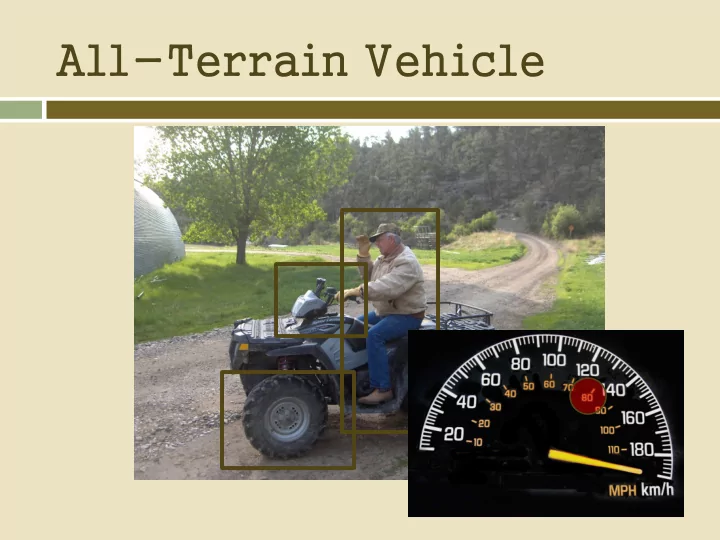
All-Terrain Vehicle
SLIDE 2
ATV adaptation by ranchers
Herding livestock Weed Spraying Mending Fences
SLIDE 3
Common ATV Fatality/Injury Events
SLIDE 4 Injuries and Fatalities
The steady increase in ATV use
increase in preventable ATV injuries and deaths:
An estimated 400,000 injuries and
800 deaths occur on ATV's each year in the U.S (GAO 2010).
SLIDE 5
Injuries and Fatalities
1992—2007
ATV deaths increased ~275%
(From 11 deaths to 41 deaths)
Fatality rate per 1 Million
workers increased ~300% (0.07 in 1992 vs. 0.28 in 2007) *This rate is conservative
SLIDE 6
Injuries and Fatalities - Agriculture
A disproportionate number of incidents at the agricultural: Comprise 65% of fatalities while representing only 20% of riders (Helmkamp, et al., 2009).
SLIDE 7
Injuries and Fatalities - Agriculture
workers age 18+ in the agriculture production industry accounted for the largest number and had the highest rate of ATV-related deaths compared to any other industry sector
SLIDE 8 potential factors associated
with accidents and injuries
Factors including speed, pitch
and roll are associated with loss
- f control events (Carman et al.,
2010).
ATV characteristics such as high
center of gravity and short wheel base.
SLIDE 9 The Training
Pre use check Operator preparedness components Maintenance issues Awareness about differences in ATV
makes and models
Identification of hazards in
loading, unloading, trailer towing, winch operation, and securing of ATVs
SLIDE 10 The Training
Bailout performance Personal protective equipment
requirements
Operation skills: safe turns,
climbing and descending hills, navigating obstacles, water crossing, scanning and evaluation techniques
SLIDE 11
Formal, Hands-on ATV Rider Training Provided by the ATV Safety Institute The Training
SLIDE 12 General ATV Safety
ATVs have operator age limitations—
Observe Them
Keep a well-maintained ATV - do a
safety inspection each time it is used
Fit the ATV to the task. A smaller
machine is easier to move by hand if necessary
Always lean your body uphill to
prevent tipping and flipping. Stand up and really lean into the hill
SLIDE 13 General ATV Safety
Be extra careful if you have a load
(front or back)
Before dismounting stop ATV
completely (preferably on a level surface), set brake, and shift into park.
Keep an eye out for new
environmental hazards like rocks, logs, sinkholes, ice patches, etc.
SLIDE 14 ATV and Animal handling
Approach at low speeds to avoid
startling the animals.
If animals are causing you
frustration, don’t act on it,
- therwise, you’ll overlook
hazards.
Use caution when making sharp
turns at higher speeds. Animals can always cut sharper corners than a vehicle.
SLIDE 15 ATV and Animal handling
Standing on the foot rests may make
you appear larger and more imposing to the animals and invite less resistance.
Don’t ride alone; Be aware of all
riders’ whereabouts. If you’re moving animals, use ATVs alongside horses, dogs, trucks, etc.
Communicate with others on ATVs or
- horses. Use hand signals, radios, etc.
SLIDE 16 Spraying with ATVs
Don’t use an inferior spray system. Keep weight balanced -lowest
practical center of gravity. (Sloshing liquid can significantly change ATV handling.)
Use a spray tank that has internal
- baffles. This will reduce liquid
surges and improve overall stability when turning on slopes or hills.
SLIDE 17 Spraying with ATVs
Choose booms that can be
- perated as low to the ground as
possible or use a nozzle sprayer.
ATVs should only be fitted with
rear-mounted spray booms or
- ther equipment to reduce the
risk of pesticide exposure.
SLIDE 18 Spraying with ATVs
Don’t ride and spray when using a
- wand. If you’re using this setup,
make sure the ATV isn’t moving while you’re spraying.
Do not drag your spray hose to
avoid losing control of the ATV.
SLIDE 19 Spraying with ATVs
Only use the speed that you need—the optimal speed for good spray distribution is probably slower than you’d like. hi highe her s r speeds m s mean great ater r chan ances s of f miss issing y your t targ arget, and nd wor
pos
ibly ly l los
ing co control o
the ATV TV.
.
SLIDE 20 Fencing with ATVs
Use a trailer to transport heavy
loads of posts and tools instead
- f stacking too much weight onto
the ATV.
If you know you’re going to have
to build or replace a lot of fence, take the pick-up truck or make multiple trips.
SLIDE 21 Fencing with ATVs
Secure fencing tools and
materials.
Watch your speed—high speeds
mean higher chances of losing control, especially if you’re carrying extra weight.
SLIDE 22 Personal Protective Equipment
Use protective gear—
A motorcycle helmet A pair of glasses, goggles or face
shield
All will help reduce the risk of
injury as well as keep dust and debris out of your eyes.
SLIDE 23 Expected Outcomes
increased awareness of ATV
safety issues
Alteration of behavior
SLIDE 24
Thank You