
Algoritmi di Bioinformatica
Zsuzsanna Lipt´ ak
Laurea Magistrale Bioinformatica e Biotechnologie Mediche (LM9) a.a. 2014/15, spring term
Computational efficiency I
2 / 18
Computational Efficiency
As we will see later in more detail, the efficiency of algorithms is measured w.r.t.
- running time
- storage space
We will make these concepts more concrete later on, but for now want to give some intuition, using an example.
3 / 18
Example: Computation of nth Fibonacci number
Fibonacci numbers: model for growth of populations (simplified model)
- Start with 1 pair of rabbits in a field
- each pair becomes mature at age of 1 month and mates
- after gestation period of 1 month, a female gives birth to 1 new pair
- rabbits never die1
Definition
F(n) = number of pairs of rabbits in field at the beginning of the n’th month.
1This unrealistic assumption simplifies the mathematics; however, it turns out that
adding a certain age at which rabbits die does not significantly change the behaviour of the sequence, so it makes sense to simplify.
4 / 18
Computation of nth Fibonacci number
- month 1: there is 1 pair of rabbits in the field
F(1) = 1
- month 2: there is still 1 pair of rabbits in the field
F(2) = 1
- month 3: there is the old pair and 1 new pair
F(3) = 1 + 1 = 2
- month 4: the 2 pairs from previous month, plus
the old pair has had another new pair F(4) = 2 + 1 = 3
- month 5: the 3 from previous month, plus
the 2 from month 3 have each had a new pair F(5) = 3 + 2 = 5
Recursion for Fibonacci numbers
F(1) = F(2) = 1 for n > 2: F(n) = F(n − 1) + F(n − 2).
5 / 18
Computation of nth Fibonacci number
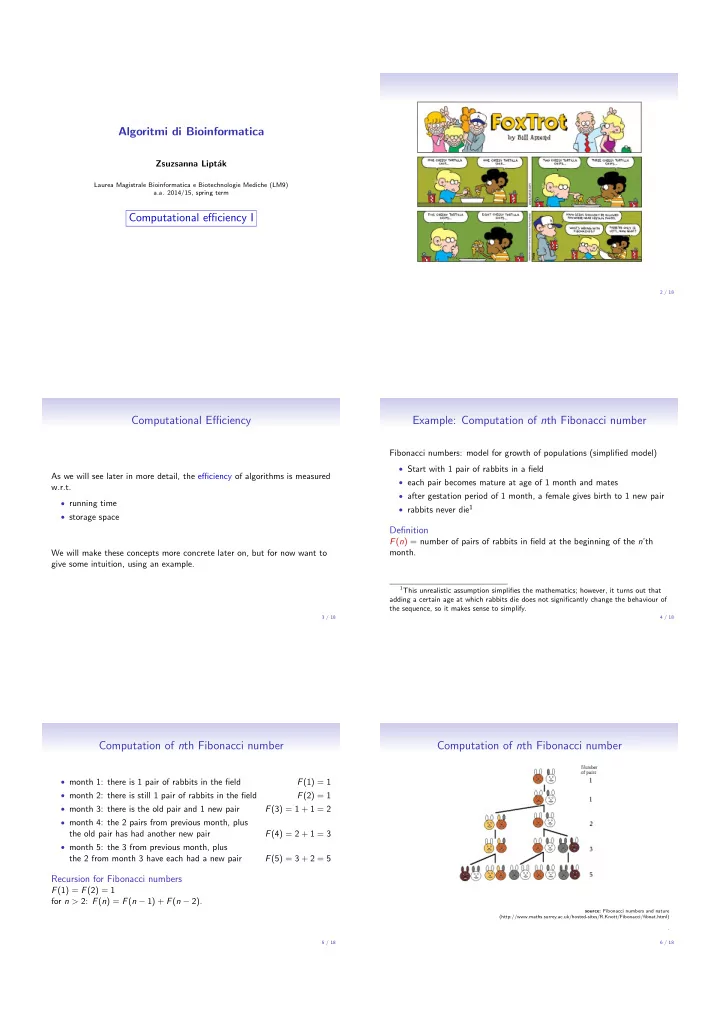
source: Fibonacci numbers and nature (http://www.maths.surrey.ac.uk/hosted-sites/R.Knott/Fibonacci/fibnat.html) . 6 / 18