ALGEBRAIC TRANSVERSALITY ANDREW RANICKI (Edinburgh) - - PDF document

algebraic transversality
SMART_READER_LITE
LIVE PREVIEW

ALGEBRAIC TRANSVERSALITY ANDREW RANICKI (Edinburgh) - - PDF document

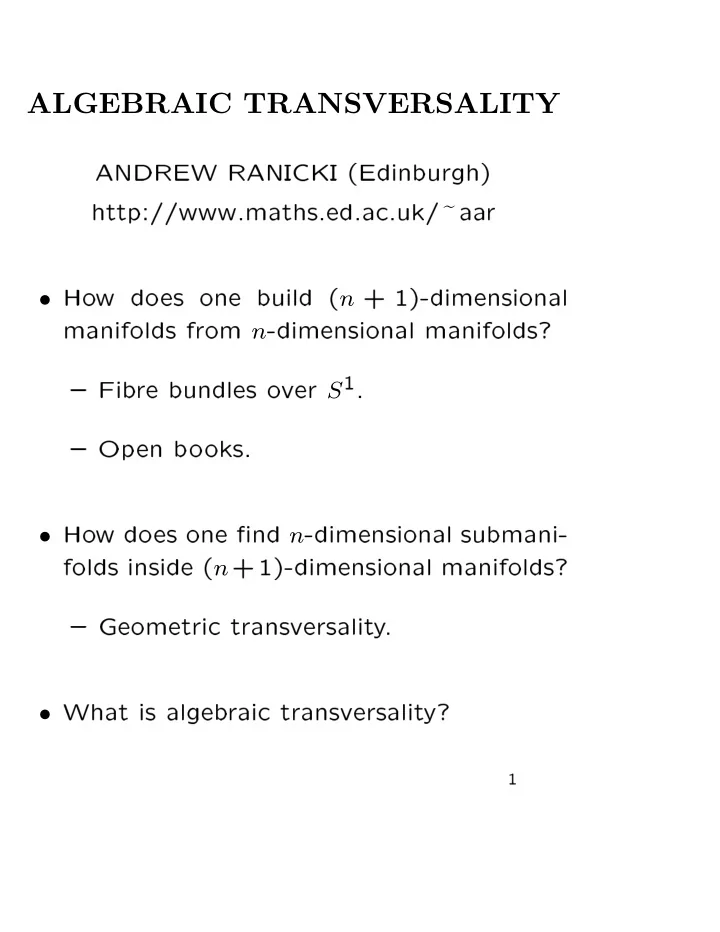
ALGEBRAIC TRANSVERSALITY ANDREW RANICKI (Edinburgh) http://www.maths.ed.ac.uk/ aa r Ho w do es one build ( n + 1)-dimensional manifolds from n -dimensional manifolds? 1 Fib re bundles over S . { Op en b o oks. {


slide-1
SLIDE 1

ALGEBRAIC TRANSVERSALITY

ANDREW RANICKI (Edinburgh) http://www.maths.ed.ac.uk/ aa r
  • Ho
w do es
  • ne
build (n + 1)-dimensional manifolds from n-dimensional manifolds? { Fib re bundles
  • ver S
1 . { Op en b
  • ks.
  • Ho
w do es
  • ne
nd n-dimensional submani- folds inside (n + 1)-dimensional manifolds? { Geometric transversalit y .
  • What
is algeb raic transversalit y? 1
slide-2
SLIDE 2 Time scale
  • 2-
and 3-dimensional manifolds : 1900 {
  • Algeb
raic va rieties : 1920 {
  • Algeb
raic K
  • and L
  • theo
ry : 1940 {
  • High-dimensional
manifolds : 1960 {
  • 3-
and 4-dimensional manifolds, TQFT : 1980 { 2
slide-3
SLIDE 3 Aims
  • 1
: Give homological criterion
  • n
a high- dimensional manifold M which is neces- sa ry and sucient to decomp
  • se M
as a b re bundle
  • ver S
1 . { Algeb raic K
  • theo
ry
  • f
chain complexes.
  • 2
: Lik ewise fo r
  • p
en b
  • k
decomp
  • sition.
{ Algeb raic L
  • theo
ry
  • f
chain complexes with P
  • inca
r
  • e
dualit y . 3
slide-4
SLIDE 4 Fib re bundles
  • ver S
1
  • The
mapping to rus
  • f
a map h : F → F is the identication space

T

(h ) = (F × [0, 1])/ ∼ with (x, 0) ∼ (h (x ), 1).
  • If F
is a closed n-dimensional manifold and

h

is an automo rphism then T (h ) is a closed (n + 1)-dimensional manifold which is a b re bundle
  • ver S
1 , with p rojection

T

(h ) → [0, 1]/(0 ∼ 1) = S 1 ; [x, t ] → [t ] . 4
slide-5
SLIDE 5 Brief histo ry
  • f
b re bundles
  • ver S
1
  • Stallings
(1961) : a sucient group- and homotop y-theo retic criterion fo r a 3-dimensional manifold M to b re
  • ver S
1 .
  • Bro
wder and Levine (1964) (π 1 (M ) = Z ) and F a rrell (1970) (any π 1 (M )) : necessa ry and sucient conditions fo r an n-dimensional manifold M to b re
  • ver S
1 , fo r n ≥ 6 : { a nitely dominated innite cyclic cover M , { the vanishing
  • f
the Whitehead to rsion

τ

= τ (M → T (ζ )) ∈ Wh (π 1 (M )) with ζ : M → M generating covering translation.
  • Novik
  • v,
F a rb er and P azhitnov (1981{ ) :

S

1
  • valued
Mo rse theo ry . 5
slide-6
SLIDE 6 F redholm lo calization
  • A
= ring.
  • A[z, z−
1 ] = Laurent p
  • lynomial
extension.
  • Denition
: A squa re matrix ω in A[z, z− 1 ] is F redholm if cok er (ω ) is a f.g. p rojective

A-mo

dule.
  • Example
: ω = 1 − z is F redholm.
  • Denition
:
  • =
F redholm matrices in A[z, z− 1 ]. − 1A[z, z− 1 ] = the noncommutative lo cal- ization
  • f A[z, z−
1 ] inverting each ω ∈ .
  • Example
: if A = K is a eld then − 1A[z, z− 1 ] = K (z ) is the function eld.
  • K
1 (− 1A[z, z− 1 ]) = K 1 (A[z, z− 1 ])⊕Aut (A). 6
slide-7
SLIDE 7 Recognizing b re bundles homologically
  • M
= compact n-dimensional manifold with innite cyclic cover M , such that

π

1 (M ) = π × Z , π 1 (M ) = π .
  • A
= Z [π ] , A[z, z− 1 ] = Z [π × Z ] .
  • Theo
rem 1 M is nitely dominated if and
  • nly
if H∗ (M ; − 1A[z, z− 1 ]) = 0.
  • Theo
rem 2 If n ≥ 6 then M is a b re bundle
  • ver S
1 if and
  • nly
if M is nitely dominated with − 1A[z, z− 1 ]-co ecient Reidemeister-Whitehead to rsion (= F a rrell
  • bstruction)
is 0, that is

τ

(M ; − 1A[z, z− 1 ]) =

∈ K

1 (− 1A[z, z− 1 ])/({±(π × Z )} ⊕ Aut (A)) = Wh (π × Z ) . 7
slide-8
SLIDE 8 Op en b
  • ks
  • The
relative mapping to rus
  • f
an automo rphism
  • f
an n-dimensional manifold with b
  • unda
ry

h

: (F, ∂F ) → (F, ∂F ) with h|∂F = id. is the closed (n + 1)-dimensional manifold

t

(h ) = T (h ) ∪∂F×S 1 ∂F × D 2 .
  • A
closed (n + 1)-dimensional manifold

M

has an
  • p
en b
  • k
decomp
  • sition
if

M

= t (h ) fo r some h .
  • Example
: fo r a b red knot k : Sn− 1 ⊂ Sn +1

Sn

+1 = t (h ), with h the mono dromy
  • f
the Seifert surface F n ⊂ Sn +1 , ∂F = k (Sn− 1 ).
  • Note
:
  • p
en b
  • k
= b re bundle
  • ver S
1 if

∂F

= ∅. 8
slide-9
SLIDE 9 Brief histo ry
  • f
  • p
en b
  • ks
  • Alexander
(1923) : every 3-dimensional manifold has an
  • p
en b
  • k
decomp
  • sition.
  • Wink
elnk emp er (1972) : fo r n ≥ 7 a simply- connected n-dimensional manifold has an
  • p
en b
  • k
decomp
  • sition
if and
  • nly
if signature(M ) = 0 ∈ Z .
  • Quinn
(1979) : non-simply-connected
  • bstruction
theo ry in dimensions ≥ 5 to the existence and uniqueness
  • f
  • p
en b
  • k
decomp
  • sitions
: { asymmetric Witt
  • bstruction
in even dimensions, { no
  • bstruction
in
  • dd
dimensions. 9
slide-10
SLIDE 10 Recognizing
  • p
en b
  • ks
homologically
  • M
= compact n-dimensional manifold.
  • A
= Z [π 1 (M )] , A[z, z− 1 ] = Z [π 1 (M × S 1 )] .
  • Theo
rem 3 If n ≥ 6 then M has an
  • p
en b
  • k
decomp
  • sition
if and
  • nly
if the − 1A[z, z− 1 ]-co ecient symmetric signature (= Quinn
  • p
en b
  • k
  • bstruction)
is

σ∗

(M ; − 1A[z, z− 1 ]) = 0 ∈ Ln (− 1A[z, z− 1 ]) .
  • A
manifold
  • f
dimension ≥ 6 has an
  • p
en b
  • k
decomp
  • sition
if and
  • nly
if it is π 1
  • b
  • rdant
to a b re bundle
  • ver S
1 . 10
slide-11
SLIDE 11 Algeb raic K
  • theo
ry transversalit y
  • Co
dimension 1 geometric transversalit y : { every innite cyclic cover
  • f
a compact manifold has a compact fundamental domain.
  • Co
dimension 1 algeb raic transversalit y : { every nite f.g. free A[z, z− 1 ]-mo dule chain complex C has an algeb raic fun- damental domain, with a chain equiva- lence

C

(f − zg : D [z, z− 1 ] → E [z, z− 1 ]) fo r A-mo dule chain maps f, g : D → E . (Higman (1940), W aldhausen (1972))
  • K
1 (A[z, z− 1 ]) = K 1 (A)⊕K (A)⊕ 2 Nil (A) . (Bass, Heller & Sw an (1965)) 11
slide-12
SLIDE 12 Algeb raic P
  • inca
r
  • e
complexes
  • A
= ring with involution a → a .
  • An n-dimensional
algeb raic P
  • inca
r
  • e
complex
  • ver A
is an A-mo dule chain complex C with a symmetric chain equivalence

φ ≃ φ∗

: Cn−∗ = HomA (C, A)n−∗ → C inducing dualit y Hn−∗ (C ) ∼ = H∗ (C ).
  • Simila
rly fo r pairs, cob
  • rdism.
  • Ln
(A) = cob
  • rdism
group
  • f n-dimensional
algeb raic P
  • inca
r
  • e
complexes
  • ver A.
  • Simila
r description
  • f
W all surgery
  • bstruc-
tion groups Ln (A), using extra quadratic structure. Dierence in 2-p rima ry to rsion
  • nly
. 12
slide-13
SLIDE 13 Symmetric signature
  • The
symmetric signature
  • f
an n-dimensional P
  • inca
r
  • e
space M is

σ∗

(M ) = (C (

M

), φ ) ∈ Ln (Z [π 1 (M )]) with

M

the universal cover
  • f M
and

φ

= [M ] ∩ − (Mishchenk
  • (1974)).
  • Homotop
y inva riant.
  • Bo
rdism inva riant

σ∗

: n (K ) → Ln (Z [π 1 (K )]) ; M → σ∗ (M ) .
  • Example
: fo r n = 4k

σ∗

(M ) = signature(M ) ∈ L 4k (Z ) = Z . 13
slide-14
SLIDE 14 Algeb raic L
  • theo
ry transversalit y
  • The
asymmetric L
  • groups
  • f
a ring with involution A a re the cob
  • rdism
groups
  • f
pairs (C, λ ) with C an n-dimensional f.g. free A-mo dule chain complex and

λ

: Cn−∗ → C a chain equivalence.
  • The
asymmetric L
  • groups
a re fo r
  • dd n.
  • Theo
rem 4 The symmetric L
  • groups

Ln

(− 1A[z, z− 1 ])
  • f
F redholm lo calization (with z = z− 1 ) a re isomo rphic to the asymmetric L
  • groups
  • f A.
14
slide-15
SLIDE 15 Manifold transversalit y
  • T
rue.
  • The
b
  • rdism
group n (X )
  • f
maps

Mn

= n-dimensional manifold → X is a generalized homology theo ry .
  • K
unneth fo rmula n (K × S 1 ) = n (K ) ⊕ n− 1 (K )
  • Co
dimension 1 transversalit y: every map

f

: Mn → K × S 1 homotopic to
  • ne
with

Nn−

1 = f− 1 (K × pt.) ⊂ Mn a co dimension 1 submanifold.
  • An
innite cyclic cover
  • f
a compact man- ifold has a compact manifold fundamental domain. 15
slide-16
SLIDE 16 P
  • inca
r
  • e
space transversalit y
  • F
alse in general { same
  • bstructions
as fo r algeb raic P
  • inca
r
  • e
complex transversalit y .
  • A
nite n-dimensional P
  • inca
r
  • e
space P is a nite CW complex with

Hn−∗

(P ) ∼ = H∗ (P ) .
  • The
b
  • rdism
group h

n

(X )
  • f
maps P → X is not a generalized homology theo ry .
  • h

n

(K × S 1 ) = h

n

(K ) ⊕ p

n−

1 (K ) with p

(K ) the b
  • rdism
group
  • f
nitely dominated P
  • inca
r
  • e
spaces with map to K .
  • An
innite cyclic cover
  • f
a nite P
  • inca
r
  • e
space has a nitely dominated fundamental domain. 16
slide-17
SLIDE 17 References
  • Lo
w er K
  • and L
  • theo
ry LMS Lecture Notes 178, Camb ridge (1992)
  • Finite
domination and Novik
  • v
rings T
  • p
  • logy
34, 619{632 (1995)
  • The
b
  • rdism
  • f
automo rphisms
  • f
manifolds from the algeb raic L
  • theo
ry p
  • int
  • f
view Pro c. 1994 Bro wder Conference, Ann.
  • f
Maths. Studies 138, 314{327, Princeton (1996)
  • (with
B. Hughes) Ends
  • f
complexes T racts in Mathematics 123, Camb ridge (1996) 17