On Projective Module with unique Maximal Submodule The 51th Ring - - PowerPoint PPT Presentation

on projective module with unique maximal submodule
SMART_READER_LITE
LIVE PREVIEW

On Projective Module with unique Maximal Submodule The 51th Ring - - PowerPoint PPT Presentation

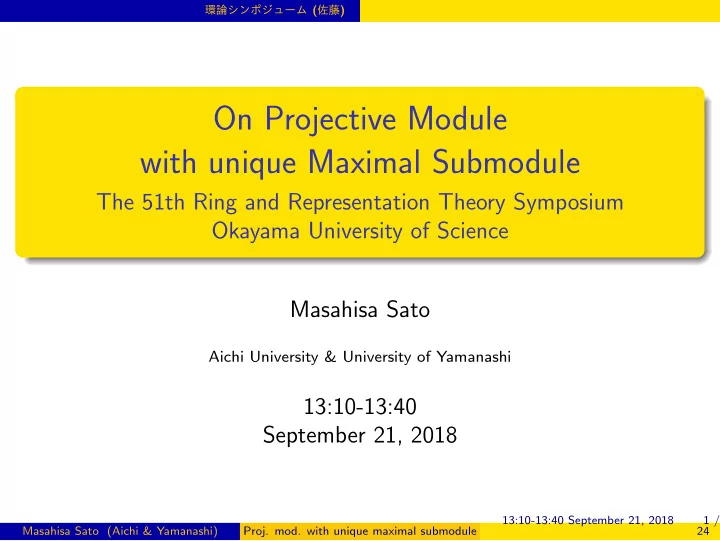
( ) On Projective Module with unique Maximal Submodule The 51th Ring and Representation Theory Symposium Okayama University of Science Masahisa Sato Aichi University & University of Yamanashi 13:10-13:40


slide-1
SLIDE 1

環論シンポジューム (佐藤)

On Projective Module with unique Maximal Submodule

The 51th Ring and Representation Theory Symposium Okayama University of Science Masahisa Sato

Aichi University & University of Yamanashi

13:10-13:40 September 21, 2018

Masahisa Sato (Aichi & Yamanashi)

  • Proj. mod. with unique maximal submodule

13:10-13:40 September 21, 2018 1 / 24

slide-2
SLIDE 2

環論シンポジューム (佐藤)

The English version of this lecture was presented in ICRA2018 as follows; On Projective Module with unique Maximal Submodule 18th International Conference On Representations of Algebras (ICRA 2018) Faculty of Civil Engineering, Czech Technical University Prague (Czech Republic) August 13-17, 2018. This lecture will be done in Japanese. So please ask your neighbors in case you do not understand Japanese.

Masahisa Sato (Aichi & Yamanashi)

  • Proj. mod. with unique maximal submodule

13:10-13:40 September 21, 2018 2 / 24

slide-3
SLIDE 3

Ware’s Problem on Projective modules

Ware’s Problem Ware’s Problem

Let R be a ring and P a projective right R-module with unique maximal submodule L, then L is the largest maximal submodule of P. R.Ware Endomorphism rings of projective modules, Trans. Amer.

  • Math. Soc. 155 (1971), 233-256.

Original Problem: EndR(PR) is local ring ?

(i.e.) P is completely indecomposable.

Masahisa Sato (Aichi & Yamanashi)

  • Proj. mod. with unique maximal submodule

13:10-13:40 September 21, 2018 3 / 24

slide-4
SLIDE 4

Ware’s Problem on Projective modules

Purpose Purpose Giving affirmative answer for this problem.

Masahisa Sato (Aichi & Yamanashi)

  • Proj. mod. with unique maximal submodule

13:10-13:40 September 21, 2018 4 / 24

slide-5
SLIDE 5

Ware’s Problem on Projective modules

Key facts

Key facts W.K. Nicholson, M.F. Yousif, Quasi-Frobenius Rings, Cambridge University Press (2002). F.W. Anderson, K.R. Fuller, Rings and Categories of Modules, GTM 13, Springer-Verlag (1992). Key facts to solve Ware’s problem: (1) Any projective module has a maximal submodule. This is equivalent to the following fact. (2) If PJ(R) = P for a projective module P, then P = 0.

Masahisa Sato (Aichi & Yamanashi)

  • Proj. mod. with unique maximal submodule

13:10-13:40 September 21, 2018 5 / 24

slide-6
SLIDE 6

Ware’s Problem on Projective modules

Remark

Remark If P is finitely generated projective R-module, then the following conditions are equivalent.

1

P = eR for some local idempotent e ∈ R.

2

EndR(P) is local ring. (i.e.) P is completely indecomposable.

3

P has unique maximal submodule.

4

P has the largest maximal submodule.

Masahisa Sato (Aichi & Yamanashi)

  • Proj. mod. with unique maximal submodule

13:10-13:40 September 21, 2018 6 / 24

slide-7
SLIDE 7

Notations

Primitive rings and ideals

Definition 1 R is right primitive ring if R has a faithful simple right R-module. A two sided ideal T of R is a primitive right ideal if R/T is a primitive right ring. An (right) annihilator of S of MR is denoted by AnnR(S) = {r ∈ R |Sr = 0}.

Masahisa Sato (Aichi & Yamanashi)

  • Proj. mod. with unique maximal submodule

13:10-13:40 September 21, 2018 7 / 24

slide-8
SLIDE 8

Notations

Jacobson radical and primitive right ideal

  • 1. The Jacobson radical J(R)

1

The intersection of all maximal right ideals of R

2

The intersection of all primitive right ideals of R

  • 2. What is a primitive right ideal T

1

A faithful simple right R/T-module R/J is given by the form T = AnnR(R/J).

2

T is maximal on two sided ideals included in the above J.

3

T = ∩

I∈Γ

I = ∩

I∈∆

I Γ = { maximal right ideals I with T ⊂ I } ∆ = { maximal right ideals I with R/J ∼ = R/I }

Masahisa Sato (Aichi & Yamanashi)

  • Proj. mod. with unique maximal submodule

13:10-13:40 September 21, 2018 8 / 24

slide-9
SLIDE 9

Preliminary Lemmas

Basic facts

We keep the follwing notations in this lecture. P is a projective right R-module with unique maximal submodule L J is a maximal right ideal such that P/L ∼ = R/J K = AnnR(R/J)

Masahisa Sato (Aichi & Yamanashi)

  • Proj. mod. with unique maximal submodule

13:10-13:40 September 21, 2018 9 / 24

slide-10
SLIDE 10

Preliminary Lemmas

Basic facts

Lemma 1

1

K is maximal among two sided ideals included in J.

2

PK ⊂ L.

3

PI = P for any maximal right ideal I such that R/I ̸∼ = R/J, PI = P for any primitive right ideal I ̸= K.

4

T = ∩

Iγ∈Γ

Iγ, then PT = ∩

Iγ∈Γ

PIγ. (Γ is a set of two sided ideals.)

5

I∈Γ

PI = PJ(R). (Γ is the set of primitive right ideals. )

6

L ⊃ PK = PJ(R).

Masahisa Sato (Aichi & Yamanashi)

  • Proj. mod. with unique maximal submodule

13:10-13:40 September 21, 2018 10 / 24

slide-11
SLIDE 11

Preliminary Lemmas

Example

In the R.Ware’s problem, the assumption ”projective” is necessary. In fact, we give an example of a ring and a module with unique maximal submodule but not largest submodule.

Masahisa Sato (Aichi & Yamanashi)

  • Proj. mod. with unique maximal submodule

13:10-13:40 September 21, 2018 11 / 24

slide-12
SLIDE 12

Preliminary Lemmas

Example

Example 1 K is a field R is a K-algebra with bases {vx |0 ≤ x ≤ 1} the multiplication vx · vy = vxy.

1

R is a uniserial commutative ring.

2

The ideals of R: Ji (0 ≤ i ≤ 1) with K-bases {vx |0 ≤ x < i} Ji with K-bases {vx |0 ≤ x ≤ i}. Closure ideal of Ji.

Masahisa Sato (Aichi & Yamanashi)

  • Proj. mod. with unique maximal submodule

13:10-13:40 September 21, 2018 12 / 24

slide-13
SLIDE 13

Preliminary Lemmas

Example

An R-module M = (R ⊕ J1)/K{(v0, 0) − (0, v0)} has unique maximal but not largest submodule. In fact,

1

An R-module L = (J1 ⊕ J1)/K{(v0, 0) − (0, v0)} is unique maximal submodule of M.

2

T = (J 1

2 ⊕ R)/K{(v0, 0) − (0, v0)}

is a submodule of M not included in L.

3

There is no maximal submodule of M which include T.

Masahisa Sato (Aichi & Yamanashi)

  • Proj. mod. with unique maximal submodule

13:10-13:40 September 21, 2018 13 / 24

slide-14
SLIDE 14

Structure Theorem

Decomposition

Proposition 2 Let M be a right R-module with unique maximal submodule L. Then

1

M is indecomposable

  • r

2

There are direct summands M1 and M2 such that M = M1 ⊕ M2, M1 has unique maximal submodule, M2 does not have any maximal submodules. Remark 3 By the former example, both cases in the above proposion happen.

Masahisa Sato (Aichi & Yamanashi)

  • Proj. mod. with unique maximal submodule

13:10-13:40 September 21, 2018 14 / 24

slide-15
SLIDE 15

Structure Theorem

Decomposition proj.

Take a projective module M = P, then we have the following proposition. Corollary 4 Let P be a projective right R-module with unique maximal submodule L. Then

1

P is indecomposable

  • r

2

There are direct summands P1 and P2 such that P = P1 ⊕ P2, P1 has unique maximal submodule, P2 does not have any maximal submodules. We show the second case does not happen.

Masahisa Sato (Aichi & Yamanashi)

  • Proj. mod. with unique maximal submodule

13:10-13:40 September 21, 2018 15 / 24

slide-16
SLIDE 16

Structure Theorem

Generalized Nakayama-Azumaya Lemma

Theorem 5 A nonzero projective module has a maximal submodule. Remark 6 In the proof of the above theorem, we use Axiom choice. Also we can show this part by using Zorn’s Lemma. The above theorem is equivalent to the following property. Theorem 7 Let P be a projective module. Then PJ(R) = P implies P = 0.

Masahisa Sato (Aichi & Yamanashi)

  • Proj. mod. with unique maximal submodule

13:10-13:40 September 21, 2018 16 / 24

slide-17
SLIDE 17

Structure Theorem

Generalized Nakayama-Azumaya Lemma

Reviewing my proof. What did I proved ? The following theorem seems to be proved. Theorem 8 (Generalized Nakayama-Azumaya Lemma) Let M be a direct summand of a direct sum of finitely generated

  • modules. Then MJ(R) = M implies M = 0.

Masahisa Sato (Aichi & Yamanashi)

  • Proj. mod. with unique maximal submodule

13:10-13:40 September 21, 2018 17 / 24

slide-18
SLIDE 18

Structure Theorem

Indecomposablity

Theorem 9 Let R be a ring and P a projective right R-module with unique maximal submodule L, then P is indecomposable.

Masahisa Sato (Aichi & Yamanashi)

  • Proj. mod. with unique maximal submodule

13:10-13:40 September 21, 2018 18 / 24

slide-19
SLIDE 19

Structure Theorem

Example of Hinohara

An example of infinitely generated indecomposable projective module P is introduced in

  • S. Hinohara, Projective modules II, The sixth proceeding of Japan

algebraic symposium (Homological algebra and its applications), Vol.6 (1964), 24―28. We review this example and we can show that PJ = P only for one maximal right ideal J.

Masahisa Sato (Aichi & Yamanashi)

  • Proj. mod. with unique maximal submodule

13:10-13:40 September 21, 2018 19 / 24

slide-20
SLIDE 20

Structure Theorem

Example of Hinohara

Example 2 R : A commutative ring consisting of continuous real functions with the domain [0, 1]. Maximal ideals : mx = {f ∈ R| f (x) = 0}, (x ∈ [0, 1]) Px : An ideal consisting of f ∈ R with f (t) = 0 for some neighborhood of x Then

1

Px is infinitely generated indecomposable projective R-module by S.Hinohara.

2

It is countably generated by Kaplanski.

3

Px does not have a simple factor module isomorphic to R/mx

4

Px has a simple factor module isomorphic to R/my for any y ̸= x (since Pxmx = Px and Pxmy ̸= Px.)

Masahisa Sato (Aichi & Yamanashi)

  • Proj. mod. with unique maximal submodule

13:10-13:40 September 21, 2018 20 / 24

slide-21
SLIDE 21

The solution of Ware’s problem

A reduced generator set

An indecomposabel projective module is countably generated by I. Kaplansky, Projective modules, Ann. of Math. Vol.68 (1958), 372–377. Definition 2 Let {a1, a2, · · · } be a generator set of P. This set is called a reduced generator set if it satisfies an+1 ̸∈ a1R + a2R + · · · + anR for any n.

Masahisa Sato (Aichi & Yamanashi)

  • Proj. mod. with unique maximal submodule

13:10-13:40 September 21, 2018 21 / 24

slide-22
SLIDE 22

The solution of Ware’s problem

A reduced generator set

Lemma 10 Let P be an indecomposable projective R-module. For any nonzero element a ∈ P, there is a reduced generator set such that a = a1. Lemma 11 Let P be a projective right R-module with a maximal submodule L, then we can take a reduced generator set {a1, a2, · · · } of P such that a1 ̸∈ L and ai ∈ L (i ≥ 2).

Masahisa Sato (Aichi & Yamanashi)

  • Proj. mod. with unique maximal submodule

13:10-13:40 September 21, 2018 22 / 24

slide-23
SLIDE 23

The solution of Ware’s problem

Ware’s problem is true

Theorem 12 Let R be a ring and P a projective right R-module with unique maximal submodule L, then P is isomorphic to eR for some local idempotent e ∈ R. Particularly L is the largest maximal submodule of P and L = eJ(R). This is proved by considering M = a1R + a3R + · · · and P/M for some reduced generating set {a1, a2, · · · } such that a1 ̸∈ L, ai ∈ L (i > 1) and M ̸= P.

Masahisa Sato (Aichi & Yamanashi)

  • Proj. mod. with unique maximal submodule

13:10-13:40 September 21, 2018 23 / 24

slide-24
SLIDE 24

References

References

[1] F.W. Anderson, K.R. Fuller, Rings and Categories of Modules, GTM 13, Springer-Verlag (1992). [2] I.N. Hernstein, Noncommutative Rings, The Carus Mathematics Monographs 15, The Mathematical Association of America, (1968). [3] S. Hinohara, Projective modules II, The sixth proceeding of Japan algebraic symposium (Homological algebra and its applications), Vol.6 (1964), 24–28. [4] I. Kaplansky, Projective modules, Ann. of Math. Vol.68 (1958), 372–377. [5] I. Kaplansky, Fields and Rings, The university of Chicago Press, Chixago (1969). [6] W.K. Nicholson, M.F. Yousif, Quasi-Frobenius Rings, Cambridge University Press (2002). [7] R. Ware, Endomorphism rings of projective modules, Trans.

  • Amer. Math. Soc. 155 (1971), 233–256.

Masahisa Sato (Aichi & Yamanashi)

  • Proj. mod. with unique maximal submodule

13:10-13:40 September 21, 2018 24 / 24
slide-25
SLIDE 25

References

Thank you for your attention !

Masahisa Sato (Aichi & Yamanashi)

  • Proj. mod. with unique maximal submodule

13:10-13:40 September 21, 2018 24 / 24