Algebra I Systems of Linear Equations and Inequalities 2015-04-23 - - PDF document

algebra i systems of linear equations and inequalities
SMART_READER_LITE
LIVE PREVIEW

Algebra I Systems of Linear Equations and Inequalities 2015-04-23 - - PDF document

Slide 1 / 179 Slide 2 / 179 Algebra I Systems of Linear Equations and Inequalities 2015-04-23 www.njctl.org Slide 3 / 179 Slide 4 / 179 Table of Contents Click on the topic to go to that section 8th Grade Review 8th Grade Review of


slide-1
SLIDE 1

Slide 1 / 179 Slide 2 / 179

www.njctl.org 2015-04-23

Algebra I Systems of Linear Equations and Inequalities

Slide 3 / 179

Teacher Note

Table of Contents

· Solving Systems by Graphing · Solving Systems by Substitution · Solving Systems by Elimination · Choosing your Strategy · Writing Systems to Model Situations · Solving Systems of Inequalities

Click on the topic to go to that section

· 8th Grade Review of Systems of Equations

Slide 4 / 179

8th Grade Review

Return to Table of Contents

Slide 5 / 179

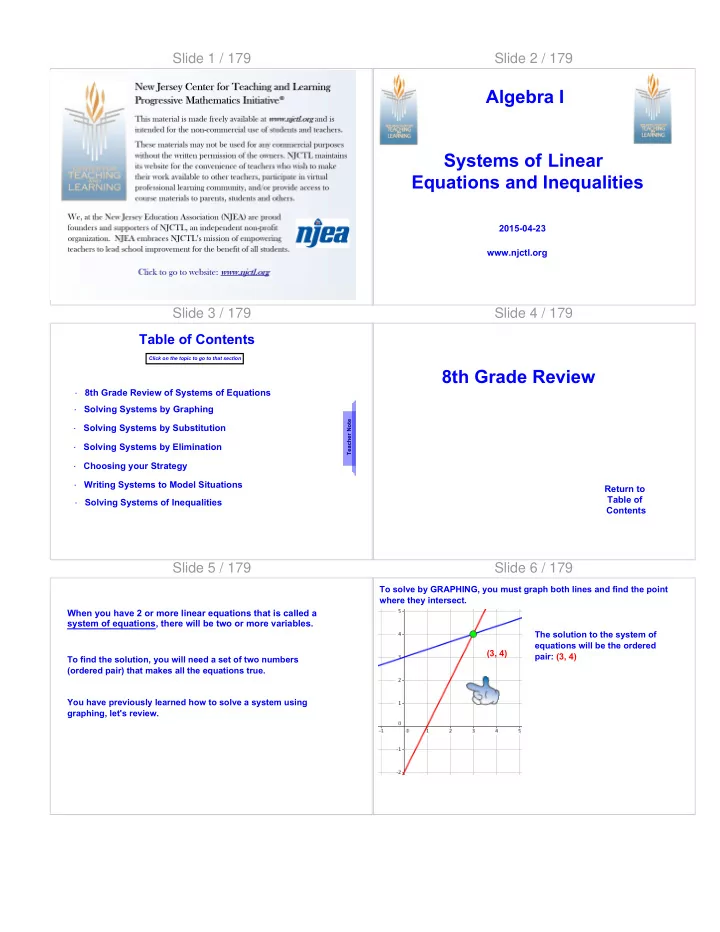
When you have 2 or more linear equations that is called a system of equations, there will be two or more variables. To find the solution, you will need a set of two numbers (ordered pair) that makes all the equations true. You have previously learned how to solve a system using graphing, let's review.

Slide 6 / 179

To solve by GRAPHING, you must graph both lines and find the point where they intersect. The solution to the system of equations will be the ordered pair: (3, 4) (3, 4)

slide-2
SLIDE 2

Slide 7 / 179

y = 2x + 3 y = -1x - 2 2 Example: Step 1: Graph both lines from slope-intercept form on the same coordinate plane Step 2: Write the intersection point as an ordered pair.

Slide 8 / 179

Given two sets of coordinate points that represent a system of linear equations, determine whether the lines intersect to given a solution to the system. Linear Equation 1: (1, 1) and (2, 3) Linear Equation 2: (1, -2) and (4, 4) Will the system of linear equations intersect into a solution?

Example Slide 9 / 179 Example

Decide if you will be able to find a solution to the system of equation just by inspecting. Do not try to solve algebraically. System: 6x + 3y = 10 6x + 3y = 5

Slide 9 (Answer) / 179 Example

Decide if you will be able to find a solution to the system of equation just by inspecting. Do not try to solve algebraically. System: 6x + 3y = 10 6x + 3y = 5

[This object is a pull tab]

Teacher Note

Discuss with the students how "6x + 3y" is identical in both

  • equations. "6x + 3y"

can not equal 10 and 5 at the same time. So, There can not be a solution found. Slide 10 / 179

Solving Systems by Graphing

Return to Table of Contents

Slide 11 / 179

A system of linear equations is two or more linear equations. The solution to a system of linear inequalities is the ordered pair that will satisfy both equations. One way to find the solution to a system is to graph the equations

  • n the same coordinate plane and find the point of intersection.

There are 3 different types of solutions that are possible to get when solving a system. They are easiest to understand by looking at the graph.

Vocabulary

Click here to watch a music video that introduces what we will learn about systems.

slide-3
SLIDE 3

Slide 12 / 179 Type 1: One Solution

This is the most common type of solution, it happens when two lines intersect in exactly ONE place The slopes of the lines will be DIFFERENT

Slide 13 / 179

y= 2x + 5 6x + 2y = 4

Compare the Slopes

m = 2

  • 6x - 6x

2y = -6x + 4 y = -3x + 2 2 2 2 m = -3 What did we find out about the slopes? So, how many solutions will there be?

Slide 14 / 179 Type 2: No Solution

This happens when the lines NEVER intersect! The lines will be PARALLEL. The slopes of the lines will be THE SAME The y-intercepts will be DIFFERENT

Slide 15 / 179

y= -5x + 4 10x + 2y = 6

Compare the Slopes and Y-Intercepts

m = -5

  • 10x - 10x

2y = -10x + 6 y = -5x + 3 2 2 2 m = -5 What did we find out about the slopes and the y-intercepts? So, how many solutions will there be? b = 4 b = 3

Slide 16 / 179 Type 3: Infinite Solutions

This happens when the lines overlap! The lines will be the SAME EXACT line! The slopes of the lines will be THE SAME The y-intercepts will beTHE SAME

Slide 17 / 179

y= 2x + 1

  • 4x + 2y = 2

Compare the Slopes and Y-Intercepts

m = 2 + 4x + 4x 2y = 4x + 2 y = 2x + 1 2 2 2 m = 2 What did we find out about the slopes and the y-intercepts? So, how many solutions will there be? b = 1 b = 1

slide-4
SLIDE 4

Slide 18 / 179 How can you quickly decide the number

  • f solutions a system has?

1 Solution Different slopes Different lines No Solution Same slope Different y-intercept Parallel Lines Infinitely Many Same slope Same y-intercept Same Line

Slide 19 / 179

1 How many solutions does the following system have: y = 2x - 7 y = 3x + 8 A 1 solution B no solution C infinitely many solutions

answer

Slide 20 / 179

2 How many solutions does the following system have: 3x - y = -2 y = 3x + 2 A 1 solution B no solution C infinitely many solutions

answer

Slide 21 / 179

3 How many solutions does the following system have: 3x + 3y = 8 y = x A 1 solution B no solution C infinitely many solutions 1 3

answer

Slide 22 / 179

4 How many solutions does the following system have: y = 4x 2x - 0.5y = 0 A 1 solution B no solution C infinitely many solutions

answer

Slide 23 / 179

5 How many solutions does the following system have: 3x + y = 5 6x + 2y = 1 A 1 solution B no solution C infinitely many solutions

answer

slide-5
SLIDE 5

Slide 24 / 179

Suppose you are walking to school. Your friend is 5 blocks ahead

  • f you. You can walk two blocks per

minute and your friend can walk one block per minute. How many minutes will it take for you to catch up with your friend?

Consider this... Slide 25 / 179

Time (min.) Friend's distance from your start (blocks) Your distance from your start (blocks) 5 1 6 2 2 7 4 3 8 6 4 9 8 5 10 10

First, make a table to represent the problem.

Solution Slide 26 / 179

Next, plot the points on a graph. Time (min.)

Blocks

Time (min.) Friend's distance from your start (blocks) Your distance from your start(blocks)

5 1 6 2 2 7 4 3 8 6 4 9 8 5 10 10

Solution Continued Slide 27 / 179

The point where the lines intersect is the solution to the system. Time (min.)

Blocks

(5,10) is the solution In the context of the problem this means after 5 minutes, you will meet your friend at block 10.

Solution Continued Slide 28 / 179 Graphing Lines

Recall from Algebra I that you need a minimum of two points to graph a line. Therefore, when solving a system of linear equations graphically, you will only need to plot two points for each equation.

Slide 29 / 179

Solve the system of equations graphically: y = 2x -3 y = x - 1

answer

Example

slide-6
SLIDE 6

Slide 30 / 179

Solve the following system by graphing: y = -3x + 4 y = x - 4

Example

answer

Slide 31 / 179

y = 4x + 6 y = -3x - 1 (-1, 2)

Checking Your Work

Given the graph below, what is the point of intersection? (move the hand!)

Slide 32 / 179

y = 4x + 6 2 = 4(-1) + 6 2 = -4 + 6 2 = 2 y = -3x - 1 2 = -3(-1) - 1 2 = 3 - 1 2 = 2 Now take the ordered pair we just found and substitute it into the equations to prove that it is a solution for BOTH lines. (-1, 2)

Checking Your Work Slide 33 / 179

6 Solve the following system by graphing: y = -x + 4 y = 2x + 1 A (3, 1) B (1, 3) C (-1, 3) D (1, -3)

Click for answer choices AFTER students have graphed the system answer

Slide 34 / 179

7 Solve the following system by graphing:

A (0,-1) B (0,0) C (-1, 0) D (0, 1)

Click for answer choices AFTER students have graphed the system

answer

Slide 35 / 179

8 Solve the following system by graphing: y = x + 3 A (0, 4) B (-4, 2) C (5, 6) D (2, 5)

answer

slide-7
SLIDE 7

Slide 36 / 179 Graphing Quickly

Recall from 8th grade that slope-intercept form of a linear equation is: y = mx + b Where m = the slope and b = the y-intercept If you transform linear equations not in slope-intercept form to slope-intercept form, graphing them will be quicker.

Slide 37 / 179

  • x + y = 2

+x +x y = x + 2 2x + y = 5

  • 2x -2 x

y = -2 x + 5

Example

Step 1: Rewrite the linear equation in slope-intercept form Solve the following system of linear equations by graphing: 2x + y = 5

  • x + y = 2

Slide 38 / 179

y-intercept = (0, 5) slope = -2 slope= (down 2, right 1) Step 2: Plot the y-intercept and use the slope to plot the second point

Solution Continued

y-intercept = (0, 2) slope = 1 slope= (up 1, right 1)

Slide 39 / 179

Step 3: Locate the Point of Intersection and check your work: (1, 3)

Solution Continued

y = x + 2 3 = 1 + 2 3 = 3 y = -2 x + 5 3 = -2(1) + 5 3 = -2 + 5 3 = 3

Slide 40 / 179

Solve the system of equations graphically: 2x + y = 3 x - 2y = 4 Step 1: Rewrite in slope-intercept form

Example

x - 2y = 4

  • x -x
  • 2y = -x + 4

2x + y = 3

  • 2x -2 x

y = -2 x + 3

  • 2
  • 2

y = x - 2 2 1

Slide 41 / 179 Solution Continued

Step 2: Plot y-intercept and use slope to plot second point Step 3: Locate the Point of Intersection and check your work: (2, -1) y-intercept = (0, 3) slope = -2 slope= (down 2, right 1) y-intercept = (0, -2) slope = slope= (up 1, right 2)

slide-8
SLIDE 8

Slide 42 / 179

Step 3: Locate the Point of Intersection and check your work: (2, -1)

Solution Continued

y = -2 x + 3

  • 1 = -2(2) + 3
  • 1 = -4 + 3
  • 1 = -1

Slide 43 / 179

9 What is the solution of the system of linear equations provided on the graph below?

A (0, 1) B (1, 0) C (2, 3) D (3, 2)

answer

Slide 44 / 179

10 Which graph below represents the solution to the following system of linear equations:

  • x + 2y = 2

3y = x + 6

A B C D

answer

Slide 45 / 179

11 Solve the following system by graphing:

A (3, 4) B (9, 2) C infintely many D no solution

Click for answer choices AFTER students have graphed the system

answer

Slide 46 / 179

Solve the system of equations graphically: y = 3x + 6 9x - 3y = -18 Step 1: Rewrite in slope-intercept form

Example

9x - 3y = -18

  • 9x -9x
  • 3y = -9x -18

y = 3x + 6

  • 3
  • 3

y = 3x + 6

Slide 47 / 179 Solution Continued

Step 2: Plot y-intercept and use slope to plot second point Step 3: Locate the Point of Intersection and check your work: infinite amount of points: infinite solutions y-intercept = (0, 6) slope = 3 slope= (up 3, right 1) y-intercept = (0, 6) slope = 3 slope= (up 3, right 1) y = 3x + 6 y = 3x + 6

slide-9
SLIDE 9

Slide 48 / 179

Solve the system of equations graphically: 4x - 2y = 10 8x - 4y = 12 Step 1: Rewrite in slope-intercept form

Example

8x - 4y = 12

  • 8x -8x
  • 4y = -8x +12

4x - 2y = 10

  • 4x -4x
  • 2y = -4x + 10
  • 2 -2

y = 2x - 5

  • 4
  • 4

y = 2x -3

Slide 49 / 179 Solution Continued

Step 2: Plot y-intercept and use slope to plot second point Step 3: Locate the Point of Intersection and check your work: no point of intersection: no solution y-intercept = (0, -5) slope = 2 slope= (up 2, right 1) y-intercept = (0, -3) slope = 2 slope= (up 2, right 1) y = 2x - 5 y = 2x -3

Slide 50 / 179

12 Solve the following system by graphing: y = 3x + 4 4y = 12x + 12 A (2, 4) B (0.4, 2.2) C infinitely many D no solution

answer

Slide 51 / 179

13 Solve the following system by graphing: y = 3x + 4 4y = 12x + 16 A (3,4) B (-3,-4) C infinitely many D no solution

answer

Slide 52 / 179

Solving Systems by Substitution

Return to Table of Contents

Slide 53 / 179

Solve the system of equations graphically. y = x + 6.1 y = -2x - 1.4

Example

Note

Why was it difficult to solve this system by graphing?

Click for Additional Question

slide-10
SLIDE 10

Slide 54 / 179

Graphing can be inefficient or approximate. Another way to solve a system of linear equations is to use substitution. Substitution allows you to create a one variable equation.

Substitution Explanation Slide 55 / 179 Solving by Substitution

Step 1: If you are not given a variable already alone, find the EASIEST variable to solve for (get it alone) Step 2: Substitute the expression into the other equation and solve for the variable Step 3: Substitute the numerical value you found into EITHER equation and solve for the other variable. Write the solution as (x, y)

Slide 56 / 179

Solve the system using substitution:

y = x + 6.1 y = -2x - 1.4 Step 1 : Choose an equation from the system and substitute it into the other equation x + 6.1 = -2x - 1.4 Substitute First Equation into Second Equation

Example

y = x + 6.1 First Equation y = -2x - 1.4 Second Equation

Slide 57 / 179

Step 2: Solve the new equation x + 6.1 = -2x - 1.4 +2x -6.1 +2x - 6.1 3x = -7.5 x = -2.5 Step 3: Substitute the solution into either equation and solve y = x + 6.1 y = (-2.5) + 6.1 y = 3.6 The solution to the system of linear equations is (-2.5, 3.6)

Solution Continued Slide 58 / 179

After you evaluate the solution, it is good practice is to check your work by substituting the solution into both equations. CHECK: See if (-2.5, 3.6) satisfies both equations If your checks end in true statements, the solution is correct.

Good Practice

y = -2x - 1.4 3.6 = -2(-2.5) - 1.4 3.6 = 5 - 1.4 3.6 = 3.6 y = x + 6.1 3.6 = -2.5 + 6.1 3.6 = 3.6

Slide 59 / 179

Solve the system using substitution: 2x - 3y = -1 y = x - 1

Example

Step 1: Substitute one equation into the other equation 2x - 3 y = -1 First Equation y = x - 1 Second Equation 2x - 3(x - 1) = -1 Substitution

slide-11
SLIDE 11

Slide 60 / 179

Step 2: Solve the new equation 2x - 3(x - 1) = -1 2x - 3x + 3 = -1 x = 4 Step 3: Substitute the solution into either equation and solve 2x - 3y = -1 y = x - 1

Solution Continued

2(4) - 3y = -1 8 - 3y = -1

  • 3y = -9

y = 3 y = 4 - 1 y = 3 (4, 3) (4, 3) You end with the correct answer with either equation you use for this step.

Slide 61 / 179

2(4) - 3(3) = -1 8 - 9 = -1

  • 1 = -1

Example Continued

Check: See if (4, 3) satisfies both equations 3 = 4 - 1 3 = 3 The ordered pair satisfies both equations so the solution is (4, 3) 2x - 3y = -1 y = x - 1

Slide 62 / 179

14 Solve the system by substitution: y = x - 3 y = -x + 5 A (4, 9) B (-4, -9) C (4, 1) D (1, 4)

Click for answer choices AFTER students have solved the system

answer

Slide 63 / 179

15 Solve the system using substitution:

A (2, -8) B (-3, 2) C infinitely many solutions D no solutions

Click for answer choices AFTER students have solved the system

answer

Slide 64 / 179

16 Solve the system using substitution. y = 4x - 11

  • 4x + 3y = -1

A (4, 5) B (5, 4) C infintely many solutions D no solutions

Click for answer choices AFTER students have solved the system

answer

Slide 65 / 179

17 y = 8x + 18 3x + 3y = 0 A (-2, -2) B (-2, 2) C (2, -2) D (2, 2)

answer

Solve the system using substitution.

Click for answer choices AFTER students have solved the system

slide-12
SLIDE 12

Slide 66 / 179

18 8x + 3y = -9 y = 3x + 14 A (-8 , 5) B (7, 5) C (-3, 5) D (-7, 5) Solve the system using substitution.

answer

Click for answer choices AFTER students have solved the system

Slide 67 / 179

Examine each system of equations. Which variable would you choose to substitute? Why? y = 4x - 9.6 y = -2x + 9

  • y + 4x = -1

x - 4y = 1 2x + 4y = -10

  • 8x - 3y = -12

Choosing a Variable

Note

Slide 68 / 179

19 Examine the system of equations below. Which variable could quickly be solved for and substituted into the other equation? y = -2x + 5 2y = 10 - 4x A x B y

answer

Slide 69 / 179

20 Examine the system of equations below. Which variable could quickly be solved for and substituted into the other equation? 2y - 8 = x y + 2x = 4 A x B y

answer

Slide 70 / 179

21 Examine the system of equations below. Which variable could quickly be solved for and substituted into the other equation? x - y = 20 2x + 3y = 0 A x B y

answer

Slide 71 / 179 Rewriting

Sometimes you need to rewrite one of the equations so that you can use the substitution method. For example: The system: Which letter is the easiest to solve for? 3x - y = 5 The "y" in the first equation because there 2x + 5y = -8 is only a "-1" as the coefficient. So, the original system is equivalent to: y = 3x - 5 2x + 5 y = -8 Click to discuss which letter. Solve for y: 3x - y = 5

  • 3x
  • 3x
  • y = -3x + 5
  • 1
  • 1
  • 1

y = 3x - 5 click to see

slide-13
SLIDE 13

Slide 72 / 179 Solution Continued

Now Substitute and Solve: y = 3x - 5 2x + 5 y = -8 2x + 5(3x - 5) = -8 2x + 15x - 25 = -8 17x - 25 = -8 17x = 17 x = 1

Slide 73 / 179

Substitute x = 1 into one of the equations. 2(1) + 5y = -8 2 + 5y = -8 5y = -10 y = -2 The ordered pair (1,-2) satisfies both equations in system. 3x - y = 5 2x + 5y = -8 3(1) - (-2) = 5 2(1) + 5(-2) = -8 3 + 2 = 5 2 - 10 = -8 5 = 5

  • 8 = -8

Solution Continued Slide 74 / 179

22 6x + y = 6

  • 3x + 2y = -18

A (-6 , 2) B (6 , -2) C (-6 , -2) D (2, -6) Solve using substitution.

Click for answer choices AFTER students have solved the system

Slide 74 (Answer) / 179

22 6x + y = 6

  • 3x + 2y = -18

A (-6 , 2) B (6 , -2) C (-6 , -2) D (2, -6) Solve using substitution.

Click for answer choices AFTER students have solved the system

[This object is a pull tab]

Answer

D Slide 75 / 179

23 2x - 8y = 20

  • x + 6y = -12

A (6, -1) B (-6, 5) C (5, 5) D (-6, -1)

Click for answer choices AFTER students have solved the system

Solve using substitution.

Slide 75 (Answer) / 179

23 2x - 8y = 20

  • x + 6y = -12

A (6, -1) B (-6, 5) C (5, 5) D (-6, -1)

Click for answer choices AFTER students have solved the system

Solve using substitution.

[This object is a pull tab]

Answer

A

slide-14
SLIDE 14

Slide 76 / 179

24

  • 3x - 3y = 12
  • 4x - 7y = 7

A (-3, -7) B (-7, 3) C (3, 7) D (7, 3) Solve using substitution.

Click for answer choices AFTER students have solved the system

Slide 76 (Answer) / 179

24

  • 3x - 3y = 12
  • 4x - 7y = 7

A (-3, -7) B (-7, 3) C (3, 7) D (7, 3) Solve using substitution.

Click for answer choices AFTER students have solved the system

[This object is a pull tab]

Answer

B Slide 77 / 179

Your class of 22 is going on a trip. There are four drivers and two types of vehicles, vans and cars. The vans seat six people, and the cars seat four people, including drivers. How many vans and cars does the class need for the trip? Let v = the number of vans and c = the number of cars

Example Slide 78 / 179

Set up the system: Drivers: v + c = 4 People: 6v + 4c = 22 Solve the system by substitution: v + c = 4

  • solve the first equation for v

v = -c + 4 -substitute -c + 4 for v in the 6(-c + 4) + 4c = 22 second equation

  • 6c + 24 + 4c = 22
  • solve for c
  • 2c + 24 = 22
  • 2c = -2

c = 1 v + c = 4 v + 1 = 4

  • substitute c = 1 in the 1st equation

v = 3

  • solve for v

Slide 79 / 179

Since c = 1 and v = 3, they should use 1 car and 3 vans. Check the solution in both equations: v + c = 4 6v + 4c = 22 3 + 1 = 4 6(3) + 4(1) = 22 4 = 4 18 + 4 = 22

Solution Slide 80 / 179

Solve this system using substitution: x + y = 6 5x + 5y = 10 x + y = 6

  • solve the first equation for x

x = 6 - y 5(6 - y) + 5y = 10

  • substitute 6 - y for x in 2nd equation

30 - 5y + 5y = 10

  • solve for y

30 = 10

  • This is FALSE!

Since 30 = 10 is a false statement, the system has no solution. Answer: NO SOLUTION

Example

slide-15
SLIDE 15

Slide 81 / 179

Solve the following system using substitution: x + 4y = -3 2x + 8y = -6 x + 4y = -3

  • solve the first equation for x

x = -3 - 4y 2(-3 - 4y) + 8y = -6

  • sub. -3 - 4y for x in 2nd equation
  • 6 - 8y + 8y = -6
  • solve for y
  • 6 = -6
  • This is ALWAYS TRUE!

Since -6 = -6 is always a true statement, there are infinitely many solutions to the system. Answer: Infinite Solutions

Example Slide 82 / 179

25 Solve the system by substitution: y = x - 6 y = -4 A (-10, -4) B (-4, 2) C (2, -4) D (10, 4)

answer

Slide 83 / 179

26 Solve the system by substitution: y + 2x = -14 y = 2x + 18 A (1, 20) B (1, 18) C (8, -2) D (-8, 2)

answer

Slide 84 / 179

27 Solve the system by substitution: 4x = -5y + 50 x = 2y - 7 A (6, 6.5) B (5, 6) C (4, 5) D (6, 5)

answer

Slide 85 / 179

28 Solve the system by substitution: y = -3x + 23

  • y + 4x = 19

A (6, 5) B (-7, 5) C (42, -103) D (6, -5)

Click for answer choices AFTER students have solved the system

answer

Slide 86 / 179

29 Solve the system using substitution.

A (-4, 5) B (4, -1) C infinitely many solutions D no solutions

answer

Click for answer choices AFTER students have solved the system

slide-16
SLIDE 16

Slide 87 / 179

30 Solve using substitution.

16x + 2y = -5 y = -8x - 6

A (-3, -1) B No Solution C Infinite Solutions D (-1, -3)

Click for answer choices AFTER students have solved the system

Slide 87 (Answer) / 179

30 Solve using substitution.

16x + 2y = -5 y = -8x - 6

A (-3, -1) B No Solution C Infinite Solutions D (-1, -3)

Click for answer choices AFTER students have solved the system

[This object is a pull tab]

Answer

B Slide 88 / 179

Solving System by Elimination

Return to Table of Contents

Slide 89 / 179

Recall that the Standard Form of a linear equation is: Ax + By = C When both linear equations of a system are in s tandard form the system can be solved by using elimination. The elimination strategy adds or subtracts the equations in the system to eliminate a variable.

Standard Form Slide 90 / 179 Additive Inverses

Let's talk about what's happening with these numbers

  • 2 + 2 =

3 + (-3)=

  • 5x + 5x =

9x + (-9x) =

Slide 91 / 179

How do you decide which variable to eliminate? First: Look to see if one variable has the same or opposite

  • coefficients. If so, eliminate that variable.

Choosing a Variable

slide-17
SLIDE 17

Slide 92 / 179

If the variables have the same coefficient, subtract the two equations to eliminate the variable. If the variables have opposite coefficients, add the two equations to eliminate the variable.

Addition or Subtraction

3x 3x 3x

  • (3x)

0x 3x

  • 3x

3x + (-3x) 0x

{

Same Coefficients

{

Subtract

{

Opposite Coefficients

{

Add

Slide 93 / 179

Solve the following system by elimination: 5x + y = 44

  • 4x - y = -34

Step 1: Choose which variable to eliminate The y in both equations have opposite coefficients so they will be the easiest to eliminate Step 2: Add the two equations 5x + y = 44

  • 4x - y = -34

x + 0y = 10 x = 10

Example Slide 94 / 179 Solution Continued

Step 3: Substitute the solution into either equation and solve x = 10 5(10) + y = 44 50 + y = 44 y = -6 The solution to the system is (10, -6) Check: 5x + y = 44 5(10) + (-6) = 44 50 - 6 = 44 44 = 44

  • 4x - y = -34
  • 4(10) - (-6) = -34
  • 40 + 6 = -34
  • 34 = -34

Slide 95 / 179

Solve the following system by elimination: 3x + y = 15

  • 3x - 3y = -21

Step 1: Choose which variable to eliminate The x in both equations have opposite coefficients so they will be the easiest to eliminate Step 2: Add the two equations 3x + y = 15

  • 3x - 3y = -21
  • 2y = -6

y = 3

Example Slide 96 / 179 Solution Continued

Step 3: Substitute the solution into either equation and solve y = 3 3x + 3 = 15 3x = 12 x = 4 The solution to the system is (4, 3) Check: 3x + y = 15 3(4) + 3 = 15 12 + 3 = 15 15 = 15

  • 3x - 3y = -21
  • 3(4) - 3(3) = -21
  • 12 - 9 = -21
  • 21 = -21

Slide 97 / 179

31 Solve the system by elimination: x + y = 6 x - y = 4 A (5, 1) B (-5, -1) C (1, 5) D no solution

answer

Click for answer choices AFTER students have solved the system

slide-18
SLIDE 18

Slide 98 / 179

32 Solve the system by elimination: 2x + y = -5 2x - y = -3 A (-2,1) B (-1,-2) C (-2,-1) D infinitely many

answer

Slide 99 / 179

33 Solve using elimination.

  • 2x - 8y = 10

2x - 6y = 18

A (-2, 3) B (4, -6) C (-6, 4) D (3, -2)

Click for answer choices AFTER students have solved the system

Slide 99 (Answer) / 179

33 Solve using elimination.

  • 2x - 8y = 10

2x - 6y = 18

A (-2, 3) B (4, -6) C (-6, 4) D (3, -2)

Click for answer choices AFTER students have solved the system

[This object is a pull tab]

Answer

D Slide 100 / 179

There are 2 ways to complete the problem below using elimination. 5x + y = 17

  • 2x + y = -4

Step 1: Choose which variable to eliminate The y in both equations have the same coefficient so they will be the easiest to eliminate Step 2: Add or Subtract the two equations First Method: Multiply one equation by -1 then add equations Second Method: Subtract equations keeping in mind that all signs change

Multiple Methods Slide 101 / 179

First Method

  • 1(-2x + y = -4) = 2x - y = 4

5x + y = 17 2x - y = 4 7x = 21 x = 3

Solution Continued

Second Method 5x + y = 17

  • (-2x + y = -4)

7x = 21 x = 3 Both methods produce the same solution because multiplying by -1 then adding is the same as subtracting the entire equation.

Slide 102 / 179 Solution Continued

Step 3: Substitute the solution into either equation and solve x = 3

  • 2(3) + y = -4
  • 6 + y = -4

y = 2 The solution to the system is (3, 2) Check: 5x + y = 17 5(3) + 2 = 17 15 + 2 = 17 17 = 17

  • 2x + y = -4
  • 2(3) + 2 = -4
  • 6 + 2 = -4
  • 4 = -4
slide-19
SLIDE 19

Slide 103 / 179

34 Solve the system by elimination: 2x + y = -6 3x + y = -10 A (-4, 2) B (3, 5) C (4, 2) D infinitely many

answer

Slide 104 / 179

35 Solve the system by elimination: 3x + 6y = 48

  • 5x + 6y = 32

A (2, -7) B (2, 7) C (7, 2) D infinitely many

answer

Slide 105 / 179

Sometimes, it is not possible to eliminate a variable by simply adding or subtracting the equations. When this is the case, you need to multiply one or both equations by a nonzero number in order to create a common coefficient before adding or subtracting the equations.

Common Coefficient Slide 106 / 179

Solve the following system using elimination: 3x + 4y = -10 5x - 2y = 18 The y would be the easiest variable to eliminate because 4 is a common coefficient. Multiply second equation by 2 so the coefficients are opposites. 2(5x - 2y = 18) The y coefficients are opposites, so solve by adding the equations 3x + 4y = -10 10x - 4y = 36 13x = 26 x = 2 +

Example Slide 107 / 179

Solve for y, by substituting x = 2 into one of the equations. 3x + 4y = -10 3(2) + 4y = -10 6 + 4y = -10 4y = -16 y = -4 (2,-4) is the solution Check:

Example Continued

3x + 4y = -10 3(2) + 4(-4) = -10 6 + -16 = -10

  • 10 = -10

5x - 2y = 18 5(2) - 2(-4) = 18 10 + 8 = 18 18 = 18

Slide 108 / 179 Choosing Variable to Eliminate

In the previous example, the y was eliminated by finding a common coefficient of 4. Creating a common coefficient of 4 required one additional step: Multiplying the second equation by 2 3x + 4y = -10 5x - 2y = 18 Either variable can be eliminated when solving a system of equations as long as a common coefficient is utilized.

slide-20
SLIDE 20

Slide 109 / 179

Solve the same system by eliminating x. 3x + 4y = -10 5x - 2y = 18 Multiply the first equation by 5 and the second equation by 3 so the coefficients will be the same Now solve by subtracting the equations. 15x + 20y = -50 (15x - 6y = 54) 26y = -104 y = -4

  • 5(3x + 4y = -10)

15x + 20y = -50 3(5x - 2y = 18) 15x - 6y = 54

Example Slide 110 / 179

Solve for x, by substituting y = -4 into one of the equations. 3x + 4y = -10 3x + 4(-4) = -10 3x + -16 = -10 3x = 6 x = 2 (2,-4) is the solution. Check:

Example Continued

3x + 4y = -10 3(2) + 4(-4) = -10 6 + -16 = -10

  • 10 = -10

5x - 2y = 18 5(2) - 2(-4) = 18 10 + 8 = 18 18 = 18

Slide 111 / 179

Examine each system of equations. Which variable would you choose to eliminate? What do you need to multiply each equation by? 2x + 5y = -1 x + 2y = 0 3x + 8y = 81 5x - 6y = -39 3x + 6y = 6 2x - 3y = 4

Note

Slide 112 / 179

36 Which variable can you eliminate with the least amount of work in the system below? 2x + 5y = 20 3x - 10y = 37

A x B y

answer

Slide 113 / 179

37 Solve the following system of equations using elimination: 2x + 5y = 20 3x - 10y = 37

A (1, 57) B (1, 77) C D infinitely many solutions

answer

Slide 114 / 179

38 Which variable can you eliminate with the least amount of work in the system below? x + 3y = 4 3x + 4y = 2

A x B y

answer

slide-21
SLIDE 21

Slide 115 / 179

39 What will you multiply the first equation by in

  • rder to solve this system using elimination?

x + 3y = 4 3x + 4y = 2

answer

Slide 116 / 179 Slide 117 / 179

Solve the following system using elimination: 9x - 5y = 4

  • 18x +10y = 10

The y would be the easiest variable to eliminate because 10 is a common coefficient. Multiply first equation by 2 so the coefficients are opposites. 2(9x - 5y = 4) The y coefficients are opposites, so solve by adding the equations 18x - 10y = 8

  • 18x + 10y = 10

0 = 18 is this true? False, NO SOLUTION +

Example

Move for solution

Slide 118 / 179

Solve the following system using elimination:

  • 4x - 10y = -22

2x + 5y = 11 The x would be the easiest variable to eliminate because 4 is a common coefficient. Multiply second equation by 2 so the coefficients are opposites. 2(2x + 5y = 11) The y coefficients are opposites, so solve by adding the equations

  • 4x - 10y = -22

4x +10y = 22 0 = 0 is this true? True, INFINITE SOLUTIONS +

Example

Move for solution

Slide 119 / 179

41 Solve the system by elimination: x - y = 5 x - y = -7 A (11, -4) B (4, 11) C (-4, -11) D no solution

Click for answer choices AFTER students have solved the system

answer

Slide 120 / 179

42 Solve using elimination.

  • 20x - 18y = -28

10x + 9y = 14

A (-8, -1) B infinite solutions C no solution D (-1, 8)

Click for answer choices AFTER students have solved the system

slide-22
SLIDE 22

Slide 120 (Answer) / 179

42 Solve using elimination.

  • 20x - 18y = -28

10x + 9y = 14

A (-8, -1) B infinite solutions C no solution D (-1, 8)

Click for answer choices AFTER students have solved the system

[This object is a pull tab]

Answer

B Slide 121 / 179

43 Solve using elimination.

9x + 3y = 27 18 + 6y = 30

A infinite solutions B (4, 7) C (-7, 4) D no solution

Click for answer choices AFTER students have solved the system

Slide 121 (Answer) / 179

43 Solve using elimination.

9x + 3y = 27 18 + 6y = 30

A infinite solutions B (4, 7) C (-7, 4) D no solution

Click for answer choices AFTER students have solved the system

[This object is a pull tab]

Answer

D Slide 122 / 179

Choose Your Strategy

Return to Table of Contents

Slide 123 / 179

Systems of linear equations can be solved using any of the three methods we previously discussed. Before solving a system, an analysis of the equations should be done to determine the "best" strategy to utilize. Graphing Substitution Elimination

Choosing Strategy Slide 124 / 179

Altogether 292 tickets were sold for a basketball game. An adult ticket cost $3 and a student ticket cost $1. Ticket sales for the event were $470. How many adult tickets were sold? How many student tickets were sold?

Example

slide-23
SLIDE 23

Slide 125 / 179

Step 1: Define your variables Let a = number of adult tickets Let s = number of student tickets Step 2: Set up the system number of tickets sold: a + s = 292 money collected: 3a + s = 470 Step 3: Solve the system a + s = 292 3a + s = 470

  • 2a+ 0 = -178

a = 89

  • (

)

Example Continued

Elimination was utilized for this example because the x had a common coefficient.

Note

Slide 126 / 179

a = 89 a + s = 292 89 + s = 292 s = 203 There were 89 adult tickets and 203 student tickets sold Check: a + s = 292 89 + 203 = 292 292 = 292 3a + s = 470 3(89) + 203 = 470 267 + 203 = 470 470 = 470

Example Continued Slide 127 / 179

44 What method would require the least amount

  • f work to solve the following system:

y = 3x - 1 y = 4x A graphing B substitution C elimination

answer

Slide 128 / 179

45 Solve the following system of linear equations using the method of your choice: y = 3x - 1 y = 4x A (-4, -1) B (-1, -4) C (-1, 4) D (1, 4)

answer

Slide 129 / 179

46 What method would require the least amount

  • f work to solve the following system:

4s - 3t = 8 t = -2s -1 A graphing B substitution C elimination

answer

Slide 130 / 179

slide-24
SLIDE 24

Slide 131 / 179

48 What method would require the least amount

  • f work to solve the following system:

3m - 4n = 1 3m - 2n = -1 A graphing B substitution C elimination

answer

Slide 132 / 179

49 Solve the following system of linear equations

using the method of your choice:

3m - 4n = 1 3m - 2n = -1 A (-2, -1) B (-1, -1) C (-1, 1) D (1, 1)

answer

Slide 133 / 179

50 What method would require the least amount

  • f work to solve the following system:

A graphing B substitution C elimination

answer

Slide 134 / 179

51 Solve the following system of linear equations using the method of your choice: A (-6, 12) B (2, -4) C (-2, 2) D (1, -2)

answer

Click for answer choices AFTER students have solved the system

y = -x

Slide 135 / 179

52 What method would require the least amount

  • f work to solve the following system:

u = 4v 3u - 3v = 7 A graphing B substitution C elimination

answer

Slide 136 / 179

53 Solve the following system of linear equations using the method of your choice: u = 4v 3u - 3v = 7 A B C D

answer

(28, 7)

slide-25
SLIDE 25

Slide 137 / 179

54 A piece of glass with an initial temperature of 99 F is cooled at a rate of 3.5 F/min. At the same time, a piece of copper with an initial temperature of 0 F is heated at a rate of 2.5 F/min. Let m = the number of minutes and t = the temperature in F. Which system models the given scenario A B C t = 99 - 3.5m t = 0 + 2.5m t = 99 + 3.5m t = 0 - 2.5m

answer

t = 99 + 3.5m t = 0 + 2.5m

Slide 138 / 179

55 Which method would you use to solve the system from the previous question? t = 99 - 3.5m t = 0 + 2.5m A graphing B substitution C elimination

answer

Slide 139 / 179

56 Solve the following system of linear equations: t = 99 - 3.5m t = 0 + 2.5m

A m = 1

t = 2.5

B m = 1

t = 95.5

C m = 16.5

t = 6.6

D m = 16.5

t = 41.25

answer

Click to Reveal System

Slide 140 / 179

57 Choose a strategy and then answer the question. What is the value of the y-coordinate of the solution to the system of equations x − 2y = 1 and x + 4y = 7? A 1 B

  • 1

C 3 D 4

From the New York State Education Department. Office of Assessment Policy, Development and

  • Administration. Internet. Available from www.nysedregents.org/IntegratedAlgebra; accessed 17, June, 2011.

answer

Slide 141 / 179

Writing Systems to Model Situations

Return to Table of Contents

Slide 142 / 179 Creating and Solving Systems

Step 1: Define the variables Step 2: Analyze components and create equations Step 3: Solve the system utilizing the best strategy

slide-26
SLIDE 26

Slide 143 / 179

From the New York State Education Department. Office of Assessment Policy, Development and

  • Administration. Internet. Available from www.nysedregents.org/IntegratedAlgebra; accessed 17, June, 2011.

Example

A group of 148 peole is spending five days at a summer camp. The cook ordered 12 pounds of food for each adult and 9 pounds of food for each child. A total of 1,410 pounds of food was ordered. Part A: Write an equation or a system of equations that describe the above situation and define your variables. a = number of adults c = number of children a + c = 148 12a + 9c = 1,410

Slide 144 / 179 Example Continued

Part B: Using your work from part A, find (1) the total number of adults in the group (2) the total number of children in the group a + c = 148 12a + 9c = 1,410 (1) (2) c = -a + 148 12a + 9(-a + 148) = 1410 12a - 9a + 1332 = 1410 3a = 78 a = 26 a + c = 148 26 + c = 148 c = 122

Slide 145 / 179

Tanisha and Rachel had lunch at the mall. Tanisha

  • rdered

three slices of pizza and two colas. Rachel

  • rdered two slices of pizza and three colas. Tanisha’s

bill was $6.00, and Rachel’s bill was $5.25. What was the price of one slice

  • f pizza? What was the price of
  • ne cola?

p = cost of pizza slice c = cost of cola

3p + 2c = 6.00 2p + 3c = 5.25

From the New York State Education Department. Office of Assessment Policy, Development and

  • Administration. Internet. Available from www.nysedregents.org/IntegratedAlgebra; accessed 17, June, 2011.

Example Slide 146 / 179

3p + 2c = 6.00 2p + 3c = 5.25 Elimination: Multiply first equation by 2 Multiply second equation by -3 Cola: $0.75 Pizza: $1.50 6p + 4c = 12

  • 6p - 9c = -15.75
  • 5c = -3.75

c = 0.75 3p + 2c = 6.00 3p + 2(0.75) = 6 3p + 1.5 = 6 3p = 4.5 p = 1.5

Example Continued Slide 147 / 179

58 Your class receives $1,105 for selling 205 packages

  • f greeting cards and gift wrap. A pack of cards

costs $4 and a pack of gift wrap costs $9. Set up a system and solve. How many packages of cards were sold?

You will answer how many packages of gift wrap in the next question.

answer

Slide 148 / 179

59 Your class receives $1105 for selling 205 packages

  • f greeting cards and gift wrap. A pack of cards

costs $4 and a pack of gift wrap costs $9. Set up a system and solve. How many packages of gift wrap were sold?

answer

slide-27
SLIDE 27

Slide 149 / 179

60 The sum of two numbers is 47, and their difference is 15. What is the larger number? A 16 B 31 C 32 D 36

From the New York State Education Department. Office of Assessment Policy, Development and

  • Administration. Internet. Available from www.nysedregents.org/IntegratedAlgebra; accessed 17, June, 2011.

answer

Slide 150 / 179

61 Ramon rented a sprayer and a generator. On his first job, he used each piece of equipment for 6 hours at a total cost of $90. On his second job, he used the sprayer for 4 hours and the generator for 8 hours at a total cost of $100. What was the hourly cost for the sprayer?

From the New York State Education Department. Office of Assessment Policy, Development and

  • Administration. Internet. Available from www.nysedregents.org/IntegratedAlgebra; accessed 17, June, 2011.

answer

Slide 151 / 179

62 You have 15 coins in your pocket that are either quarters or nickels. They total $2.75. How many quarters do you have?

answer

Slide 152 / 179

63 You have 15 coins in your pocket that are either quarters or nickels. They total $2.75. How many nickels do you have?

answer

Slide 153 / 179

64 Julia went to the movies and bought one jumbo popcorn and two chocolate chip cookies for $5.00. Marvin went to the same movie and bought one jumbo popcorn and four chocolate chip cookies for $6.00. How much does one chocolate chip cookie cost? A $0.50 B $0.75 C $1.00 D $2.00

From the New York State Education Department. Office of Assessment Policy, Development and

  • Administration. Internet. Available from www.nysedregents.org/IntegratedAlgebra; accessed 17, June, 2011.

answer

Slide 154 / 179

65 Mary and Amy had a total of 20 yards of material from which to make costumes. Mary used three times more material to make her costume than Amy used, and 2 yards of material was not used. How many yards of material did Amy use for her costume?

From the New York State Education Department. Office of Assessment Policy, Development and

  • Administration. Internet. Available from www.nysedregents.org/IntegratedAlgebra; accessed 17, June, 2011.

answer

slide-28
SLIDE 28

Slide 155 / 179

66 The tickets for a dance recital cost $5.00 for adults and $2.00 for children. If the total number

  • f tickets sold was 295 and the total amount

collected was $1220, how many adult tickets were sold?

From the New York State Education Department. Office of Assessment Policy, Development and

  • Administration. Internet. Available from www.nysedregents.org/IntegratedAlgebra; accessed 17, June, 2011.

answer

Slide 156 / 179

Solving Systems of Inequalities

Return to Table of Contents

Slide 157 / 179 Vocabulary

A system of linear inequalities is two or more linear inequalities. The solution to a system of linear inequalities is the intersection

  • f the half-planes formed by each linear inequality.

The most direct way to find the solution to a system of linear inequalities is to graph the equations on the same coordinate plane and find the region of intersection.

Slide 158 / 179

Step 1: Graph the boundary lines of each inequality. Remember: dashed line for < and > solid line for < and > Step 2: Shade the half-plane for each inequality. Step 3: Identify the intersection of the half-planes. This is the solution to the system of linear inequalities.

Graphing a System of Linear Inequalities Slide 159 / 179

Solve the following system of linear inequalities. y < -1x + 3 y < 1x Step 1:

Example

2 4

Slide 160 / 179 Example Continued

Step 2: y < -1x + 3 y < 1x 2 4

slide-29
SLIDE 29

Slide 161 / 179 Example Continued

Step 3: y < -1x + 3 y < 1x 2 4

Slide 162 / 179

Solve the following system of linear inequalities. 2x + y > -4 x - 2y < 4 Step 1:

Example Slide 163 / 179 Example Continued

2x + y > -4 x - 2y < 4 Step 2:

Slide 164 / 179 Example Continued

2x + y > -4 x - 2y < 4 Step 3:

Slide 165 / 179

Solve the following system of linear inequalities. 4x + 2y < 8 4x + 2y > -8 Step 1:

Example Slide 166 / 179 Example Continued

4x + 2y < 8 4x + 2y > -8 Step 2:

slide-30
SLIDE 30

Slide 167 / 179 Example Continued

4x + 2y < 8 4x + 2y > -8 Step 3:

Slide 168 / 179

Solve the following system of linear inequalities. y < 3 x > 1 Step 1:

Example Slide 169 / 179

y < 3 x > 1 Step 2:

Example Continued Slide 170 / 179

y < 3 x > 1 Step 3:

Example Continued Slide 171 / 179

67 Choose the graph below that displays the solution to the following system of linear inequalities: y > -2x + 1 y < x + 2 A B C

answer

Slide 172 / 179

68 Choose the graph below that displays the solution to the following system of linear inequalities: x > 2 y < 5 A B C

answer

slide-31
SLIDE 31

Slide 173 / 179

69 Choose the graph below that displays the solution to the following system of linear inequalities:

  • 5x + y > -2

4x + y < 1 A B C

answer

Slide 174 / 179

70 Choose the graph below that displays the solution to the following system of linear inequalities: 3x + 2y < 12 2x - 2y < 20 A B C

answer

Slide 175 / 179

71 Choose all of the linear inequalities that correspond to the following graph:

A y > -2 B y < 2 C 3x + 4y > 12 D 3x + 4y < 12

answer

Slide 176 / 179

72 Which point is in the solution set of the system of inequalities shown in the accompanying graph? A (0, 4) B (2, 4) C (-4, 1) D (4, -1)

From the New York State Education Department. Office of Assessment Policy, Development and

  • Administration. Internet. Available from www.nysedregents.org/IntegratedAlgebra; accessed 17, June, 2011.

answer

Slide 177 / 179

73 Which ordered pair is in the solution set of the system of inequalities shown in the accompanying graph? A (0, 0) B (0, 1) C (1, 5) D (3, 2)

From the New York State Education Department. Office of Assessment Policy, Development and

  • Administration. Internet. Available from www.nysedregents.org/IntegratedAlgebra; accessed 17, June, 2011.

answer

Slide 178 / 179

74 Which ordered pair is in the solution set of the following system of linear inequalities? y < 2x + 2 y ≥ −x − 1 A (0, 3) B (2, 0) C (−1, 0) D (−1, −4)

From the New York State Education Department. Office of Assessment Policy, Development and Administration.

  • Internet. Available from www.nysedregents.org/IntegratedAlgebra; accessed 17, June, 2011.

answer

slide-32
SLIDE 32

Slide 179 / 179

75 Mr. Braun has $75.00 to spend on pizzas and soda for a picnic. Pizzas cost $9.00 each and the drinks cost $0.75 each. Five times as many drinks as pizzas are needed. What is the maximum number of pizzas that Mr. Braun can buy?

From the New York State Education Department. Office of Assessment Policy, Development and

  • Administration. Internet. Available from www.nysedregents.org/IntegratedAlgebra; accessed 17, June, 2011.

answer