Alex Suciu Northeastern University Joint work with Stefan Papadima - - PowerPoint PPT Presentation

alex suciu
SMART_READER_LITE
LIVE PREVIEW

Alex Suciu Northeastern University Joint work with Stefan Papadima - - PowerPoint PPT Presentation

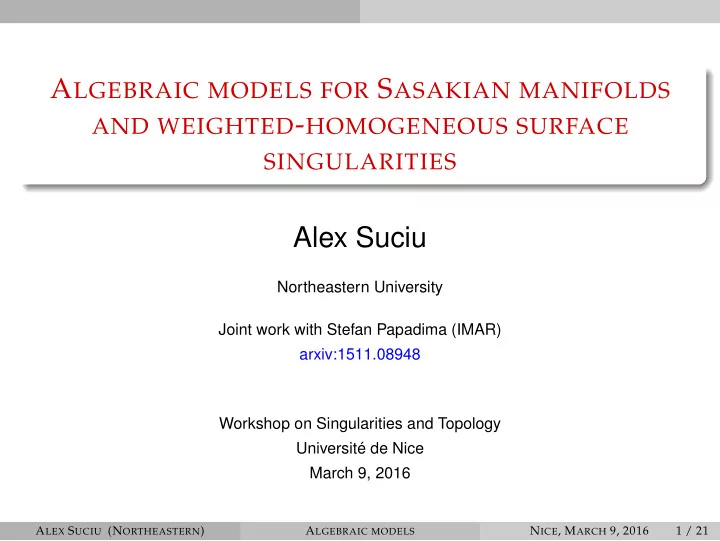
A LGEBRAIC MODELS FOR S ASAKIAN MANIFOLDS AND WEIGHTED - HOMOGENEOUS SURFACE SINGULARITIES Alex Suciu Northeastern University Joint work with Stefan Papadima (IMAR) arxiv:1511.08948 Workshop on Singularities and Topology Universit de Nice


slide-1
SLIDE 1

ALGEBRAIC MODELS FOR SASAKIAN MANIFOLDS

AND WEIGHTED-HOMOGENEOUS SURFACE SINGULARITIES

Alex Suciu

Northeastern University Joint work with Stefan Papadima (IMAR) arxiv:1511.08948 Workshop on Singularities and Topology Université de Nice March 9, 2016

ALEX SUCIU (NORTHEASTERN) ALGEBRAIC MODELS NICE, MARCH 9, 2016 1 / 21

slide-2
SLIDE 2

OUTLINE

1

ALGEBRAIC MODELS FOR SPACES

2

MODELS FOR GROUP ACTIONS

3

SASAKIAN MANIFOLDS

4

WEIGHTED HOMOGENEOUS SINGULARITIES

ALEX SUCIU (NORTHEASTERN) ALGEBRAIC MODELS NICE, MARCH 9, 2016 2 / 21

slide-3
SLIDE 3

ALGEBRAIC MODELS FOR SPACES CDGAS

CDGAS

Let A “ pA‚, dq be a commutative, differential graded C-algebra.

Multiplication ¨: Ai b Aj Ñ Ai`j is graded-commutative. Differential d: Ai Ñ Ai`1 satisfies the graded Leibnitz rule.

Fix integer q ě 1 (or q “ 8). We say that A is q-finite if

A is connected, i.e., A0 “ C. Ai is finite-dimensional, for each i ď q (or i ă 8).

Two CDGAs have the same q-type if there is a zig-zag of connecting morphisms, each one inducing isomorphisms in homology up to degree q and a monomorphism in degree q ` 1. A CDGA pA, dq is q-formal if it has the same q-type as pH‚pAq, d “ 0q.

ALEX SUCIU (NORTHEASTERN) ALGEBRAIC MODELS NICE, MARCH 9, 2016 3 / 21

slide-4
SLIDE 4

ALGEBRAIC MODELS FOR SPACES REGULAR SEQUENCES

REGULAR SEQUENCES

Let H‚ be a connected, commutative graded algebra. A sequence teαu of homogeneous elements in Hą0 is said to be q-regular if for each α, the class of eα in Hα “ H{ ÿ

βăα

eβH is a non-zero divisor up to degree q. That is, the multiplication map ¯ eα¨: H

i α Ñ H i`nα α

is injective, for all i ď q, where nα “ degpeαq. THEOREM Suppose e1, . . . , er is an even-degree, q-regular sequence in H. Then the Hirsch extension A “ H bτ

Źpt1, . . . , trq with d “ 0 on H and

dtα “ τptαq “ eα has the same q-type as ´ H{ ÿ

α eαH, d “ 0

¯ . In particular, A is q-formal.

ALEX SUCIU (NORTHEASTERN) ALGEBRAIC MODELS NICE, MARCH 9, 2016 4 / 21

slide-5
SLIDE 5

ALGEBRAIC MODELS FOR SPACES THE SULLIVAN MODEL

THE SULLIVAN MODEL

To a large extent, the rational homotopy type of a space can be reconstructed from algebraic models associated to it. If the space is a smooth manifold M, the standard model is the de Rham algebra ΩdRpMq. More generally, any space X has an associated Sullivan CDGA, APLpXq, which serves as the reference algebraic model. In particular, H˚pAPLpXqq “ H˚pX, Cq. A CDGA pA, dq is a q-model for X if A has the same q-type as APLpXq. We say X is q-formal if APLpXq has this property.

ALEX SUCIU (NORTHEASTERN) ALGEBRAIC MODELS NICE, MARCH 9, 2016 5 / 21

slide-6
SLIDE 6

ALGEBRAIC MODELS FOR SPACES THE MALCEV LIE ALGEBRA

THE MALCEV LIE ALGEBRA

The 1-formality property of a connected CW-complex X with finite 1-skeleton depends only on its fundamental group, π “ π1pXq. Let mpπq “ Primpz Crπsq be the Malcev Lie algebra of π, where p is completion with respect to powers of the augmentation ideal. The 1-formality of the group π is equivalent to mpπq – p L, for some quadratic, finitely generated Lie algebra L, where p is the degree completion. If mpπq – p L, where L is merely assumed to have homogeneous relations, then π is said to be filtered formal (see [SW] for details).

ALEX SUCIU (NORTHEASTERN) ALGEBRAIC MODELS NICE, MARCH 9, 2016 6 / 21

slide-7
SLIDE 7

ALGEBRAIC MODELS FOR SPACES COHOMOLOGY JUMP LOCI

COHOMOLOGY JUMP LOCI

Let X be a connected, finite-type CW-complex, and let G be a complex linear algebraic group. The characteristic varieties of X with respect to a rational, finite-dimensional representation ϕ: G Ñ GLpVq are the sets Vi

spX, ϕq “

! ρ P Hompπ, Gq | dim HipX, Vϕ˝ρq ě s ) . In degree i “ 1, these varieties depend only on the group π “ π1pXq, and so we may denote them as V1

s pπ, ϕq.

When G “ C˚ and ϕ “ idC˚, we simply write these sets as Vi

spXq.

ALEX SUCIU (NORTHEASTERN) ALGEBRAIC MODELS NICE, MARCH 9, 2016 7 / 21

slide-8
SLIDE 8

MODELS FOR GROUP ACTIONS COMPACT LIE GROUP ACTIONS

COMPACT LIE GROUP ACTIONS

Let M be a compact, connected, smooth manifold (with BM “ H). Suppose a compact, connected Lie group K acts smoothly and almost freely on M (i.e., all the isotropy groups are finite). Let K Ñ EK ˆ M Ñ MK be the Borel construction on M. Let τ : H‚pK, Cq Ñ H‚`1pMK, Cq be the transgression in the Serre spectral sequence of this bundle. Let N “ M{K be the orbit space (a smooth orbifold). The projection map pr: MK Ñ N induces an isomorphism pr˚ : H‚pN, Cq Ñ H‚pMK, Cq. By a theorem of H. Hopf, we may dentify H‚pK, Cq “ ŹP‚, where P “ spantt1, . . . , tru where mα “ degptαq is odd.

ALEX SUCIU (NORTHEASTERN) ALGEBRAIC MODELS NICE, MARCH 9, 2016 8 / 21

slide-9
SLIDE 9

MODELS FOR GROUP ACTIONS COMPACT LIE GROUP ACTIONS

THEOREM There is a map σ: P‚ Ñ Z ‚`1pAPLpNqq such that pr˚ ˝rσs “ τ and APLpMq » APLpNq bσ

ŹP.

THEOREM Suppose that The orbit space N “ M{K is k-formal, for some k ą maxtmαu. The characteristic classes eα “ ppr˚q´1pτptαqq P Hmα`1pN, Cq form a q-regular sequence in H‚ “ H‚pN, Cq, for some q ď k. Then the CDGA ´ H‚L ÿ

α

eαH‚, d “ 0 ¯ is a finite q-model for M. In particular, M is q-formal.

ALEX SUCIU (NORTHEASTERN) ALGEBRAIC MODELS NICE, MARCH 9, 2016 9 / 21

slide-10
SLIDE 10

MODELS FOR GROUP ACTIONS COMPACT LIE GROUP ACTIONS

THEOREM Suppose the orbit space N “ M{K is 2-formal. Then:

1

The group π “ π1pMq is filtered-formal. In fact, mpπq is the degree completion of L{r, where L “ LiepH1pπ, Cqq and r is a homogeneous ideal generated in degrees 2 and 3.

2

For every complex linear algebraic group G, the germ at 1 of the representation variety Hompπ, Gq is defined by quadrics and cubics only.

ALEX SUCIU (NORTHEASTERN) ALGEBRAIC MODELS NICE, MARCH 9, 2016 10 / 21

slide-11
SLIDE 11

MODELS FOR GROUP ACTIONS COMPACT LIE GROUP ACTIONS

The projection map p: M Ñ M{K induces an epimorphism p7 : π1pMq ։ πorb

1 pM{Kq between orbifold fundamental groups.

THEOREM Suppose that the transgression P‚ Ñ H‚`1pM{K, Cq is injective in degree 1. Then:

1

If the orbit space N “ M{K has a 2-finite 2-model, then p7 induces analytic isomorphisms V1

s pπorb 1 pNqqp1q – V1 s pπ1pMqqp1q.

2

If N is 2-formal, then p7 induces an analytic isomorphism Hompπorb

1 pNq, SL2pCqqp1q – Hompπ1pMq, SL2pCqqp1q.

ALEX SUCIU (NORTHEASTERN) ALGEBRAIC MODELS NICE, MARCH 9, 2016 11 / 21

slide-12
SLIDE 12

SASAKIAN MANIFOLDS SASAKIAN MANIFOLDS AND q-FORMALITY

SASAKIAN MANIFOLDS AND q-FORMALITY

Sasakian geometry is an odd-dimensional analogue of Kähler geometry. Every compact Sasakian manifold M admits an almost-free circle action with orbit space N “ M{S1 a Kähler orbifold. The Euler class of the action coincides with the Kähler class of the base, h P H2pN, Qq. The class h satisfies the Hard Lefschetz property, i.e., ¨hk : Hn´kpN, Cq Ñ Hn`kpN, Cq is an isomorphism, for each 1 ď k ď n. Thus, thu is an pn ´ 1q-regular sequence in H‚pN, Cq EXAMPLE Let N be a compact Kähler manifold such that the Kähler class is integral, i.e., h P H2pN, Zq, and let M be the total space of the principal S1-bundle classified by h. Then M is a (regular) Sasakian manifold.

ALEX SUCIU (NORTHEASTERN) ALGEBRAIC MODELS NICE, MARCH 9, 2016 12 / 21

slide-13
SLIDE 13

SASAKIAN MANIFOLDS SASAKIAN MANIFOLDS AND q-FORMALITY

As shown by Deligne, Griffiths, Morgan, and Sullivan, compact Kähler manifolds are formal. As shown by A. Tievsky, every compact Sasakian manifold M has a finite model of the form pH‚pN, Cq b Źptq, dq, where d vanishes

  • n H‚pN, Cq and sends t to h.

THEOREM Let M be a compact Sasakian manifold of dimension 2n ` 1. Then M is pn ´ 1q-formal. This result is optimal: for each n ě 1, the p2n ` 1q-dimensional Heisenberg compact nilmanifold (with orbit space T 2n) is a Sasakian manifold, yet it is not n-formal. This theorem strengthens a statement of H. Kasuya, who claimed that, for n ě 2, a Sasakian manifold M2n`1 is 1-formal. The proof

  • f that claim, though, has a gap.

ALEX SUCIU (NORTHEASTERN) ALGEBRAIC MODELS NICE, MARCH 9, 2016 13 / 21

slide-14
SLIDE 14

SASAKIAN MANIFOLDS SASAKIAN GROUPS

SASAKIAN GROUPS

A group π is said to be a Sasakian group if it can be realized as the fundamental group of a compact, Sasakian manifold. Open problem: Which finitely presented groups are Sasakian? A first, well-known obstruction is that b1pπq must be even. THEOREM Let π “ π1pM2n`1q be the fundamental group of a compact Sasakian manifold of dimension 2n ` 1. Then:

1

The group π is filtered-formal, and in fact 1-formal if n ą 1.

2

All irreducible components of the characteristic varieties V1

s pπq

passing through 1 are algebraic subtori of Hompπ, C˚q.

3

If G is a complex linear algebraic group, then the germ at 1 of Hompπ, Gq is defined by quadrics and cubics only, and in fact by quadrics only if n ą 1.

ALEX SUCIU (NORTHEASTERN) ALGEBRAIC MODELS NICE, MARCH 9, 2016 14 / 21

slide-15
SLIDE 15

WEIGHTED HOMOGENEOUS SINGULARITIES RESONANCE VARIETIES

RESONANCE VARIETIES

Once again, let pA, dq be a CDGA model for a connected, finite-type CW-complex X. Let π “ π1pXq, let G be a complex algebraic group, and let g be its Lie algebra. The infinitesimal analogue (around the origin) of the G-representation variety Hompπ, Gq is the set FpA, gq of g-valued flat connections on a CDGA A, FpA, gq “ ! ω P A1 b g | dω ` 1

2rω, ωs “ 0

) . If dim A1 ă 8, then FpA, gq is a Zariski-closed subset, which contains the closed subvariety F1pA, gq “ tη b g P A1 b g | dη “ 0u. Next, we define the infinitesimal counterpart of the characteristic varieties.

ALEX SUCIU (NORTHEASTERN) ALGEBRAIC MODELS NICE, MARCH 9, 2016 15 / 21

slide-16
SLIDE 16

WEIGHTED HOMOGENEOUS SINGULARITIES RESONANCE VARIETIES

Let θ: g Ñ glpVq be a finite-dimensional representation. To each ω P FpA, gq there is an associated covariant derivative, dω : A‚ b V Ñ A‚`1 b V, given by dω “ d b idV ` adω. By flatness, d2

ω “ 0.

The resonance varieties of A with respect to θ are the sets Ri

spA, θq “

! ω P FpA, gq | dim HipA b V, dωq ě s ) . If A is q-finite, these sets are Zariski-closed in FpA, gq, @i ď q. If HipAq ‰ 0, then Ri

1pA, θq contains the closed subvariety

ΠpA, θq “ tη b g P F1pA, gq | det θpgq “ 0u. When g “ C, θ “ idC we have that FpA, gq “ H1pAq and Ri

spAq are

the usual resonance varieties of pA, dq.

ALEX SUCIU (NORTHEASTERN) ALGEBRAIC MODELS NICE, MARCH 9, 2016 16 / 21

slide-17
SLIDE 17

WEIGHTED HOMOGENEOUS SINGULARITIES SMOOTH QUASI-PROJECTIVE VARIETIES

SMOOTH QUASI-PROJECTIVE VARIETIES

Let X be a smooth quasi-projective variety. Let EpXq be the (finite!) set of regular, surjective maps f : X Ñ S for which the generic fiber is connected and is a smooth curve S with χpSq ă 0, up to reparametrization at the target. All such maps extend to regular maps ¯ f : X Ñ S, for some ‘convenient’ compactification X “ X Y D. The variety X admits a finite CDGA model with positive weights, ApXq “ ApX, Dq. Such a ‘Gysin’ model was constructed by Morgan, and was recently improved upon by C. Dupont.

ALEX SUCIU (NORTHEASTERN) ALGEBRAIC MODELS NICE, MARCH 9, 2016 17 / 21

slide-18
SLIDE 18

WEIGHTED HOMOGENEOUS SINGULARITIES SMOOTH QUASI-PROJECTIVE VARIETIES

THEOREM (ARAPURA) The correspondence f f ˚pH1pS, C˚qq gives a bijection between the set EpXq and the set of positive-dimensional irreducible components of V1

1pXq passing through the identity of the character group H1pX, C˚q.

THEOREM (DIMCA–PAPADIMA) Let X be smooth, quasi-projective variety X, and let A be a finite CDGA model with positive weights. The set EpXq is then in bijection with the set of positive-dimensional, irreducible components of R1

1pAq Ď H1pAq “ H1pX, Cq via the correspondence f f !pH1pS, Cqq.

ALEX SUCIU (NORTHEASTERN) ALGEBRAIC MODELS NICE, MARCH 9, 2016 18 / 21

slide-19
SLIDE 19

WEIGHTED HOMOGENEOUS SINGULARITIES WEIGHTED HOMOGENEOUS SINGULARITIES

WEIGHTED HOMOGENEOUS SINGULARITIES

Let X be a complex affine surface endowed with a ‘good’ C˚-action and having a normal, isolated singularity at 0. The punctured surface X ˚ “ Xzt0u is a smooth quasi-projective variety which deform-retracts onto the singularity link, M. The almost free C˚-action on X ˚ restricts to an S1-action on M with finite isotropy subgroups. In particular, M is an orientable Seifert fibered 3-manifold. The orbit space, M{S1 “ X ˚{C˚, is a smooth projective curve Σg,

  • f genus g “ 1
  • 2b1pMq. The canonical projection, f : X ˚ Ñ X ˚{C˚,

induces an isomorphism on first homology. It turns out that EpX ˚q “ H if g “ 1 and EpX ˚q “ tfu if g ą 1.

ALEX SUCIU (NORTHEASTERN) ALGEBRAIC MODELS NICE, MARCH 9, 2016 19 / 21

slide-20
SLIDE 20

WEIGHTED HOMOGENEOUS SINGULARITIES WEIGHTED HOMOGENEOUS SINGULARITIES

THEOREM Let g “ sl2pCq, and let θ: g Ñ glpVq be a finite-dimensional rep. There is then a convenient compactification of X ˚ such that FpApX ˚q, gq “ F1pApX ˚q, gq Y ď

fPEpX ˚q

f !pFpApSq, gqq, R1

1pApX ˚q, θq “ ΠpApX ˚q, θq Y

ď

fPEpX ˚q

f !pFpApSq, gqq. For the proof, we replace X ˚ (up to homotopy) by the singularity link M, and ApX ˚q by a finite model A for this almost free S1-manifold. As shown in [MPPS], the inclusions Ě hold for arbitrary smooth, quasi-projective varieties X, with equality if X is 1-formal. We do not know (yet) whether the above equalities hold for arbitrary smooth, quasi-projective varieties.

ALEX SUCIU (NORTHEASTERN) ALGEBRAIC MODELS NICE, MARCH 9, 2016 20 / 21

slide-21
SLIDE 21

WEIGHTED HOMOGENEOUS SINGULARITIES WEIGHTED HOMOGENEOUS SINGULARITIES

REFERENCES

Stefan Papadima and Alex Suciu, The topology of compact Lie group actions through the lens of finite models, arxiv:1511.08948. Anca M˘ acinic, Stefan Papadima, Radu Popescu, and Alex Suciu, Flat connections and resonance varieties: from rank one to higher ranks, arxiv:1312.1439, to appear in Trans. Amer. Math. Soc. Alex Suciu and He Wang, Formality properties of finitely generated groups and Lie algebras, arxiv:1504.08294.

ALEX SUCIU (NORTHEASTERN) ALGEBRAIC MODELS NICE, MARCH 9, 2016 21 / 21