Alex Suciu Northeastern University Workshop on Configuration Spaces - - PowerPoint PPT Presentation

alex suciu
SMART_READER_LITE
LIVE PREVIEW

Alex Suciu Northeastern University Workshop on Configuration Spaces - - PowerPoint PPT Presentation

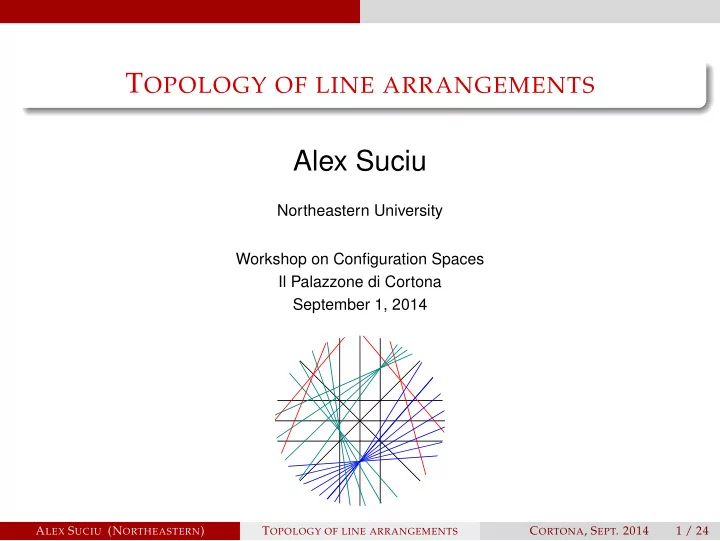
T OPOLOGY OF LINE ARRANGEMENTS Alex Suciu Northeastern University Workshop on Configuration Spaces Il Palazzone di Cortona September 1, 2014 A LEX S UCIU (N ORTHEASTERN ) T OPOLOGY OF LINE ARRANGEMENTS C ORTONA , S EPT . 2014 1 / 24 O UTLINE I


slide-1
SLIDE 1

TOPOLOGY OF LINE ARRANGEMENTS Alex Suciu

Northeastern University Workshop on Configuration Spaces Il Palazzone di Cortona September 1, 2014

ALEX SUCIU (NORTHEASTERN) TOPOLOGY OF LINE ARRANGEMENTS CORTONA, SEPT. 2014 1 / 24
slide-2
SLIDE 2

OUTLINE

1

INTRODUCTION

Plane algebraic curves Line arrangements Residual properties Milnor fibration Techniques

2

RESIDUAL PROPERTIES

The RFRp property Boundary manifolds Towers of congruence covers

3

MILNOR FIBRATION

Resonance varieties and multinets Modular inequalities Combinatorics and monodromy

ALEX SUCIU (NORTHEASTERN) TOPOLOGY OF LINE ARRANGEMENTS CORTONA, SEPT. 2014 2 / 24

slide-3
SLIDE 3

INTRODUCTION PLANE ALGEBRAIC CURVES

PLANE ALGEBRAIC CURVES

Let C Ă CP2 be a plane algebraic curve, defined by a homogeneous polynomial f P C[z1, z2, z3]. In the 1930s, Zariski studied the topology of the complement, U = CP2zC . He commissioned Van Kampen to find a presentation for the fundamental group, π = π1(U). Zariski noticed that π is not determined by the combinatorics of C , but depends on the position of its singularities. He asked whether π is residually finite, i.e., whether the map to its profinite completion, π Ñ p π =: πalg, is injective.

ALEX SUCIU (NORTHEASTERN) TOPOLOGY OF LINE ARRANGEMENTS CORTONA, SEPT. 2014 3 / 24

slide-4
SLIDE 4

INTRODUCTION LINE ARRANGEMENTS

LINE ARRANGEMENTS

Let A be an arrangement of lines in CP2, defined by a polynomial f = ź

HPA

fH P C[z1, z2, z3], with fH linear forms so that H = P ker(fH) for each H P A . Let L(A ) be the intersection lattice of A , with L1(A ) = tlinesu and L2(A ) = tintersection pointsu. Let U(A ) = CP2z Ť

HPA H be the complement of A .

ALEX SUCIU (NORTHEASTERN) TOPOLOGY OF LINE ARRANGEMENTS CORTONA, SEPT. 2014 4 / 24

slide-5
SLIDE 5

INTRODUCTION RESIDUAL PROPERTIES

RESIDUAL PROPERTIES OF ARRANGEMENT GROUPS

THEOREM (THOMAS KOBERDA–A.S. 2014) Let A be a complexified real line arrangement, and let π = π1(U(A )). Then

1

π is residually finite.

2

π is residually nilpotent.

3

π is torsion-free.

ALEX SUCIU (NORTHEASTERN) TOPOLOGY OF LINE ARRANGEMENTS CORTONA, SEPT. 2014 5 / 24

slide-6
SLIDE 6

INTRODUCTION MILNOR FIBRATION

MILNOR FIBRATION

Let f P C[z1, z2, z3] be a homogeneous polynomial of degree n. The map f : C3ztf = 0u Ñ C˚ is a smooth fibration (Milnor), with fiber F = f ´1(1), and monodromy h: F Ñ F, z ÞÑ e2πi/nz. The Milnor fiber F is a regular, Zn-cover of U = CP2ztf = 0u. COROLLARY (T.K.–A.S.) Let A be an arrangement defined by a polynomial f P R[z1, z2, z3], let F = F(A ) be its Milnor fiber, and let π = π1(F). Then

1

π is residually finite.

2

π is residually nilpotent.

3

π is torsion-free.

ALEX SUCIU (NORTHEASTERN) TOPOLOGY OF LINE ARRANGEMENTS CORTONA, SEPT. 2014 6 / 24

slide-7
SLIDE 7

INTRODUCTION MILNOR FIBRATION

Let ∆(t) = det(tI ´ h˚) be the characteristic polynomial of the algebraic monodromy, h˚ : H1(F, C) Ñ H1(F, C). PROBLEM When f is the defining polynomial of an arrangement A , is ∆ = ∆A determined solely by L(A )? THEOREM (STEFAN PAPADIMA–A.S. 2014) Suppose A has only double and triple points. Then ∆A (t) = (t ´ 1)|A |´1 ¨ (t2 + t + 1)β3(A ), where β3(A ) is an integer between 0 and 2 that depends only on L(A ).

ALEX SUCIU (NORTHEASTERN) TOPOLOGY OF LINE ARRANGEMENTS CORTONA, SEPT. 2014 7 / 24

slide-8
SLIDE 8

INTRODUCTION TECHNIQUES

TECHNIQUES

Common themes:

Homology with coefficients in rank 1 local systems. Homology of finite abelian covers.

Specific techniques for residual properties:

Boundary manifold of line arrangement. Towers of congruence covers. The RFRp property.

Specific techniques for Milnor fibration:

Nets, multinets, and pencils. Cohomology jump loci (in characteristic 0 and p). Modular bounds for twisted Betti numbers.

ALEX SUCIU (NORTHEASTERN) TOPOLOGY OF LINE ARRANGEMENTS CORTONA, SEPT. 2014 8 / 24

slide-9
SLIDE 9

RESIDUAL PROPERTIES THE RFRp PROPERTY

THE RFRp PROPERTY

Let G be a finitely generated group and let p be a prime. We say that G is residually finite rationally p if there exists a sequence

  • f subgroups G = G0 ą ¨ ¨ ¨ ą Gi ą Gi+1 ą ¨ ¨ ¨ such that

1

Gi+1 Ÿ Gi.

2

Ş

iě0 Gi = t1u.

3

Gi/Gi+1 is an elementary abelian p-group.

4

ker(Gi Ñ H1(Gi, Q)) ă Gi+1. Remarks: May assume each Gi Ÿ G. Compare with Agol’s RFRS property, where Gi/Gi+1 only finite. G RFRp ñ residually p ñ residually finite and residually nilpotent. G RFRp ñ G RFRS ñ torsion-free.

ALEX SUCIU (NORTHEASTERN) TOPOLOGY OF LINE ARRANGEMENTS CORTONA, SEPT. 2014 9 / 24

slide-10
SLIDE 10

RESIDUAL PROPERTIES THE RFRp PROPERTY

The class of RFRp groups is closed under the following

  • perations:

1

Taking subgroups.

2

Finite direct products.

3

Finite free products.

The following groups are RFRp:

1

Finitely generated free groups.

2

Closed, orientable surface groups.

3

Right-angled Artin groups.

ALEX SUCIU (NORTHEASTERN) TOPOLOGY OF LINE ARRANGEMENTS CORTONA, SEPT. 2014 10 / 24

slide-11
SLIDE 11

RESIDUAL PROPERTIES BOUNDARY MANIFOLDS

BOUNDARY MANIFOLDS

Let N be a regular neighborhood of Ť

HPA H inside CP2.

Let U = CP2z int(N) be the exterior of A . The boundary manifold of A is M = BU = BN, a compact, orientable, smooth manifold of dimension 3. EXAMPLE Let A be a pencil of n hyperplanes in C2, defined by f = zn

1 ´ zn 2.

If n = 1, then M = S3. If n ą 1, then M = 7n´1S1 ˆ S2. EXAMPLE Let A be a near-pencil of n planes in CP2, defined by f = z1(zn´1

2

´ zn´1

3

). Then M = S1 ˆ Σn´2, where Σg = 7gS1 ˆ S1.

ALEX SUCIU (NORTHEASTERN) TOPOLOGY OF LINE ARRANGEMENTS CORTONA, SEPT. 2014 11 / 24

slide-12
SLIDE 12

RESIDUAL PROPERTIES BOUNDARY MANIFOLDS

Work of Hirzebruch, Jiang–Yau, and E. Hironaka shows that M = MΓ is a graph-manifold. The graph Γ is the incidence graph of A , with vertex set V(Γ) = L1(A ) Y L2(A ) and edge set E(Γ) = t(H, P) | P P Hu. For each v P V(Γ), there is a vertex manifold Mv = S1 ˆ Sv, with Sv = S2z ď

tv,wuPE(Γ)

D2

v,w,

a sphere with deg v disjoint open disks removed. For each e P E(Γ), there is an edge manifold Me = S1 ˆ S1. Vertex manifolds are glued along edge manifolds via flips.

ALEX SUCIU (NORTHEASTERN) TOPOLOGY OF LINE ARRANGEMENTS CORTONA, SEPT. 2014 12 / 24

slide-13
SLIDE 13

RESIDUAL PROPERTIES BOUNDARY MANIFOLDS

The inclusion i : M Ñ U induces a surjection i7 : π1(M) ։ π1(U). By collapsing each vertex manifold of M = MΓ to a point, we

  • btain a map κ : M Ñ Γ.

Using work of D. Cohen–A.S. (2006, 2008), we get a split exact sequence

H1(U, Z) H1(M, Z)

  • κ˚

H1(Γ, Z)

  • 0 .

LEMMA Suppose A is an essential line arrangement in CP2. Then, for each v P V(Γ) and e P E(Γ), the inclusions iv : Mv ã Ñ M and ie : Me ã Ñ M induce split injections on H1, whose images are contained in ker(κ˚).

ALEX SUCIU (NORTHEASTERN) TOPOLOGY OF LINE ARRANGEMENTS CORTONA, SEPT. 2014 13 / 24

slide-14
SLIDE 14

RESIDUAL PROPERTIES BOUNDARY MANIFOLDS

Using work of E. Hironaka (2001), we obtain: LEMMA Suppose A is the complexification of a real arrangement. There is then a finite, simplicial graph G and an embedding j : G ã Ñ M such that:

1

The graph G is homotopy equivalent to the incidence graph Γ.

2

We have an exact sequence,

H1(G , Z)

H1(M, Z)

H1(U, Z) 0 .

3

We have an exact sequence, 1

π1(G )

j7

π1(M)

i7

π1(U) 1 .

ALEX SUCIU (NORTHEASTERN) TOPOLOGY OF LINE ARRANGEMENTS CORTONA, SEPT. 2014 14 / 24

slide-15
SLIDE 15

RESIDUAL PROPERTIES TOWERS OF CONGRUENCE COVERS

TOWERS OF CONGRUENCE COVERS

For each prime p, we construct a tower of regular covers of M, ¨ ¨ ¨

Mi+1

qi+1 Mi qi

¨ ¨ ¨

q1 M0 = M.

Each Mi is a graph-manifold, modelled on a graph Γi. The group of deck-transformations for qi+1 is the elementary abelian p-group (H1(Mi, Z)/tors)/H1(Γi, Z)

  • b Zp.

The covering maps preserve the graph-manifold structures, e.g., Mv,i

  • qv
  • Mi

q

  • Mv

M

where Mv,i is a connected component of q´1(Mv) and qv = q|Mv,i.

ALEX SUCIU (NORTHEASTERN) TOPOLOGY OF LINE ARRANGEMENTS CORTONA, SEPT. 2014 15 / 24

slide-16
SLIDE 16

RESIDUAL PROPERTIES TOWERS OF CONGRUENCE COVERS

The inclusions Mv,i ã Ñ Mi and Me,i ã Ñ Mi induce injections on H1, whose images are contained in ker((κi)˚). If A is complexified real, the graph G ã Ñ M lifts to a graph Gi ã Ñ Mi so that

The group H1(Mi, Z) splits off H1(Gi, Z) as a direct summand. H1(Gi, Z) X H1(Mv,i, Z) = 0, for all v P V(Γ).

Finally, For each v P V(Γ), the group π1(Mv) = Z ˆ π1(Sv) is RFRp. From the construction of the tower, it follows that π1(M) is RFRp. If A is complexified real, the above properties of the lifts of G imply that π1(U) = π1(M)/x xj7(π1(G ))y y is also RFRp.

ALEX SUCIU (NORTHEASTERN) TOPOLOGY OF LINE ARRANGEMENTS CORTONA, SEPT. 2014 16 / 24

slide-17
SLIDE 17

MILNOR FIBRATION RESONANCE VARIETIES AND MULTINETS

RESONANCE VARIETIES AND MULTINETS

Let X(A ) = C3z Ť

HPA ker(fH), so that U(A ) = PX(A ) and

X(A ) – C˚ ˆ U(A ). Let A = H˚(X(A ), k): an algebra that depends only on L(A ) and the field k (Orlik and Solomon). For each a P A1, we have a2 = 0. Thus, we get a cochain complex, (A, ¨a): A0

a

A1

a

A2 ¨ ¨ ¨

The (degree 1) resonance varieties of A are the cohomology jump loci of this “Aomoto complex": Rs(A , k) = ta P A1 | dimk H1(A, ¨a) ě su,

ALEX SUCIU (NORTHEASTERN) TOPOLOGY OF LINE ARRANGEMENTS CORTONA, SEPT. 2014 17 / 24

slide-18
SLIDE 18

MILNOR FIBRATION RESONANCE VARIETIES AND MULTINETS

Work of Arapura, Falk, Cohen–A.S., Libgober–Yuzvinsky, and Falk–Yuzvinsky completely describes the varieties Rs(A , C): R1(A , C) is a union of linear subspaces in H1(X(A ), C) – C|A |. Each subspace has dimension at least 2, and each pair of subspaces meets transversely at 0. Rs(A , C) is the union of those linear subspaces that have dimension at least s + 1. Each k-multinet on a sub-arrangement B Ď A gives rise to a component of R1(A , C) of dimension k ´ 1. Moreover, all components of R1(A , C) arise in this way.

ALEX SUCIU (NORTHEASTERN) TOPOLOGY OF LINE ARRANGEMENTS CORTONA, SEPT. 2014 18 / 24

slide-19
SLIDE 19

MILNOR FIBRATION RESONANCE VARIETIES AND MULTINETS

DEFINITION (FALK AND YUZVINSKY) A multinet on A is a partition of the set A into k ě 3 subsets A1, . . . , Ak, together with an assignment of multiplicities, m: A Ñ N, and a subset X Ď L2(A ), called the base locus, such that:

1

There is an integer d such that ř

HPAα mH = d, for all α P [k].

2

If H and H1 are in different classes, then H X H1 P X .

3

For each X P X , the sum nX = ř

HPAα:HĄX mH is independent of α.

4

Each set Ť

HPAα H

  • zX is connected.

A multinet as above is also called a (k, d)-multinet, or a k-multinet. The multinet is reduced if mH = 1, for all H P A . A net is a reduced multinet with nX = 1, for all X P X .

ALEX SUCIU (NORTHEASTERN) TOPOLOGY OF LINE ARRANGEMENTS CORTONA, SEPT. 2014 19 / 24

slide-20
SLIDE 20

MILNOR FIBRATION RESONANCE VARIETIES AND MULTINETS

‚ ‚ ‚ ‚

2 2 2 A (3, 2)-net on the A3 arrangement A (3, 4)-multinet on the B3 arrangement X consists of 4 triple points (nX = 1) X consists of 4 triple points (nX = 1) and 3 triple points (nX = 2)

(Yuzvinsky and Pereira–Yuz): If A supports a k-multinet with |X | ą 1, then k = 3 or 4; if the multinet is not reduced, then k = 3. Conjecture (Yuz): The only 4-multinet is the Hessian (4, 3)-net. (Cordovil–Forge and Torielli–Yoshinaga): There are no 4-nets on real arrangements.

ALEX SUCIU (NORTHEASTERN) TOPOLOGY OF LINE ARRANGEMENTS CORTONA, SEPT. 2014 20 / 24

slide-21
SLIDE 21

MILNOR FIBRATION MODULAR INEQUALITIES

MODULAR INEQUALITIES

Recall ∆(t) is the characteristic polynomial of the algebraic monodromy of the Milnor fibration, h˚ : H1(F, C) Ñ H1(F, C). Set n = |A |. Since hn = id, we have ∆(t) = ź

d|n

Φd(t)ed(A ), where Φd(t) is the d-th cyclotomic polynomial, and ed(A ) P Zě0. If there is a non-transverse multiple point on A of multiplicity not divisible by d, then ed(A ) = 0 (Libgober 2002). In particular, if A has only points of multiplicity 2 and 3, then ∆(t) = (t ´ 1)n´1(t2 + t + 1)e3. If multiplicity 4 appears, then also get factor of (t + 1)e2 ¨ (t2 + 1)e4.

ALEX SUCIU (NORTHEASTERN) TOPOLOGY OF LINE ARRANGEMENTS CORTONA, SEPT. 2014 21 / 24

slide-22
SLIDE 22

MILNOR FIBRATION MODULAR INEQUALITIES

Let σ = ř

HPA eH P A1 be the “diagonal" vector.

Assume k has characteristic p ą 0, and define βp(A ) = dimk H1(A, ¨σ). That is, βp(A ) = maxts | σ P R1

s (A, k)u.

THEOREM (COHEN–ORLIK 2000, PAPADIMA–A.S. 2010) eps(A ) ď βp(A ), for all s ě 1. THEOREM (S.P.–A.S.)

1

Suppose A admits a k-net. Then βp(A ) = 0 if p ∤ k and βp(A ) ě k ´ 2, otherwise.

2

If A admits a reduced k-multinet, then ek(A ) ě k ´ 2.

ALEX SUCIU (NORTHEASTERN) TOPOLOGY OF LINE ARRANGEMENTS CORTONA, SEPT. 2014 22 / 24

slide-23
SLIDE 23

MILNOR FIBRATION COMBINATORICS AND MONODROMY

COMBINATORICS AND MONODROMY

THEOREM (S.P.–A.S.) Suppose A has no points of multiplicity 3r with r ą 1. Then, the following conditions are equivalent:

1

A admits a reduced 3-multinet.

2

A admits a 3-net.

3

β3(A ) ‰ 0. Moreover, the following hold:

4

β3(A ) ď 2.

5

e3(A ) = β3(A ), and thus e3(A ) is combinatorially determined. THEOREM (S.P.–A.S.) Suppose A supports a 4-net and β2(A ) ď 2. Then e2(A ) = e4(A ) = β2(A ) = 2.

ALEX SUCIU (NORTHEASTERN) TOPOLOGY OF LINE ARRANGEMENTS CORTONA, SEPT. 2014 23 / 24

slide-24
SLIDE 24

MILNOR FIBRATION COMBINATORICS AND MONODROMY

CONJECTURE (S.P.–A.S.) Let A be an arrangement which is not a pencil. Then eps(A ) = 0 for all primes p and integers s ě 1, with two possible exceptions: e2(A ) = e4(A ) = β2(A ) and e3(A ) = β3(A ). If ed(A ) = 0 for all divisors d of |A | which are not prime powers, this conjecture would give: ∆A (t) = (t ´ 1)|A |´1((t + 1)(t2 + 1))β2(A )(t2 + t + 1)β3(A ). The conjecture has been verified for several classes of arrangements, including complex reflection arrangements and certain types of real arrangements.

ALEX SUCIU (NORTHEASTERN) TOPOLOGY OF LINE ARRANGEMENTS CORTONA, SEPT. 2014 24 / 24