Alex Popiel Morphology of the Worlds Languages Goethe Universitt - - PDF document

alex popiel morphology of the world s languages goethe
SMART_READER_LITE
LIVE PREVIEW

Alex Popiel Morphology of the Worlds Languages Goethe Universitt - - PDF document

G RAMMATICALIZATION P ATHS OF ko Y ES IN M EGRELIAN Alex Popiel Morphology of the Worlds Languages Goethe Universitt Frankfurt June 11-13, 2009, Leipzig 0. P RELIMINARIES This paper addresses the grammaticalization paths of the


slide-1
SLIDE 1

1

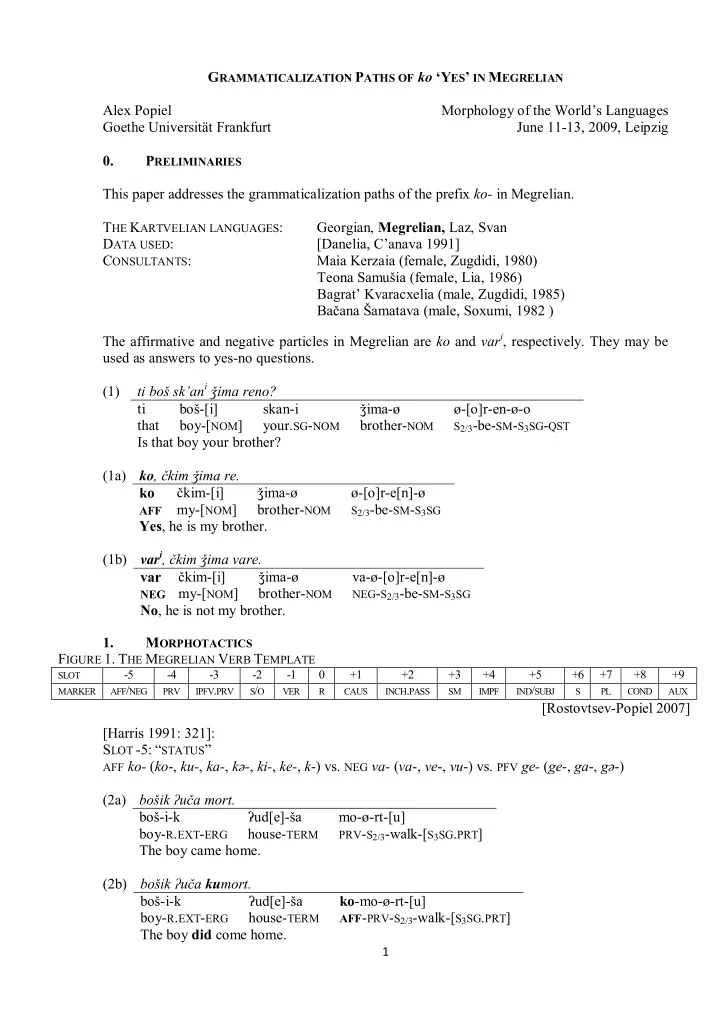
GRAMMATICALIZATION PATHS OF ko ‘YES’ IN MEGRELIAN Alex Popiel Morphology of the World’s Languages Goethe Universität Frankfurt June 11-13, 2009, Leipzig 0. PRELIMINARIES This paper addresses the grammaticalization paths of the prefix ko- in Megrelian. THE KARTVELIAN LANGUAGES: Georgian, Megrelian, Laz, Svan DATA USED: [Danelia, C’anava 1991] CONSULTANTS: Maia Kerzaia (female, Zugdidi, 1980) Teona Samušia (female, Lia, 1986) Bagrat’ Kvaracxelia (male, Zugdidi, 1985) Bačana Šamatava (male, Soxumi, 1982 ) The affirmative and negative particles in Megrelian are ko and vari, respectively. They may be used as answers to yes-no questions. (1) ti boš sk’ani ǯima reno? ti boš-[i] skan-i ǯima-ø ø-[o]r-en-ø-o that boy-[NOM] your.SG-NOM brother-NOM

S2/3-be-SM-S3SG-QST

Is that boy your brother? (1a) ko, čkim ǯima re. ko čkim-[i] ǯima-ø ø-[o]r-e[n]-ø

AFF

my-[NOM] brother-NOM

S2/3-be-SM-S3SG

Yes, he is my brother. (1b) vari, čkim ǯima vare. var čkim-[i] ǯima-ø va-ø-[o]r-e[n]-ø

NEG

my-[NOM] brother-NOM

NEG-S2/3-be-SM-S3SG

No, he is not my brother. 1. MORPHOTACTICS FIGURE 1. THE MEGRELIAN VERB TEMPLATE

SLOT

  • 5
  • 4
  • 3
  • 2
  • 1

+1 +2 +3 +4 +5 +6 +7 +8 +9

MARKER AFF/NEG PRV IPFV.PRV S/O VER R CAUS INCH.PASS SM IMPF IND/SUBJ S PL COND AUX

[Rostovtsev-Popiel 2007] [Harris 1991: 321]: SLOT -5: “STATUS”

AFF ko- (ko-, ku-, ka-, kǝ-, ki-, ke-, k-) vs. NEG va- (va-, ve-, vu-) vs. PFV ge- (ge-, ga-, gǝ-)

(2a) bošik ʔuča mort. boš-i-k ʔud[e]-ša mo-ø-rt-[u] boy-R.EXT-ERG house-TERM

PRV-S2/3-walk-[S3SG.PRT]

The boy came home. (2b) bošik ʔuča kumort. boš-i-k ʔud[e]-ša ko-mo-ø-rt-[u] boy-R.EXT-ERG house-TERM

AFF-PRV-S2/3-walk-[S3SG.PRT]

The boy did come home.

slide-2
SLIDE 2

2

(2c) bošik ʔuča vamort. boš-i-k ʔud[e]-ša va-mo-ø-rt-[u] boy-R.EXT-ERG house-TERM

NEG-PRV-S2/3-walk-[S3SG.PRT]

The boy did not come home. [Mak’ar Xubua 1942]: The position of the AFF ko- is not restricted to the beginning of the word. (3a) kimtāgans (3b) mitkāgans ko-m[i]=to-ø-o-g-an-s mi=t[o]-ko-ø-o-g-an-s

AFF-PRV=PRV-S2/3-VERL-(play)-SM-S3SG PRV=PRV-S2/3-AFF-VERL-(play)-SM-S3SG

X plays on Y X plays on Y The slot -5 affixes never occur in non-finite verbal forms, and thus they are inflectional unlike the slot -4 affixes, namely derivational preverbs that also occur in masdars and participles [Šerozia 2000]: ge-

PERFECTIVE ASPECT (FUTURE)

ko-

AFFIRMATIVITY (PRESENT)

va-

NEGATION (PRESENT AND FUTURE)

(4a) ginok’ilans (4b) kignok’ilans gi=no-ø-k’il-an-s ko-g[i]=no-ø-k’il-an-s

PRV=PRV-S2/3-lock-SM-S3SG AFF-PRV=PRV-S2/3-lock-SM-S3SG

X locks/blocks Y X definitely locks Y (4c) gegnok’ilans (4d) vegnok’ilans ge-g[i]=no-ø-k’il-an-s va-g[i]=no-ø-k’il-an-s

PRF-PRV=PRV-S2/3-lock-SM-S3SG NEG-PRV=PRV-S2/3-lock-SM-S3SG

X will block Y X does not/will not lock/block Y NB! Co-occurrence of ko- and va- within a verbal form: the negative assertive question. Conventionalization of the AFF ko- already passed. (5) vakumortuo? va-ko-mo-ø-rt-u-o

NEG-AFF-PRV-S2/3-walk-S3SG.PRT-QST

didn’t X come? [=X unexpectedly came] 2. FUNCTIONS OF THE PREFIX ko-

FIGURE 2. OVERVIEW OF THE PREFIX USE TYPES

(MORPHOLOGICAL) SEMANTICS (MORPHOLOGICAL) COUNTERPART affirmativity ko- negation va- volitionality ko-

  • intentionality

ko-

  • contact

ko- separation ge- completivity ko-

  • perfectivity

ko-

  • imperativity

ko- preterite 2nd person

  • focus

ko-

  • concessive conditionals

ko-

slide-3
SLIDE 3

3

evidentiality ko-

  • humanlike arguments

ko- non-humanlike arguments

  • transitivity

ko- intransitivity

  • subjunctive

ko- indicative

  • 2.1.

AFFIRMATIVITY, VOLITIONALITY, AND INTENTIONALITY YES-NO QUESTIONS LAYERING (6a) pacxas osurep kumtorenano? pacxa-s

  • sur-ep-[i]

ko-mu=to-ø-[o]r-en-an-o kitchen-DAT woman-PL-[NOM]

AFF-PRV=PRV-S2/3-be-SM-S3PL-QST

Are the women standing under the kitchen roof? (6b) ko, osurep pacxas mutorena. ko

  • sur-ep-[i]

pacxa-s mu=to-ø-[o]r-en-a[n]

AFF

woman-PL-[NOM] kitchen-DAT

PRV=PRV-S2/3-be-SM-S3PL

Yes, the women are standing under the kitchen roof. REAFFIRMATION OF THE KNOWN INFORMATION (7) ti boš sk’anj ǯima xo kore?.. ti boš-[i] skan-i ǯima-ø xo ko-ø-[o]r-e[n]-ø that boy-[NOM] your.SG-[NOM] brother-NOM indeed

AFF-S2/3-be-SM-S3SG

That guy is your brother, right?..

VOLITIONALITY: One cannot want to feel terrible.

(8a) uareso vorekia uc’u dak. uares-o v-or-e[n]-k-i-a ø-u-c’w-u da[l]-k worst-ADV

S1-be-SM-S1/2-SBM-QUOT S2/3-VERO-tell-S3SG.PRT

sister-ERG The sister told X, ‘I am feeling terrible.’ (8b) uǯgušo kuvorekia uc’u dak. uǯguš-o ko-v-or-e[n]-k-i-a ø-u-c’w-u da[l]-k best-ADV

AFF-S1-be-SM-S1/2-SBM-QUOT S2/3-VERO-tell-S3SG.PRT

sister-ERG The sister told X, ‘I am feeling excellent.’

INTENTIONALITY

(9a) doxvad (9b) sadguris kudoxvad do-ø-xvad-[u] sadgur-i-s ko-do-ø-xvad-[u]

PRV-S2/3-meet-S3SG.PRT

train station-R.EXT-DAT

AFF-PRV-S2/3-meet-S3SG.PRT

X accidentally met Y X intentionally met Y at the train station

slide-4
SLIDE 4

4

2.2. CONTACT VS. SEPARATION [Hewitt 2004: 309]:

AFF ko- marks CONTACT, PRF ge- marks SEPARATION

(10a) ušk’uri gemk’oc’ili! ušk’ur-i ge-m[i]=k’o=ø-c’il-i apple-NOM

PRF-PRV=PRV-S2/3-pluck-IMP

Pluck the apple (off the tree)! (10b) *ušk’uri kimk’oc’ili! ušk’ur-i ko-m[i]=k’o=ø-c’il-i apple-NOM

AFF-PRV=PRV-S2/3-pluck-IMP

(11a) magidas kǝmk’udoxodi. magida-s ko-m[i]=k’[o]-[w]-u-doxod-i-ø table-DAT

AFF-PRV=PRV-[S1]-VERO-sit-IND-S1/2

I sat down to/at the side of the table. (11b) *magidas gamk’udoxodi. magida-s ge-m[i]=k’[o]-[w]-u-doxod-i-ø table-DAT

PRF-PRV=PRV-[S1]-VERO-sit-IND-S1/2

(12a)

  • k’o kimk’apurt’inas

ø-o-k’-o[n] ko-m[i]=k’o-ø-o-purt’in-a-s

O3-VERL-хотеть-SM AFF-PRV=PRV-S2/3-VERL-spit-SUBJ-S3

X must spit all over/around Y (12b)

  • k’o gemk’apurt’inas

ø-o-k’-o[n] ge-m[i]=k’[o]-[w]-u-doxod-i-ø

O3-VERL-хотеть-SM PRF-PRV=PRV-[S1]-sit-IND-S1/2

X must spit to the side of (but not on) Y 2.3. COMPLETIVITY, PERFECTIVITY, AND IMPERATIVITY COMPLETIVITY (13a) dirtu (13b) kidirtu ø-dirt-u ko-ø-dirt-u

S2/3-turn-S3SG.PRT AFF-S2/3-turn-S3SG.PRT

X (re)turned (and stopped half-turned) X turned around Y (i.e. made a full circle) (14a)

  • diares mišaǯan
  • -diar-e-s

mi=ša-ø-ǯan-[u]

NOMLOC-fodder-NOMLOC-DAT PRV=PRV-S2/3-lie-[S3SG.PRT]

X is lying in the grass (14b)

  • diares kimšaǯan
  • -diar-e-s

ko-m[i]=ša-ø-ǯan-[u]

NOMLOC-fodder-NOMLOC-DAT AFF-PRV=PRV-S2/3-lie-[S3SG.PRT]

X is lying in the grass with his/her head completely covered

slide-5
SLIDE 5

5

PERFECTIVITY PRESENT VS. FUTURE (15a) sxap’unc (15b) kosxap’unc ø-sxap’-un-s ko-ø-sxap’-un-s

S2/3-jump-SM-S3SG AFF-S2/3-jump-SM-S3SG

X jumps/dances X will jump/dance PERFECTIVE VS. PROGRESSIVE (16a) ašo mursǝni, tina gic’ins mudgarens. ašo mo-ø-wl-s-ǝ-ni tina g-i-c’w-in-s mudgaren-s hither

PRV-S2/3-walk-S3SG-SBM-CMPL

that

O2-VERO-tell-SM-S3PL

something-DAT On his/her way here X will tell you something. (16b) tina gic’ins mudgarens, ašo kumursǝni. tina g-i-c’w-in-s mudgaren-s ašo ko-mo-ø-wl-s-ǝ-ni that

O2-VERO-tell-SM-S3PL

something-DAT hither

AFF-PRV-S2/3-walk-S3SG-SBM-CMPL

X will tell you something when s/he comes here. SINGLE ACTION VS. MULTIPLE ACTION (17a) dak txu muš ǯimas… da[l]-k ø-txw-u mu-š[i] ǯima-s sister-ERG

S2/3-ask-S3SG.PRT

s/he-GEN brother-DAT The girl requested X from her brother… (right now) (17b) dak kotxu muš ǯimas… da[l]-k ko-ø-txw-u mu-š[i] ǯima-s sister-ERG

AFF-S2/3-ask-S3SG.PRT

s/he-GEN brother-DAT The girl requested X from her brother… (long ago) IMPERATIVE VS. PRETERITE (18a) te ambe mic’i. te ambe-ø m-i-c’w-i-ø this story-NOM

O1-VERO-tell-IND-S1/2

You told me this story. (18b) te ambe komic’i! te ambe-ø ko-m-i-c’w-i this story-NOM

AFF-O1-VERO-tell-IMP

Tell me this story! 2.3. FOCUS PREDICATION FOCUS (19a) ti k’os oze kuγud. ti k’o[č]-s

  • ze-ø

k[o]-ø-u-γw-u[n]-d-[u] that man-DAT garden-NOM

AFF-O3-VERO-have-SM-IMPF-[S3SG.PRT]

That man had a garden.

slide-6
SLIDE 6

6

(19b) ti k’os uγud oze, ti k’o[č]-s ø-u-γw-u[n]-d-[u]

  • ze-ø

that man-DAT

O3-VERO-have-SM-IMPF-[S3SG.PRT]

garden-NOM The garden of that man ečdoxut met’ra magirʒa do eč met’ra maganava. eč-do-xut met’ra ma-girʒ-a do eč met’ra ma-ganaw-a 20-and-5 meter

EQT-long-EQT

and 20 meter

EQT-wide-EQT

was 25 meters long and 20 meters wide. NOMINAL OBJECT VS. SENTENTIAL OBJECT (20a) č’k’wer k’očik tenas simartle kuc’u. č’k’wer k’oč-i-k tena-s simartle-ø k[o]-ø-u-c’w-u wise man-R.EXT-ERG this-DAT truth-NOM

AFF-O3-VERO-tell-S3SG.PRT

The wise man told him the truth. (20b) č’k’wer k’očik tenas molartia uc’u. č’k’wer k’oč-i-k tena-s mo=la-ø-rt-i-a k[o]-ø-u-c’w-u wise man-R.EXT-ERG this-DAT

PRV=PRV-S2/3-walk-IMP-QUOT AFF-O3-VERO-tell-S3SG.PRT

The wise man said to him: ‘Come with me.’ 2.4. CONCESSIVE CONDITIONALITY THE ko- -da MODEL (21) gio germanias korduda, giorgi-ø germania-s ko-ø-[o]r-d-u-da Giorgi-NOM Germany-DAT

AFF-S2/3-be-IMPF-S3SG.PRT-COND

Once Giorgi was in Germany, sk’anda mušen vamort? skan-da mušen va-mo-ø-rt-[u] your.SG-TERM why

NEG-PRV-S2/3-walk-[S3SG.PRT]

why didn’t he visit your house?

CONCESSIVE CONDITIONALS VS. DEFOCUSED VERBS WITH SENTENTIAL OBJECTS

(22a) soiša meurkia? rk’itx. so-i-ša me-ø-wl-k-i-a-da g-k’itx-[u] where-SBM-TERM

PRV-S2/3-walk-S1/2-SBM-QUOT-COND O2-ask-[S3SG.PRT]

X asked you: ‘Where are you driving?’(It’s a usual question of a hitch-hiker.) (22b) soiša meurkia? kork’itxuda, so-i-ša me-ø-wl-k-i-a-da ko-g-k’itx-[u] where-SBM-TERM

PRV-S2/3-walk-S1/2-SBM-QUOT-COND AFF-O2-ask-[S3SG.PRT]

Once X asked you: ‘Where are you driving?’ mušen vaup’asuxi? mušen va-ø-u-p’asux-i-ø why

NEG-O3-VERO-answer-IND-S1/2

why didn’t you answer?

slide-7
SLIDE 7

7

2.5. FOCUS REVISITED: THE WH QUESTION CONSTRAINT WH-FOCUS VS. PREDICATION FOCUS (THE CASE OF HUMANLIKE ARGUMENTS) (23a)

  • čxoules milare čxou.
  • -čxou[l]-e-s

mi=la-ø-[o]r-e[n]-ø čxou[l]-ø

NOMLOC-cow-NOMLOC-DAT PRV=PRV-S2/3-be-SM-S3SG

cow-NOM The cow is/lives in the cowshed. (23b) ate ʔudes kimlare čkim moǯgire. ate ʔude-s ko-m[i]=la-ø-[o]r-e[n]-ø čkim-[i] mo-ǯgir-e-ø this house-DAT

AFF-PRV=PRV-S2/3-be-SM-S3SG

my-[NOM]

SUBST-good-SUBST-NOM

My close friend lives in this house. (23c) atak mi milare? atak mi[n]-ø mi=la-ø-[o]r-e[n]-ø

  • ver here

who-NOM

PRV=PRV-S2/3-be-SM-S3SG

Who lives over here? WH-FOCUS VS. CONCESSIVE CONDITIONAL RULE (24a) mi rekiada mušen vauc’i? mi[n]-ø ø-[o]r-e[n]-k-i-a-da mušen va-ø-u-c’w-i-ø who-DAT

S2/3-be-SM-S1/2-SBM-QUOT-COND

why

NEG-O3-VERO-tell-IND-S1/2

Once X asked you: ‘Who are you?’ why didn’t you answer? (24b) *mi korekiada mušen vauc’i? mi[n]-ø ko-ø-[o]r-e[n]-k-i-a-da mušen va-ø-u-c’w-i-ø who-DAT

AFF-S2/3-be-SM-S1/2-SBM-QUOT-COND

why

NEG-O3-VERO-tell-IND-S1/2

3. GRAMMATICALIZATION PATHS OF THE PREFIX ko-

KEY NOTIONS FOR GRAMMATICALIZATION MAPPING: FOCUS AND AFFIRMATIVITY. FIGURE 3. GRAMMATICALIZATION MAPPING FOCUS

COMPLETIVITY

PERFECTIVITY

IMPERATIVES

CONTACT AFFIRMATIVITY

VOLITIONALITY

INTENTIONALITY

CONCESSIVE CONDITIONALITY

The prefixed forms develop from analytic constructions of the ko + verb type. Such constructions are likely to occur in high focus environments [Klein-Andreu 1990]. For the earlier stages of grammaticalization, forms expressing completion are under emphasis [Bybee et al. 1994: 74]. Development along the regularity scale: completives–perfectives–imperatives. Another direction: completivity–contact.

slide-8
SLIDE 8

8

Affirmativity is the source meaning of verbal forms that express volition and intention. Another direction: concessive conditionals reaffirm the fact in the past which results in the reality that goes against speaker’s expectations. ETYMOLOGY OF THE AFFIRMATIVE PARTICLE ko- [Klimov 1998: 232; Fähnrich, Sarǯvelaʒe 2000: 492-493]: GZ *kwe-, GEO k(w)e, MEGR ko, LAZ ko, ‘affirmative particle’ (25) me ke ver gevige, čemo k’argo,

GEO me

ke ver ga-v-i-g-e-ø čem-o k’arg-o

I:ERG DP NEG PRV-S1-VERS-(understand)-IND-S1/2

my-VOC good-VOC As for me, I couldn’t understand this, my dear, mara bič’ebma k’i geiges. magram bič’-eb-ma k’i ga-ø-i-g-es but boy-PL-ERG indeed

PRV-S2/3-VERS-(understand)-S3PL.PRT

but my friends could. AFFIRMATIVITY DERIVES HERE FROM FOCUS. A case study of the Portuguese word pois that passed the following stages of grammaticalization: [LOCATIVE ADVERB] > TEMPORAL ADVERB/PREPOSITION/CONJUNCTION > CAUSAL ADVERB/

CONJUNCTION > DISCOURSE MARKER > AFFIRMATION MARKER > PHATIC MARKER

[Lima 2002] ETYMOLOGY OF THE SPATIAL TERM ‘DOWN’ [Klimov 1998: 232; Fähnrich, Sarǯvelaʒe 2000: 492-493]: PK *kwe-, GEO kwe- ‘down(wards), below’, SVAN ču- ‘down(wards)’ THE USE OF THE SVAN PREVERB ču- IN YES-NO QUESTIONS (26a) c’andold bepšw čwadmäm mo?

SVAN

c’andol-d bepšw-ø ču=ad-ø-mam-e mo bedbug-ERG bedbug-NOM

PRV=PRV-O3-eat-PRT QST

Did the bedbug sting the child? (26b) ču.

SVAN

ču

PRV

Yes, already. 4. CONCLUSION

FIGURE 4. THE COGNATES OF THE PK *kwe ‘below, down’ LOCATIVE ADVERB POSTPOSITION PREVERB DISCOURSE PARTICLE AFFIRMATIVE PARTICLE INFLECTIONAL PREFIX

PK *kwe *kwe SVAN ču

  • ču

ču- ču ču GEO kwe- ke MEGR ko [ko] ko ko-

slide-9
SLIDE 9

9

HYPOTHESIS The semantics of the particle ko that grammaticalized into the inflectional prefix and the affirmative semantics of the particle ko in Modern Megrelian must not be viewed as one. It was probably the discourse particle that grammaticalized into the focal marker and further resulted in target meanings that we have now in the verb, and there was a different, though a related process

  • f development into the affirmative particle which exists as a separate word in Modern

Megrelian–parallel to the inflectional prefix. ABBREVIATIONS

ADV

adverbial case

PL

plural

AFF

affirmative marker

PRF

perfectivizer

AUX

auxiliary verb

PRT

preterite

CAUS

causative

PRV

preverb

CMPL

complementizer

PRV=PRV

complex preverb

COND

conditional

QST

question marker

DAT

dative case

QUOT

quotative marker

DEST

destinative case

R

root

DP

discourse particle

R.EXT

root extension

ERG

ergative case

S

subject person marker

EQT

equative (adjectives)

SBM

submorph

GEN

genitive case

SG

singular

IMP

imperative

SM

series marker

IMPF

imperfect

SUBJ

subjunctive

INCH.PASS

inchoative passive

SUBST

substantivizer

IND

indicative

TERM

terminative case

IPFV.PRV

imperfectivizing preverb

VERL

locative versionizer

MSD

masdar, nomen actionis

VERN

neutral versionizer

NEG

negation marker

VERO

  • bject versionizer

NOMLOC

nomen loci

VERS

subject versionizer

O

  • bject person marker

VOC

vocative case

slide-10
SLIDE 10

10

REFERENCES Bybee, Joan L. 2003. Cognitive Processes in Grammaticalization, in: Tomasello, Michael (ed.). The New Psychology of Language. Vol. 2. New Jersey: Lawrence Erlbaum Associates Inc:

  • pp. 145-167.

Bybee, Joan L., Perkins, Revere and William Pagliuca. 1994. The Evolution of Grammar: Tense, Aspect, and Modality in the Languages of the World. Chicago/London: The University of Chicago Press. Danelia, K’orneli and Ap’olon C’anava. 1991. Kartuli xalxuri sit’q’viereba. Megruli t’ekst’ebi (Georgian Folklore. Megrelian Texts). II. Tbilisi. Fähnrich, Heinz and Zurab Sarǯvelaʒe. 2000. Kartvelur enata et’imologiuri leksik’oni (Etymological Dictionary of the Kartvelian Languages). Tbilisi: TGPU Press. Harris, Alice. 1991. Mingrelian, in: Harris, Alice (ed.). The Indigenous Languages of the

  • Caucasus. Vol. 1. The Kartvelian Languages. Caravan Books. Delmar, New York: pp. 313-

394. Heine, Bernd. 2002. On the Role of Context in Grammaticalization, in: Wischer, Ilse and Gabriele Diewald (eds.). New reflections of Grammaticalization. Amsterdam/Philadelphia: John Benjamins: pp. 83-101. Hewitt, B. George. 2004. Introduction to the Study of the Languages of the Caucasus. München: Lincom Europa. Hopper, Paul J. 1991. On Some Principles of Grammaticalization, in: Traugott, Elizabeth and Bernd Heine (eds.). Approaches to Grammaticalization V. 1. Amsterdam/Philadelphia: John Benjamins. Klein-Andreu, Flora. 1990. Losing Ground: A Discourse-Pragmatic Solution to the History of -ra in Spanish, in: Fleischman, Suzanne and Linda R. Waugh (eds.). Discourse-Pragmatics and the Verb: Evidence from Romance. London: Routledge: pp. 164-178. Klimov, Georgij A. 1998. Etymological Dictionary of the Kartvelian Languages. Trends in Linguistics Documentation 16. Mouton de Gruyter Berlin/New York. Leech, Geoffrey N. 1983. Principles of Pragmatics. London/ New York: Longman Lima, José Pinto, de. 2002. Grammaticalization, Subjectification and the Origin of Phatic Markers, in: Wischer, Ilse and Gabriele Diewald (eds.). New Reflections of

  • Grammaticalization. John Benjamins Amsterdam/Philadelphia: pp. 363-378.

Rostovtsev-Popiel, Alexander. 2007. Megrelian Verbal Inflection. A Talk Presented at the Conference on the Languages of the Caucasus, 7-9 December 2007. Web-link:

http://www.eva.mpg.de/lingua/conference/07-CaucasusConference/pdf/handout/Popiel_handout.pdf

Šerozia, Revaz. 2000. ko- nac’ilak’sa da zmnisc’ibebtan dak’avširebuli zogi sak’itxvisatvis megrul-lazurši (On Some Peculiarities of the Particle ko and Preverbs in Megrelian and Laz), in: Saenatmecniero ʒiebani. X: pp. 283-286. Xubua, Mak’ar. 1942. Mt’k’icebiti ko nac’ilak’is xmarebisatvis megrulši (To the Use of the Affirmative Particle ko in Megrelian), in: Bulletin of the Academy of Sciences of the Georgian SSR. V. III. 6: pp. 631-632.