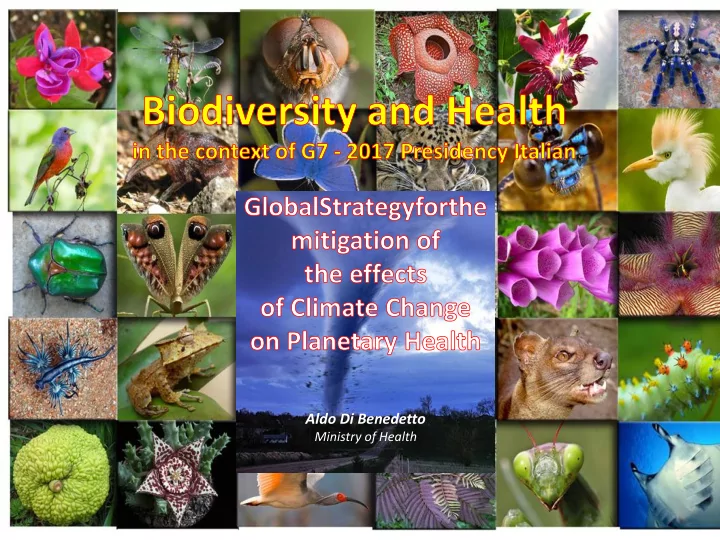
SLIDE 1 Aldo Di Benedetto
Ministry of Health
SLIDE 2
The concerns of the third millennium
which have taken on a paramount importance Are global issues that affect the biosphere but have disturbing consequences for human life Extinction of animal and plant species Loss of biodiversity Resource penalties, expansion of ethnic violence Environmental degradation and health threats Planetary iniquity Climate changes
SLIDE 3
Human health and the health of planet Earth are strictly interconnected
SLIDE 4
Climate changes and health
SLIDE 5
SLIDE 6 In the framework of the 2030 Agenda and building upon the achievements of the past Presidencies, the objective of the Italian Presidency is the formulation and launch of a “Global Strategy for the mitigation of the effects of Climate Change on Planetary Health” This should define both the high priorities and policies, and translate these into practical tools according to the following two principles “one health” and “health for all”.
SLIDE 7 METHODOLOGY
In order to develop this approach, during two meetings with the representatives
G7 Countries and International Organizations, the Italian Presidency has proposed a preparatory process relying on:
- a Matrix, which is a broad and cross-cutting
framework, used as a tool to investigate all the available information, to share strategies and to highlight a set of possible actions
- a Delphi questionnaire, which is structured on
the statements and actions identified in the Matrix for global experts consultation.
SLIDE 8
SLIDE 9 MATRIX
Taking into account the known climate drivers (as identified by IPCC - Intergovernmental Panel on Climate Change in its assessment reports), eight main topics have been identified in the Matrix, as follows the
Extreme Events Health effects of air pollution related to climate change Vector borne diseases Water access and waterborne diseases Food System and Nutrition Animal health at the animal/human interface Migrant’s flows Antimicrobial resistance
In the Matrix, each topic is discussed starting from the ‘exposures’ derived by the climate drivers impact through the ‘health outcomes’ on human and animal health in order to identify strategies (‘expert statements’) leading to possible corrective ‘actions’.
SLIDE 10 Biodiversity in Italy
Italy is one of the richest biodiversity in Europe, thanks to a favorable geographic position and a large geological, climatic and vegetational variety.
The Italian fauna: 58,000 species, of which about 55,000 species of invertebrates, mostly belonging to the class of insects, and 1,258 vertebrates The Italian flora: the upper plants 6,711 species
SLIDE 11 The richness of biodiversity in Italy
Is the richest country in
Europe's Sites of Interest with Environmental Conservation Systems in protected areas at various levels:
- 24 National Parks,
- 26 protected marine areas
- 140 regional parks
covering 10% of the land area.
(Around one million five hundred thousand hectares)
SLIDE 12 The value of the Natural Parks
SLIDE 13
Biodiversity and invasive species
An important problem is the invasion of allergenic plant species with a short life cycle that results in widespread pathologies with very variable seasonality, plus impacts on indigenous biodiversity The country has an additional tool for monitoring and mitigating climate change, including the introduction of aloft and invasive species
SLIDE 14 The Mediterranean Sea has the highest rates of invasion
- ver all European seas; The recent enlargement of the
Suez Canal, along with climate change, will result in further invasion of aloft species In Italy, the largest number of alien species is recorded, in all grading classifications of the living, microbial, vegetal and animal world
3,000 terrestrial aloft species: 1,645 animal species 1,400 plant species 156 whitewashed species and 726 marine species
SLIDE 15
SLIDE 16 Biodiversity and medicine
"Few people realize to what extent Western medicine depends on wild organisms"
Edwards O. Wilson
Philipendula ulmaria: plant where salicylic acid was first extracted
SLIDE 17 Biodiversity and human nutrition
Plants with edible parts are about 30000, but over the course of history
- nly 7000 types have been cultivated and harvested.
Of these, 20 species account for only 90% of the food consumed all over the world; Among these only three species, wheat, rice and maize form more than half We still depend on the plant species discovered and cultivated by our ancestors of the Neolithic in the regions that saw the birth of agriculture
Amaranthus tricolor
SLIDE 18
Biodiversity and resilience
SLIDE 19 Biodiversity, complexity and redundancy
Biodiversity redundancy in an ecosystem is a factor
proportional to its capacity to create new conditions for balance.
SLIDE 20
Process of becoming
It implies ongoing activities and changes that reflect the creative response of the organism to environmental challenges
SLIDE 21 Monet poppies And the systemic vision of health
Form beauty order Emerging organizations
As unexpected properties not owned by the individual parts of the artistic work
Single brush strokes do not have any properties, But something emerges at the level of the whole work, in scientific terms we would say
the "complex system"
SLIDE 22
The concept of dynamic balancing is a useful concept for defining health, not a static equilibrium but a flexible pattern of fluctuations
SLIDE 23 Homeostasis: a coherent key to survival
Some definitions
SLIDE 24
The Earth's atmosphere is constrained by stabilizing, homeostatic forces, those same vital forces that formed it
Human beings and microbes have been living and interacting continuously for millions of years. Rarely, this interaction produces a new illness. Factors that disturb the homeostatic balance of the biosphere may favor this phenomenon
Homeostasis of the biosphere
SLIDE 25 Systemic vision of life recognizes that in living systems living include individual organisms, parts of organisms, organism
- communities. Everyone shares a common set of common and
common organization principles
We can distinguish three levels of interconnected health:
Individual, social, ecological
All variables in a living system fluctuate continuously within tolerance limits: the more dynamic the state of the system is and the redundant, the greater its plasticity For the system, it is essential to adapt to environmental
- change. Loss of complexity , biodiversity, flexibility, means
loss of health Conclusions:
SLIDE 26 Aldo Di Benedetto
SLIDE 27
SLIDE 28
Amleto (Act 1, Scene 5)
«…My mission is to fix this disconnected world»
SLIDE 29 *
Synestanai
from the Greek – put together
The power of relationships
Considering the power of connections allows you to evaluate the multiple combinations of factors that, by affecting each other, give rise to and maintain the health system
"Put together" both living organisms and social systems
SLIDE 30 More is different
That is the title of the article published in the journal Science by Philip Anderson, Nobel Prize for condensed matter physics, symbolizing the manifest of complexity. (Science 1977) «This is more than the sum of the parts»
SLIDE 31
I think the integration of the disciplines is a step forward, but it is not enough, because in order to build a systemic vision, it is necessary to modify the basics of formation through a path based on the culture of complexity.
SLIDE 32