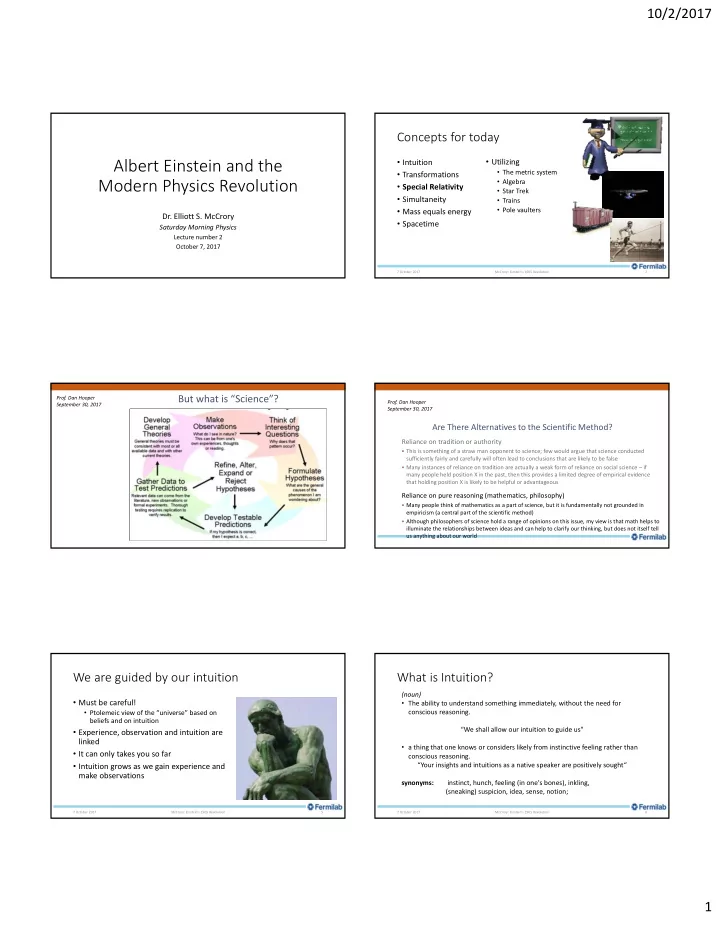
Albert Einstein and the The metric system Transformations Algebra - - PDF document

albert einstein and the
SMART_READER_LITE
LIVE PREVIEW

Albert Einstein and the The metric system Transformations Algebra - - PDF document

10/2/2017 Concepts for today Intuition Utilizing Albert Einstein and the The metric system Transformations Algebra Modern Physics Revolution Special Relativity Star Trek Simultaneity Trains Pole vaulters


slide-1
SLIDE 1

10/2/2017 1

Albert Einstein and the Modern Physics Revolution

  • Dr. Elliott S. McCrory

Saturday Morning Physics Lecture number 2 October 7, 2017

Concepts for today

  • Intuition
  • Transformations
  • Special Relativity
  • Simultaneity
  • Mass equals energy
  • Spacetime
  • Utilizing
  • The metric system
  • Algebra
  • Star Trek
  • Trains
  • Pole vaulters
7 October 2017 McCrory: Einstein's 1905 Revolution 2

But what is “Science”?

  • Prof. Dan Hooper

September 30, 2017

Are There Alternatives to the Scientific Method?

Reliance on tradition or authority

  • This is something of a straw man opponent to science; few would argue that science conducted

sufficiently fairly and carefully will often lead to conclusions that are likely to be false

  • Many instances of reliance on tradition are actually a weak form of reliance on social science – if

many people held position X in the past, then this provides a limited degree of empirical evidence that holding position X is likely to be helpful or advantageous

Reliance on pure reasoning (mathematics, philosophy)

  • Many people think of mathematics as a part of science, but it is fundamentally not grounded in

empiricism (a central part of the scientific method)

  • Although philosophers of science hold a range of opinions on this issue, my view is that math helps to

illuminate the relationships between ideas and can help to clarify our thinking, but does not itself tell us anything about our world

  • Prof. Dan Hooper

September 30, 2017

We are guided by our intuition

  • Must be careful!
  • Ptolemeic view of the “universe” based on

beliefs and on intuition

  • Experience, observation and intuition are

linked

  • It can only takes you so far
  • Intuition grows as we gain experience and

make observations

7 October 2017 McCrory: Einstein's 1905 Revolution 5

What is Intuition?

7 October 2017 McCrory: Einstein's 1905 Revolution 6

(noun)

  • The ability to understand something immediately, without the need for

conscious reasoning. “We shall allow our intuition to guide us"

  • a thing that one knows or considers likely from instinctive feeling rather than

conscious reasoning. “Your insights and intuitions as a native speaker are positively sought“ synonyms: instinct, hunch, feeling (in one's bones), inkling, (sneaking) suspicion, idea, sense, notion;

slide-2
SLIDE 2

10/2/2017 2

Modern Physics: Our Intuition is incomplete

Much is, at first, counter‐intuitive We must develop new intuition

Terminology: A quantity is said to be

  • Invariant
  • If different observers would obtain the same result from a

measurement of this quantity.

  • The mass of an object.
  • Relative
  • If different observers would obtain different result from a

measurement of this quantity.

  • The speed of an object.
7 October 2017 McCrory: Einstein's 1905 Revolution 8

Terms: Frame of Reference

  • A coordinate system and some way to fix stuff

into that coordinate system.

  • A football field
  • This room
7 October 2017 McCrory: Einstein's 1905 Revolution 9

x y z

Terms: Inertial Frame of Reference

  • A frame of reference in which the stuff in it has

no forces acting on them.

  • The stuff is at rest or it moves at a constant velocity in

a straight line.

  • Examples:
  • The car that brought you here this morning, moving steadily
  • A train car moving steadily
  • The bridge of the Enterprise
7 October 2017 McCrory: Einstein's 1905 Revolution 10

Ph Physics ics Velocity : v Distance : d Time : t Gr Greek eek le letters Beta : ß Gamma : γ What are these symbols?

Frame of reference

7 October 2017 McCrory: Einstein's 1905 Revolution 12
slide-3
SLIDE 3

10/2/2017 3

Another term: Coordinate Transformations

A regular transformation: We call this the “Galilean Transformation”

7 October 2017 McCrory: Einstein's 1905 Revolution 13

t t vt x x   

  • Italian astronomer
  • Physicist
  • Engineer
  • philosopher
  • mathematician.
He has been called
  • "father of observational
astronomy",
  • "father of modern physics",
  • "father of the scientific method",
and
  • "father of science".
Galileo studied speed and velocity, gravity and free fall, the principle of relativity, inertia, projectile motion and also worked in applied science and technology, describing the properties of pendulums and "hydrostatic balances", inventing the thermoscope and various military compasses, and using the telescope for scientific observations of celestial
  • bjects.

Galileo Galilei: 1564‐1642 Galileo?

7 October 2017 McCrory: Einstein's 1905 Revolution 14

Example of a coordinate transformation

7 October 2017 McCrory: Einstein's 1905 Revolution 15

t t vt x x   

xo y0 x y v v = 5 [m/s] t0 = 10 [sec] x0 = 0 What are x and t?

Coordinate Transformation Example: Throwing a ball from a moving train car

7 October 2017 McCrory: Einstein's 1905 Revolution 16

vball = -vtrain = 70 MPH What is the velocity of the ball when it emerges from the train?

Recap: Frame of reference

7 October 2017 McCrory: Einstein's 1905 Revolution 17

1905

The Year

slide-4
SLIDE 4

10/2/2017 4

Physics into 1905: Many successes!

  • Newton’s laws of mechanics are known and are

very accurate

  • The laws of electricity and magnetism were

discovered and have been determined to be very accurate

7 October 2017 McCrory: Einstein's 1905 Revolution 19

Physics into 1905: Many successes!

  • Newton’s laws of gravity are very accurate
  • Predicts orbits of the planets and their moons
  • Predicts appearance of comets
  • Predicts eclipses
7 October 2017 McCrory: Einstein's 1905 Revolution 20

But ..

There are a few loose ends to tidy up. A big one is contained within Maxwell’s Equations of Electricity and Magnetism

Electricity and magnetism: Maxwell’s Equations

Maxwell’s Equations, 1862

  • James Clerk Maxwell, 1831‐1879
  • Form the foundation of classical

electromagnetism, quantum field theory, classical optics, and electric circuits.

7 October 2017 McCrory: Einstein's 1905 Revolution 23

Maxwell’s Equations (for reference)

Note that the speed of light, c, is part of these equations

slide-5
SLIDE 5

10/2/2017 5

Maxwell’s Equations: Powerful and accurate

  • Electricity and magnetism are the same thing
  • Predict the existence of light waves.
  • Light is a form of electromagnetism
  • Light travels with a velocity of 299,792,458 meters

per second (“the speed of light”, c)

  • Wow! That’s Fabulous!
7 October 2017 McCrory: Einstein's 1905 Revolution 25

Maxwell’s Equations: Powerful and accurate

  • But Maxwell’s Equations have a some strange features:

The speed of light is the same for all observers They are not invariant under a Galilean coordinate transformation

7 October 2017 McCrory: Einstein's 1905 Revolution 26

The Speed of Light

  • It seems like* speed is relative:
  • Maxwell's Equations say that the speed of light is invariant

?? ' ' ' '

?

v c c v v v t t vt x x       

7 October 2017 McCrory: Einstein's 1905 Revolution 27

* Intuition

What do Maxwell’s Equations say?

  • Light travels at the same speed even if the observer is moving
  • Velocities do not add up in the expected way
  • How’s that?
  • Mathematicians to the rescue
7 October 2017 McCrory: Einstein's 1905 Revolution 28

v v v   '

Hendrik Lorentz (1823‐1928)

  • Lorentz developed a coordinate

transformation that kept Maxwell’s Equations invariant

  • By doing deep math on these complicated

equations – amazing!

  • Maxwell’s Equations are invariant under the

Lorentz transformation.

7 October 2017 McCrory: Einstein's 1905 Revolution 29

Coordinate Transformations

Galilean transformation:

7 October 2017 McCrory: Einstein's 1905 Revolution 30

t t vt x x   

2 2 2

/ 1 1 ) ( c v c vx t t vt x x               

Lorentz transformation:

slide-6
SLIDE 6

10/2/2017 6

Understanding of Lorentz Transformations in 1905

  • Even at the speed of sound, 340 m/s, this

“gamma” factor is almost irrelevant:

7 October 2017 McCrory: Einstein's 1905 Revolution 31

* Intuition

0064 0000000000 . 1 99357 9999999999 . 1 / 1 ) 458 , 792 , 299 / 340 ( 1 / 1 ) / ( 1 / 1

2 2

         c v

2 2 2

/ 1 1 ) ( c v c vx t t vt x x               

Understanding of Lorentz Transformations in 1905

  • For speeds a lot less than the speed of light,

Galilean and Lorentz transformations are identical.

7 October 2017 McCrory: Einstein's 1905 Revolution 32

* Intuition 2 2 2

/ 1 1 ) ( c v c vx t t vt x x               

2 2

1 0064 0000000000 . 1 / 1 1 t t vt x x c v          

Understanding of Lorentz Transformations in 1905

  • However, for speeds close to the speed of light,

Lorentz transformation predicted weird things.

  • This seemed* so radical that scientist were reluctant to

accept it

  • For example, what happens when v=c?
  • Or worse: when v>c??
  • Then there came along this patent clerk in Bern,

Switzerland ...

7 October 2017 McCrory: Einstein's 1905 Revolution 33

* Intuition 2 2 2

/ 1 1 ) ( c v c vx t t vt x x               

Albert Einstein (1879 – 1955)

  • At age 4 (1883)
  • At 23 (1902): Patent clerk
  • At 26 (1905): Published 4 papers that

changed everything

  • At 29 (1908): Professor at U Bern
  • At 36 (1915): Published The General Theory
  • f Relativity
  • At 42 (1921): Nobel Prize
  • At 54 (1933): Emigrated to America
  • At 76 (1955): Completes The Meaning of

Relativity, 5th edition

7 October 2017 McCrory: Einstein's 1905 Revolution 34

1905: Einstein’s Extraordinary Year

  • https://en.wikipedia.org/wiki/Annus_Mirabilis_papers
  • Annus Mirabilis = Extraordinary year
  • Einstein published four spectacular papers, which derived

explanations for:

1. The Photoelectric Effect 2. Brownian Motion 3. Coordinate transformations in Maxwell’s Equations (Special Relativity)  4. Mass‐energy equivalence 

7 October 2017 McCrory: Einstein's 1905 Revolution 35

1905: Old Memes ‐ Gone

  • He introduced to humans:
  • Quantum Mechanics
  • Special Relativity
  • E=mc2
7 October 2017 McCrory: Einstein's 1905 Revolution 36
slide-7
SLIDE 7

10/2/2017 7

4 papers: More than a century of physics

  • Each of these papers, individually,

would have turned physics on its head

  • All of them together from one

person, in one year, is (to me) incomprehensible!

7 October 2017 McCrory: Einstein's 1905 Revolution 37

Genius

  • Einstein was one of the hardest‐working scientists of the 20th Century
7 October 2017 McCrory: Einstein's 1905 Revolution 38

Thomas Edison, 1903

Ph Physics ics: Velocity (v), Distance (d) and Time (t)

Hint: Use the units [meters per second] = [meters] ÷ [second] [m] = [m/s]  [s] [s] = [m] ÷ [m/s]

v d t vt d t d v / /   

7 October 2017 McCrory: Einstein's 1905 Revolution 39

Special Relativity

And now …

"On the Electrodynamics of Moving Bodies”

Special Relativity

Einstein stipulated

  • The laws of nature are the same in all inertial frames of

reference.

  • Intuition
  • The speed of light in the vacuum is the same in all inertial

frames of reference.

  • Recognized as a (crazy?) feature of Maxwell’s Equations
7 October 2017 McCrory: Einstein's 1905 Revolution 42
slide-8
SLIDE 8

10/2/2017 8

What can we predict* from these two assumptions?

Let invent a new type of clock and see

* Scientific method

The Light Clock

7 October 2017 McCrory: Einstein's 1905 Revolution 44

Time = distance / velocity

tc h c h t v h t

2 1

/ 2 / 2   

For a clock that ticks every t seconds, the mirrors are ½ tc apart

7 October 2017 McCrory: Einstein's 1905 Revolution 45

The clock ticks at a rate of 2h/c seconds

For the clock to tick at 1 second ] [ 229 , 896 , 149 ] / [ 8 299,792,45

2 1 2 1

m h s m c c h tc h     

7 October 2017 McCrory: Einstein's 1905 Revolution 46

The Light Clock

(150 million meters: 1/3 of the way to the moon)

Remember, we assumed The speed of light is the same for all observers

slide-9
SLIDE 9

10/2/2017 9

β ≡ v/c

“The Greek letter beta is defined to be v over c”

From the perspective of the Light Clock

50

vEnterprise < c

v

h

t=0 t=x/v t=2x/v

From the perspective of the Enterprise

51 2 2

x h 

x x

 

c vt h t vt x c x h t

2 2 2 2

     

v

h x

How long does it take for the initial “Tock”?

x 52 2 2 x h  t=0 t=x/v t=2x/v

A little algebra …

53

     

    ...

2 2 2 2 2 2 2 2 2 2 2 2 2 2 2 2 2 2 2 2 2 2 2 2 2 2

v c t h h v c t h t v c t t v h c t vt h c t vt h tc c vt h t              

v

h x x 2 2 x h  t=0 t=x/v t=2x/v

A little more algebra …

54

   

2 2 2 2 2 2 2 2 2 2 2 2 2 2 2 2 2 2

1 / 1 1 1 1 1 1 1                                t t c h t c h t t c h c t h c v c t h

 

 

c v v c t h c vt h t      

2 2 2 2 2 2

...

slide-10
SLIDE 10

10/2/2017 10

Lorentz Transformation of time!

The time for the light to travel this path is longer to the Enterprise observer than it is to the observer sitting on the clock! The time is “dilated”

7 October 2017 McCrory: Einstein's 1905 Revolution 55

2

1    t t

Wow! That’s Fantastic!

Dilate

7 October 2017 McCrory: Einstein's 1905 Revolution 57

v.tr. To make wider or larger; cause to expand. v.intr.

  • 1. To become wider or larger; expand.
  • 2. To speak or write at great length on a subject

; expatiate.

The passage of time on the Enterprise has to be slower than the passage of time on the mirrors!

In other words …

For the observer on the Enterprise and the

  • bserver on the mirrors to see the light to go

between the mirrors the same way, … Special Relativity Shorthand

2

1 1    

Speed [m/s] Beta Gamma Example 1 You and me in Wilson Hall 36 1.210‐7 1 Me on I‐88 343 1.110‐6 1 Speed of sound 3889 1.310‐5 1.00000000008 Speed of a GPS Satellite 1498962 0.005 1.00001 Fermilab Ion Source protons 2.997924E+07 0.1 1.01 5.995849E+07 0.2 1.02 1.498962E+08 0.5 1.15 2.098547E+08 0.7136 1.43 Fermilab Linac protons 2.698132E+08 0.9000 2.29 2.967945E+08 0.9945 9.53 Fermilab Booster protons 2.994927E+08 0.9990 22.4 2.997625E+08 0.9999000 70.7 2.997895E+08 0.9999653 120 Main Injector Protons 2.997921E+08 0.9999990 707 2.997924E+08 0.9999999 2236 2.997924E+08 0.9999999898 7000 Large Hadron Collider protons 7 October 2017 McCrory: Einstein's 1905 Revolution 59

  / t t t t  

The time observed on the moving clock is longer than the observer’s clock The time on the observer’s clock is shorter than the moving clock

Re Recap: Time dilation

slide-11
SLIDE 11

10/2/2017 11

How long is one second, as seen from the Earth,

  • n the Enterprise for v = 0.25c ? *

2

1 /      t t t t

E E c/4

* ST:TNG Technical Manual: “High relativistic speeds are to be avoided unless absolutely necessary; impulse power should be limited to a maximum of 1⁄4 lightspeed” 7 October 2017 McCrory: Einstein's 1905 Revolution 61
  • A. 0.9682
  • B. 3.1416
  • C. 0.7071
  • D. 1.0328
  • E. 1.1412

Light Clock also leads to length contraction

v = ßc

d

 / d d 

62

c d t / 2

0 

d0

v = ßc

The time for the light to make one round trip as seen while sitting on the clock

t0 : Time as seen on the clock d0 : Distance as seen on the clock t : Time as seen on the Enterprise d : Distance as seen on the Enterprise

7 October 2017 McCrory: Einstein's 1905 Revolution 63

 

v c d t c v c d t c v c d t c d c v t c vt c d t                

1 1 1 1 1 1

/ 1 / 1 / 1

The time for the light to go from left to right, as seen from NCC‐1701D

v = ßc

d - (a little bit)

 

v c d t c v c d c v c d t c d c v t t c v c d t                

2 2 2 2 2

/ 1 / 1 / 1

The time for the light to go from right to left, as seen from NCC‐1701D

v = ßc

d + (a little extra)

v c d v c d t t t t      

2 1

The total time for the light to go from left to right, and back, as seen from NCC‐1701D

7 October 2017 McCrory: Einstein's 1905 Revolution 66
slide-12
SLIDE 12

10/2/2017 12

        

2 2

2 2 1 1 b a a b a b a a b a b a b a b a b a b a b a b a                                       We’ll use this:

 

2 2 2 2 2 2 2 2 2

2 2 2 1 1 2 1 2 2     ct d d ct c d c d c v c cd v c c d v c d v c d t                                           

2

2 / ) 2 /( ) ( 2 2 2 d d c t d c t d c t c t t t t t tc d           

Special Relativity Summary

1 d d t t    

Time Dilation Length Contraction

7 October 2017 McCrory: Einstein's 1905 Revolution 69

c v / 1 / 1

2

     

With,

A nice velocity

7 October 2017 McCrory: Einstein's 1905 Revolution 70

2 5 . / 1 75 . 1 / 1 749956 . 1 / 1 ) 866 . ( 1 / 1 866 . 866 .

2

            c v

Questions?

Simultaneity

  • Noun form of “simultaneous”
  • Two events happen simultaneously

when you see/observe that they have

  • ccurred at the same time.
  • The fact that the speed of light is the

same to all observers means that our intuitive understanding of simultaneity needs to be extended.

  • Let’s see why
7 October 2017 McCrory: Einstein's 1905 Revolution 71

A thought experiment: Stationary train car

3 nanoseconds 6 nanoseconds 9 nanoseconds 12 nanoseconds

7 October 2017 McCrory: Einstein's 1905 Revolution 72

7.3 m (24 feet) A light pulse

slide-13
SLIDE 13

10/2/2017 13

The light pulses hit the ends simultaneously

12 nanoseconds

7 October 2017 McCrory: Einstein's 1905 Revolution 73

About 7.3 m (24 feet)

7 October 2017 McCrory: Einstein's 1905 Revolution 74

A thought experiment: Moving train car

The The lig light hi hits ts the the back back of

  • f the

the tr train ca car fir first

7 October 2017 McCrory: Einstein's 1905 Revolution 75 Repeat this animation

Simultaneity is different (!!!)

  • Because the speed of light is the same for all observers …
  • The observer on the train sees the light hit the ends of the train

simultaneously

  • The observer on the ground sees the light hit the ends of the train at

different times.

7 October 2017 McCrory: Einstein's 1905 Revolution 76

Scientists tried to disprove counter‐intuitive aspects of Special Relativity

10 meters Velocity: v

Physicist’s view of a pole vaulter

7 October 2017 McCrory: Einstein's 1905 Revolution 78
slide-14
SLIDE 14

10/2/2017 14

Physicist’s view of a barn

7 October 2017 McCrory: Einstein's 1905 Revolution 79

5 meters

A pole vaulter and a barn

10 meters 5 meters

7 October 2017 McCrory: Einstein's 1905 Revolution 80

Let the speed of vaulter be 0.866c (γ = 2)

5 meters 5 meters

 / d d 

7 October 2017 McCrory: Einstein's 1905 Revolution 81

5 meters

Barn, with doors shut, fully contains vaulter

7 October 2017 McCrory: Einstein's 1905 Revolution 82

5 meters

And the vaulter keeps running, pole in tact

7 October 2017 McCrory: Einstein's 1905 Revolution 83

From the point of view of the vaulter

10 meters 2.5 meters

7 October 2017 McCrory: Einstein's 1905 Revolution 84

v=0.866c

slide-15
SLIDE 15

10/2/2017 15

A Paradox?

Either the pole gets smashed by the doors or it does not! It cannot be both whole and broken. Resolving this is a little tricky.

Questions?

What causes the doors to close?

5 meters

7 October 2017 McCrory: Einstein's 1905 Revolution 86

causality

noun The relationship between cause and effect.

causal

adjective Relating to or acting as a cause.

Causality can travel no faster than the speed of light

So, let’s use a light‐based signal to cause the doors to close

What causes the doors to close?

5 meters Sensor

7 October 2017 McCrory: Einstein's 1905 Revolution 89

The signal propagates to the doors …

5 meters Sensor

7 October 2017 McCrory: Einstein's 1905 Revolution 90
slide-16
SLIDE 16

10/2/2017 16

… And causes doors to close

Just like the train car, previously!

5 meters Sensor

7 October 2017 McCrory: Einstein's 1905 Revolution 91

And vaulter continues with an unbroken pole

5 meters Sensor Questions?

7 October 2017 McCrory: Einstein's 1905 Revolution 92 Repeat this animation

From the point of view of the vaulter

2.5 meters

7 October 2017 McCrory: Einstein's 1905 Revolution 93

The front door closes (quickly)

7 October 2017 McCrory: Einstein's 1905 Revolution 94

The front door opens

7 October 2017 McCrory: Einstein's 1905 Revolution 95

Back door closes when the signal reaches it

7 October 2017 McCrory: Einstein's 1905 Revolution 96
slide-17
SLIDE 17

10/2/2017 17

And vaulter continues with an unbroken pole

7 October 2017 McCrory: Einstein's 1905 Revolution 97 Repeat this animation

The paradox is resolved through careful application of cause‐and‐ effect in Special Relativity

10 meters 5 meters

7 October 2017 McCrory: Einstein's 1905 Revolution 98

More on this apparent paradox …

  • https://en.wikipedia.org/wiki/Ladder_paradox
  • YouTube: “Relativity 5b ‐ pole and barn paradox”, by viascience.
  • https://www.youtube.com/watch?v=0TU1tKTOIj4

At first, this seemed counter‐intuitive We have improved our intuition

7 October 2017 McCrory: Einstein's 1905 Revolution

Equivalence of mass and energy

“Does the Inertia of a Body Depend Upon Its Energy Content?”

E = mc2

101

Special Relativity: E = mc2

  • It is possible to derive this formula using algebra
  • Energy = force  distance
  • Force = the change in the momentum of an object
  • Lorentz transformations of time (that is, the velocity)
  • But it is easier (and cleaner) to use calculus
  • http://www.emc2‐explained.info/Emc2/Deriving.htm
7 October 2017 McCrory: Einstein's 1905 Revolution 102
slide-18
SLIDE 18

10/2/2017 18

E = mc2

Derived using only math (mostly algebra) and the two conjectures:

  • 1. The laws of nature are the same in all inertial frames of reference.
  • 2. The speed of light in the vacuum is the same in all inertial frames of reference.

Mind: Blown! Wonderful Theoretical Fun!

Energy and mass are the same thing

An aside: Our nomenclature at Fermilab

  • Physicists at Fermilab set the speed of light equal to one

E = m

  • This is only a change in units
  • Emphasizing even more clearly that energy is the same thing as mass
7 October 2017 McCrory: Einstein's 1905 Revolution 105

What does this mean? E = mc2

  • What is the energy of 1 gram of matter?

E = 0.001 [kg](2.998  108 [m/s])2 E = 1  10-3 8.988004  1016 [kg m2/sec2] E = 8.988004  1013 [Joules] E ≈ 90 Terajoules  Burning 691,538 gallons of gasoline  Exploding 42,964,554 pounds (21.5 kilo‐tons (kT)) of TNT

7 October 2017 McCrory: Einstein's 1905 Revolution 106

First atomic bomb: Hiroshima (USA, fission)

  • Hiroshima bomb: 63 Terajoules [6.3  1013 Joules] (15 kT)
  • Equivalent to about 0.7 grams of matter converted to energy
7 October 2017 McCrory: Einstein's 1905 Revolution 107

Largest bomb: Tsar Bomba (USSR, fusion)

  • Tsar Bomba: 240 Petajoules [2.4  1017 joules] (57 MT)
  • 3800 times larger than Hiroshima bomb
  • Converted about 2.7 kg of matter into energy
7 October 2017 McCrory: Einstein's 1905 Revolution 108
slide-19
SLIDE 19

10/2/2017 19

How do we know Special Relativity is accurate?

No Lorentz violations could be measured thus far, and exceptions in which positive results were reported have been refuted or lack further confirmations.

Everyday uses of Special Relativity

  • Global Positioning System (GPS)
  • Muon Decay
7 October 2017 McCrory: Einstein's 1905 Revolution 111

GPS is based on very accurate clocks

  • GPS clock ticks must be known to an accuracy of 20‐30 nanoseconds
  • ~5 meters on the road.
  • GPS satellites are constantly moving relative to Earthly observers
  • These clocks move a little more slowly
  • Special Relativity predictions … next slide
  • GPS also gets substantial corrections from General Relativity
http://www.astronomy.ohio‐state.edu/~pogge/Ast162/Unit5/gps.html 7 October 2017 McCrory: Einstein's 1905 Revolution 112

GPS: How big an effect is satellite motion?

Speed of a GPS satellite is 14,000 KPH (3889 m/s)

βsatellite = 3889 / 299,792,458 = 0.0000129633 γsatellite = 1.00000000008402 One day = 84600 seconds γsatellite(one day) = 84600.0000071084 seconds 7.1 microseconds off

   

2

1 / 1 / t t c v    

This means that over a day, your position inaccuracy would grow from about 5 meters to about 300 meters.

7 October 2017 McCrory: Einstein's 1905 Revolution 113

An aside – GPS and General relativity

  • The satellite is in micro‐gravity
  • The receiver is in Earth gravity
  • General Relativity:
  • Earth clock runs 38 microseconds slower per day
  • 5.4X bigger effect than Special Relativity
  • About a mile of error per day
7 October 2017 McCrory: Einstein's 1905 Revolution 114
slide-20
SLIDE 20

10/2/2017 20

Muon Decay

  • 1941 experiment
  • Now a common experiment in

a graduate physics laboratory

115

Distance: 10,000 meters Time = distance / velocity t = 1104 [m]/( (0.98) (3 108 [m/s] )) t = 34  10‐6 [sec] Muon lifetime = 2.2  10‐6 [sec] 15.5X longer Expect to see about 20 muons

20

No relativity

Distance: 10,000 meters Time = distance / velocity tEnterprise = t0 / γ t = (1104 [m]/( (0.98) (3 108 [m/s] )))/ γ t = (34  10‐6 [sec]) / γ t =6.8  10‐6 [sec] Muon lifetime = 2.2  10‐6 [sec] 3.1X longer Expect to see about 116,000 muons

With time dilation

025 . 5 0396 . 1 98 . 1 1 1 1 2 2        

116,000

Special Relativity includes Newton and E&M

  • Special Relativity extends Newtonian Mechanics to close‐to‐c speeds,

but it does not contradict it

  • It includes all of Newtonian Mechanics in its entirety.

Questions?

7 October 2017 McCrory: Einstein's 1905 Revolution 118

Special Relativity

Newtonian Mechanics Electro‐ magnetism (Maxwell)

General Relativity …

  • Einstein’s Relativity does not

end here

  • General relativity combines

acceleration (non‐inertial reference frames) with gravity

  • Gravity is a result of the

geometry of spacetime (!)

7 October 2017 McCrory: Einstein's 1905 Revolution 119 We are moving fast enough that you might think we have the time to go over General Relativity in some detail. But, alas, we do not.

Spacetime

slide-21
SLIDE 21

10/2/2017 21

Time I‐88

Past Future

600 seconds You and me now Fermilab Davenport Chicago You and me in 5 minutes

7 October 2017 McCrory: Einstein's 1905 Revolution 121

Time I‐88

600 seconds 10 miles What are our speeds? 15 miles As seen from Wilson Hall Davenport Chicago Fermilab At about 12:05 PM today

7 October 2017 McCrory: Einstein's 1905 Revolution 122

You = 10 miles / (1/6 hr) = 60 MPH Me = 15 miles / (1/6 hr) = 90 MPH

Time I‐88

600 seconds 5 miles You on I88 Same thing, as seen from your car

7 October 2017 McCrory: Einstein's 1905 Revolution 123

2 sec 1 sec

7 October 2017 McCrory: Einstein's 1905 Revolution 124

Us Space Time

Mirror at 299,792,458 meters Mirror at

  • 299,792,458 meters

Causality: The fastest a signal can travel is c

Space Time

7 October 2017 McCrory: Einstein's 1905 Revolution 126 US
slide-22
SLIDE 22

10/2/2017 22

Space Time

Causal Non‐causal Non‐causal

7 October 2017 McCrory: Einstein's 1905 Revolution 127

Units of mass and energy

  • We use “Electron Volts” as an energy
  • 1.6×10⁻¹⁹ joules
  • Since mass=energy, we also say that a

particle has a mass in “electron volts”

7 October 2017 McCrory: Einstein's 1905 Revolution 128

] [ 938 ] 938272081[ ] [ 511 ] [ 510999 MeV eV m keV eV m

p e

   

Converting between energy and mass

  • When two particles collide at high energy, the result has a lot of

energy

  • Often (usually) this energy becomes mass.
7 October 2017 McCrory: Einstein's 1905 Revolution 129

Intuition … reprise

  • How do we know what we know?
  • Intuition
  • Deduction
  • Observation
  • This talk:
  • Intuition can be incomplete
  • “Counter intuitive”
  • Deduction and observation can be amazing
7 October 2017 McCrory: Einstein's 1905 Revolution 130

In other words, Special Relativity is

A triumph of the Scientific Method

Special Relativity: Conclusions

  • Time dilates
  • Length contracts
  • Simultaneity is relative
  • Matter and energy are the same thing
  • It agrees, impressively, with experiments
  • Our old intuition must change
  • Maxwell’s Equations are correct
  • And they always have been
  • Einstein was clever
7 October 2017 McCrory: Einstein's 1905 Revolution 132

1 d d t t    

c v / 1 / 1

2

     

slide-23
SLIDE 23

10/2/2017 23

Conclusions

Weary, though fascinated!

  • Einstein was one of the greatest minds ever
  • 1905: Four papers changed humans’ understanding of the physical

world

  • Special Relativity: Old intuition of space and time must be adjusted
  • Algebra is cool
7 October 2017 McCrory: Einstein's 1905 Revolution 134

Relativity does not end here

  • General relativity
  • Einstein’s life’s work
  • Space is warped by mass
  • Mass moves according to how

space is warped

  • Mind‐blowing predictions:
  • Precession of the orbit of Mercury
  • Light is bent by a gravity field
  • Black holes
  • Expansion of the universe
  • Gravity waves
7 October 2017 McCrory: Einstein's 1905 Revolution 135

That’s all, folks!

These slides:

  • 1. https://smp.fnal.gov
  • 2. “Session I: Fall 2017”

The other 1905 Einstein papers were also profound Brownian Motion

slide-24
SLIDE 24

10/2/2017 24

“Investigations on the theory of Brownian Movement”

Brownian Motion

7 October 2017 McCrory: Einstein's 1905 Revolution 139

Brownian Motion

  • A tiny, visible object

(suspended in water) will move about randomly.

  • Could the pollen grains be

alive?

  • Nope. Shown to happen

with lab‐created inanimate stuff

7 October 2017 McCrory: Einstein's 1905 Revolution 140

Botanist Robert Brown, 1773‐1858

Brownian Motion: Einstein

  • Einstein solved the

problem, assuming “molecules” are what is pushing the object around.

  • His calculations revealed

the size of these molecules

  • Avagadro’s Number
7 October 2017 McCrory: Einstein's 1905 Revolution 141

"On a Heuristic Point of View about the Creation and Conversion of Light”

Photoelectric Effect

7 October 2017 McCrory: Einstein's 1905 Revolution 142

The Photoelectric Effect

  • Covered last week by Professor Hooper
  • Emission of electrons when light shines
  • nto a material … sometimes
  • This phenomenon was discovered by

Hertz and Hallwachs in 1887.

7 October 2017 McCrory: Einstein's 1905 Revolution 143

Interpretation based on Maxwell’s Equations

  • Light is a wave
  • Brighter light  More energetic electrons
  • Brighter light  More prompt emission of electrons
  • Dim light: electrons would be released slowly and at low energy
7 October 2017 McCrory: Einstein's 1905 Revolution 144
slide-25
SLIDE 25

10/2/2017 25

Observations

  • In 1902, Lenard observed that the energy of individual emitted

electrons increased with the color of the light, but not the intensity.

  • Furthermore, when the color was blue enough, electrons would be

emitted instantly

7 October 2017 McCrory: Einstein's 1905 Revolution 145

Max Planck

  • Studied the radiation emitted from a glowing body
  • “Black Body Radiation”
  • (Radiation: energy from light)
7 October 2017 McCrory: Einstein's 1905 Revolution 146

How to fit this frequency curve?

  • Assume that electromagnetic energy could be

emitted only in quantized form

  • He introduced a new constant, h:

E = hν

  • h is Planck's constant,

6.62607×10⁻³⁴ [Joules seconds]

  • ν (“nu”) is the frequency of the radiation.
  • Scientists appreciated the novelty and correctness

(mathematically) of this assumption, but they did not (particularly) like what this meant!

7 October 2017 McCrory: Einstein's 1905 Revolution 147

Max Planck and Einstein

  • Einstein showed that Planck’s assertion, that light is made up of

particles, would resolve the photoelectric effect

  • Light comes in quanta, and they behave like particles in the

Photoelectric effect

  • These particles (now called “photons”) hit electrons in the atoms of

the metal and can only kick them out if the energy of the photos is high enough

7 October 2017 McCrory: Einstein's 1905 Revolution 148

Wave/particle duality

  • The photoelectric effect helped to propel the then‐emerging concept
  • f wave–particle duality in the nature of light.
  • Light simultaneously possesses the characteristics of both waves and

particles, each being manifested according to the circumstances.

  • It was soon realized that particles with mass also have a wavelength
7 October 2017 McCrory: Einstein's 1905 Revolution 149

Full equation for total energy

  • In other words …
  • Anything with energy has

momentum

  • A photon has momentum
7 October 2017 McCrory: Einstein's 1905 Revolution 150 4 2 2 2 4 2 2 2 4 2 4 2 2 2 4 2 4 2 2 2 2 4 2 4 2 2 2 4 2 2 2 4 2 4 2 2 2 4 2 4 2 4 2 2 2

1 1 1 c m c p E c m c p c m c m c p c m mv p c m c v m c m c m c v c m c v c m c m c v c m c m c m E mc E                            

4 2 2 2

c m c p E  

Return
slide-26
SLIDE 26

10/2/2017 26

An aside: No new physics in 20th Century?

  • One school of thought:
  • Classical mechanics could cope with highly complex problems involving macroscopic situations
  • Thermodynamics and kinetic theory were well established
  • Geometrical and physical optics could be understood in terms of electromagnetic waves
  • Conservation laws for energy and momentum (and mass) were widely accepted
  • It was generally accepted that all the important laws of physics had been discovered
  • Research would be concerned with clearing up minor problems and particularly with improvements of method and
measurement.
  • However, A. A. Michelson's in his 1899 lectures Light Waves and Their Uses:
  • What would be the use of extreme refinement in the science of measurement?
  • […] all future discovery must lie [here].
  • The more important fundamental laws and facts of physical science have all been discovered, and these are now so firmly
established that the possibility of their ever being supplanted in consequence of new discoveries is exceedingly remote.
  • Nevertheless, it has been found that there are apparent exceptions to most of these laws, and this is particularly true when
the observations are pushed to a limit, i. e., whenever the circumstances of experiment are such that extreme cases can be
  • examined. Such examination almost surely leads, not to the overthrow of the law, but to the discovery of other facts and
laws whose action produces the apparent exceptions. 7 October 2017 McCrory: Einstein's 1905 Revolution 151

Some perspective on Annus Miralilis

  • Worked as an examiner at the Patent Office in Bern, Switzerland
  • Limited access to scientific reference materials,
  • Co‐worker: “[Einstein] could not have found a better sounding board for his

ideas in all of Europe".

  • Einstein tackles some of the era's most important physics questions
  • These papers solved the primary scientific problems of the era:
  • Lord Kelvin lecture titled "Nineteenth‐Century Clouds over the Dynamical

Theory of Heat and Light”

  • Michelson–Morley experiment
  • Black body radiation.
  • Coordinate transformation of Maxwell’s Equations.
7 October 2017 McCrory: Einstein's 1905 Revolution 152