Akila Viswanathan, MD MPH BWH/Dana-Farber Cancer Institute Harvard - - PowerPoint PPT Presentation

akila viswanathan md mph bwh dana farber cancer institute
SMART_READER_LITE
LIVE PREVIEW

Akila Viswanathan, MD MPH BWH/Dana-Farber Cancer Institute Harvard - - PowerPoint PPT Presentation

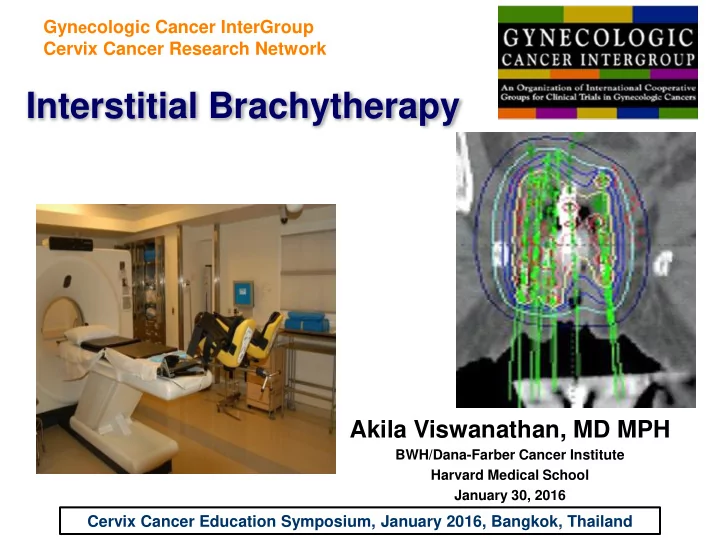
Gyn e cologic Cancer InterGroup Cervix Cancer Research Network Interstitial Brachytherapy Akila Viswanathan, MD MPH BWH/Dana-Farber Cancer Institute Harvard Medical School January 30, 2016 Cervix Cancer Education Symposium, January 2016,


slide-1
SLIDE 1

Gynecologic Cancer InterGroup Cervix Cancer Research Network

Cervix Cancer Education Symposium, January 2016, Bangkok, Thailand

Interstitial Brachytherapy

Akila Viswanathan, MD MPH

BWH/Dana-Farber Cancer Institute Harvard Medical School January 30, 2016

slide-2
SLIDE 2

Gynecologic Cancer InterGroup Cervix Cancer Research Network

Cervix Cancer Education Symposium, January 2016, Bangkok, Thailand

Challenges to 3D interstitial

ACCESS

1. Expertise 2. Applicators (precision, expense) 3. Imaging (CT, MRI, PET…)

TREATMENT PLANNING

  • 3. Utilization of images or contouring (relevant information)
  • 4. Treatment planning systems (variability)

5. Treatment planning parameters (standardization)

OUTCOMES

  • 6. Outcome measures (#s, local control, toxicity)
  • 7. Patient quality of life (inpatient, bedrest)
  • 8. Time (physician and physicist)
slide-3
SLIDE 3

Gynecologic Cancer InterGroup Cervix Cancer Research Network

Cervix Cancer Education Symposium, January 2016, Bangkok, Thailand

Patient Assessment

  • Speculum

– Assess vaginal disease – Place gold seed at inferior extent

  • Manual

– Assess vaginal width – Tumor size – Fixation to one side – Fistula

slide-4
SLIDE 4

Gynecologic Cancer InterGroup Cervix Cancer Research Network

Cervix Cancer Education Symposium, January 2016, Bangkok, Thailand

Indications for Interstitial

  • Large Cervical Ca

– Vaginal involvement – Sidewall involvement – Bladder involvement

  • Vaginal Cancer

(>5mm thickness)

  • Vulvar Cancer with

vaginal extension

  • Urethral Cancer,

Bladder Cancer

slide-5
SLIDE 5

Gynecologic Cancer InterGroup Cervix Cancer Research Network

Cervix Cancer Education Symposium, January 2016, Bangkok, Thailand

Indications

  • Postop recurrence
  • Recurrent endometrial

cancer in vagina

  • Ovarian recurrence in

vagina

  • Extensive distal

vaginal involvement from any ca

  • Large pelvic mass
  • Fistula
slide-6
SLIDE 6

Gynecologic Cancer InterGroup Cervix Cancer Research Network

Cervix Cancer Education Symposium, January 2016, Bangkok, Thailand

  • Historically, either laparoscopic,

laparotomy or no guidance

  • 10% toxicity rate (Syed IJROBP 2002; 54:67-78 )
  • 11% rate bowel insertion (Eisbruch 1998)
  • Long-term fistula formation ~4-10%
  • Imaging: US, MR or CT improves
  • utcomes
slide-7
SLIDE 7

Gynecologic Cancer InterGroup Cervix Cancer Research Network

Cervix Cancer Education Symposium, January 2016, Bangkok, Thailand

Cylinder vs Interstitial

Cylinder

  • For postop endo ca

Interstitial

  • For gross disease
slide-8
SLIDE 8

Gynecologic Cancer InterGroup Cervix Cancer Research Network

Cervix Cancer Education Symposium, January 2016, Bangkok, Thailand

Clinical preparation

  • Post EB exam, H/P
  • Seed placement
  • Pre-op anethesia check
  • Bowel prep
  • NPO
  • Baseline toxicity

assessment

  • DVT prophylaxis
slide-9
SLIDE 9

Gynecologic Cancer InterGroup Cervix Cancer Research Network

Cervix Cancer Education Symposium, January 2016, Bangkok, Thailand

Applicators: Individualize Selection

  • Syed

– Circular formation

  • Martinez

– Angled insertion to cover parametria – No obturator/not for vaginal ca

  • Ring or ovoids with needles

– Short needles to cover – Not for extensive vaginal ca

  • Cylinder with catheters (multichannel)
  • Free hand

– Customized design

slide-10
SLIDE 10

Gynecologic Cancer InterGroup Cervix Cancer Research Network

Cervix Cancer Education Symposium, January 2016, Bangkok, Thailand

Applicators

Tempalte Interstitial Tandem and Ring Tandem and Ovoids Multichannel cylinder

slide-11
SLIDE 11

Gynecologic Cancer InterGroup Cervix Cancer Research Network

Cervix Cancer Education Symposium, January 2016, Bangkok, Thailand

Need for central tandem

  • 70 pts cervical cancer pts

– All IIIB

  • EBRT+LDR
  • Tandem used in 73%
  • Only sig predictor of OS on MVA was

use of a tandem (HR 0.46)

Pinn-Bingham M et al. IJROBP. 2012. Int J Gynecol Cancer. 2009.

ABS guidelines recommend use of central tandem

slide-12
SLIDE 12

Gynecologic Cancer InterGroup Cervix Cancer Research Network

Cervix Cancer Education Symposium, January 2016, Bangkok, Thailand

Applicators: Syed Template

Fleming et al. Obst Gyn 55(4):525-530, 1980

slide-13
SLIDE 13

Gynecologic Cancer InterGroup Cervix Cancer Research Network

Cervix Cancer Education Symposium, January 2016, Bangkok, Thailand

Anesthesia

  • Bowel Prep, NPO
  • Informed Consent
  • Spinal

– Patient mobility – High-risk if anti-coagulated

  • General

– Quick to start – No patient motion

  • Epidural – hold

anticoagulation

– Inpatient – DVT prophylaxis SQ Heparin, TEDs, pneumoboots OK

slide-14
SLIDE 14

Template and Catheter Placement

Ultrasound

Stitch at vaginal apex for countertraction Stitch template Stylets, change to Radioque markers for imaging Number steri-strips, attach clockwise

slide-15
SLIDE 15

Gynecologic Cancer InterGroup Cervix Cancer Research Network

Cervix Cancer Education Symposium, January 2016, Bangkok, Thailand

U/S and MRI lesion correlation

Mahantshetty U et al. Radiotherapy and Oncology. 2012.

Trans rectal

Schmid MP et al. Strahlenther Onkol. 2013.

slide-16
SLIDE 16

Gynecologic Cancer InterGroup Cervix Cancer Research Network

Cervix Cancer Education Symposium, January 2016, Bangkok, Thailand

Iterative Insertion: US, CT or MR

MR Workflow: Diagnostic series: T2 a/s/c T1 contrast DWI Intra-procedure: bSSFP Sagittal bSSFP Axial T2 axial Final series: T2 axial/sag/cor for planning 1.6mm thick cover template Serial 1.25-2.5 mm slice thickness CT

slide-17
SLIDE 17
slide-18
SLIDE 18

Gynecologic Cancer InterGroup Cervix Cancer Research Network

Cervix Cancer Education Symposium, January 2016, Bangkok, Thailand

Point A vs. 3D

Narrow cvx Wide cvx

slide-19
SLIDE 19

Gynecologic Cancer InterGroup Cervix Cancer Research Network

Cervix Cancer Education Symposium, January 2016, Bangkok, Thailand

3T MR Treatment Planning

slide-20
SLIDE 20

Gynecologic Cancer InterGroup Cervix Cancer Research Network

Cervix Cancer Education Symposium, January 2016, Bangkok, Thailand

Case: Pre and post EB Sag MR

slide-21
SLIDE 21

Gynecologic Cancer InterGroup Cervix Cancer Research Network

Cervix Cancer Education Symposium, January 2016, Bangkok, Thailand

Brachy Target EBRT PTV

slide-22
SLIDE 22

Gynecologic Cancer InterGroup Cervix Cancer Research Network

Cervix Cancer Education Symposium, January 2016, Bangkok, Thailand

Ovoids, Needles, Template

slide-23
SLIDE 23

Gynecologic Cancer InterGroup Cervix Cancer Research Network

Cervix Cancer Education Symposium, January 2016, Bangkok, Thailand

Follow-up 5 months later

Biopsies Gyn Onc and Urology (EUA and Cysto): all negative

slide-24
SLIDE 24

Gynecologic Cancer InterGroup Cervix Cancer Research Network

Cervix Cancer Education Symposium, January 2016, Bangkok, Thailand

MR-Interstitial Outcomes

  • First prospective trial in IGBT
  • Real-time guidance
  • 2004-2006
  • 25 patients
  • 15 recurrent ca
  • All Interstitial
  • 0.5 T MR
  • 2 yr PFS 65%
  • 2 yr OS 60%
  • 2 persistent disease
  • No Local Recurrence

Brachytherapy 2013 May-Jun;12(3):240-7

slide-25
SLIDE 25

Gynecologic Cancer InterGroup Cervix Cancer Research Network

Cervix Cancer Education Symposium, January 2016, Bangkok, Thailand

Contouring

  • OAR contrast for CT:

rectum, sigmoid, bladder

  • Primary

– Tumor mass (HR-CTV):

  • Pre-implant imaging

– Caution: appliator distortion

  • Exam, fiducials

– Entire cervix – Secondary:

  • Vagina or uterus

Rectum Bladder

slide-26
SLIDE 26

Gynecologic Cancer InterGroup Cervix Cancer Research Network

Cervix Cancer Education Symposium, January 2016, Bangkok, Thailand

HR-CTV Rectum CT MR Bladder

CT versus MR contouring

  • CT larger than MR
  • CT with contrast

clear OAR delineation

  • CT interface

bowel/cervix difficult

  • MR visualize GTV

– Still treat entire uterus

Int J Radiat Oncol Biol Phys 2007 Jun 1;68(2):491-8

slide-27
SLIDE 27

Gynecologic Cancer InterGroup Cervix Cancer Research Network

Cervix Cancer Education Symposium, January 2016, Bangkok, Thailand

Treatment planning parameters

  • CTV - Contour entire

visible mass (70- 80Gy)

  • IR-CTV: entire

vagina (60Gy)

  • D90
  • V100, V150, V200
  • OAR: D0.1cc, D2cc

– Rectum, Sigmoid <70Gy; – Bladder < 90 Gy

CT MRI

slide-28
SLIDE 28

Gynecologic Cancer InterGroup Cervix Cancer Research Network

Cervix Cancer Education Symposium, January 2016, Bangkok, Thailand

Evaluate isodose distributions

slide-29
SLIDE 29

Gynecologic Cancer InterGroup Cervix Cancer Research Network

Cervix Cancer Education Symposium, January 2016, Bangkok, Thailand

Optimization

slide-30
SLIDE 30

Gynecologic Cancer InterGroup Cervix Cancer Research Network

Cervix Cancer Education Symposium, January 2016, Bangkok, Thailand

MR versus CT

MR: Identify tumor CT: identify catheters

slide-31
SLIDE 31

Gynecologic Cancer InterGroup Cervix Cancer Research Network

Cervix Cancer Education Symposium, January 2016, Bangkok, Thailand

Central hot spots may be a desired feature

slide-32
SLIDE 32

Gynecologic Cancer InterGroup Cervix Cancer Research Network

Cervix Cancer Education Symposium, January 2016, Bangkok, Thailand

Normal Tissue Variation

slide-33
SLIDE 33

Gynecologic Cancer InterGroup Cervix Cancer Research Network

Cervix Cancer Education Symposium, January 2016, Bangkok, Thailand

Catheter Motion

  • 198 catheters analyzed

– 43% caudal (5.0±2.0 mm), 22% cranial (7.9±4.0 mm), 14% anterior (6.3±2.1 mm), 48% posterior (8.7±3.1 mm), 7% left (4.8±0.4 mm), 9% right (5.4±0.9 mm). – Catheter offsets were: 3% caudal (7.2± 6.3 mm), and 11% cranial (6.1±2.6 mm). – Template shifts were: 43% caudal (5.2±1.6 mm) and 14% cranial (6.6±4.0 mm). – Deformations were: 10 shrinkages (4.7±0.9 mm), and 32 expansions (4.7±0.5 mm). – Dosimetric changes were: 5.2±10.8% for rectum D2cc, -1.1±18.5% for bladder D2cc, and -5.1±6.7% for tumor D90.

  • On average, less than 1 cm displacements and deformations of the implant occurred
  • ver the course of treatment.
  • Brachytherapy. 2014 Jan-Feb;13(1):100-9
slide-34
SLIDE 34

Gynecologic Cancer InterGroup Cervix Cancer Research Network

Cervix Cancer Education Symposium, January 2016, Bangkok, Thailand

HDR Fractionation

www.americanbrachytherapy.org/guidelines

Brachytherapy, Jan 2012

D90 >90% V100 >90% D2cc bladder <90 Gy D2cc rectum 70-75 Gy D2cc sigmoid 70-75 Gy

slide-35
SLIDE 35

http://www.americanbrachytherapy.org/ guidelines/gyn_HDR_BT_docu_sheets.xls

slide-36
SLIDE 36

Gynecologic Cancer InterGroup Cervix Cancer Research Network

Cervix Cancer Education Symposium, January 2016, Bangkok, Thailand

ABS IC vs IS Cervix Recommendations

ABS Guidelines Brachytherapy. 2012.

Intracavitary Interstitial vs

slide-37
SLIDE 37

Gynecologic Cancer InterGroup Cervix Cancer Research Network

Cervix Cancer Education Symposium, January 2016, Bangkok, Thailand Publication Total # of pts Case Mix Mean EQD2 Total Dose (EBRT+BT) Median F/U (months ) Local Control

Pinn-Bingham M et al, 2012 116 Primary (100%) 87 36 85% Lee L et al, 2012 68 Primary (50%) Recurrent (50%) 75 17 2y - 86% Kannan N et al, 2012 47 Primary (100%) 71 15 2y – 61% Thibault I et al, 2012 43 Primary (79%) Recurrent (21%) 80 19 2y - 87% (primary) 2y – 45% (recurrent) De Ieso P et al, 2012 37 Primary (40%) Recurrent (60%) 71 (definitive) 48 (palliative) 27 (mean) 2y – 74% 5y – 63% Beriwal S et al, 2012 30 Primary (57%) Recurrent (43%) 74 17 2y – 79% Fokdal L et al, 2011 28 Recurrent (68%) Vaginal (32%) 82 18 2 y - 92% Yoshida K et al, 2010 18 Primary (100%) 70 18 83% Dimopoulos J et al, 13 Primary (100%) 78 43 3y – 92%

slide-38
SLIDE 38

Gynecologic Cancer InterGroup Cervix Cancer Research Network

Cervix Cancer Education Symposium, January 2016, Bangkok, Thailand

Quality of Life

  • Inpatient stay
  • Bedrest
  • Isolation for LDR
  • After care
  • Elderly

Collaboration with nursing

slide-39
SLIDE 39

Gynecologic Cancer InterGroup Cervix Cancer Research Network

Cervix Cancer Education Symposium, January 2016, Bangkok, Thailand

Follow-up

  • On protocol, MRI at 3 and 6 months
  • Off protocol, PET at 3 months
  • Pap smear every 3 months for 2 years

then 6 months for 3 years then every year

slide-40
SLIDE 40

Gynecologic Cancer InterGroup Cervix Cancer Research Network

Cervix Cancer Education Symposium, January 2016, Bangkok, Thailand

Novel developments

slide-41
SLIDE 41

Gynecologic Cancer InterGroup Cervix Cancer Research Network

Cervix Cancer Education Symposium, January 2016, Bangkok, Thailand 1 cm 1 cm

1.5 mm 8 mm

Active MR Tracker

Real-Time Active-Tracking of Metallic Needles during MR-Guided Radiation Therapy

Real-time active MR-tracking of metallic stylets in MR-guided radiation therapy.Wang W, Dumoulin CL, Viswanathan AN, Tse ZT, Mehrtash A, Loew W, Norton I, Tokuda J, Seethamraju RT, Kapur T, Damato AL, Cormack RA, Schmidt EJ.Magn Reson Med. 2014 Jun 5.

slide-42
SLIDE 42

Gynecologic Cancer InterGroup Cervix Cancer Research Network

Cervix Cancer Education Symposium, January 2016, Bangkok, Thailand Real-Time Active-Tracking of Metallic Needles during MR-Guided Radiation Therapy

First Clinical Case

Visualization Interface Needle Trajectory Reconstruction from MR tracking

Real-time MR- tracking in Human

 Speed 40 updates/second  Resolution 0.6 mm × 0.6 mm × 0.6 mm

Simultaneous navigation of two needles in animal tissue

axi al Sa gitt al

slide-43
SLIDE 43

Gynecologic Cancer InterGroup Cervix Cancer Research Network

Cervix Cancer Education Symposium, January 2016, Bangkok, Thailand

Imaging Protocol

  • 3 Tesla in AMIGO at BWH
  • T2-weighted turbo-spin-echo (TSE)
  • Diffusion-weighted
  • Pre and post-contrast enhanced T1-

weighted

  • Multi-echo gradient-echo for T2* mapping

(TE= 3, 9, 18, 27, 36, 45ms) over multiple O2 levels

slide-44
SLIDE 44

Gynecologic Cancer InterGroup Cervix Cancer Research Network

Cervix Cancer Education Symposium, January 2016, Bangkok, Thailand

Endogenous deoxyhemoglobin (Hb)

  • ↓T2*
  • ↓ MR signal
  • Single T2*-weighted measurement => BOLD
  • Multiple measurements & exponential fit => T2* map

BOLD & T2* Mapping

Hb (paramagnetic) HbO2

slide-45
SLIDE 45

Gynecologic Cancer InterGroup Cervix Cancer Research Network

Cervix Cancer Education Symposium, January 2016, Bangkok, Thailand

T2* Mapping

Residual tumor & muscle contours on T2-TSE T2* map with color

  • verlay within tumor and

muscle contours

(ms) 70

Ciris PA, Damato AL, Schmidt EJ, Viswanathan AN. Preliminary Study of Oxygenation Assessment in Residual Cervical Cancer after External Beam Radiation using Blood Oxygenation Level Dependent (BOLD) MRI. American Brachytherapy Society, Gyn School 2014

slide-46
SLIDE 46

Gynecologic Cancer InterGroup Cervix Cancer Research Network

Cervix Cancer Education Symposium, January 2016, Bangkok, Thailand

Plans, Trials and the Future

Resources: Ultrasound for planning HPV stratification/Dose escalate lg residual High Tech: MR Radiomics EM-Tracking for identification of catheters Robotic insertion

slide-47
SLIDE 47

Gynecologic Cancer InterGroup Cervix Cancer Research Network

Cervix Cancer Education Symposium, January 2016, Bangkok, Thailand

Thank You