AIS Aids to Navigation AIS AtoN Technology DigAtoN AIS AtoNs fit to - - PowerPoint PPT Presentation

ais aids to navigation ais aton technology
SMART_READER_LITE
LIVE PREVIEW

AIS Aids to Navigation AIS AtoN Technology DigAtoN AIS AtoNs fit to - - PowerPoint PPT Presentation

DigAtoN AIS Aids to Navigation AIS AtoN Technology DigAtoN AIS AtoNs fit to marine structures, hazards, Core capability buoys or can be configured to represent a virtual or synthetic point if mounted remotely from a physical Adds AIS


slide-1
SLIDE 1

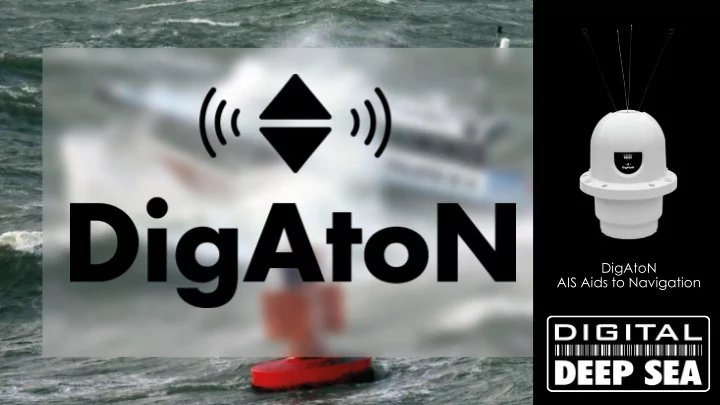
DigAtoN AIS Aids to Navigation
slide-2
SLIDE 2

AIS AtoN Technology

Core capability

  • Adds AIS capability to a buoy,

lighthouse, marine structure, wreck or virtual point

  • Allows positive identification

by any vessel or shore station equipped with AIS

  • Local data from

meteorological or hydrological sensors can be transmitted by the DigAtoN to other AIS users

  • Digital and analogue switching

and sensing capability for the local structure

  • 1 local DigAtoN can cover

multiple physical or virtual structures

DigAtoN AIS AtoNs fit to marine structures, hazards, buoys or can be configured to represent a virtual or synthetic point if mounted remotely from a physical location. AIS equipped vessels and shore stations can then not

  • nly identify the position of these marks but also read

data (such as weather and instruments) collected by the AtoN. The DigAtoN is available as a Class 1 device (transmit

  • nly) or a Class 3 device (transmit and receive). Class

1 devices require a local AIS base station to be

  • perating in the same area as the AtoN whereas Class

3 devices can internally allocate slots for transmission allowing them to be placed anywhere. Class 3 devices can also be configured and queried remotely and wirelessly “chained” together for extended range configuration. DigAtoN products are also available with an additional sensor interface installed to allow extended monitoring and digital switching capability

slide-3
SLIDE 3

DigAtoN Class 1 Products

  • Transmit only device using

FATDMA (fixed access time division multiple access) technology

  • Requires the DigAtoN to be

within VHF range of an AIS base station for correct operation

  • Pre-configured for specific

transmission time slots allocated by the AIS base station

Class 1

slide-4
SLIDE 4

DigAtoN Class 3 Products

  • Physically similar to the Class 1 product
  • Transmit and receive device using FTDMA or

RATDMA (random access time division multiple access) technology

  • DigAtoN Class 3 can internally allocate time

slots for transmission so no need for a local AIS Base Station

  • Effectively allows installation “anywhere”
  • AIS receive capability also allows for device to

be remotely configured and queried for status via AIS messages from a shore station (VDL configuration)

  • Wireless chaining also possible to allow

extension of control and configuration from AIS base station using multiple DigAtoNs

Class 3

slide-5
SLIDE 5

Features - At a glance

  • Available as a Class 1 or Class 3 device
  • Ultra tough and waterproof to IPX7
  • Approved for global use
  • Internal GPS sensor and antenna with external

antenna option available

  • Best in class power consumption (important for self

powered structures)

  • Class 3 devices support chaining and remote

(VDL) configuration and monitoring

  • Additional S models feature extended digital and

analogue I/O capability

  • Virtual and synthetic capability (up to 5)
  • Adjustable transmit power (1 to 12.5W)
  • Highly configurable for all AtoN applications with

full range of interface solutions from Digital DeepSea

slide-6
SLIDE 6

Interfacing - S Model (With additional sensor interface)

  • All models feature:
  • Dual NMEA interfaces
  • 4 User IOs for light or racon health status
  • S Models feature additional interface card with:
  • Current sense
  • Three non-isolated analogue inputs and two isolated analogue

inputs

  • 5 isolated digital I/Os and 5 non-isolated digital I/Os
  • Two RS232 ports and a fully isolated RS422/NMEA port
  • Two relay drive outputs
  • SDI-12 serial bus (note only 1 RS232 port available if this interface

is utilised)

  • Input voltage monitor (no external connection required)
slide-7
SLIDE 7

Typical configuration

DigAtoN incorporates an internal GPS antenna and our MA800 antenna can be used as an external option if required. DigAtoN requires a suitable VHF antenna ideally tuned specifically to 162MHz. Our CX4A 1.2m is ideal

slide-8
SLIDE 8

Physical

387mm 235mm 188mm Weight 1.3kg

Bird detterant components

What’s in the box

Additional connectors with S variants

Power consumption

Type 12V DC with message #21 transmission every 3 mins Type 1 FATDMA 0.1Ah/day Type 3 RATDMA 1.0Ah/day

slide-9
SLIDE 9

Typical connections

The unit is waterproof to IPX7 and all base mounted connectors are certified to a minimum of IPX6. Additional protection can be applied if required

slide-10
SLIDE 10

Applicatons

Potential applications include:

  • Marking offshore structures, wind farms, wrecks, points of interest or

danger areas

  • Transfer of local meteorological conditions such as wind, pressure,

wave height

  • Custom data transmission to base stations such as electrical status,

tide, current, salinity etc measurements

  • Localised tide and current information
  • Use virtual or synthetic AtoN capability to mark 5 virtual points (ideal

for yacht club racing or movable marks)

slide-11
SLIDE 11

Custom Configurations

Digital Deep Sea have an extensive range

  • f sensors and interface modules

designed to interface with the DigAtoN

  • range. We offer custom AIS filtering

alarms, AISNET base station receivers, serial data multiplexers and a full line up of rate, attitude and heading sensors We can supply DigAtoN pre configured for your application as well as fabricate specialist interfaces, sensors and mounting kits