Air Force Institute of Technology The AFIT of Today is the Air Force - - PowerPoint PPT Presentation

air force institute of technology
SMART_READER_LITE
LIVE PREVIEW

Air Force Institute of Technology The AFIT of Today is the Air Force - - PowerPoint PPT Presentation

Air Force Institute of Technology The AFIT of Today is the Air Force of Tomorrow. Modeling Quantum Optical Components, Pulses & Fiber Channels Using OMNeT++ Ryan D. L. Engle, MS Quantum Key Distribution (QKD) System Douglas D. Hodson,


slide-1
SLIDE 1

The AFIT of Today is the Air Force of Tomorrow.

1

Modeling Quantum Optical Components, Pulses & Fiber Channels Using OMNeT++

Ryan D. L. Engle, MS Douglas D. Hodson, PhD

OMNeT++ Community Summit 2015 IBM Research - Zurich, Switzerland September 3-4, 2015

Research Team Members:

  • Dr. Michael R. Grimaila
  • Dr. Douglas D. Hodson

Maj Logan O. Mailloux Capt Ryan D. L. Engle

  • Dr. Colin V. McLaughlin
  • Dr. Gerald Baumgartner

The views expressed in this presentation are those of the authors and do not reflect the official policy or position of the United States Air Force, the Department of Defense, or the U.S. Government.

Air Force Institute of Technology

Air University: The Intellectual and Leadership Center of the Air Force Fly, Fight, and Win, in Air, Space, and Cyberspace

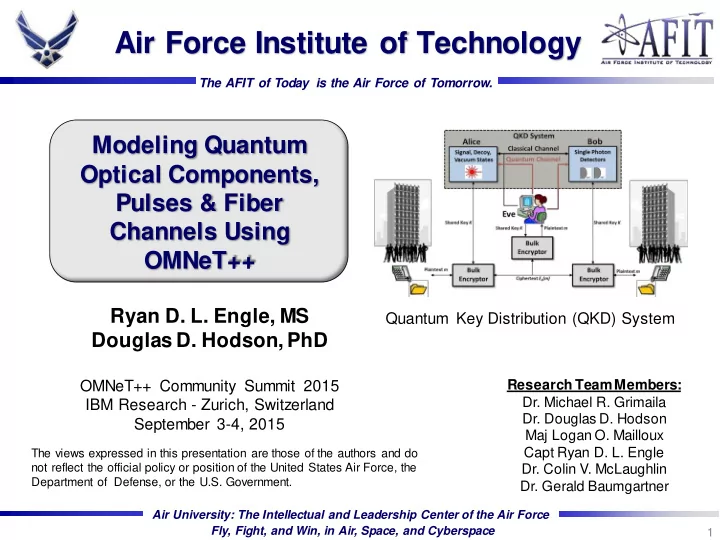
Quantum Key Distribution (QKD) System

slide-2
SLIDE 2

The AFIT of Today is the Air Force of Tomorrow.

2

  • Motivation: Quantum Key Distribution (QKD)
  • Framework Packages & Organization
  • Optical Pulses
  • Optical Components
  • Fiber Channels
  • Testing
  • Simulation Studies
  • Publications

Overview

slide-3
SLIDE 3

The AFIT of Today is the Air Force of Tomorrow.

3

QKD System Operation / Protocol

  • Innovative technology

which exploits the laws of quantum mechanics to generate and distribute unconditionally secure cryptographic keys

  • Unique in its ability to

detect the presence

  • f an eavesdropper

attempting to subvert the distribution of key material

  • Protocol assumes

certain idealities with regard to pulse generation and detection

slide-4
SLIDE 4

The AFIT of Today is the Air Force of Tomorrow.

4

  • Motivation: simulate various system designs/architectures to understand the effects of

‘non-idealities’ on security and system performance

  • Need to model: optical components (laser, beamsplitters, fiber channels, etc.), optical

pulses, detectors

  • System architecture easy to describe as a hierarchy of modules/components
  • Created a framework to model these types of components (i.e., ‘qkdX’ framework)

System Architecture

slide-5
SLIDE 5

The AFIT of Today is the Air Force of Tomorrow.

5

OMNeT++ Modeling Concepts

  • Simple modules define behavior
  • Compound modules are used to assemble a hierarchy
  • A network defines the system of interest (no gates)
  • Gates define interface points – data (messages) flows through channels

Network Compound Module Simple Modules Channel Gates Message

slide-6
SLIDE 6

The AFIT of Today is the Air Force of Tomorrow.

6

qkdX Modeling Concepts

QKD System Optical System Optical Components

Laser Attenuator SPD

Fiber Channel Optical Port Optical Pulse

slide-7
SLIDE 7

The AFIT of Today is the Air Force of Tomorrow.

7

qkdX Classical Pulse Generator

Modeled components must account for mathematics, state, data flow and timing

CTRL

PM PM PM PM PM

99/1 BS PM or SM Class Det Laser - λs Isolator Pol BP Filter λs

1 2 4 3 1 1 1 2 2 2 1

Modules (Optical & Electrical) Fiber Channels Electrical Channel Compound Module Laser Creates Pulses (Msgs)

slide-8
SLIDE 8

The AFIT of Today is the Air Force of Tomorrow.

8

qkdX Components

Each component has multiple attributes:

  • Type
  • Active or Passive
  • Number connections
  • Type of connections
  • Input / Output / Bidirectional
  • Optical, Electrical, or Environmental
  • Temporal behavior (OMNeT++)
  • Functional behavior (C++)
  • Component aging
  • Failure modes (degraded/damaged)
  • Parameterization depends upon abstraction
slide-9
SLIDE 9

The AFIT of Today is the Air Force of Tomorrow.

9

Package Relationships

slide-10
SLIDE 10

The AFIT of Today is the Air Force of Tomorrow.

10

  • Pulses encoded as messages
  • Custom pulse message class created to manage pointer to actual

pulse object

  • A variety of pulse objects have been created
  • The shape of pulses are described by functor-like objects

Optical Pulse Representation

Example Pulse Representation

slide-11
SLIDE 11

The AFIT of Today is the Air Force of Tomorrow.

11

  • Optical components are structured as simple modules
  • Need to account for mathematics (pulse transformations), component state (e.g., damaged),

dataflow (physical path pulse traverses and reflections), and timing (propagation delay)

  • Much of the code structured so that simple modules facilitate data flow and timing
  • State of components represented by different types (i.e., properties)
  • Interfaces (mostly abstract classes) are defined to represent types (and support a

public API)

  • Simple modules are viewed as a structuring concept (i.e., not as a ‘type’)

Optical Components

Interfaces Properties

slide-12
SLIDE 12

The AFIT of Today is the Air Force of Tomorrow.

12

  • Fiber channels are implemented as a custom Channel
  • They add ‘behavior’ to the flow of pulses between components

(e.g., attenuation, delay, polarization drift effects, etc.)

  • They include optional ‘smarts’ to delete pulses below a certain

energy level (prevent infinite reflections between components)

Fiber Channel

slide-13
SLIDE 13

The AFIT of Today is the Air Force of Tomorrow.

13

Testing

  • Mathematics (pulse transformations)
  • Component state (e.g., damaged)
  • Dataflow (physical path pulse traverses)
  • Timing (propagation delay)
  • The mathematical calculations/transformations

associated with component models does not require reside with simple modules

  • They are simple math functions that can be compiled

separately into a library and called from Python

  • SWIG tool was used to generate proxy information
  • Python made it easier to ‘script’ extensive test cases to

ensure this aspect of code is implemented correctly

slide-14
SLIDE 14

The AFIT of Today is the Air Force of Tomorrow.

14

Example Simulation Studies

The variety and diversity of products have grown to support a number of Master and PhD thesis students resulting in a number of publications (provided at the end) Examples:

  • Development of a BB84

reference architecture

  • Decoy state enabled system

designs

  • Measurement device

independent systems

slide-15
SLIDE 15

The AFIT of Today is the Air Force of Tomorrow.

15

BB84 Reference Architecture

TA . SPDH TA . SPDD TA . SPDA TA . SPDV WDM TA . SPDA TA . SPDD TA . SPDH TA . SPDV WDM

slide-16
SLIDE 16

The AFIT of Today is the Air Force of Tomorrow.

16

Polarization Drift

slide-17
SLIDE 17

The AFIT of Today is the Air Force of Tomorrow.

17

Decoy State Enabled QKD

slide-18
SLIDE 18

The AFIT of Today is the Air Force of Tomorrow.

18

Measurement Device Independent QKD

  • F. Xu, M. Curty, B. Qi, and H.-K. Lo, “Measurement-device-independent

quantum cryptography,” IEEE Journal of Selected Topics in Quantum Electronics, 2014.

slide-19
SLIDE 19

The AFIT of Today is the Air Force of Tomorrow.

19

  • Archival Journals
  • Mailloux, L.O., Hodson, D.D., Grimaila, M.R., Colombi, J.M., McLaughlin, C.V., and Baumgartner, G.B., “Test and Ev aluation of Complex Cy bersecurity Sy stems: A Case Study in Using Modeling

and Simulation to More Ef f iciently Understand, Test, and Ev aluate the Security of Quantum Key Distribution Sy stems,” ITEA Journal. Submitted June, 2015.

  • Mailloux, L.O., Engle, R.D., Grimaila, M.R., Hodson, D.D., Colombi, J.M., and McLaughlin, C.V., “Modeling Decoy State Enabled Quantum Key Distribution Sy stems,” The Journal of Def ense

Modeling and Simulation: Applications, Methodology , Technology , Accepted f or Publication April, 2015.

  • Mailloux, L.O., Grimaila, M.R., Colombi, J.M., Hodson, D.D., McLaughlin, C., and Baumgartner, G., “Quantum Key Distribution: Ev aluation of the Decoy State Protocol, ” IEEE Com

m unications Magazine, Submitted March, 2015.

  • Engle, R.D., Grimaila, M.R., Mailloux, L.O., Hodson, D.D., McLaughlin, C., and Baumgartner, G., “Dev eloping a Decoy State Enabled Quantum Key Distribution Sy stem Model,” IEEE Transactions
  • n System

s, Man, and Cybernetics: System s, Submitted February , 2015.

  • Mailloux, L.O., Grimaila, M.R., Hodson, D.D., Baumgartner, G., and McLaughlin, C., “Perf ormance Ev aluations of Quantum Key Distribution Sy stem Architectures,” IEEE Security and Priv acy ,

January /February 2015, pp. 30-40. DOI: 10.1109/MSP.2015.11

  • Mailloux, L.O., Morris, J.D., Grimaila, M.R., Hodson, D.D., Jacques, D.R., Colombi, J.M., McLaughlin, C.V., and Holes, J.A. “A Modeling Framework f or Study ing Quantum Key Distribution Sy stem

Implementation Non-Idealities,” IEEE Access, January , 2015. DOI: 10.1109/ACCESS.2015.2399101

  • Sorensen, N.T., Grimaila, M.R., “Discrete Ev ent Simulation of the Quantum Channel within a Quantum Key Distribution Sy stem,” The Journal of Def ense Modeling and Simulation: Applications,

Methodology , Technology , February , 2015. DOI: 10.1177/1548512915569743

  • Mailloux, L.O., Grimaila, M.R., Hodson, D.D., Colombi, J.M., “A Practical Assessment of Security Design Patterns,” The Inform

ation System Security Association (ISSA) Journal, 11(9), September 2014, pp. 29-35.

  • Morris, J.D., Grimaila, M.R., Hodson, D., McLaughlin, C., and Jacques, D., “Using the Discrete Ev ent Sy stem Specif ication to Model Quantum Key Distribution Sy stem Components,” The Journal
  • f Defense Modeling and Sim

ulation: Applications, Methodology, Technology, October 17, 2014, pp. 1-24, , DOI: 10.1177/1548512914554404

  • Morris, J.D., Hodson, D.D., Grimaila, M.R., Jacques, D.R., and Baumgartner, G., “Towards the Modeling and Simulation of Quant um Key Distribution Sy stems,” International Journal of Em

erging Technology and Advanced Engineering, Vol. 4, No. 2, February 2014, pp. 11-22.

  • Grimaila, M.R., Morris, J., Hodson, D., “Quantum Key Distribution: A Rev olutionary Security Technology ,” The Inform

ation System Security Association (ISSA) Journal, 10(6), June 2012, pp. 20- 27.

  • Theses/Dissertations
  • Mailloux, L.O. (Scheduled August 2015) A perf ormance and security analy sis of practical decoy state enabled quantum key distribution sy stems (PhD Dissertation, Air Force Institute of

Technology ).

  • Cernera, R.C. (Summer 2015) A Sy stem-Lev el Throughput Model f or Quantum Key Distribution (Master’s thesis, Air Force Institute of Technology ).
  • Engle, R.D. (2015) Modeling, sim

ulation, and analysis of a decoy state enabled quantum key distribution system. (Master’s thesis, Air Force Institute of Technology ). Av ailable f rom Def ense Technical Inf ormation Center. (ADA615556).

  • Morris, J.D. (2014) Conceptual modeling of a quantum key distribution simulation f ramework using the discrete ev ent sy stem specification (PhD Dissertation, Air Force Institute of Technology ).

Av ailable f rom Def ense Technical Inf ormation Center. (ADA609513)

  • Harper, C.A. (2012) Security standards and best practice considerations for quantum

key distribution (qkd) (Master’s thesis, Air Force Institute of Technology ). Av ailable f rom Def ense Technical Inf ormation Center. (ADA558003)

  • Johnson, J.S. (2012) An analysis of error reconciliation protocols for use in quantum

key distribution (Master’s thesis, Air Force Institute of Technology ). Av ailable f rom Def ense Technical Inf ormation Center. (ADA557404)

  • Sorensen, N.T. (2012). Quantum

channel m

  • deling for discrete event sim

ulation of quantum key distribution (Master’s thesis, Air Force Institute of Technology ). Limited Distribution.

  • Thomas, A.C. (2012). Em

pirical analysis of optical attenuator perform ance in quantum key distribution system s using a particle m

  • del (Master’s thesis, Air Force Institute of Technology ). Av ailable

f rom Def ense Technical Inf ormation Center. (ADA557492)

  • Calv er, T.I. (2011) An empirical analy sis of the cascade secret key reconciliation protocol f or quantum key distribution (Mas ter’s thesis, Air Force Institute of Technology ). Av ailable f rom Def ense

Technical Inf ormation Center. (ADA549804)

  • Lustic, K.C (2011). Perf ormance analy sis and optimization of the winnow secret key reconciliation protocol (Master’s thesis, Air Force Institute of Technology ). Av ailable f rom Def ense Technical

Inf ormation Center. (ADA544630)

Publications
slide-20
SLIDE 20

The AFIT of Today is the Air Force of Tomorrow.

20

Questions?

This work was supported by the Laboratory for T elecommunication Sciences [grant number 5743400- 304-6448] and in part by a grant of computer time from the DoD High Performance Computing Modernization Program at the Air Force Research Laboratory, Wright-Patterson AFB, OH.