AICPA Peer Review Program Compliance: Responding to Latest - - PowerPoint PPT Presentation

aicpa peer review program compliance responding to latest
SMART_READER_LITE
LIVE PREVIEW

AICPA Peer Review Program Compliance: Responding to Latest - - PowerPoint PPT Presentation

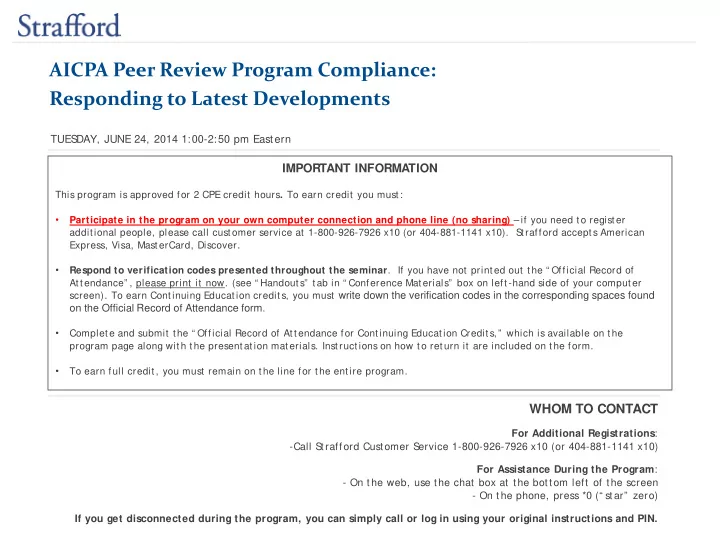
AICPA Peer Review Program Compliance: Responding to Latest Developments TUES DAY, JUNE 24, 2014 1:00-2:50 pm Eastern IMPORTANT INFORMATION This program is approved for 2 CPE credit hours . To earn credit you must: Participate in the program


slide-1
SLIDE 1

AICPA Peer Review Program Compliance: Responding to Latest Developments

TUES DAY, JUNE 24, 2014 1:00-2:50 pm Eastern

WHOM TO CONTACT

For Additional Registrations:

  • Call S

trafford Customer S ervice 1-800-926-7926 x10 (or 404-881-1141 x10) For Assistance During the Program:

  • On the web, use the chat box at the bottom left of the screen
  • On the phone, press *0 (“ star” zero)

If you get disconnected during the program, you can simply call or log in using your original instructions and PIN.

IMPORTANT INFORMATION

This program is approved for 2 CPE credit hours. To earn credit you must:

  • Participate in the program on your own computer connection and phone line (no sharing) –

if you need to register additional people, please call customer service at 1-800-926-7926 x10 (or 404-881-1141 x10). S trafford accepts American Express, Visa, MasterCard, Discover.

  • Respond to verification codes presented throughout the seminar. If you have not printed out the “ Official Record of

Attendance” , please print it now. (see “ Handouts” tab in “ Conference Materials” box on left -hand side of your computer screen). To earn Continuing Education credits, you must write down the verification codes in the corresponding spaces found

  • n the Official Record of Attendance form.
  • Complete and submit the “ Official Record of Attendance for Continuing Education Credits,” which is available on the

program page along with the presentation materials. Instructions on how to return it are included on the form.

  • To earn full credit, you must remain on the line for the entire program.
slide-2
SLIDE 2

Tips for Optimal Quality

S

  • und Qualit y

If you are listening via your computer speakers, please note that the quality

  • f your sound will vary depending on the speed and quality of your internet

connection. If the sound quality is not satisfactory, you may listen via the phone: dial 1-866-873-1442 and enter your PIN when prompted. Otherwise, please send us a chat or e-mail sound@ straffordpub.com immediately so we can address the problem. If you dialed in and have any difficulties during the call, press *0 for assistance. Viewing Qualit y To maximize your screen, press the F11 key on your keyboard. To exit full screen, press the F11 key again.

FOR LIVE EVENT ONLY

slide-3
SLIDE 3

Program Materials

If you have not printed the conference materials for this program, please complete the following steps:

  • Click on the ^ symbol next to “ Conference Materials” in the middle of t he left-

hand column on your screen.

  • Click on the tab labeled “ Handouts” that appears, and there you will see a

PDF of the slides and the Official Record of Attendance for today's program.

  • Double-click on the PDF and a separate page will open.
  • Print the slides by clicking on the printer icon.

FOR LIVE EVENT ONLY

slide-4
SLIDE 4

AICPA Peer Review Program Compliance

June 24, 2014 Thad E. Porch, Porch & Associates thad.porch@ porchcpa.com Duane Reyhl, Andrews Hooper & Pavlik duane.reyhl@ ahpplc.com

slide-5
SLIDE 5

Notice

ANY TAX ADVICE IN THIS COMMUNICATION IS NOT INTENDED OR WRITTEN BY THE S PEAKERS ’ FIRMS TO BE US ED, AND CANNOT BE US ED, BY A CLIENT OR ANY OTHER PERS ON OR ENTITY FOR THE PURPOS E OF (i) AVOIDING PENALTIES THAT MA Y BE IMPOS ED ON ANY TAXP A YER OR (ii) PROMOTING, MARKETING OR RECOMMENDING TO ANOTHER P ARTY ANY MATTERS ADDRES SED HEREIN.

Y

  • u (and your employees, representatives, or agents) may disclose to any and all persons,

without limitation, the tax treatment or tax structure, or both, of any transaction described in the associated materials we provide to you, including, but not limited to, any tax opinions, memoranda, or other tax analyses contained in those materials. The information contained herein is of a general nature and based on authorities that are subj ect to change. Applicability of the information to specific situations should be determined through consultation with your tax adviser.

5

slide-6
SLIDE 6

AICPA PEER REVIEW PROGRAM COMPLIANCE

Thad E. Porch Porch & Associates Albuquerque, NM thad.porch@porchcpa.com

slide-7
SLIDE 7

Porch & Associates LLC

Peer Review Program Annual Report on Oversight The purpose of the Annual Report on Oversight is to provide a general overview, statistics and information, and the results of the various

  • versight procedures performed on the AICPA

Peer Review Program and to conclude on whether the objectives of the AICPA Peer Review Board’s

  • versight process were met.

It is a review of the peer reviewers.

Part I, Section A: Criticisms from Annual Report on Oversight

7

slide-8
SLIDE 8

Porch & Associates LLC

Peer Review Program Annual Report on Oversight

  • Approximately 29,000 peer reviews are

performed in a three year cycle.

  • For system and engagement reviews during this

cycle approximately 90% were pass, 8% were pass with deficiencies, and 2% were fail.

  • Engagement reviews went from 1% fail to 7% fail,

and 8% pass with deficiencies to 18% pass with deficiencies with the introduction of SSARS 19.

Part I, Section A: Criticisms from Annual Report on Oversight, Continued

8

slide-9
SLIDE 9

Porch & Associates LLC

Peer Review Program Annual Report on Oversight

Approximately 5% of the engagements reviewed were identified as “not being performed and/or reported in accordance with professional standards in all material respects.” The Standards state that an engagement is

  • rdinarily considered “not being performed and /or reported

in accordance with professional standards in all material respects” when deficiencies, individually or in the aggregate, exist that are material to understanding the report or the financial statements accompanying the report

  • r represents omission of a critical accounting, auditing or

attestation procedure required by professional standards.

Part I, Section A: Criticisms from Annual Report on Oversight, Continued

9

slide-10
SLIDE 10

Porch & Associates LLC

Peer Review Program Annual Report on Oversight A General Comment on Regulatory Independence

Peer review failures in must select industries have gained the attention of regulators in those industries. Their universal question:

“Where was peer review?”

Part I, Section A: Criticisms from Annual Report on Oversight, Continued

10

slide-11
SLIDE 11

Porch & Associates LLC

Peer Review Program Annual Report on Oversight – Most Common Compliance Failures

Accounting and Reporting Matters

  • Income taxes. Disclosures relative to uncertain tax positions failed to

include open tax years as required by FASB ASC 740-10-50 (FASB Interpretation No. 48, Accounting for Uncertainty in Income Taxes: an interpretation of FASB Statement No. 109).

  • Fair value. Failure to disclose the fair value of investments by levels

1, 2 and 3 as required by FASB ASC 820-10-50.

  • Debt. Failure to disclose five years of debt maturities as required by

FASB ASC 470-10-50.

  • Statement of cash flows. Failure to properly identify certain cash flow

items as operating, investing or as financing activities as required by FASB ASC 230-10-45.

Part I, Section A: Criticisms from Annual Report on Oversight, Continued

11

slide-12
SLIDE 12

Porch & Associates LLC

Peer Review Program Annual Report on Oversight – Most Common Compliance Failures, Continued Accounting and Reporting Matters, Continued

  • Risks and uncertainties. Failure to properly disclose risks and

uncertainties such as nature of operations, the use of estimates and concentrations as required by FASB ASC 275-10-50.

  • Subsequent events. Failure to disclose date through which

subsequent events have been evaluated as required by FASB ASC 855-10-50-1.

Part I, Section A: Criticisms from Annual Report on Oversight, Continued

12

slide-13
SLIDE 13

Porch & Associates LLC

Peer Review Program Annual Report on Oversight – Most Common Compliance Failures, Continued

Audit and Attest Services

  • Auditor’s communication with those charged with governance. Failure

to document those communications in accordance with AU-C 260, The Auditor's Communication with Those Charged with Governance (AICPA, Professional Standards).

  • Planning and supervision. Incomplete or undocumented planning

procedures related to risk.

  • Communicating internal control matters identified in an audit,

including the following:

  • Failure to note the auditor's responsibility for communicating internal

control matters identified in the audit in the engagement letter.

  • Failure to complete or inaccurate completion of the internal control matters

section of the firm's audit work programs in accordance with quality control policies and procedures. Part I, Section A: Criticisms from Annual Report on Oversight, Continued

13

slide-14
SLIDE 14

Porch & Associates LLC

Peer Review Program Annual Report on Oversight – Most Common Compliance Failures, Continued

Audit and Attest Services, Continued

  • Failure to identify internal control matters during the planning stage of the

engagement.

  • Failure to disclose significant deficiencies identified.
  • Audit documentation. Failure to prepare audit documentation in

accordance with AU-C 230.

  • Analytical procedures. General analytical procedures and specifically

the failure to document expectations prior to performing analytical procedures and then failing to compare final results to expectations as well as document the procedures performed.

Part I, Section A: Criticisms from Annual Report on Oversight, Continued

14

slide-15
SLIDE 15

Porch & Associates LLC

Peer Review Program Annual Report on Oversight – Most Common Compliance Failures, Continued

Audit and Attest Services, Continued

  • Sampling. Failure to adequately document sample size determination,

methodology, failure to project the results of sampling to the population.

  • Governmental and Not for Profit specific matters, including the

following:

  • Failure to use a risk-based approach to determine major programs.
  • Missed major programs (thresholds, improper low-risk auditee

determination, failure to use a risk-based approach to determine major programs, not meeting percentage of coverage).

  • SEFA errors.

Part I, Section A: Criticisms from Annual Report on Oversight, Continued

15

slide-16
SLIDE 16

Porch & Associates LLC

Peer Review Program Annual Report on Oversight – Most Common Compliance Failures, Continued Review Services

  • Analytical procedures. Failure to document expectations when

performing analytical procedures and to compare results to those expectations.

  • Management representations. Omissions and errors, including the

following:

  • Management’s representation letter failed to include all periods covered by

the accountant’s review report.

  • The representation letter did not include the statement about

management’s responsibility to detect and prevent fraud as required by AR

section 90, Review of Financial Statements (AICPA, Professional Standards).

  • Basic reporting elements. Failure to follow the basic report elements

as required by the SSARS.

Part I, Section A: Criticisms from Annual Report on Oversight, Continued

16

slide-17
SLIDE 17

Porch & Associates LLC

Peer Review Program Annual Report on Oversight – Most Common Compliance Failures, Continued Review Services, Continued

  • Establishing an understanding with management. Errors or omissions

in the engagement letter, including the following:

  • Missing required signatures.
  • The required wording that the engagement could not be relied upon to

disclose errors, fraud or illegal acts.

  • The required wording that the accountant would inform the appropriate

level of management if certain matters came to his or her attention unless clearly inconsequential.

  • Reporting on comparative financial statements and supplemental
  • information. Indication of accountant’s responsibility with respect to all

periods and any supplemental information presented.

Part I, Section A: Criticisms from Annual Report on Oversight, Continued

17

slide-18
SLIDE 18

Porch & Associates LLC

Peer Review Program Annual Report on Oversight – Most Common Compliance Failures, Continued

Compilation Services

  • Basic presentation requirements, including financial statements

containing ―current liabilities without the appropriate caption or description and income statement noting the wrong periods (for example, 2012 and 2011 instead of 2013 and 2012)

  • Failure to appropriately title financial statements or adequately

describe basis if not GAAP.

  • Reporting on the financial statements. Basic report elements were

missing in accordance with AR section 80 or all periods presented in the compilation report not addressed in accordance with AR section 60.

  • Form of a standard compilation report. Issuing tax basis financial

statements and the compilation report was not modified to reflect this GAAP departure.

Part I, Section A: Criticisms from Annual Report on Oversight, Continued

18

slide-19
SLIDE 19

Porch & Associates LLC

Peer Review Program Annual Report on Oversight – Most Common Compliance Failures, Continued Other

  • Engagement Quality Control Review (EQCR).
  • Documentation of System of Quality Control.
  • Monitoring and the related internal inspection.
  • Yearly independence documentation.
  • Peer review population completeness.

Part I, Section A: Criticisms from Annual Report on Oversight, Continued

19

slide-20
SLIDE 20

Porch & Associates LLC

Peer Review Program Annual Report on Oversight – Reasons for Report Modifications

Leadership responsibilities for quality within the firm ("the tone at the top") 43 Relevant Ethical Requirements 7 Acceptance and Continuance of Client Relationships and Specific Engagements 33 Human Resources 80 Engagement Performance 392 Monitoring 192 Totals 747

Part I, Section A: Criticisms from Annual Report on Oversight, Continued

20

slide-21
SLIDE 21

Porch & Associates LLC

Peer Review Program Annual Report on Oversight – Where is the Risk? Percentage of Engagements Not Performed in Accordance With Professional Standards in All Material Respects Single audit 11% Governmental – all other 7% ERISA 6% Reviews 8% Compilation with disclosures 8% Compilation without disclosures 14%

Part I, Section A: Criticisms from Annual Report on Oversight, Continued

21

slide-22
SLIDE 22

Slide Intentionally Left Blank

slide-23
SLIDE 23

Porch & Associates LLC

Requirements for Single Audit

The President’s Council on Integrity and Efficiency (PCIE) issued its report on the study of the quality of audits performed under OMB Circular A-133, Audits of States, Local Governments, and Non-Profit Organizations, which showed that improvements were needed in many

  • areas. The report titled, Report on National Single Audit Sampling

Project (the PCIE report), identified a number of common deficiencies with the conduct and reporting of A-133 audits. The results of the PCIE report should be taken very seriously and completely reviewed in detail by all individuals who are reviewing engagements conducted under A-

  • 133. The full report can be accessed at the following link:

www.ignet.gov/pande/audit/NatSamProjRptFINAL2.pdf.

Part I, Section B: Requirement to Submit Single Audit Checklists

23

slide-24
SLIDE 24

Porch & Associates LLC

Requirements for Single Audit

The PCIE’s recommendations resulted in the division of the Single Audit supplemental checklist into two parts. Part A focuses on the audit areas noted by the PCIE report as most frequently not being performed in accordance with professional standards. These areas include major program determination, documentation of compliance testing, audit findings, sampling, materiality at the major program level and SEFA reporting issues. The reviewer should be aware that failures to conform to professional standards in these areas are seen by the Inspectors General as resulting in substandard audits. Auditors whose audits are deemed substandard by an IG could be required to perform additional procedures and may be referred by the IGs to the AICPA Professional Ethics Division and/or State Boards of Accountancy. In addition, the PRB has concluded that a failure to properly perform audit procedures in

  • ne or more of the areas covered in Part A will result in an engagement that

has not been performed in accordance with professional standards in all material respects. Part I, Section B: Requirement to Submit Single Audit Checklists

24

slide-25
SLIDE 25

Porch & Associates LLC

Requirements for Single Audit

Documentation was one of the key deficiencies noted by the PCIE

  • report. Reviewers are reminded that a firm’s verbal description of work

performed is not adequate. Verbally verifying that procedures were performed, when the documentation required by professional standards is lacking, is as not been performed in accordance with GAAS or GAGAS in all material respects.

Part I, Section B: Requirement to Submit Single Audit Checklists

25

slide-26
SLIDE 26

Porch & Associates LLC

Requirements for Single Audit, Continued

Part I, Section B: Requirement to Submit Single Audit Checklists

26

slide-27
SLIDE 27

Porch & Associates LLC

SSARS 19 Compliance

  • SSARS 19 was effective for periods ending on or after December 15,

2010.

  • Even though it has been in effect for many years, it is a significant

source of peer review findings, deficiencies, and failures (more than five years after implementation!).

  • A review of the online MLCs disclosed the following compliance

issues related to SSARS 19:

  • Inadequate documentation of analytical procedures.
  • The accountants compilation report was outdated and did not

comply with SSARS 19.

  • Independence: Firms are not modifying the compilation reports to

note that they are not independent when performing significant non-attest services.

Part I, Section C: SSARS 19 and Impact on Compilation Peer Reviews

27

slide-28
SLIDE 28

Porch & Associates LLC

SSARS 19 Compliance, Continued

  • Arrangement letter: An arrangement letter is a requirement. Components that

are being missed regularly include:

  • Management is responsible for the preparation and fair presentation of the

financial statements in accordance with the applicable financial reporting framework.

  • Management is responsible for designing, implementing, and maintaining internal

control relevant to the preparation and fair presentation of the financial statements

  • Management is responsible to prevent and detect fraud
  • Management is responsible for identifying and ensuring that the entity complies

with the laws and regulations applicable to its activities.

  • Management is responsible for making all financial records and related

information available to the accountant.

  • The engagement cannot be relied upon to disclose errors, fraud, or illegal acts.
  • The effect of any independence impairments on the expected form of the

accountant’s compilation report, if applicable.

Part I, Section C: SSARS 19 and Impact on Compilation Peer Reviews

28

slide-29
SLIDE 29

Porch & Associates LLC

SSARS 19 Compliance, Continued

  • Identification of non-attest services - has the accountant established

and documented in writing the accountant’s:

  • understanding with the client? [ET 101.05] This includes objectives
  • f the non-attest service engagement,
  • non-attest services to be performed,
  • client’s acceptance of its responsibilities,
  • the accountant’s responsibilities, and
  • any limitations of the non-attest service engagement.
  • For any non-attest services provided to the client, has the accountant:
  • determined before performing the service whether such a service

would not impair independence? [ET 101.05]

  • The non-attest service is not specifically prohibited under

interpretation 101-3.

Part I, Section C: SSARS 19 and Impact on Compilation Peer Reviews

29

slide-30
SLIDE 30

Porch & Associates LLC

SSARS 19 Compliance, Continued

  • The accountant does not assume management responsibilities for

the client.

  • The accountant is satisfied that client management performs all of

the following functions in connection with the non-attest services (either through documentation or verbal discussions with the client):

  • Assumes all management responsibilities
  • Oversees the services, by designating an individual, preferably

within senior management, who possesses suitable skill, knowledge, and/or experience

  • Evaluates the adequacy and results of the services performed
  • Accepts responsibility for the results of the services

Part I, Section C: SSARS 19 and Impact on Compilation Peer Reviews

30

slide-31
SLIDE 31

Andrews Hooper Pavlik PLC

AICPA Peer Review Program Compliance: Responding to Latest Developments

Duane Reyhl, CPA, CGMA Andrews Hooper Pavlik PLC

31

slide-32
SLIDE 32

403(b) Regulations and Impact on Employee Benefit/ERISA Peer Reviews

32

slide-33
SLIDE 33

EBP Developments

  • 403(b)
  • DOL observations
  • Considerations for limited scope audits
  • 11-K

33

slide-34
SLIDE 34

Porch & Associates LLC

Principles Based Standards

  • Principles-based standards provides a conceptual basis for

accountants to follow instead of a list of rules.

  • The principles lay out a the key objectives to be achieved and then

provides application guidance and examples. It does not tell you how to comply.

  • When in doubt, look back to the principles. What are they trying to

achieve.

  • The statement “but the rules don’t say that” is no longer valid.
  • It allows for considerable leeway for individual judgment and

subsequent abuse. Peer reviews are now considering if the judgments made are correct relative to facts and circumstances.

Part II, Section A: Principles-based Standards

34

slide-35
SLIDE 35

Porch & Associates LLC

Single Unified Set of Standards and Interpretations

  • Peer review is meant to be a single integrated set of standards and

interpretations that enable the CPA profession to self regulate. The standards are meant to provide credibility, improve performance, and maintain the standard of quality.

Part II, Section B: Single Unified Set of Standards and Interpretations

35

slide-36
SLIDE 36

Porch & Associates LLC

Electronic MFCs and Reporting

Information at: http://www.aicpa.org/InterestAreas/PeerReview/Comm unity/PeerReviewers/Pages/matters-for-further- consideration-project.aspx Firms must register on AICPA.org at least 24 hours before you can respond to MFCs https://www.aicpa.org/_catalogs/masterpage/Registrati

  • nStart.aspx

Register before your peer review. Not doing so will delay your review.

Part II: Electronic MFCs and Reporting

36

slide-37
SLIDE 37

Experiences with Current Peer Review Standards

37

slide-38
SLIDE 38

Compliance Challenges

  • Peer reviewers
  • Firms
  • QC system design
  • Documentation
  • Standards and interpretations
  • New developments

38

slide-39
SLIDE 39

Tough Oversight

  • State CPA societies
  • AICPA
  • State boards of accountancies
  • SEC / PCAOB

39

slide-40
SLIDE 40

Transparency of Peer Review Reports

40

slide-41
SLIDE 41

Transparency Importance

  • Credibility
  • Trust
  • Consistency

41

slide-42
SLIDE 42

Transparency Uniformity

  • How is it achieved?
  • AICPA oversight results and reports
  • Report formats and content
  • AICPA public file
  • Firm websites
  • Training

42

slide-43
SLIDE 43

Slide Intentionally Left Blank

slide-44
SLIDE 44

Porch & Associates LLC

Must vs. Should

Unconditional requirements. The accountant is required to comply with an unconditional requirement in all cases in which the circumstances exist to which the unconditional requirement applies. SSARSs use the words must or is required to indicate an unconditional requirement. Presumptively mandatory requirements. The accountant also is required to comply with a presumptively mandatory requirement in all cases in which the circumstances exist to which the presumptively mandatory requirement applies; however, in rare circumstances, the accountant may depart from a presumptively mandatory requirement provided that the accountant documents his or her justification for the departure and how the alternative procedures performed in the circumstances were sufficient to achieve the objectives of the presumptively mandatory requirement. SSARSs use the word should to indicate a presumptively mandatory requirement.

Part IV, Continuing Issues with Quality Control Standards

44

slide-45
SLIDE 45

Porch & Associates LLC

Should Consider

If a SSARS provides that a procedure or action is one that the accountant “should consider,” the consideration of the procedure or action is presumptively required, whereas carrying out the procedure or action is not. Document your must, should, and should consider items.

Part IV, Continuing Issues with Quality Control Standards

45

slide-46
SLIDE 46

Porch & Associates LLC

Elements of a Good Quality Control System

The system of quality control is required to be documented. This documentation is firm specific and should reflect the size and complexity of the firm.

  • PRP Section 4300 - Quality Control Policies and Procedures

Documentation Questionnaire for a Sole Practitioner With No Personnel

  • PRP Section 4400 - Quality Control Policies and Procedures

Documentation Questionnaire for Firms With Two or More Personnel

  • These may be used as templates for preparing a system of quality

control

  • Get the AICPA Publication – Establishing and Maintaining a System of

Quality Control for a CPA Firm’s Accounting and Auditing Practice

Part IV, Continuing Issues with Quality Control Standards

46

slide-47
SLIDE 47

Porch & Associates LLC

Elements of a Good Quality Control System – Ethical Requirements

  • Dabbling in an industry is risky.
  • EQCR for new industries.
  • Fee pressure should not drive audit procedures.
  • Lack of understanding of the Quality Control Standards, and the need

to have it documented.

  • Lack of understanding of monitoring and the related inspection.
  • Peer review is not an very three year item. It is continuous.
  • Reach out for help – peer review is meant to be educational. All of

your colleagues are willing to help.

Part IV, Continuing Issues with Quality Control Standards

47

slide-48
SLIDE 48

Porch & Associates LLC

Elements of a Good Quality Control System – Engagement Performance

Continuing areas of engagement performance compliance problems:

  • Client acceptance – needs to be done and documented. “Done” on a checklist is

no longer sufficient.

  • Updating quality control materials – check the dates. Old checklists are not a

protection against missing new standards. Checklists should be seen as your primary SAS compliance tool.

  • Documentation of sampling method and judgment.
  • Documentation of analytical procedures when they are the primary substantive

test.

  • Tone at the top – involvement of partners at the planning stage, and planning

being done before fieldwork.

  • Documentation!!! Tell the story. You cannot prove compliance if you do not say

what you did.

  • Review, review, review!!!
  • Lockdown dates – 60 days following the report release date. Changes after this

date must be documented.

Part IV, Continuing Issues with Quality Control Standards

48

slide-49
SLIDE 49

Common Peer Review Deficiencies

49

slide-50
SLIDE 50

A Successful Peer Review

  • Improves performance
  • Provides new knowledge
  • New perspectives on standards
  • Suggests tips for preventing missteps

50

slide-51
SLIDE 51

The Language of Peer Review “Deficiencies”

51

slide-52
SLIDE 52

Matter

  • Minor item
  • Usually a “no” answer on a reviewer checklist
  • Documented on an MFC form
  • May stop there
  • Can relate to the QC system or a specific

engagement

52

slide-53
SLIDE 53

Finding

  • One or more matters
  • “Remote” possibility threshold
  • Includes documentation issues
  • Documented on an FFC form
  • Report rating of pass

53

slide-54
SLIDE 54

FFC Form

  • Replaces the LOC
  • Stand alone document
  • Includes:

– Reviewer’s recommendation – Firm’s actions planned or taken and timing of those actions.

  • Not part of the report

54

slide-55
SLIDE 55

Deficiency

  • One or more findings
  • Reasonable assurance threshold in one or

more important areas

  • Report rating of pass with deficiencies

55

slide-56
SLIDE 56

Significant Deficiency

  • One or more deficiencies
  • Reasonable assurance threshold not met in

all material respects

  • Report rating of fail

56

slide-57
SLIDE 57

Slide Intentionally Left Blank

slide-58
SLIDE 58

Common Quality Control Areas of Focus

58

slide-59
SLIDE 59
  • 1. Leadership
  • Managing partner’s attitude toward quality
  • Firm’s attitudes toward quality

59

slide-60
SLIDE 60
  • 2. Relevant Ethical Requirements
  • Questions that arose and how they were

resolved

  • Written confirmations of independence
  • Staff familiarity with policies and procedures

related to relevant ethical requirements

  • Documentation of non-attest services and

management responsibilities

60

slide-61
SLIDE 61
  • 3. Acceptance / Continuance
  • Documentation that the firm complied with its

policies and procedures and with the requirements of professional standards

  • Match firm’s abilities with engagement

demands

  • Client integrity

61

slide-62
SLIDE 62
  • 4. Human Resources
  • Documentation of new hires
  • Adequate training
  • Performance evaluations
  • Compliance with training / CPE requirements

62

slide-63
SLIDE 63
  • 5. Engagement Performance
  • Carry out engagement appropriately
  • Maintain current, comprehensive A&A

resources

  • Consultations when necessary and document

appropriately

  • Engagement quality control reviews

63

slide-64
SLIDE 64
  • 5. Engagement Performance (cont.)

Did the firm evaluate:

– F/S reporting and disclosure? – Procedures in supporting report? – Engagement documentation? – Implementation of new standards?

64

slide-65
SLIDE 65
  • 6. Monitoring in Small Firms
  • Required
  • Must be able to critically review own work,

assess strengths and weaknesses, and maintain attitude of continual improvement

  • Individuals who inspect their own work might

not be as effective as another qualified person

  • Must document annually

65

slide-66
SLIDE 66

Inspecting Engagements

Look for:

  • Patterns of policy noncompliance
  • Difficulty in applying new standards
  • Need for additional training
  • Inconsistent practice aid preparation
  • Documentation weaknesses
  • Errors in pro forma practice aids

66

slide-67
SLIDE 67

Engagement Procedures

  • Risk assessment
  • Internal control
  • Fraud assessments
  • Selecting the right procedures
  • Corroborating evidence

67

slide-68
SLIDE 68

Engagement Documentation

  • Documentation = Performance
  • Documentation is a performance standard
  • Experienced reviewer test
  • Planning and risk assessment
  • Analytical procedures
  • Procedures for tests of balances

68

slide-69
SLIDE 69

Engagement Financial Statements

  • Recognition
  • Measurement
  • Presentation
  • Disclosure.
  • Materiality thresholds
  • Missing disclosures

69

slide-70
SLIDE 70

Engagement Reports

  • Required elements
  • Reference appropriate framework
  • Dangers of automated templates
  • Lack of independence
  • Procedures and documentation

70

slide-71
SLIDE 71

Common Matters Financial Statement Elements

  • Assets
  • Liabilities
  • Equity
  • Statement of income
  • Statement of cash flows
  • Disclosures

71

slide-72
SLIDE 72

Common Matters Specialized Engagements

  • Yellow Book and A-133 audits
  • CIRAS
  • Not-for-profit organizations
  • Employee benefit plans
  • Personal financial statements
  • Construction contractors
  • OCBOA engagements

72

slide-73
SLIDE 73

Other Engagement Matters

  • Illustrative report variations
  • Reporting vs. F/S departures.
  • Personal preferences
  • Over-reliance on 3rd party practice aids
  • Other matters

73

slide-74
SLIDE 74

Engagements That Do Not Meet Professional Standards

  • Consideration of omitted procedures
  • Subsequent discovery of financial statement

matters

74

slide-75
SLIDE 75

Isolated Matters

  • Definition
  • How to evaluate
  • Inability to expand scope

75

slide-76
SLIDE 76

Contact Information

Duane M. Reyhl – CPA, CGMA Partner Andrews Hooper Pavlik PLC 5300 Gratiot Saginaw, MI 48638 p: 989-497-5300 f: 989-497-5353 e: duane.reyhl@ahpplc.com www.ahpplc.com

76

slide-77
SLIDE 77

Thank You

\

This presentation was produced in connection with an educational and informational program. It represents the statements and views of the author(s) alone and does not necessarily represent the official policies or positions of the AICPA, Andrews Hooper Pavlik PLC, its partners, or any sponsor of this program. This presentation is not intended to be, nor should it be construed as constituting tax, accounting, auditing, security, or consulting advice with regard to specific cases, transactions, or situations used by the author(s).

77