Agility: Problems and Exemplars Exemplars Problems - - PDF document

agility problems and exemplars
SMART_READER_LITE
LIVE PREVIEW

Agility: Problems and Exemplars Exemplars Problems - - PDF document

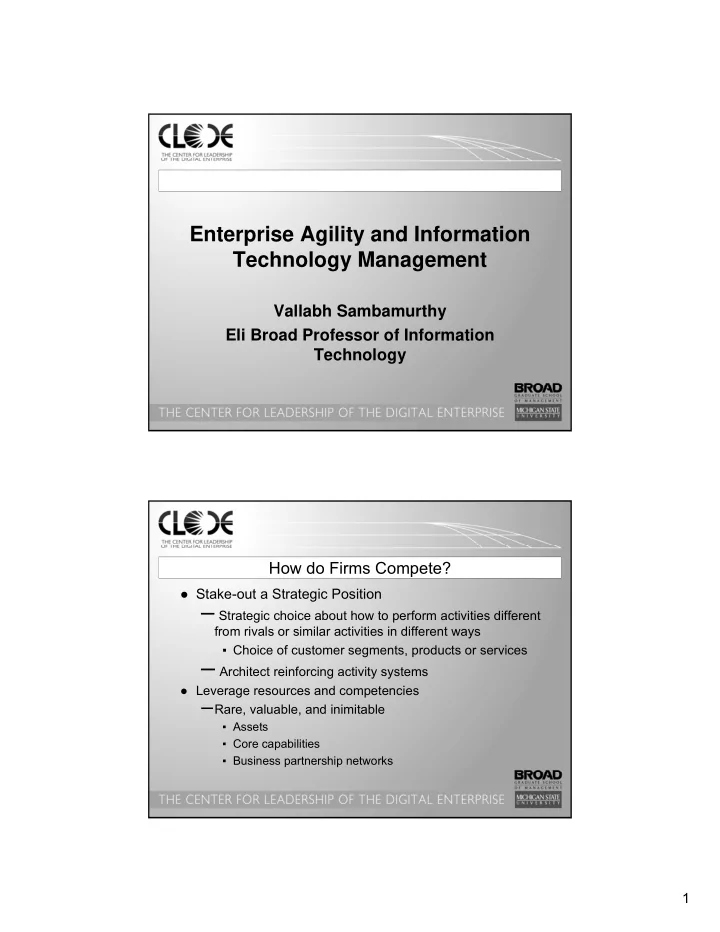
Enterprise Agility and Information Technology Management Vallabh Sambamurthy Eli Broad Professor of Information Technology How do Firms Compete? Stake-out a Strategic Position Strategic choice about how to perform activities different


slide-1
SLIDE 1

1

Enterprise Agility and Information Technology Management

Vallabh Sambamurthy Eli Broad Professor of Information Technology How do Firms Compete?

  • Stake-out a Strategic Position

– Strategic choice about how to perform activities different

from rivals or similar activities in different ways ▪ Choice of customer segments, products or services

– Architect reinforcing activity systems

  • Leverage resources and competencies

–Rare, valuable, and inimitable

▪ Assets ▪ Core capabilities ▪ Business partnership networks

slide-2
SLIDE 2

2

How do Firms Compete?

  • Seize strategic opportunities

–Innovative business models –Innovative products and services, channels, and

processes

  • Maintain resilience

–Prosper, despite changing economic cycles –Defend against threats and discontinuities in the business

ecosystem

Agility: A New Corporate Orientation

  • Ability of a firm to continually sense and explore

customer and marketplace enrichment opportunities

  • Mobilize appropriate configurations of capabilities

and capacities to seize these opportunities

  • Optimize with speed, surprise, and competitive

success

–Entrepreneurship –Resilience –Flexibility –Opportunism

Sense and respond “open”system

slide-3
SLIDE 3

3

Why is Agility Important?

  • Globalized and intensified

competitive rivalry

  • Accelerated velocity of economic

cycles

  • Blurring of industry boundaries
  • Solution-centricity and

customization of customer relationships

  • Accelerated innovations in the

business eco-systems and business models

  • Significant IT-enabled

transformation opportunities

  • Firms that engage in continuous

innovation sustain competitive advantage and superior financial performance

– Incremental, architectural, and

radical product or service innovation

– Business model innovation – Customer and channel

innovation

– Operational innovation – Partnering, sourcing, and

alliancing innovation

Competitive advantages are temporary

Agility: Problems and Exemplars

Problems Katrina breakdowns Pocket-PC launch crisis Cisco’s inventory meltdown Flu vaccine shortages SARS epidemic response Exemplars Dell-Cisco-Wal-Mart mantras Cemex’s entrepreneurial disruption Bank of America’s Check 21 Initiative Wal-Mart’s Katrina Response GM’s On-Star Project Open source initiative EBay & Skype: VOIP-services

slide-4
SLIDE 4

4

What is Agility?

Strategy Formulation Strategic Action

Anticipate Sense Lead Respond

Entrepreneurial Agility Adaptive Agility Resiliency Flexibility Opportunism Disruption Range of strategic behaviors

Disruptive Innovation at Cemex

Customer

Cement trucks can deliver orders in a 20 minute window Dynamic Synchronization of operations Global Digital enables tracking of

  • rders and payments

Transition from product selling (cement) to solution selling (ready-to-pour- concrete)

slide-5
SLIDE 5

5

Opportunistic Exploitation at Bank of America

  • New image-based check

clearing products, services, and technology to operationalize a new federal law, Check21, that went into effect October 28, 2004

– Image replacement

documents (IRDs) the legal equivalent of

  • riginal checks
  • Digitized processes ready

for launch in mid- November

Flexible Responsiveness at British Airways

  • Variety of business and IT-enabled threats and opportunities

–Low cost carriers (not a level playing field) –Online selling and customer personalization

  • Responsiveness innovations: Cost-competitive full service

–Greater personalization –Self-service and other services convenience

slide-6
SLIDE 6

6

Resilience at Cisco

Rethinking Strategy

Positioning Agility

Predict and commit Anticipate, sense, and improvise Competitive success = Positioning + Agility Positioning without agility erodes strategic advantage Agility without positioning dilutes competitive gains

slide-7
SLIDE 7

7

  • Nurture multiple strategic behaviors and capabilities
  • Alignment
  • Leverage current business model
  • World class execution
  • Adaptive agility
  • Operational innovation
  • Offensive and defensive competitive moves
  • Entrepreneurial agility
  • Strategic experiments
  • Shaping business options

Rethinking Strategy Adaptive Agility at Nordea Bank

Source: Enders, Jelassi, and Harald, 2006

slide-8
SLIDE 8

8

Adaptive Agility at Nordea Bank

Source: Enders, Jelassi, and Harald, 2006

Expansion of e-Business Services

Entrepreneurial Agility at IndyMac Bank

  • 9th largest mortgage bank in the US with a fast rise and

innovative business model (23% annualized total return to shareholders, 1993-2005)

– Design, “manufacture,” and distribute cost-efficient financing for

the acquisition, development, and improvement of single-family homes

– Fast response and convenience

▪ 3-minute response for loan approval and rate lockin ▪ “One-door” policy for generating multiple loan options ▪ Delivery of offerings through multiple channels

slide-9
SLIDE 9

9

The Building Blocks of Agility

Agility

Enriching customers

  • Customer-centric innovation
  • Solution-centric innovation

Mastering change and uncertainty

  • Entrepreneurial orientation
  • Sensing capabilities

Building Collaborative Value Nets Leveraging capabilities and capacities

  • Assets and competencies

Implications for IS Executives

Alignment Adaptive Agility Entrepreneurial Agility Business Domain IT Domain Support Efficient Execution Platform for Productivity

Strategic Imperative for IT

Platform for Business Enablement Platform for Business Futures Shape Business Vigilance Shape Strategic Experimentation

slide-10
SLIDE 10

10

The IT Management Imperative

  • What should be the value proposition of the IS
  • rganization?
  • What should be the nature of the IS organization

design?

  • What capabilities should be the focus of the IS
  • rganization?
  • What processes should the IS organization nurture?

The Value Proposition of an IS Organization

Source: Gartner, 2006

Operational Excellence Customer Intimacy Innovation leadership

slide-11
SLIDE 11

11

Changing Nature of the IS Organization

Driving innovation Delivering change Supporting infrastructure

Outsourced to external services providers Driven by business and enabled by external consultants

Changing Nature of the IS Organization

Driving innovation Delivering change Supporting infrastructure Business aligned

1 2 3 4 5

IT leadership Architecture development Business enhancement Technology enhancement Vendor management

1 2 3 4 5

Outsourced to external services providers

slide-12
SLIDE 12

12

Rethinking IT Governance Rethinking IT Governance

Business Technology Council – Project Managers – Business Analysts – Technical Analysts IT Investment Board Office of Architecture & Standards – Head of Enterprise Architecture – Business Architects – Technical Architects – CIO – CTO – Head of IT Finance (e.g. CFO of IT) – CIO – CFO – Selected Business SVPs – Developers – Trainers – Head of IT Strategy – CIO – Selected Business SVPs – Head of IT Applications – Functional Area Leads – Client Relationship Managers Project Teams Functional Groups – IT Director – IT Strategists – Business Analysts Office of the CIO – Head of IT HR – Head of Vendor Management – Head of IT Application Areas – Head of Portfolio & Program Mgt. – Head of Enterprise Architecture – Head of IT Communications – Chief Information Officer (CIO) – Chief Technology Officer (CTO) – Head of IT Security – Head of IT Risk – Head of IT Finance – Head of IT Strategy Corporate Project Approval Committee

– Head of Portfolio &

Program Mgt.

– Head of Enterprise

Architecture

– Head of IT Strategy – Business Strategy Analyst – Finance Representative

Divisional Project Approval Committee

– Divisional Functional Heads – Divisional CFO – Divisional PMO and Finance rep. – Divisional CIO, Divisional CTO – Enterprise Functional Leads – IT Directors

slide-13
SLIDE 13

13

Strategic Enterprise Architecture

Business Architecture Technology Architecture EA Standards Application Portfolio Management Asset Rationalization

Strategy and Planning

Business-Driven IT Strategy Strategic Planning and Budgeting Strategic Sourcing and Vendor Management Consolidation and Standardization

Managing Technology Investments

Portfolio and Program Management Approval and Prioritization Project Analysis & Design Resource and Demand Management

Governance and Organization

Strategic and Tactical Governance Organizational Design & Change Management Communication Strategy & Management Compliance and Risk Management

Needed IT Management Capabilities

Source: Hoque et al, Winning the Three-Legged Race, 2006

A Portfolio Perspective on IT Investments

Infrastructure

  • Business integration & flexibility
  • Reduced cost of operations
  • Standardization

Transactional

  • Reduced costs
  • Throughput

Informational

  • Enhanced control
  • Enhanced information
  • Enhanced intelligence

Strategic

  • Innovation
  • Customer relationship
  • Competitive advantage

Source: Weil and Broadbent, 1998

slide-14
SLIDE 14

14

Critical IT Management Processes

  • Program and portfolio management
  • Vendor and partner relationship management
  • Architecture management
  • Demand shaping

–Catalyzing IT-based innovation

Summary

  • Agility is an important strategic behavior and capability for

most firms

– Yet, executives must balance their attention between alignment

and agility

  • The charter of the IT function will expand to include efficient

execution of current activities to enabling strategic experimentation and shaping of business futures