Aggregate key findings from Aggregate key findings from Surveys - - PDF document

aggregate key findings from aggregate key findings from
SMART_READER_LITE
LIVE PREVIEW

Aggregate key findings from Aggregate key findings from Surveys - - PDF document

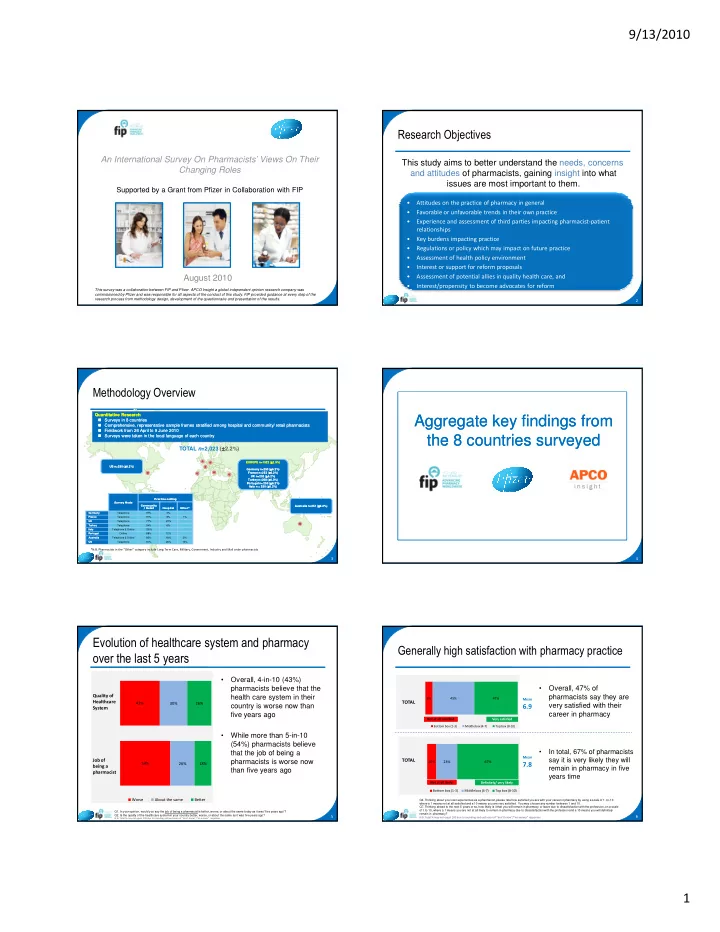
9/13/2010 An International Survey On Pharmacists Views On Their This study aims to better understand the needs, concerns Changing Roles and attitudes of pharmacists, gaining insight


slide-1
SLIDE 1

9/13/2010 1

An International Survey On Pharmacists’ Views On Their Changing Roles

Supported by a Grant from Pfizer in Collaboration with FIP

August 2010

This survey was a collaboration between FIP and Pfizer. APCO Insight a global independent opinion research company was commissioned by Pfizer and was responsible for all aspects of the conduct of this study. FIP provided guidance at every step of the research process from methodology design, development of the questionnaire and presentation of the results.

  • This study aims to better understand the needs, concerns

and attitudes of pharmacists, gaining insight into what issues are most important to them.

2

  • Attitudes on the practice of pharmacy in general
  • Favorable or unfavorable trends in their own practice
  • Experience and assessment of third parties impacting pharmacist-patient

relationships

  • Key burdens impacting practice
  • Regulations or policy which may impact on future practice
  • Assessment of health policy environment
  • Interest or support for reform proposals
  • Assessment of potential allies in quality health care, and
  • Interest/propensity to become advocates for reform
  • US n=250 (

US n=250 (± ± ± ± ± ± ± ±6.2%) 6.2%) Australia n=251 ( Australia n=251 (± ± ± ± ± ± ± ±6.2%) 6.2%) EUROPE n=1522 ( EUROPE n=1522 (± ± ± ± ± ± ± ±2.5%) 2.5%) Germany n=250 ( Germany n=250 (± ± ± ± ± ± ± ±6.2%) 6.2%) France n=252 ( France n=252 (± ± ± ± ± ± ± ±6.2%) 6.2%) UK n=252 ( UK n=252 (± ± ± ± ± ± ± ±6.2%) 6.2%) Turkey n=268 ( Turkey n=268 (± ± ± ± ± ± ± ±6.0%) 6.0%) Portugal n= 250 ( Portugal n= 250 (± ± ± ± ± ± ± ±6.2%) 6.2%) Italy n = 250 ( Italy n = 250 (± ± ± ± ± ± ± ±6.2%) 6.2%)

Quantitative Research Quantitative Research

  • Surveys in

Surveys in 8 8 countries countries

  • Comprehensive, representative sample frames stratified among

Comprehensive, representative sample frames stratified among hospital and community/ retail pharmacists hospital and community/ retail pharmacists

  • Fieldwork from 26 April to 9 June 2010

Fieldwork from 26 April to 9 June 2010

  • Surveys were taken in the local language of each country

Surveys were taken in the local language of each country

  • Germany

Germany Telephone 97% 3%

  • France

France Telephone 91% 8% 1% UK UK Telephone 77% 23%

  • Turkey

Turkey Telephone 94% 6%

  • Italy

Italy Telephone & Online 100%

  • Portugal

Portugal Online 88% 12%

  • Australia

Australia Telephone & Online 80% 18% 2% US US Telephone 61% 26% 13%

3

TOTAL n=2,023 (± ± ± ±2.2%)

*N.B. Pharmacists in the “Other” category include Long Term Care, Military, Government, Industry and Mail order pharmacists

Aggregate key findings from Aggregate key findings from the 8 countries surveyed the 8 countries surveyed

4

  • 5
  • Q1. In your opinion, would you say the job of being a pharmacist is better, worse, or about the same today as it was “five years ago”?
  • Q2. Is the quality of the healthcare system in your country better, worse, or about the same as it was five years ago?

N.B. Total % may not equal 100 due to rounding and exclusion of “don’t know”/”no answer” responses

43% 54% 30% 26% 26% 18% Worse About the same Better

Quality of Healthcare System

  • Overall, 4-in-10 (43%)

pharmacists believe that the health care system in their country is worse now than five years ago

  • While more than 5-in-10

(54%) pharmacists believe that the job of being a pharmacists is worse now than five years ago

Job of being a pharmacist

  • 6

8% 45% 47% Bottom box (1-3) Middle box (4-7) Top box (8-10) Not at all satisfied Not at all satisfied Very satisfied Very satisfied Mean

6.9

TOTAL

  • Q4. Thinking about your own experiences as a pharmacist, please rate how satisfied you are with your career in pharmacy by using a scale of 1 -to-10

where a 1 means not at all satisfied and a 10 means you are very satisfied. You may choose any number between 1 and 10.

  • Q7. Thinking ahead to the next 5 years or so, how likely is it that you will remain in pharmacy or leave due to dissatisfaction with the profession, on a scale
  • f 1 to 10, where a 1 means you are not at all likely to remain in pharmacy due to dissatisfaction with the profession and a 10 means you will definitely

remain in pharmacy? N.B. Total % may not equal 100 due to rounding and exclusion of “don’t know”/”no answer” responses

  • Overall, 47% of

pharmacists say they are very satisfied with their career in pharmacy

10% 23% 67% Bottom box (1-3) Middle box (4-7) Top box (8-10) Mean

7.8

TOTAL

Definitely/ very likely Definitely/ very likely Not at all likely Not at all likely

  • In total, 67% of pharmacists

say it is very likely they will remain in pharmacy in five years time

slide-2
SLIDE 2

9/13/2010 2

  • Most favorable part

%

Helping patients/ Patient contact 76%

Most unfavorable part %

Bureaucracy and insurance contracts 47% Workload/ working conditions 24%

  • Q5. Still thinking about your own experiences as a pharmacist, what is the most

unfavorable part of your job today? N.B. Total % may not equal 100 due to rounding and exclusion of “don’t know”/”no answer” responses

  • Q6. And what do you see as the most favorable part of your job today?

N.B. Total % may not equal 100 due to rounding and exclusion of “don’t know”/”no answer” responses

7

  • 8
  • Q5. Still thinking about your own experiences as a pharmacist, what is the most unfavorable part of your job today?

N.B. Total % may not equal 100 due to rounding and exclusion of “don’t know”/”no answer” responses

47% 24% 11% 8% 3% 2% 2% 2% 2% 1% 1% 1% 1% 8% 4%

Bureaucracy and dealing with insurance Workload/ working conditions Relationship with society and patients Competition/ economic viability Business and managerial challenges/ activities Providing additional services Dispensing/ product sales Job security/ lack of career development Relationship with other healthcare professionals The salary Other Don’t know/ no answer

[Unprompted, multiple response]

  • When asked what the

most unfavorable part of their job today is, pharmacists are most likely to volunteer:

– Bureaucracy and dealing with insurance – Workload/ working conditions

Nothing Professional updates Not being able to use my pharmaceutical knowledge

  • 9
  • Q6. And what do you see as the most favorable part of your job today?

N.B. Total % may not equal 100 due to rounding and exclusion of “don’t know”/”no answer” responses

76% 15% 15% 5% 3% 5% 2%

Helping patients/ patient contact Job characteristics non specific to pharmacy Being in the health care sector/ interaction with doctors and staff Pharmaceutical part of the job Nothing Other Don’t know/ no answer

[Unprompted, multiple response]

  • When asked what the

most favorable part of their job is, pharmacists are most likely to volunteer:

– Helping patients/ patient contact

  • When asked to rate how important

various issues are to their career satisfaction using a 1 to 10 scale (1 means very negative and a 10 means very positive), pharmacists are most like to say: Having a positive impact on patients' outcomes (mean score 8.8) Being recognized with trust & respect by patients (8.7) Staying up to date with the latest pharmaceutical knowledge and training (8.2) Being recognized with trust and respect by other health care professionals (8.0)

!

8.8 8.7 8.2 8.0 7.9 7.8 7.5 7.3 7.2 7.1 6.5 6.0 5.9

  • !

" # $ %

  • Mean score
  • Q8. Here are some issues that many pharmacists say are important to their career satisfaction. For each one, please tell me if your own experience of these issues has a

positive or negative impact on your satisfaction at work using the same 10 point scale as before, where a 1 means very negative and a 10 means very positive. N.B. Total % may not equal 100 due to rounding and exclusion of “don’t know”/”no answer” responses

10

1 –Very negative 10 -Very positive

"# $# "# %# &"# "'# ('# %)# * * * *

  • When asked to rate a

variety of statements about being a pharmacist and pharmacy today pharmacists tend to agree that:

– More information and advice are expected from pharmacists than ever before (93%) – Pharmacists are expected to provide additional services to patients without fair compensation (78%)

+,,,

  • 11
  • Q9. Please tell me if you strongly agree, somewhat agree, somewhat disagree or strongly disagree with each of the following statements about being a pharmacist

and pharmacy practice today: N.B. Total % may not equal 100 due to rounding and exclusion of “don’t know”/”no answer” responses

Total

(Disagree)

Total

(Agree)

6% 93%

  • 20%

78%

&

  • 12

3% 4% 26% 11% 21% 9% 10% 11%

0-10 11-25 26-50 51-75 76-100 101-150 151-200 More than 200

  • Q. How many patients per day do

you serve? On Average: 114 patients per day

59% 19% 13% 1% 3%

0-10 11-25 26-50 51-75 76-100

Q.How many times per day do you give advice without selling medicines or healthcare products? On Average: 19 times per day

For every 6 patients pharmacists serve every day, 1 receive advices for free

N.B. Total % may not equal 100 due to rounding and exclusion of “don’t know”/”no answer” responses

N=2023 N=2023

slide-3
SLIDE 3

9/13/2010 3

.

  • 13
  • Q14. As you may know, some pharmacies and pharmacists offer health promotion, health management programs, medication reviews and/or compliance
  • support. Have you or your pharmacy ever provided patients with such services?

N.B. Total % may not equal 100 due to rounding and exclusion of “don’t know”/”no answer” responses

Offer these services, 73% Don't offer these services, 26% Don't Know, 1%

  • /+
  • Almost 9 in 10

pharmacists agree that:

– They are valuable for improving health

  • utcomes for patients

(90%) – They increase the visibility of pharmacists’ expertise (87%)

14

  • Q15. Please tell me if you strongly agree, somewhat agree, somewhat disagree or strongly disagree with the following statements about health promotion and

health management programs: N.B. Total % may not equal 100 due to rounding and exclusion of “don’t know”/”no answer” responses

# (# "# %# "0# "0# %# 1# * * * * Total

(Disagree)

8%

Total

(Agree)

90%

'

  • 11%

87%

' (

23

  • When asked to rate how much interest they

have in providing a variety of health promotion and management programs using a 1 to 10 scale where 1 means no interest and 10 means a great deal of interest, pharmacists are most likely to say they are interested in providing:

– Diabetes management (mean score 8.1) – Compliance support (7.9) – Blood pressure management (7.8) – Asthma management (7.8) – Medication reviews (7.7) – Smoking cessation (7.6)

8.1 7.9 7.8 7.8 7.7 7.6 7.3 6.5 6.2 6.2 6 5.7 4.9 Mean score

1 –No interest at all 10 –Great deal of interest

  • )

#*

  • +

!

  • ,
  • Q16. Here are some types of health promotion and management programs that some pharmacists offer. For each one, please tell me how much interest you have (or would have)

in providing this service to your patients. Please use a 10 point scale, where a 1 means you have no interest and a 10 means you have a great deal of interest. If you already provide the service or if it’s not allowed, just say so. N.B. Total % may not equal 100 due to rounding and exclusion of “don’t know”/”no answer” responses

15

4 +

  • 16
  • Q19. What would you say are the critical success factors for the next generation of pharmacists?

N.B. Total % may not equal 100 due to rounding and exclusion of “don’t know”/”no answer” responses

39% 36% 10% 8% 6% 5% 5% 4% 3% 3% 3% 2% 2% 2% 2% 10% 11% More and better services

  • riented to patients / extended

activities Competences and education Better integration into health system and government Don't know / no answer Other Not any critical success factors Pharmacy location/ availability Liberalization Ability to work hard, long hours & handle stress Professionalism - being ethical, honest & trustworthy No future, already too many pharmacists Ability to deal with bureaucracy / insurance Passionate for the job & career Financial situation Management and business skills Political decisions / legislation Flexibility/ ability to multitask and innovate [Unprompted, Multiple Response]

  • When asked what the critical

success factors for the next generation of pharmacists are, pharmacists are most likely to volunteer:

– More and better services

  • riented to patients /

extended activities (39%) – Competences and education (36%)

61% 19% 11% 11% 8% 6% 4% 3% 2% 1% 7% 24%

2!

17

ASK HOSPITAL PHARMACISTS ONLY:

  • Q20. What skills and services do you think will be most important for hospital pharmacists in the next five to ten years?

N.B. Total % may not equal 100 due to rounding and exclusion of “don’t know”/”no answer” responses

Don't know / no answer Other n=280 Health promotion, prevention, screening Further interaction with the national health system Flexibility & ability to multitask Providing more services Team working with other healthcare professionals Financial and economics knowledge Communication skills, patient interactions and counseling Better patient care/disease management/ compliance Resource and management Increased knowledge and competence (incl. specialization) [Unprompted, Multiple Response]

  • When asked what skills and

services will be most important for hospital pharmacists in the next five to ten years, hospital pharmacists are most likely to volunteer:

– Increased knowledge and competence (incl. specialization) (61%) – Communication skills, patient interactions and counseling (19%)

32% 23% 16% 13% 12% 10% 9% 7% 3% 3% 1% 1% 1% 12% 14%

  • 5!

ASK COMMUNITY/RETAIL PHARMACISTS ONLY:

  • Q21. What skills and services do you think will be most important for community pharmacists in the next five to ten years?

N.B. Total % may not equal 100 due to rounding and exclusion of “don’t know”/”no answer” responses

N=1766 Don't know / no answer Other Availability Develop relationships with

  • ther pharmacists

Patient-oriented skills New services Disease management Product-oriented knowledge Education (initial and continuing) / competence Business/ management

  • riented skills

Flexibility, adaptability/ability to handle change [Unprompted, Multiple Response]

  • When asked to volunteer

which skills and services will be most important for community pharmacists in the next five to ten years, community pharmacists are most likely to volunteer:

– Patient-oriented skills (32%) – Disease management (23%) – New services (16%)

Health promotion Clinical/ medical training Legal knowledge Sales skills 18

slide-4
SLIDE 4

9/13/2010 4

Counterfeit medicines Counterfeit medicines

19

  • /
  • 20
  • Q9. Please tell me if you strongly agree, somewhat agree, somewhat disagree or strongly disagree with each of the following statements about being a

pharmacist and pharmacy practice today: N.B. Total % may not equal 100 due to rounding and exclusion of “don’t know”/”no answer” responses

&1# &1# 1&# 1%# 1'# 0# &)# "# "&# ""# &)# %# * * * * Total

(Disagree)

35%

Total

(Agree)

61%

'

  • ./0'"12

18% 77%

'

  • '
  • 3

31% 63%

[n=1254] * N.B. Based on pre-test feedback, respondents in Italy, Turkey and Portugal did not answer this question. They felt it was not relevant because machine readable bar codes on medicines already exist in those countries.

  • Majorities of pharmacists

believe:

– The prevalence of counterfeit medication is a serious issue in their country – Current policies and technology are insufficient to deal with counterfeit medicines – Machine readable bar codes are needed to prevent counterfeit medicines

Any questions? Any questions?

21 Dr Luc Besançon Project Manager, FIP Luc@fip.org Dr Emma Andrews Director of External Medical Affairs, Pfizer Inc. Emma.N.Andrews@pfizer.com Phil Riggins Director, EMEA priggins@apcoworldwide.com