Agenda TRANSDEC: Transportation Decision Project Overview Making - - PDF document

agenda transdec transportation decision project overview
SMART_READER_LITE
LIVE PREVIEW

Agenda TRANSDEC: Transportation Decision Project Overview Making - - PDF document

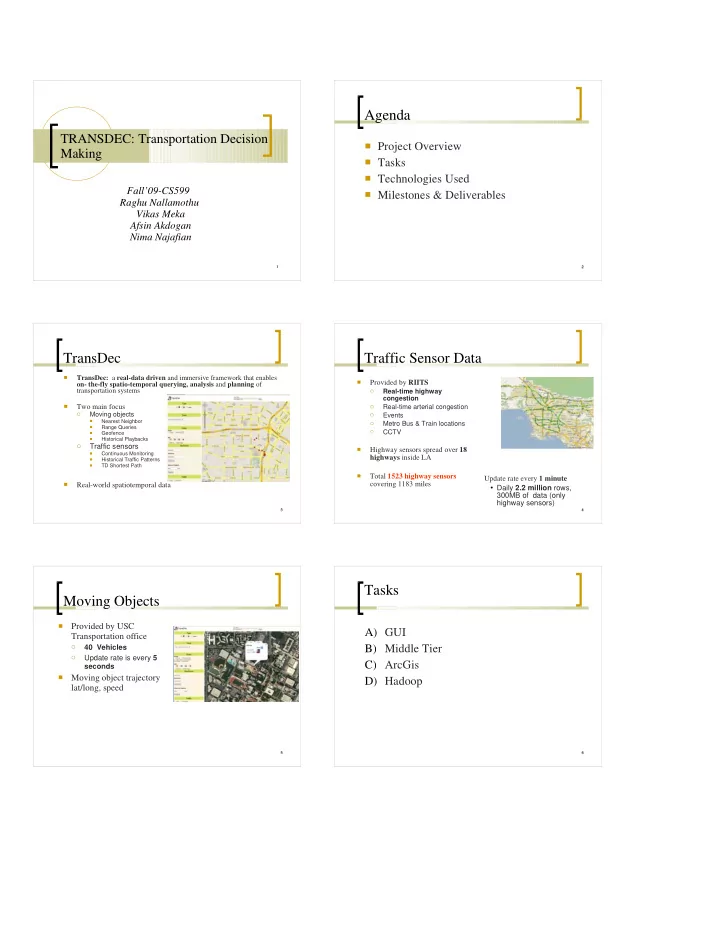
Agenda TRANSDEC: Transportation Decision Project Overview Making Tasks Technologies Used Fall09-CS599 Milestones & Deliverables Raghu Nallamothu Vikas Meka Afsin Akdogan Nima Najafian 1 1 2 2 TransDec Traffic


slide-1
SLIDE 1

1 1

TRANSDEC: Transportation Decision Making

Fall’09-CS599 Raghu Nallamothu Vikas Meka Afsin Akdogan Nima Najafian

2 2

Agenda

Project Overview Tasks Technologies Used Milestones & Deliverables

3 3

TransDec

  • TransDec: a real-data driven and immersive framework that enables
  • n- the-fly spatio-temporal querying, analysis and planning of

transportation systems

  • Two main focus
  • Moving objects
  • Nearest Neighbor
  • Range Queries
  • Geofence
  • Historical Playbacks
  • Traffic sensors
  • Continuous Monitoring
  • Historical Traffic Patterns
  • TD Shortest Path
  • Real-world spatiotemporal data

4 4

Traffic Sensor Data

  • Provided by RIITS
  • Real-time highway

congestion

  • Real-time arterial congestion
  • Events
  • Metro Bus & Train locations
  • CCTV
  • Highway sensors spread over 18

highways inside LA

  • Total 1523 highway sensors

covering 1183 miles Update rate every 1 minute

Daily 2.2 million rows,

300MB of data (only highway sensors)

5 5

Moving Objects

  • Provided by USC

Transportation office

  • 40 Vehicles
  • Update rate is every 5

seconds

  • Moving object trajectory

lat/long, speed

6 6

Tasks

A) GUI B) Middle Tier C) ArcGis D) Hadoop

slide-2
SLIDE 2

7 7

GUI & Middle Tier

8 8

Tasks A & B

1.Real-time data integration from RIITS

  • Traffic Sensor Data for main Streets
  • CCTV

2.Generic Query Interface , “Middle Tier” 3.Temporal Traffic Pattern Analysis 4.Traffic Flow Implementation 5.CCTV Footages 6.Granular Querying

9 9

Task A -RIITS Data Integration

Data is Provided in an predefined XML format. Traffic sensor data and the CCTV snapshots are updated every minute Congestion freeway inventory data is updated on a daily basis CCTV Inventory data is updated quarterly.

10 10

Task B -Query Interface

A generic Query interface is designed to interact with all the webservices. Based on the type of request each of them is called for a specific purpose. All the webservices can be accessed through SOAP calls.

11 11

Temporal Traffic Pattern Analysis

 Users can

adjust the date and time to analyse traffic patterns

12 12

Task A -Traffic Flow Implementation

Monitoring the

movement of traffic in any specific location between various segments.

slide-3
SLIDE 3

13 13

Task A - CCTV Footages

  • Users can also view

CCTV footages of vehicular flow at various segements.

  • If we have multiple

snapshots of a particular location we also show them a video.

14 14

Task B - Granular Querying

We can Custom Query any segment of

the map to retreive historical patterns about the vehicular flow.

15 15

Cube Operations

16 16

ArcGis

17

ArcGIS Integration

What Are we trying to do:

Feed ArcGIS with our Data Use ArcGIS tools and functions to display our

data

Import our queries to ArcGIS and adjusting them

to work with ArcGIS libraries and tools(Current Traffic and Traffic prediction)

18

Task C - Getting Started

Preparing the programming environment: obtaining the software and installing it

slide-4
SLIDE 4

19

Task C – Connecting Oracle to ArcGis

Connecting to OracleDB using a direct Connection

Utilize ARCTOOLBOX for geoprocessing (extract,overlay,..)

Query our data(highway sensors) with ArcMap and mapping it by adding data layers ( displaying highway sensors)

20

Task C - Querying Traffic

Displaying realtime traffic flow on the map

Visualizing current traffic and the historical pattern using ArcGIS Analysis tools

21

Task C - Tracking moving objects

Tracking moving objects using Arc GIS Tracking Analyst

22 22

Hadoop

23 23

Task D–Distributed Computing

  • GeoSpatial Queries
  • Computationally Complex
  • Time Consuming on large Datasets
  • Solution
  • Parallelize the Queries

24 24

Task D - Hadoop

  • What is Hadoop?
  • A Software Framework to support data

intensive distributed applications. It enables to work with thousands of nodes and petabytes of data.

  • Why do we need Hadoop ?
  • Parallelization
  • Scalability
  • Fault Tolerance
  • Cost Effectiveness
slide-5
SLIDE 5

25 25

Task D – Execution Flow

26 26

Task D - Map/Reduce

 Hadoop File System  Map/Reduce Model  Retreiving Hadoop

  • utput

 Automating input to

Hadoop

27 27

Technologies Used

Oracle Spatial – PL/SQL AJAX, Flex Java- Servlet, Jsp SOAP, XML, WSDL

28

`

Week/Tasks 1 2 3 4 5 6 7 8 9 10 11 12

RIITS CCTV FOOTAGE TRAFFIC FLOW MIDDLE TIER PATTERN ANALYSIS GRANULAR QUERYING SOFTWARE ENVIRONMENT ARCGIS QUERYING TRAFFIC TRACKING MOVING OBJECTS HADOOP File System MAP MODEL HADOOP OUTPUT ANALYSIS AUTOMATING HADOOP I/P

Nima Nima Nima Nima Afsin Afsin Afsin

Vikas

Afsin

Vikas Vikas Raghu Raghu Raghu

29

Deliverables- Vikas

 Understanding and displaying the data

from RIITS – 4 weeks

 Including the CCTV footages in the GUI

– 4 weeks

 Implementing traffic flow – 4 weeks

30

Deliverables- Raghu

 Middle Tier implementation – 4 weeks  Traffic pattern analysis – 4 weeks  Granular Querying and retreiving

results – 4 weeks

slide-6
SLIDE 6

31

Deliverables- Nima

 Installing ArcGIS – 3 weeks  Loading our data to ArcGIS – 3 weeks  Querying Traffic - 3 weeks  Tracking moving objects – 3 weeks

32

Deliverables- Afsin

 Retreiving output from Hadoop -9

weeks

 Automating input to Hadoop – 3 weeks

33

Thank You