Agenda # SESSION FACILITATOR TIMING 12.45 1.00 Arrival / Coffee - - PowerPoint PPT Presentation

agenda
SMART_READER_LITE
LIVE PREVIEW

Agenda # SESSION FACILITATOR TIMING 12.45 1.00 Arrival / Coffee - - PowerPoint PPT Presentation

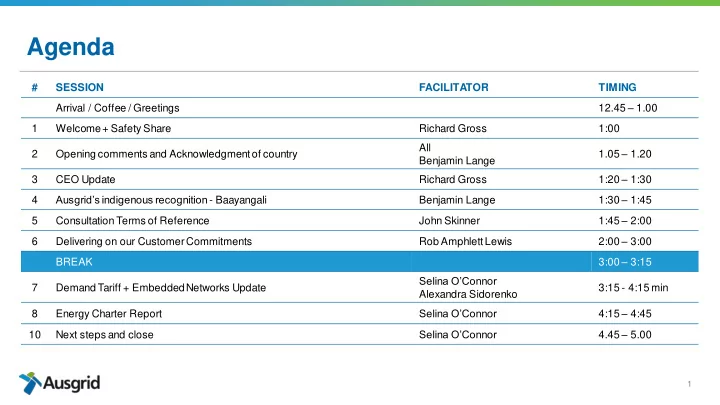
Agenda # SESSION FACILITATOR TIMING 12.45 1.00 Arrival / Coffee / Greetings 1 Welcome + Safety Share Richard Gross 1:00 All 1.05 1.20 2 Opening comments and Acknowledgment of country Benjamin Lange 1:20 1:30 3 CEO Update


slide-1
SLIDE 1

1

Agenda

# SESSION FACILITATOR TIMING Arrival / Coffee / Greetings 12.45 – 1.00 1 Welcome + Safety Share Richard Gross 1:00 2 Opening comments and Acknowledgment of country All Benjamin Lange 1.05 – 1.20 3 CEO Update Richard Gross 1:20 – 1:30 4 Ausgrid’s indigenous recognition - Baayangali Benjamin Lange 1:30 – 1:45 5 Consultation Terms of Reference John Skinner 1:45 – 2:00 6 Delivering on our Customer Commitments Rob Amphlett Lewis 2:00 – 3:00 BREAK 3:00 – 3:15 7 Demand Tariff + Embedded Networks Update Selina O’Connor Alexandra Sidorenko 3:15 - 4:15 min 8 Energy Charter Report Selina O’Connor 4:15 – 4:45 10 Next steps and close Selina O’Connor 4.45 – 5.00

slide-2
SLIDE 2

2

Customer Consultative Committee

25 July 2019

slide-3
SLIDE 3

Safety Share & Opening comments

3

All Advocates

slide-4
SLIDE 4

4

Acknowledgement of Country

Benjamin Lange

slide-5
SLIDE 5

CEO Opening

Richard Gross

5

slide-6
SLIDE 6

6

CEO Update

AFFORDABILITY SAFETY CUSTOMER FOCUS

  • Introduction of demand

tariffs

  • Uplift frontline safety

leadership

  • Improve controls to

reduce risk ▪ Live Pause update

New strategic focus ‘Foster Community Trust’ Lowering prices for customers

$71 reductions

Revenue per residential customer

▪ Chief Customer Officer appointed ▪ Delivery of Customer Commitments underway ▪ Scorecard development ▪ Energy Charter report in development

New strategic focus ‘Lead Better Safety Outcomes’

slide-7
SLIDE 7

Stakeholders

  • Customers
  • Energy retailers
  • Councils
  • Accredited Service Providers (ASP) and National Electricity

and Communications Association (NECA)

  • Urban Development Industry Association (UDIA)
  • Government, Regulators (Safework, IPART), MPs
  • Staff

Communications:

  • Web page
  • ASP alerts issued
  • Stakeholder update briefings provided
  • Media statement / Press release / NSW advertising
  • Regular internal staff updates

Advisory Committee on Live Pause

  • Established to consult and align on plans to return to work.
  • Developed Communications Protocol
  • First meeting 26 July 2019
  • Endeavour CEO, Essential CEO, ETU secretary, Energy

Consumers Australia CEO and National Electrical Communications Alliance CEO

7

CCC Discussion – Customers are being inconvenienced are we doing all we can.

Safety – Live pause update

▪ The pause on live work was introduced on the Ausgrid network after a worker tragically lost his life completing live work in April. ▪ This was the first fatality of a worker on our network in more than 20 years and prompted a comprehensive safety review. ▪ Work on the network is continuing, but with power switched off (de- energised). Work will take longer to arrange. Phase 1 - Risk assessment ▪ Full inventory all the 205 high and low voltage tasks and controls. ▪ Segmentation of live works:

  • Connection of electricity supply to premises
  • Low voltage distribution no longer requiring a loss of supply
  • Temporary installation (tiger tails)
  • Street lighting and LED work.

▪ 18 June resumption of ASP Level 2 work with additional controls ▪ New live work training materials are in development to support staff to recommence Stage 1 activities. ▪ Ausgrid aims to return Stage 1 activities late August early September following stakeholder approvals. Phase 2 – Verification Phase 3 – Assurance

slide-8
SLIDE 8

8

Indigenous recognition – Baayangali

Benjamin Lange

slide-9
SLIDE 9

9

NAIDOC celebrations

Why reconciliation is important to Ausgrid

  • Ausgrid is committed to taking steps towards reconciliation and building stronger relationships with Aboriginal and Torres Strait

Islander peoples in the communities in which we operate.

  • This commitment speaks directly to our purpose of ‘Connecting Communities, Empowering Lives’

NAIDOC week launch of Lucy Simpson’s design for Roden Cutler House interiors

  • Ausgrid supports and celebrates our indigenous team members and our relationship with the indigenous community.
  • We commissioned Yuwaalaraay artist Lucy Simpson to tell Ausgrid’s story through art, now showcased at RodenCutler House

(RCH).

  • On 10 July 2019 CEO Richard Gross, members of the Inclusion & Diversity Council, the Aboriginal and Torres Strait Islander

Network and Executive Leadership Team held a morning tea at RCH to celebrate NAIDOC Week.

  • Lucy Simpson shared her experience of creating a visual narrative which translates and brings together many elements of a

story unique to Ausgrid that begins above and rests underfoot.

The inspiration for Lucy’s work comes from the word Baayangali

  • Baayangali is a Yuwaalaraay word from the north-west of New South Wales referring to the concept in nature of ‘the system by

which things work and are interconnected, or the natural order of all living things’.

  • Three distinct elements in nature that represent POWER, ENERGY and LIFE are all interwoven and represented through the

series which incorporates the transfer of energy, knowledge systems and our role in sustaining the balance.

slide-10
SLIDE 10

NAIDOC celebrations - introducing Lucy Simpson

slide-11
SLIDE 11

Footer 11

slide-12
SLIDE 12

Footer 12

slide-13
SLIDE 13

Footer 13

slide-14
SLIDE 14

Footer 14

photos

slide-15
SLIDE 15

Footer 15

slide-16
SLIDE 16

Committees’ terms of reference

16

John Skinner

slide-17
SLIDE 17

17

Ausgrid engagement principles and customer committees

Ausgrid’s objective is to continue building trust with customers. The following principles aim to support this goal.

Be collaborative: Proactively engage and collaborate with stakeholders Be quantitative: Provide data from the perspective of the consumer Be accountable: Agree a timeframe and deliver Be transparent: Ask for regular feedback, understand what is required Be adaptable: Be prepared to change based on feedback​

Through our customer committees we aim to embed customer views in our business decisions and collaborate on the future direction of our network

Network Innovation Advisory Committee (NIAC) Pricing Working Group (PWG) Technology Review Committee (TRC)

Customer Consultative Committee (CCC)

slide-18
SLIDE 18

18

Collaboration goal Through our customer committees we aim to collaborate with customers about the future direction of the network

Terms of Reference

Public participation goal

Through our customer committees we aim to embed customer views in our business decisions and collaborate on the future direction of our network.

Promise to the public

We will look to you for advice and innovation in formulating solutions and incorporate your advice and recommendations into the decisions to the maximum extent possible.

Draft Terms of Reference We are seeking views on a new draft T erms

  • f Reference covering all our customer

committees

Draft Terms of Referencefor our customer committees

Our draft T erms of Reference (attached) will cover the CCC, NIAC, PWG and TRC

Ausgrid Customer Charter supporting the CCC

Established in 2016 and due for review in 2019

Draft NIAC ToR

Developed with consumer advocates in December 2018 and submitted with Revised Proposal

>

slide-19
SLIDE 19

19

Delivering on Customer Commitments

Rob Amphlett Lewis

slide-20
SLIDE 20

20

Delivering on Revised Proposal customer commitments

Commitment

Committee / Working Group responsible

Share and improve internal cost benefit analysis, risk based assessment, internal governance processes and forecasting investment - identifying a way to give customers a more meaningful role in developing spending plans

Technical Review Committee

Explore role of optionality in long term asset decisions

Technical Review Committee

Support industry-wide IT review

Complete

Engage with customers on cyber expenditure and maturity levels

Technical Review Committee

Jointly develop policy and regulatory framework submissions

All committees

Collaborate with AER to improve repex model and drive greater confidence in the tool

Technical Review Committee

Work with AER to give effect to tax Review Final Decisions and accept Rate of Return decision

Report completion to CCC

Establish Network Innovation Advisory Committee (AMO), Technical Review Committee (AMO/IT ) and continue Pricing Working Group (S&R)

In Progress

Implement opex productivity from FY21

Complete

Deliver against Energy Charter 5 principles

Report to CCC

Deeper engagement in customer strategy and business planning

CCC / NIAC / TRC

Greater focus on non-network/DM solutions and support demand response rule changes

NIAC

Exclude Innovation, cyber and ADMS from CESS

Complete

slide-21
SLIDE 21

21

Customer Commitments Update

Commitment Ausgrid Action Outcome Status Update Committee

Share and improve internal cost benefit analysis, risk based assessment, internal governance processes and forecasting investment - identifying a way to give customers a more meaningful role in developing spending plans − Revising Investment Governance Framework to target customer

  • utcomes and developing an

improved investment evaluation framework (better cost benefit analysis) − Develop timeline for program delivery − Improved quantification of customer benefits and consideration of customer in investment decisions − Provide transparency on incorporating customer preferences in decisions (Energy Charter) Consolidating internal and external feedback and identifyingdetailed areas

  • f improvementto

informwork program Will develop for first TRC meeting. Technical Review Committee Explore role of optionality in long term asset decisions - show that investment decisions have taken into consideration optionality (eg: new technologies)

  • Incorporated in above
  • As above

Technical Review Committee Support industry-wide IT review − Co-develop submission to the AER ICT review due to AER 19 June − Ensure efficiency of ICT expenditure − Better articulation of customer benefits from ICT expenditure Submission developed with input from customers and lodged with the AER 19 June 2019 Complete Engage with customers on cyber expenditure & maturity levels − Determine decision making frame and trigger for additional cyber security capex − Improved customer understanding of cyber spending Discuss at first TRC meeting Technical Review Committee

slide-22
SLIDE 22

22

Customer Commitments Update

Commitment Action Status Committee

Jointly develop policy & regulatory framework submissions S&R advocacy program - Identifying listof potential policy initiatives Allocate regulatory submissions working groups to develop (NIAC, TRC or PWG) Underway Will report list to first TRC NIAC, TRC and PWG Collaborate with AER to improve Repex model and drive greater confidence in the tool Scope Ausgrid ideas to improve Repex model Align with AER on engagement Underway Will share will first TRC committee Technical Review Committee Work with AER to give effect to tax Review Final Decisions and accept Rate of Return decision Updated PTRM Complete Complete Establish Network Innovation Advisory, Technical Review Committee, Pricing Working Group − Collaborate on Terms of Reference − NIAC meeting 24 July − TRC meeting TBC − PWG meetings ongoing Committees established Shared updated terms of reference Set date for TRC Implement opex productivity from FY21 Complete Complete Deliver against Energy Charter principles − Gathering input from Ausgrid business units to show initiatives against Energy Charter Principles. Developing draft report to share for feedback CCC Deeper engagement in customer strategy and business planning − Share Customer Strategy and program rollout − Develop scorecard improve transparency of performance and provide input to actions Seeking feedback from CCC on Scorecard All committees Greater focus on non-network/DM solutions and work on demand response rule change − Advocated for rule change via ENA Policy Steering Committee − Review AEMC wholesale demand response mechanism rule change draft rule Ongoing Developing submission to draft rule. NIAC/TRC Exclude Innovation, cyber and ADMS from CESS − Identified data sources and owners and developing tracking tool to ensure exclusion is implemented by 30 June 2019 Complete Complete

slide-23
SLIDE 23

23

Health & Safety

  • LTIFR
  • TRIFR (trend period)
  • Engineering Solutions

Scorecard Development

Customer Volumes

  • Number of Customers by category
  • DER customers
  • Life Support Customers
  • Battery customers

Reliability

  • SAIDI
  • SAIFI (trend period)
  • Reliability programs

Customer demand

  • Phone and email
  • Digital
  • Social
  • Field

Voice of Customer

  • Complaints lodged + closed
  • Age of complaints

EWON

  • Cases referred + closed
  • Cases returned

Compliance

  • Life Support
  • Public Lighting

Staff numbers Program Delivery Capex Power Supplied

  • Residential
  • Business

Affordability

  • Revenue per customer
  • Cost to serve

Incentive scheme performance

(CESS + EBSS)

Sustainability

  • Emissions reductions

Customer experience NPS

  • Residents
  • Retailers
  • ASPs
  • Major Customers
  • SMEs

Objective: Develop a customer and corporate scorecard with input from committee members to report back to CCC members. T

  • discuss: Items to be included and items that should be added.
slide-24
SLIDE 24

Footer 24

Policy development and collaboration

  • AER IT review
  • AER review of customer service incentive schemes
  • Principles for Management of Voltage Variation Customer Claims
  • AEMC wholesale demand response mechanism
  • AEMC regulatory sandboxes
  • AEMC stand-alone power systems/embedded networks
  • Energy Charter Better Together initiatives
  • Contributing to development of AEMO DER register with NSW Government

CCC discussion – Above are the submissions we have recently submitted or are developing, which of these would you like to discuss with us or contribute to.

slide-25
SLIDE 25

25

NIAC Update

  • First meeting of the Network Innovation Advisory Committee

meeting 24 July

  • Mike Swanston to provide update on meeting discussion
slide-26
SLIDE 26

26

Break

Resume at 3:00pm

slide-27
SLIDE 27

Demand Tariff Communications Update

Selina O’Connor

27

slide-28
SLIDE 28

Footer 28

Program to support implementation of new tariffs

Retailers

  • Working with retailers to clarify intention to launch demand products – potential for joint projects
  • Sharing materials with retailers

Customer support

  • Call centre staff trained to assist
  • Development of materials to explain new tariffs and steps that can be taken to reduce demand charges
  • Customers on average will be better off on demand tariff (compared to current tariff) and can further reduce their bill be

taking some steps Monitoring systems

  • Setting up monitoring of all customers on a demand tariff with flags for those with high use for peak periods

Research

  • Continuing research

Government

  • Providing briefings - no new initiatives

Energy Charter

  • Better Together initiative + research opportunity
  • AGL Energy Affordability and Energy Literacy program support - Sydney Alliance ‘Voices for Power’ project
slide-29
SLIDE 29

In addition to customer materials briefing packs were also created for government and politicians drawing from customer materials as appropriate.

The demand tariff introduction is supported by a range of communication materials designed to answer key customer questions and guide customers through the change.

Communications materials

1.1 Your energy use webpage Purpose: provide customers with a single site to answer their key demand tariff questions Status1: ready to go live 1.2 Energy landscape video Purpose: provide customers with the context of distributor and retailer roles in the energy landscape in an easy to digest format Status1: storyboard complete 1.3 Demand tariff materials

  • A. Video
  • B. Factsheets
  • C. FAQ

Purpose: help customers understand what a demand tariff is and what it means for them, assist customers to minimise their bills, and answer common customer demand tariff questions Status1: written materials and video incorporating customer testing complete Materials were developed and refined through:

  • Review and feedback from consumer advocates
  • Focus group testing
  • Expert assistance from a firm specialising in

communicating energy sector concepts to customers.

1. Status as at 24th July

New item created in response to focus group testing

Y

  • ur Energy Use website

https://newagauth.ausgrid.com .au/Y

  • ur-energy-use
slide-30
SLIDE 30

30

Feedback and our response

Customer Advocates

  • Demand tariff video - we need to be clearer that this is a new tariff not an add on to customers existing tariff structure, we could say

more clearly say that customers can benefit from the demand tariff in comparison to the Time of Use tariff.

  • Overall the demand video was clear, using customer friendly language and images.
  • Ausgrid could better describe the context for implementation of demand tariffs and more clearly show the role of the retailer and the

distributor. Ipsos testing

  • Participants were very attuned to messages around saving - saving money and controlling your bill.
  • Overall the materials tested well – they were considered strong and would generate a basic understanding of demand tariffs.
  • Fine tuning some of the language was required - Don’t' assume people have any base level knowledge.
  • Sequence of progression through materials was important – consider layout and order of presentation, for example the demand video

was better understood when the context who Ausgrid was.

  • Not many people knew that Ausgrid was not a retailer. Not clear what we meant by customer.
  • The Demand Tariff fact sheets and Q&A were seen as valuable support to the video and did not need to be amended.

Response

  • Created new video and diagram on covering our role in the energy supply chain and how we bill for energy use. [Slide 23 + Storyboard]
  • Redrafted web text and redesigned web page, simplified language and created a ‘definitions’ page. [Link on S30].
  • Updated the ‘Understanding demand tariff’ video – provided better context in the opening voice over, clarification that not all retailers will
  • ffer a demand plan and clarification that taking turns needs to be within the 30min window. [Slide 34]
slide-31
SLIDE 31

Footer 31

Energy supply diagram

slide-32
SLIDE 32

Footer 32

slide-33
SLIDE 33

Embedded Networks update

Alexandra Sidorenko

33

slide-34
SLIDE 34

Footer 34

Embedded networks: what is the issue?

C&I tariff C&I tariff Residential tariff Residential tariff Residential tariff

Child connections Parent connection

Embedded network (mixed residential)

slide-35
SLIDE 35

35

Embedded Networks issue summary

  • The number of Embedded Networks (EN) within the Ausgrid network is growing. This is a problem because:
  • Embedded networks are driven by arbitrage between current residential and non-residential network tariffs and not by competition to provide higher level
  • f service to the end customers.
  • Maintaining the current pricing it is not in the long-term interests of the broader customer base who would carry the higher share of residual costs after

the establishment of the embedded network.

  • Ausgrid is seeking a TSS amendment pursuant to the AEMC final report on embedded networks.
  • The pack provided includes analysis we have conducted that demonstrates ENs are different from the commercial and industrial customers in

their load profile, peak consumption and diversity (the timing of their peak). This has impact on all our tariffs.

  • The change we are looking to propose includes a dedicated secondary tariff for EN based on the forecast number of child connections by

type.

  • This approach has a good fit with our tariff strategy, which focussed on cost reflective tariffs and demand response through behavioural

change or use of technology such as HEMS.

  • The new tariff if approved would ensure that conversions to EN occur only if there are value added services offered to the end customers that

future members of the EN are willing to fund, without any cross-subsidy from our existing customer base.

CCC discussion – Do members of the CCC support our approach? Are there any other issues we should consider?

slide-36
SLIDE 36

Energy Charter Report

36

Selina O’Connor

slide-37
SLIDE 37

37

Energy Charter Principles

slide-38
SLIDE 38

38

Customer expectations

CCC discussion – Is this a fair representation of customer concerns ?

slide-39
SLIDE 39

1

Overview of actions against Principles

Principle Principle in action Examples of Ausgrid actions

Principle 1 - We will put customers at the centre of

  • ur business and the energy

system

  • Board oversight
  • Management accountability
  • Workforce is engaged and incentivised
  • Processes in place to determine community needs and how feedback is adopted
  • Demonstrate a culture of innovation and collaboration for positive customer outcomes.
  • Board updated business strategy + board support for Energy

Charter

  • Monitoring of corporate scorecard (NECF, STPIS)
  • STI + LTI incorporate customer metrics, Impact of

Transformation workstreams

  • Staff survey, NPS customer surveys, CCC, project consultation,

NIAC, evolve, VPP

Principle 2 - We will improve energy affordability for customers

  • Ensure investment and operational decisions are efficient
  • Offer customers tools to manage energy use and cost
  • Improve efficiency across the supply chain to improve affordability over the short and long term
  • Innovate to deliver competitive energy solutions for business and residential customers
  • Advocate to improve energy affordability
  • 19-24 Regulatory Proposal development process
  • Evidence of price reductions
  • Innovation program + NIAC and TRC, Evolve program, Virtual

Power Plant, Demand response programs Power 2U

  • NMI reports and online energy efficiency materials

Principle 3 - We will provide energy safely, sustainably and reliably

  • Maintain the highest standards of safety for its people, the community and the environment
  • Engage on investments and manage operations in line with customer expectations, demonstrating

community benefit

  • Develop business strategy and manage operations to respond to the shift to a cleaner energy

system

  • Facilitate new services and technologies that support sustainable energy solutions to meet

changing market needs

  • Implement supply chain solutions to support energy connection, service and reliability that meets

customers needs.

  • Health & Safety reset – Life savers
  • PESAP program, bushfire and storm safety - CALD safety

communications

  • Customer Consultation Committee - Major projects community

engagement

  • Production of sustainability report - carbon emission target
  • Innovation program, ADMS, NIAC + TRC
  • Streamline solar connections, ASP portal

Principle 4 - We will improve the customer experience

  • Enable customers to get fair outcomes regardless of their ability or desire to participate in the

energy market.

  • Empower customers by making sure all communication is clear, in plain terms, accessible and

understandable

  • Have effective and accessible dispute resolution processes, to resolve customer issues and

implement process improvements in response.

  • Ensure that innovation and design in products and services are driven by customers’ needs and

preferences.

  • New CRM process to better manage and track complaints
  • Website refresh and user experience testing
  • Website outage tools to improve reporting
  • Clear approach to pricing that doesn’t discriminate

Principle 5 - We will support customers facing vulnerable circumstances

  • Provide products and services that are tailored to customers facing vulnerable circumstances and

support them to get back on track

  • Take a collaborative approach to implement innovative solutions that improve outcomes

(affordability or experience) for customers facing vulnerable circumstances.

  • New classification of services (20min fix)
  • Review vulnerable customer program
  • Approach to customer defect disconnections
  • Tarif research program
slide-40
SLIDE 40

1

  • Accountability Panel expectations:
  • Views the Charter as trying to re-establish trust, build the social licence of energy businesses

and restore consumer confidence in them. And doing those things through the significant culture change that puts the customer at the centre of the business.

  • Looking for reporting of customer outcomes not just activity, and how these customer outcomes

have been measured.

  • Report structure – CEO, Chair and CCC opening, executive summary, overview, outline of

actions per principle, highlighted case studies, future actions and conclusion.

  • CCC review report out of session
  • CCC ‘endorsement’ to be included in the report or provided separately

Energy Charter Report update

CCC discussion – Ways to gather feedback from committee members, discuss what is needed to be capable of endorsement, discuss drafting text for the Ausgrid Energy Charter Report.

slide-41
SLIDE 41

41

Next Steps and Close