Agenda 8:15am 9:00am Registration and Check-In 9:00am 9:05am - - PowerPoint PPT Presentation

agenda
SMART_READER_LITE
LIVE PREVIEW

Agenda 8:15am 9:00am Registration and Check-In 9:00am 9:05am - - PowerPoint PPT Presentation

Agenda 8:15am 9:00am Registration and Check-In 9:00am 9:05am Welcome and Overview of Event 9:05am 9:20am Opening Remarks 9:20am 9:35am Doing Business in the Federal Marketplace & the Acquisition Lifecycle PSC will


slide-1
SLIDE 1

Department of Commerce // National Oceanic and Atmospheric Administration // 10

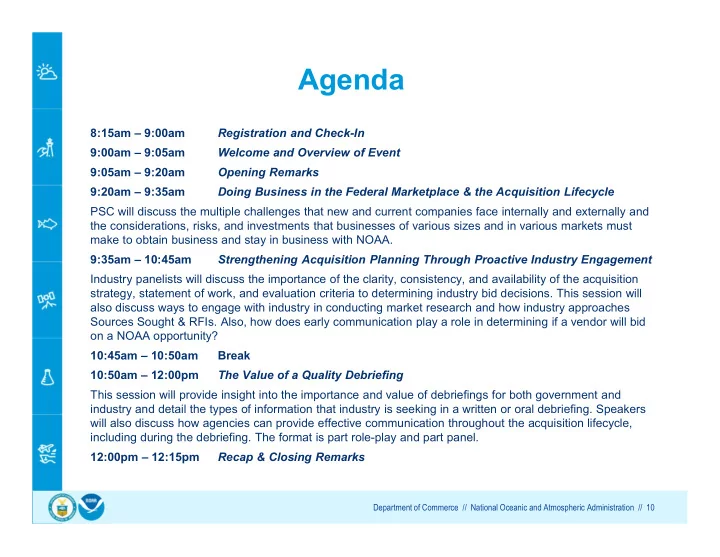
Agenda

8:15am – 9:00am Registration and Check-In 9:00am – 9:05am Welcome and Overview of Event 9:05am – 9:20am Opening Remarks 9:20am – 9:35am Doing Business in the Federal Marketplace & the Acquisition Lifecycle PSC will discuss the multiple challenges that new and current companies face internally and externally and the considerations, risks, and investments that businesses of various sizes and in various markets must make to obtain business and stay in business with NOAA. 9:35am – 10:45am Strengthening Acquisition Planning Through Proactive Industry Engagement Industry panelists will discuss the importance of the clarity, consistency, and availability of the acquisition strategy, statement of work, and evaluation criteria to determining industry bid decisions. This session will also discuss ways to engage with industry in conducting market research and how industry approaches Sources Sought & RFIs. Also, how does early communication play a role in determining if a vendor will bid

  • n a NOAA opportunity?

10:45am – 10:50am Break 10:50am – 12:00pm The Value of a Quality Debriefing This session will provide insight into the importance and value of debriefings for both government and industry and detail the types of information that industry is seeking in a written or oral debriefing. Speakers will also discuss how agencies can provide effective communication throughout the acquisition lifecycle, including during the debriefing. The format is part role-play and part panel. 12:00pm – 12:15pm Recap & Closing Remarks

slide-2
SLIDE 2

NOAA Acquisition & Grants Office (AGO)

REVERSE INDUSTRY DAY

KELLY MABE, AGO DEPUTY DIRECTOR

April 16, 2019

slide-3
SLIDE 3

Department of Commerce // National Oceanic and Atmospheric Administration // 2

A Bureau (Agency) in a Department

  • U. S. Department of Commerce
  • Formed in 1903 to promote American business and trade
  • Twelve bureaus of differing size and scope pursuing diverse missions

National Oceanic and Atmospheric Administration

  • NOAA is the nation’s first physical science, atmospheric science, and

conservation agency, tracing its lineage to the U.S. Coast and Geodetic Survey of 1807, the Weather Bureau of 1870, and the Bureau of Commercial Fisheries of 1871

  • Formed in 1970 to coordinate the work of predecessor organizations

working on the oceans and atmosphere, as part of a total environmental system

slide-4
SLIDE 4

Department of Commerce // National Oceanic and Atmospheric Administration // 3

Department of Commerce Strategic Plan

ACCELERATE AMERICAN LEADERSHIP

  • Expand Commercial Space Activities
  • Advance Innovation
  • Strengthen Intellectual Property Protection

ENHANCE JOB CREATION

  • Increase Aquaculture Production
  • Reduce and Streamline Regulations
  • Strengthen Domestic Commerce and the U.S. Industrial

Base

  • Increase U.S. Exports
  • Increase Inward Investment Into the United States

STRENGTHEN U.S. ECONOMIC AND NATIONAL SECURITY

  • Enforce the Nation’s Trade Laws and Security Laws
  • Enhance the Nation’s Cybersecurity
  • Reduce Extreme Weather Impacts
  • Deploy Public Safety Broadband

FULFILL CONSTITUTIONAL REQUIREMENTS AND SUPPORT ECONOMIC ACTIVITY

  • Conduct a Complete and Accurate Decennial

Census

  • Provide Accurate Data to Support Economic Activity

DELIVER CUSTOMER-CENTRIC SERVICE EXCELLENCE

  • Engage Commerce Employees
  • Accelerate IT Modernization
  • Consolidate Functions for Cost Savings
slide-5
SLIDE 5

Department of Commerce // National Oceanic and Atmospheric Administration // 4

NOAA Primary Objectives

Lead the world in earth system observation and prediction to enhance the nation's economy Minimize the impacts of severe weather by implementing Public Law 115-25 (Weather Research and Forecasting Innovation Act) Increase the sustainable contributions to the nation's economy through fishery and marine resource management, mapping, exploration, observation, and prediction

slide-6
SLIDE 6

Department of Commerce // National Oceanic and Atmospheric Administration // 5

slide-7
SLIDE 7

Department of Commerce // National Oceanic and Atmospheric Administration // 6

AGO Director’s Office

Jeffrey S.Thomas, Director Kelly D. Mabe, Deputy Director Edward C. Horton, Senior Advisor David G. Price, Chief of Staff

Grants Management Division

Arlene Simpson Porter

Strategic Sourcing Acquisition Division

Marcelle L. Loveday

Satellite and Information Acquisition Division

Rafael Rivera

Eastern Acquisition Division

Jack O. Salmon

Western Acquisition Division

Chad M. Hepp

Staff Services Management Division

David G. Price

Ombudsman and Risk Management

Rafael Roman

Policy and Oversight Division

  • W. Chad Wagner

Small Business

Jeffrey Hale Natalie Colbert

AGO Organization Chart

slide-8
SLIDE 8

Department of Commerce // National Oceanic and Atmospheric Administration // 7

Who We Work With

NOAA Clients:

  • National Environmental Satellite Data & Information Service (NESDIS): Centralized

major programs & locations

  • National Fisheries Management Service (NFMS): Decentralized, smaller programs,

geographically dispersed

  • National Ocean Service (NOS): Moderately centralized & dispersed; few major

programs

  • Office of Marine & Aviation (OAR): Moderately decentralized, lab independence,

HQ programs

  • National Weather Service (NWS): Centralized portfolios, highly decentralized

regions

  • Office of Marine & Aviation Operations (OMAO): Decentralized operations &

periodic major purchases

  • Staff Offices: Support line offices, small dollars, mixed programs constrained

Department of Commerce:

  • 12 bureaus – 8 very small, 3 medium, 1 large (NOAA)

Industry:

  • Over 2,000 suppliers
  • Continue to seek strong partnerships with industry
slide-9
SLIDE 9

Department of Commerce // National Oceanic and Atmospheric Administration // 8

FY18 Acquisition Activity by NOAA Client

FY2018 Acquisition Activity by Client September 30, 2018 2018 Transactions (excludes

closeout team) Average $ Per Transaction CLIENTS # $ $ NESDIS 884 $500,621,806 $566,314 NMFS 4,210 $183,731,912 $43,642 NOS 2,227 $146,847,217 $65,939 NWS 3,937 $302,850,292 $76,924 OAR 2,047 $70,492,042 $34,437 OMAO 2,203 $74,871,767 $33,986 NOAA Line Offices Total 15,508 $1,279,415,036 $82,500 AGO 142 $14,567,585 $102,589 CAO 416 $33,505,557 $80,542 CFO 52 $14,885,528 $286,260 CIO 506 $109,094,945 $215,603 GC 17 $361,766 $21,280 OHCS 42 $19,569,346 $465,937 PPI 2 $0 $0 USEC 45 $9,563,251 $212,517 NOAA Staff Offices Total 1,222 $201,547,977 $164,933 External Clients Totals 14

  • $17
  • $1

NOAA Total

16,744 $1,480,962,996 $88,447

slide-10
SLIDE 10

Department of Commerce // National Oceanic and Atmospheric Administration // 9

SMALL BUINESS TYPE 2018 DOC GOAL % 2018 NOAA GOAL % 2018 NOAA Only % of $ 2018 NOAA Goaling % of $ 2018 NOAA Achievement w/o NASA % of $ 2018 NOAA Achievement w/o NASA $ VALUE 2019 NOAA Goal Small Business - Achievement Method 37.2% 49% 50.2% 35.6% 52.1% $745,701,909 49% Sub-category Reporting Small Disadvantaged Business 12% 14% 25.9% 17.8% 26.0% $372,890,691 14.0% 8(a) 8% 6% 9.2% 6.3% 9.2% $132,006,992 8.0% Woman-Owned Small Business 10% 12% 15.0% 10.5% 15.4% $221,173,639 12.0% HUBZone Small Business 3% 3% 4.2% 2.9% 4.2% $60,741,144 3.0% Veteran-Owned Small Business 4% 4% 5.9% 4.8% 7.1% $100,989,657 4.0% Service Disabled Veteran Owned 3% 3.5% 4.0% 3.3% 4.8% $68,509,176 3.5% Notes: 1.Source: FPDS 10/04/2018 for FY2018 Results 2.The Small Business Administration sets targets for a subset (not all) of the small business categories; the sub-categories will not total to the Small Business total. Some awards fall into multiple categories

  • 3. Goaling method of measurement includes what other agencies award with NOAA funds
  • 4. Achievement method of measurement excludes funds transferred to NASA for award
  • 5. FY19 Goals Updated from DOC SBP 2019-01 Memo (10/19/2018).

Socio-Economic Programs Small Business Achievements

slide-11
SLIDE 11

Department of Commerce // National Oceanic and Atmospheric Administration // 10

  • ProTech - Professional and Technical Services.

○ Mandatory program for NOAA, available to DOC. ○ Four Domains – Ocean, Fisheries, Weather, Satellites – and will be multiple award. ○ 75 percent reserved for small businesses. ○ Program estimated at $3B over 5 year period.

  • NOAALink – NOAA’s Current IT Services IDIQ

○ AGO & the NOAALink Program Office have begun acquisition planning for the follow-on NOAA Mission IT Services (NMITS) contracts ○ NMITS will be a mandatory program for NOAA ○ Estimated dollar value is between $2-3B

  • Department of Commerce

Strategic Sourcing

slide-12
SLIDE 12

NOAA Reverse Industry Day

Doing Business in the Federal Marketplace & Understanding the Acquisition Lifecycle

April 16, 2019

@PSCspeaks

slide-13
SLIDE 13

About the Professional al S Services C Council

2

The Professional Services Council (PSC) is the voice of the government technology and professional services industry, representing the full range and diversity of the government services sector. PSC is the most respected industry leader on legislative and regulatory issues related to government acquisition, business and technology. PSC helps shape public policy, leads strategic coalitions, and works to build consensus between government and industry. PSC’s more than 400 member companies represent small, medium, and large businesses that provide federal agencies with services of all kinds, including information technology, engineering, logistics, facilities management, operations and maintenance, consulting, international development, scientific, healthcare, environmental services, and more. Together, the trade association’s members employ hundreds of thousands of Americans in all 50 states.

  • Founded in 1972
  • Five Councils
  • Acquisition Business Policy
  • Technology
  • Defense & Intelligence
  • Civilian
  • International Development
  • Three Core Functions
  • Advocate
  • Educate
  • Facilitate

Technology Defense & Intelligence Acquisition Business Policy Civilian Agencies International Development

slide-14
SLIDE 14

Choice o

  • f I

Instrument – Contr tract o t or Grant? t?

  • The Federal Grant and Cooperative Agreement Act of 1977 (41 USC

501) guides government agencies in their use of federal funds to distinguish between contracts, grants, and cooperative agreements.

  • The central issue is the “principal purpose” of the action or relationship.
  • Principal Purpose
  • For federal grants, the principal purpose is to transfer something to “carry
  • ut a public purpose of support or stimulation authorized by a law.”
  • For federal contracts, the principal purpose is “to acquire . . . property or

services for the direct benefit or use of the United States Government.”

  • Contract Type
  • PSC Taxonomy for Services Contracts
  • Different Tools = Different Partners
  • Some private sector companies bid on both grants & contracts; however,

many companies do not compete for work when a grant mechanism is used instead of a contract.

3

Be the Trusted Business Advisor to Program Offices on which Tool is Appropriate

slide-15
SLIDE 15

Gover ernmen ent/Industry A y Actions A Along Program L Lifec ecycle

Government/Buyer Industry/Seller

4

slide-16
SLIDE 16

Industry P Pre-Awar ard Actions A Along Program am L Lifecycle

1. Understand the Need 2. Define Requirements 3. Market Research/RFI Response 4. Formulate Team 5. Industry Day/Objective 6. Prepare Proposal 7. Debriefing

5

Government/Buyer Industry/Seller

slide-17
SLIDE 17

Busines ess D Dev evelopm pmen ent & Capt ptur ure P e Proces ess

6

Timeline 2+ Years Pre-RFP 1+ Years Pre-RFP 6+ Months Pre- RFP RFP Step Long-Term Positioning Identification & Assessment Capture & Proposal Planning Proposal Who’s Involved

Marketing manager, business developer/sales, senior leadership Business developer/sales, capture manager Business developer/sales, capture manager, proposal team, solution architect, contracts Business developer/ sales, capture manager, proposal team, solution architect, contracts, pricing, all teammates

Activities

  • Develop

marketing plan

  • Study agency

website & budget documents

  • Attend industry

days & conferences

  • Develop account

plan

  • Develop white

papers or unsolicited materials on specific capabilities

  • Submit FOIA

requests

  • Broaden current contract

knowledge with tools such as forecasts and Deltek’s GovWin tool

  • Assess if we can prime or

need to sub (or don’t know)

  • Cultivate relationship

with customer

  • Gather program

information from CO/CS

  • Identify and profile

competitors

  • Develop partnership
  • ptions
  • Conduct gate review or

bid decision. Request resources to pursue.

  • Identify capture manager
  • Establish capture

team

  • Gather additional

program intelligence

  • Solidify partnerships

with teaming agreements

  • Engage solution

architect

  • Continue cultivating

customer relationship

  • Develop proposal
  • matrix. Assign

writing.

  • Make bid/no-bid

decision

  • Quickly revisit bid/no-

bid decision

  • Finalize teaming

partners and roles

  • Have kick-off meeting

with team

  • Provide each partner a

SOW

  • Develop pricing and

proposal

  • Conduct 4 reviews of

proposal by capture team and senior leadership.

slide-18
SLIDE 18

Capture T Team & & M Management Lead E Evolution

“Corporate” Staff

Contracts Subcontracts Pricing Accounting Talent Acquisition

Business Development

Marketing Manager Marketing Analyst Sales Manager Capture Manager

Proposal Development

Technical Proposal Manager Production Manager Writing Graphics

Line Operations

Solution Architect Proposal Authors Program Manager Capture Team

Capture Manager Marketing Manager Proposal Manager Program Manager Solution Architect

Long-Term Positioning Identification & Assessment Strategy Proposal Performance 7

slide-19
SLIDE 19

What’s s With Al All o

  • f t

the C Colors?

  • Most companies use a structured business development process
  • Designed to increase win probability and keep bid and proposal costs down
  • Systematic gate reviews along acquisition lifecycle based on known info
  • Color reviews* occur during the proposal development process; early

reviews can occur before RFP is released

Gate Reviews Exist at Multiple Points

8

*Drawn from Shipley Associates as one example

slide-20
SLIDE 20

Competing f for R Resources Within t the Company

9

Opportunity Name Pipeline Priority RFP Release Date RFP Due Date Award Date Expected Value

Commerce Do Cool Things BAA

1 4/10/2019 6/7/2019 12/30/2019 $10M

NIST Agile Work

2 3/29/2019 4/29/2019 5/31/2019 $700K

Census Modeling

3 5/15/2019 5/31/2019 6/28/2019 $1.5M

PTO Research Support Services

4 6/10/2019 7/10/2019 9/30/2019 $1M

EPA Clean Water Support

5 3/15/2019 4/29/2019 9/30/2019 $3M

Salmon Migration Program

6 12/1/2018 1/15/2019 4/30/2019 $500K Generally, higher priority items have more insight into scope and customer needs, but could also be strategic. Does the timing conflict with our other priorities? What if the timeline of your opportunity slips one or two months?

slide-21
SLIDE 21

Analyzing t the C Competitive Landscape

10

Evaluation Factors Innovate R Us Cheap Cheap The Big Dog Ol’ Faithful Our Company

Technical Understanding & Capability

4 3 4 4 4

Technical Experience

3 3 4 5 3

Management Approach

3 3 4 3 3

Past Performance

2 3 4 5 4

SB Utilization

5 5 5 5 5

Price

2 5 3 4 4

Total 19 22 24 26 23

While this company is 3rd on the list competitively, they want to increase their technical understanding and management approach with a further customer conversation to validate and vet some of their ideas on the solution to see if they are on the right track. NOAA Satellite Support Services

slide-22
SLIDE 22

Post-Awar ard A Actions Along P Program am Lifecycle

  • 1. Onboard Staff
  • 2. Program Execution
  • 3. Contract Administration
  • 4. Invoice/Payment
  • 5. Recompetition/Exercise

Options

  • 6. Contract Closeout

11

Industry/Seller Government/Buyer

slide-23
SLIDE 23

Understan anding o

  • f Risk A

Along Lifecycle

  • Types of Industry Risk
  • Performance
  • Financial
  • Business
  • Reputation
  • Legal/Contractual
  • Government and industry assess and view risk differently
  • Contract Type
  • PSC Taxonomy for Services Contracts
  • Evaluation Criteria are key to selection and implementation
  • Period of Performance
  • Risk (Actual and Perceived) Impacts
  • Degree of Competition – Bid/No Bid Action
  • Pricing Decisions
  • Teaming Decisions
  • Solutions Proposed

12

slide-24
SLIDE 24

Key I Industry M Messages

  • Industry has an acquisition process that parallels government
  • Significant government & industry work occurs before the RFP is released
  • Timelines impact quality of response; some choose not to bid
  • Neither side has unlimited time or resources
  • Early, accurate, continuous, and robust communication = Better

proposals, better solutions, and better execution

  • Use trade associations to leverage “one to many” communications
  • Government and industry assess and view risk differently
  • A quality debriefing, especially conducted in-person, can reduce

protests

  • For government, protests may not be failures
  • Sometimes protests are unavoidable

Federal employees and contractors must work together – The key factor is communication.

13

slide-25
SLIDE 25

Cont ntact U Us Bradley Saull

Vice President for Civilian Agencies Saull@pscouncil.org

14

slide-26
SLIDE 26

Appen pendix

15

slide-27
SLIDE 27

Additional al R Resources

  • OMB
  • Mythbusters Memo #1, February 2011
  • Mythbusters Memo #2, May 2012
  • Mythbusters Memo #3, January 2017
  • Professional Services Council
  • Government Resources
  • PSC Taxonomy for Services Contracts
  • Standardized Past Performance Information Collection Forms
  • Independent Government Cost Estimate Matrix
  • Innovation Template
  • PSC Acquisition Policy Survey & PSC CIO Survey
  • Delivering Results: A Framework for Federal Government Technology

Access & Acquisition

  • PSC Acquisition and Technology Policy Agenda

Visit - www.pscouncil.org/govresources

16

slide-28
SLIDE 28

@PSCspeaks

slide-29
SLIDE 29

NOAA Reverse Industry Day

Strengthening Acquisition Planning Through Proactive Industry Engagement

April 16, 2019

@PSCspeaks

slide-30
SLIDE 30

Industry P Panelists

  • Jingli Yang, Chief Executive Officer, Earth Resources

Technology

  • Tom Bucher, Chief Executive Officer, Integrated Systems

Solutions

  • Raul Pineiro, Business Development Director, Harris
  • Joe Linza, Founder & President, Lynker Technologies
  • Moderator: Bradley Saull, PSC

19

slide-31
SLIDE 31

Industry P Pre-Awar ard Actions A Along Program am L Lifecycle

1. Understand the Need 2. Define Requirements 3. Market Research/RFI Response 4. Formulate Team 5. Industry Day/Objective 6. Prepare Proposal 7. Debriefing

20

Government/Buyer Industry/Seller

slide-32
SLIDE 32

Topics cs R Requested f from N NOAA S Staff

  • What is the brand or reputation among industry about

NOAA?

  • How can NOAA reach out to industry within the allowable

rules?

  • What are the rules of engagement?
  • What is GovWin / Bloomberg Government?
  • Should I talk with them if they call me?
  • What is the role of forecasts in industry planning?
  • Are there any common or individual significant

constraints to companies working with NOAA?

Federal employees and contractors must work together to best support outcomes.

21

slide-33
SLIDE 33

22 1820: Space Vehicle Components $359,821,382.60 26% D318: IT and Telecom - Integrated Hardware/Software/Ser vices Solutions, Predominantly Services $244,048,902.88… R425: Support- Professional: Engineering/Technic al $197,638,382.85… R799: Support- Management: Other $119,441,567.88 9% D302: IT and Telecom - Systems Development $116,930,337.49 9% C219: Architect and Engineering - General: Other $74,104,127.95… R408: Support - Professional: Program Management/Support $72,443,790.12… V126: Transportation/Travel/Relocation- Transportation: Space Transportation/Launch $61,413,169.00… AR95: R&D- Space: Other (Operational Systems Development) $58,574,000.00 4% AR35: R&D- Space: Flight (Operational Systems Development) $54,500,000.00…

NOAA: F FY18 S 8 Spen ending b by T Top 1 10 P Product/Ser Service C e Codes es

Source: BGOV, Product and Service Codes (PSC)

slide-34
SLIDE 34

Contrac act V Vehicles U Used Across Commerce

23

Unlike many Departments, Commerce has very few Department-wide services acquisition vehicles

Bureau IT Services and Product Contracts

National Oceanic and Atmospheric Administration (NOAA)

  • Professional and Technical Services (Pro-Tech) - $3B TCV (Commerce-wide and

mandated for use at NOAA once awarded in Fiscal Year 2017)

  • NOAALINK Umbrella Program - $2.5B TCV
  • GSA Schedules including 70, MOBIS, and 8a STARS. NASA SEWP for hardware

Department of Commerce - Headquarters

  • GSA Schedules including 70, MOBIS, and 8a STARS, ALLIANT, NASA SEWP for

hardware United States Patent and Trademark Office (USPTO)

  • Software Development and Integration Next Generation (SDI-NG) - $768M TCV
  • Infrastructure, Design, Engineering, Architecture, and Integration (IDEA-2) -

$119M TCV

  • GSA Schedules including 70, MOBIS, and 8a STARS. NASA SEWP for hardware

United States Census Bureau

  • Software, Engineering, Integration Support Services (SE&I) - $2.5B TCV
  • GSA Schedules including 70, MOBIS, Alliant SB, and 8a STARS. NASA SEWP for

hardware

  • CIO-SP3 SB and unrestricted

National Institute of Standards and Technology (NIST)

  • Multiple NIST BPAs for Cyber and IT Database and Application Support
  • GSA Schedules including 70, MOBIS, and 8a STARS. NASA SEWP for hardware

National Telecommunications and Information Admin (NTIA)

  • Relies on NIST, and possibly external acquisition vehicles
  • FirstNET standing up its own acquisitions function within the organization
slide-35
SLIDE 35

Commerce A Acq cquisition En Envi vironment Differs by A Agency

  • Heavy emphasis on Small Business (SB) spending across Commerce

to meet small business goals

  • Shared Services has run into challenges executing their planned

initiatives

  • Diverse acquisition approaches – use of numerous GWACs, bureau-

specific IDIQs and stand-alone contracts, but also used joint ventures and other types of partnerships

  • Commerce struggles with effective use of FITARA to improve

visibility and decision-making related to IT spending

  • Rich Pipeline of upcoming procurements

24

NOAA acquisition approaches are often different from other Commerce agencies

slide-36
SLIDE 36

NOAA A Acq cquisition R Reputation

  • NOAA meets small business goals & are among the highest in gov.
  • Communication is not consistent across NOAA
  • Some are more communicative; some are less communicative
  • NOAA has established good industry communication channels
  • NOAALink Executive Industry Council (EIC) quarterly meetings
  • ProTech Industry Days

25

Industry prefers more communication conducted consistently across NOAA

slide-37
SLIDE 37

Evaluation C Criteria (S (Secti tion M M)

  • Evaluation criteria has a significant impact on competition and

acquisition outcomes

  • Order of factors is important
  • Use a meaningful rating system that justifies decisions
  • Use criteria that matter for execution not just for source selection
  • Identify the discriminators
  • What would you be willing to pay more for, if anything?
  • Does the evaluation criteria reflect those discriminators?
  • If innovation is desired, is innovation addressed in requirements and in

evaluation criteria?

  • Trade Offs
  • Best Value vs. LPTA
  • Past Performance/Experience
  • Management vs. Technical Excellence
  • Does small business utilization matter? Does the solicitation describes how

this will be evaluated?

  • Who you have on source selection committee is key
  • Make sure they understand the mission impact of program
  • Should not simply be who is available to work on a source selection

26

slide-38
SLIDE 38

Under Understand nding t the he Need eed (Sec ection C) n C)

Conduct Robust Market Research

  • Engage industry early in the process to get new insights and ideas
  • Appropriate Use of RFIs and draft RFPs
  • Sources Sought Notice: NOAA knows its requirement and seeks companies that can meet it—often work that

will be set aside for small businesses

  • Request for Information: NOAA does not know its requirement(s) or NOAA is interested in specific industry

feedback to shape acquisition strategy

  • Draft RFP: Allow time before final RFP and include sections B, C, L, & M
  • Pre-Solicitation Notice: NOAA knows its requirement and its acquisition strategy and intends to alert industry
  • f a forthcoming solicitation
  • Give industry feedback about RFI responses so that they can better understand

your objectives

  • Consider having the best RFI responses get a one on one meeting with the technical team
  • Pre-DRFP meet with leading vendors to better communicate the need and learn

about industry trends

  • “Free ideas” as part of market research
  • It’s allowed

Define Requirements

  • Engage and collaborate with all internal agency stakeholders
  • Whether using a Statement of Objectives or Statement of Work, the key is to

engage industry to ensure mutual understanding of the SOO or SOW

27

slide-39
SLIDE 39

Prici cing ( (Sect ction B)

  • Providing Section B in advance will allow comments from industry that

give insight into the best way to provide pricing

  • Does Section B align with Section C?
  • Understanding Importance Of Pricing Structure
  • Services vs. Products; Contract Type; Period of Performance; Risk Assessment
  • The more complete and exact the requirement is written, the more

confidence in the price and the lower the price contingencies

  • Innovative Pricing
  • Does the solicitation require innovative pricing? e.g. consumption-based buying
  • Program managers want mission outcomes
  • Pricing can align program managers, contracting officers, and industry to

mission

  • Innovative pricing requires flexibility in meeting Section B requirements
  • NOAA will get increased value from contractors by defining performance metrics

such as SLAs and KPIs

  • Some in industry like innovative pricing; others do not
  • Watch Use of Labor Categories
  • Where NOAA issues labor categories for vendors to bid against
  • Make sure that each of the labor categories reflects the qualification and

experience required to perform the work as specified in a RFP; and

  • Avoid using a labor category with a broad range of years of experiences, for

example, from zero to eight years of experience.

28

slide-40
SLIDE 40

Cost E Evaluation

  • For non-FFP contracts, include cost realism analysis and make

adjustments as needed. NASA and many DoD agencies do that routinely, and it has helped avoid contract non-performance issues due to low-ball bids being awarded. The DoD went thru a phase where many awards were LPTA; they have moved away from that in the past 2-3 years.

  • To ensure getting the right LOE/skills at the "best value" price, require and

evaluate BOEs as part of the management or staffing plan. This has helped avoid the perception that awards are LPTA and reduce execution risks

  • Where possible, have specific contract SLAs or KPIs. Most of the time, the

deliverables requirements are too high level or non-recurring that they don't really tie back to continuity of services or contract performance

  • Clarify how the government will ensure that there is undiminished “continuity of

services” including the capturing of qualified incumbent workforce.

29

slide-41
SLIDE 41

Organizing & & Formatting a a Solicitation (S (Section L) L)

  • Sections B & C must align with sections L & M
  • For more consistently organized proposals, Sections L & M must directly

align.

  • Consider page count requirements when mapping Sections C and L
  • Request only what you will evaluate and expect to execute
  • Industry notices the copy/paste instructions (and will therefore also copy

and paste)

  • The more specific the instructions, the more specific content you may expect

to receive

  • Therefore, the more likely contractors will adhere to the instructions
  • Break apart large factors into sub-factors
  • During Q&A on any section, please answer questions in detail and avoid

cross-referencing to other questions that have boilerplate answers or refer to the solicitation

30

slide-42
SLIDE 42

Recommendations

  • Communication
  • Don’t be afraid to pick up the phone
  • Follow-up on the outcome of an RFI
  • Provide Section B in advance to allow comments from

industry that give insight into innovative pricing strategies

  • Include sections B, C, L & M in draft RFPs as soon as

possible

  • More information is better than less – even if it changes
  • Use evaluation criteria that matters for execution not just

for source selection

  • Identify source selection committee evaluators who

understand the mission impact of program

31

slide-43
SLIDE 43

Key I Industry M Messages

  • Industry has an acquisition process that parallels government
  • Significant government & industry work occurs before the RFP is released
  • Timelines impact quality of response; neither side has unlimited time or

resources

  • A Bid or No-Bid determination involves multiple company

stakeholders

  • Business units within companies vie for proposal resources
  • Early, accurate, and robust communication = Better teaming, better

proposals, better solutions, and better execution

Federal employees and contractors must work together to best support outcomes.

32

slide-44
SLIDE 44

Cont ntact U Us Bradley Saull

Vice President for Civilian Agencies Saull@pscouncil.org

33

slide-45
SLIDE 45

Appen pendix

34

slide-46
SLIDE 46

Additional al R Resources

  • OMB
  • Mythbusters Memo #1, February 2011
  • Mythbusters Memo #2, May 2012
  • Professional Services Council
  • Government Resources
  • PSC Taxonomy for Services Contracts
  • Standardized Past Performance Information Collection Forms
  • Independent Government Cost Estimate Matrix
  • Innovation Template
  • PSC Acquisition Policy Survey & PSC CIO Survey
  • Delivering Results: A Framework for Federal Government Technology

Access & Acquisition

  • PSC Acquisition and Technology Policy Agenda

Visit - www.pscouncil.org/govresources

35

slide-47
SLIDE 47

@PSCspeaks

slide-48
SLIDE 48

NOAA Reverse Industry Day

The Value of a Quality Post-Award Debriefing

April 16, 2019

@PSCspeaks

slide-49
SLIDE 49

Post-Award D Debriefing - Parti ticipants ts (T (Today’s C Cast) t)

Science Corporation Representatives

  • Account Executive:

Harinder Bawa, Think Tank

  • Contracts:

Jacqueline Genovesi, Gama-1 Technologies

NOAA Representatives

  • Contracting Officer:

Mike Palensky, Maximus Federal

  • Technical Representative:

Michael O’Hara, Raytheon

  • Narrator: Bradley Saull, PSC

38

slide-50
SLIDE 50

Proposal al E Evaluation S Standar ards

39

slide-51
SLIDE 51

Setti ting th the S Scene

Procurement Details

  • SharePoint Technical Services was a FFP commercial services (new requirement)
  • Best value procurement
  • Evaluation Criteria
  • Included Technical Approach, Proposed Staff, Past Performance and Price
  • Descending order of importance
  • The non-price factors, Technical Approach, Proposed Staff, and Past Performance when

combined, were considered to be significantly more important than price

40

Factor Science Corp Tech R Us

Technical Approach Good Outstanding Proposed Staff Good Good Past Performance Acceptable Acceptable Price $4,257,056 $5,427,340

slide-52
SLIDE 52

Benefi fits ts o

  • f

f Dialogue

  • Benefits to Government
  • Foster a relationship of trust between Government and Industry
  • Improve the quality of future proposals
  • Increase competition
  • Potentially deter protests
  • Benefits to Industry
  • Well-prepared debriefings and explanations:
  • Improve decision-making capabilities
  • Enhance the quality of future proposals
  • Reduce costly protests to obtain information
  • Give industry the opportunity to provide feedback on the NOAA

procurement process

41

slide-53
SLIDE 53
  • Best practices for Government:
  • Review all source selection documents
  • Make a detailed agenda
  • Outline talking points
  • Clearly assign roles and responsibilities for the

government team

  • Draft the opening and closing statements
  • Anticipate questions and prepare answers
  • Stage at least one dry run
  • Know your team and attendees from industry

Preparing f for a a Debriefing

42

slide-54
SLIDE 54
  • Based on good preparation with appropriate

written materials (e.g., agenda, handout)

  • Use the proper terminology to deliver a clear

message

  • Debriefing vs. Explanation
  • Price Analysis vs. Cost Analysis
  • Price Reasonableness vs. Price Realism
  • Rating vs. Ranking
  • Weakness vs. Deficiency

De Delivering A g A De Debriefing

43

  • Note: FY18 NDAA Changes at DoD
  • “Enhanced debriefing” language
  • Industry allowed to ask questions in writing and the agency must respond
slide-55
SLIDE 55
  • Tone, Syntax, Technique
  • Maintain a positive delivery by avoiding the extensive

use of “will not” and “cannot” statements

  • Balance controlling the meeting with dialogue and

interchange

  • Avoid reading a script if possible
  • Listen carefully to the offeror’s questions and verify you

have answered them

  • Watch body language and make eye contact
  • Use a professional tone and refrain from being

condescending or abrupt

Delivering A An Oral Debriefing

44

slide-56
SLIDE 56

Industry Objectives I In D Debriefings and Ex Explanations

  • What in our proposal caused us to lose?
  • How can we improve for the next competition?
  • Was there something wrong with the award process?
  • How does this contracting office compare to others?
  • Is this an office that we want to do business with in

the future?

45

slide-57
SLIDE 57

Recommendations - Keys t to Succe ccess

  • The entire solicitation process influences debriefings
  • Good requirements
  • Clear evaluation factors
  • Clear communications with industry
  • Solid evaluation documentation
  • Ensure meaningful dialogue. Give information beyond just a

written de-brief letter

  • Consider “Dear Colleague” approach
  • Provide specific and honest feedback within regulations
  • Written debriefing followed by a oral discussion is most

valuable

  • Time should be allotted for offerors to review written materials before verbal session

46

slide-58
SLIDE 58

Key I Industry M Messages

  • Plan and prepare for the post-award debriefing or explanation
  • Focus on providing tangible feedback to help the company do better next time
  • Effective post-award debriefings or explanations:
  • Are critical to instilling confidence in the source selection process
  • Enable industry to apply lessons learned to improve future proposals
  • Provide companies relevant and accurate info regarding source selection
  • Industry expends tremendous resources in responding to RFPs
  • The government’s willingness to share info in the debriefing/explanation is one
  • f the few things a losing company gets out of its investment in the proposal
  • Debriefings/explanations are important to strengthening relationships, and to

improve future competitions

  • A well run procurement, including an informative debriefing or

explanation (especially conducted in-person), can reduce protests

  • For government, protests may not be failures
  • Sometimes protests are unavoidable

The patient benefits most when government and contractors work together.

47

slide-59
SLIDE 59

Cont ntact U Us Bradley Saull

Vice President for Civilian Agencies Saull@pscouncil.org

48

slide-60
SLIDE 60

Appen pendix

49

slide-61
SLIDE 61

Additional al R Resources

  • OMB
  • Mythbusters Memo #3, January 2017
  • Professional Services Council
  • Government Resources
  • PSC Taxonomy for Services Contracts
  • Standardized Past Performance Information Collection Forms
  • Independent Government Cost Estimate Matrix
  • Innovation Template
  • PSC Acquisition Policy Survey & PSC CIO Survey
  • Delivering Results: A Framework for Federal Government Technology

Access & Acquisition

  • PSC Acquisition and Technology Policy Agenda

Visit - www.pscouncil.org/govresources

50

slide-62
SLIDE 62

@PSCspeaks

slide-63
SLIDE 63