Agenda 1. Campus Police Safety Briefing 2. Call to Order Shawn - - PowerPoint PPT Presentation

agenda
SMART_READER_LITE
LIVE PREVIEW

Agenda 1. Campus Police Safety Briefing 2. Call to Order Shawn - - PowerPoint PPT Presentation

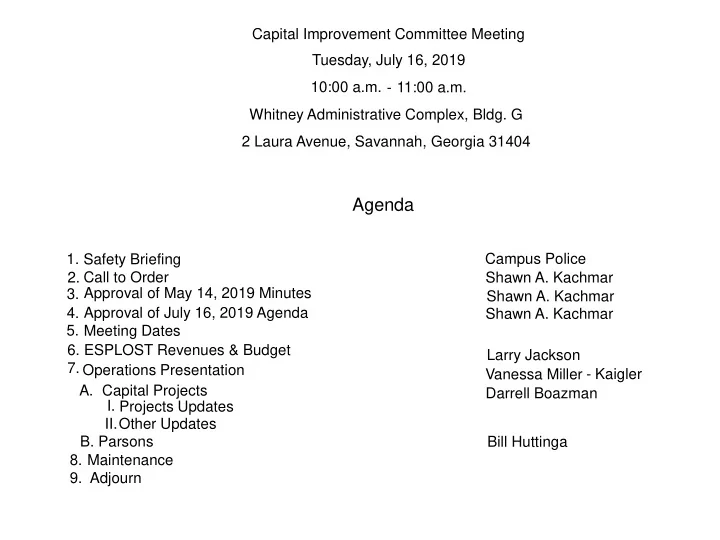
Capital Improvement Committee Meeting Tuesday, July 16, 2019 10:00 a.m. - 11:00 a.m. Whitney Administrative Complex, Bldg. G 2 Laura Avenue, Savannah, Georgia 31404 Agenda 1. Campus Police Safety Briefing 2. Call to Order Shawn A. Kachmar


slide-1
SLIDE 1

Capital Improvement Committee Meeting 10:00 a.m. - 11:00 a.m. Whitney Administrative Complex, Bldg. G 2 Laura Avenue, Savannah, Georgia 31404

Agenda

1. 2. Safety Briefing Call to Order Shawn A. Kachmar

  • 3. Approval of May 14, 2019 Minutes Shawn A. Kachmar
  • 4. Approval of July 16, 2019 Agenda

Meeting Dates Shawn A. Kachmar ESPLOST Revenues & Budget Larry Jackson 6.

  • 7. Operations Presentation

Vanessa Miller - Kaigler

  • A. Capital Projects

Darrell Boazman

  • I. Projects Updates

II.Other Updates Maintenance Bill Huttinga 8.

  • 9. Adjourn
  • B. Parsons

Campus Police Tuesday, July 16, 2019 5.

slide-2
SLIDE 2

2

Capital Improvement Committee Meeting Minutes

Tuesday, May 14,2019 10:00AM -11:00 AM 2 Laura Avenue, Bldg. G Savannah, GA 31404

BOE Staff Present:

Ann Levett, Superintendent Vanessa Miller-Kaigler,Deputy Superintendent-Chief Operations Officer Darrell Boazman, Executive Director of Capital Projects and ESPLOST Larry Jackson, Chief Financial Officer Andrea DeShazo, Interim Lead Executive Director Arnold Jackson, Executive Director of Operations Ramon Ray, Chief of Human Resources Officer Terry Enoch, Chief of Campus Police Kevin Ralston, Senior Director of Capital Projects Roger Roriex, Budget Analyst Marshall Withers, Director Internal Audit Tiffany Lovezzola, Senior Internal Auditor Davida Banks, Operations Technician Terry Alexander, Office Manager of Operations Slade Hemly, Project Manager

Other Board Members Present:

Joe Buck, Board President Julie Wade, District 1 Cornelia Hall, District 3

  • Dr. Bringman, District 6

Others in Attendance:

Bill Huttinga, Parsons Timothy Sparks, Parsons Sylvester Formey, Parsons and Vanguard Lorne George, Parsons Brett Lundy, Parsons Ross Cairney, Parsons Ivan Cohen, Community Stakeholder Larry Lower Irene Hines, District 5

Capital Committee Members Present:

Shawn Kachmar, District 4 Tonia Howard-Hall, District 8

slide-3
SLIDE 3

3

Capital Improvement Committee Meeting Minutes

10:00AM -11:00 AM 2 Laura Avenue, Bldg. G Savannah, GA 31404

Safety Briefing Officer Ware provided the audience with a public safety briefing in the event of an emergency or an unexpected crisis within the facility. He identified all exit doors, fire extinguishers, and AED’s. Welcome/Introduction May 14, 2019 the meeting of the Capital Improvement Committee was chaired by Mr. Kachmar and was called to order at 10:00 a.m. Mr. Kachmar welcomed the committee and other attendees. Approval of the February 21, 2019, Minutes: Mrs. Hines moved; Dr. Bringman seconded. The motion carried. Approval of the May 14, 2019 Agenda: Dr. Bringman moved; Mrs. Hines seconded. The motion carried. Meeting Dates

  • Mr. Kachmar: “As everyone knows we’ve gone away from monthly meetings to a schedule of meetings, so we do have a meeting today on

May 14, 2019. The other meetings scheduled for the rest of the year; I will announce them now and we will also put them on our website. July 16, 2019, September 17, 2019 and November 19, 2019. All at 10:00 AM and all here at Whitney.” ESPLOST Revenues & Budgets-Larry Jackson

  • Mr. Roriex: . ESPLOST I and II you can see that we have the sixty months out of sixty months received already for those two ESPLOSTs.

Our main focus today is going to be really on ESPLOST III. Our actual sales tax for the month of March was $7,232,745.30. For our local tax we received $191,725.69 with a combined total that you see on your slides for $7,424,470.99. A side note; we do have the monthly interest for the Georgia funds statement, which was for the month of March of $271,422.38. We are still trending upward with our collections. If we can turn to page twenty-five we can see those trends. The new trend would be tracked with the blue line. I apologize; there is an error on the projected budget line. It should be at about $6,083,000. It’s showing on the blue line that it’s a little below that. We have not gone below our projected budget, so we will get that corrected and changed right away. Our revenues have been above our projected budgets thus far and we are still trending upward. Also, we are above our total collection, which $173,567,541.79 with twenty-seven months of collections received. Basically, that puts us with our projected budget times the twenty-seven we would be about $9,000,317.50 above that, so we are actually trending very well, and we are having some good months as well. With that said I will turn it back over to my CFO, Mr. Larry Jackson.

Tuesday, May 14, 2019

slide-4
SLIDE 4

4

  • Mr. Jackson: “I will briefly talk about the expenditures and just only talk about ESPLOST I. It’s our goal within the next month

to close out all of the projects in E-I finally and we can take those pages off of this report. I think we have finished up all of the flooring and those were the last few projects that we had in ESPLOST I, so you should no longer see that the next time we have a report. I really won’t get into the other budget expenditures. I will leave that up to the facilities staff and they can talk about the budget expenditures as they go through their individual projects.”

  • Mr. Kachmar: “Just to remind everyone. Staff has developed a pretty detailed tracking mechanism for revenues and expenditures

both real and anticipated in terms of state reimbursements as well. We’re very cognizant of the market is good right now but who knows what two years from now is going to look like. We’re tracking all of this pretty closely, so that we can anticipate any changes that might need to be made. Things are looking bright right now and hopefully they stay that way but it’s worth reminding that we are tracking it closely so that we can anticipate what might be coming down the pike. Questions on tax revenues or expenditures either based on anything that’s been said or on the detailed reports that are contained in our packets? Alright.”

OPERATIONS PRESENTATIONS

  • Mrs. Miller-Kaigler: “Good morning all and thank you Mr. Kachmar and for the comments relative to funding, and we’ll go into

that with a little more detail shortly. We’ll introduce you to our cash flow sheet and let you see how we track our revenues and

  • ur expenditures and all of the various funding sources. We’ll be able to provide you with some information relative to that; what

we expect and what we’ve received. We’ll talk a little bit about capital outlay. We’ve had that discussion and how that is based

  • n enrollment. We’ll talk about the time we had an opportunity to spend with our state rep as well as some of our other
  • colleagues. We’ve certainly been working very diligently to identify some additional opportunities that we can apply for through

Capital Outlay where we’ve traditionally applied for new schools’ renovations but we’re looking at modernization looking at those other areas. Those HVAC systems and roofing just as an opportunity to be able to capitalize on any dollars that are available to the district. So, you’ll see us focus in on that a little bit today.” “Just a couple of updates that I wanted to bring to your attention this morning. We’ve had some discussions in the past about how we can continue to be more efficient as an Operations Division. In one of those areas we work closely with our Finance team. We work with Purchasing. It’s kind of one of those arteries as a part of our heart beat. Making sure our solicitations are released in a timely manner. There are some areas where we want to automate and be more efficient.”

slide-5
SLIDE 5

5

“The district is embarking on a new financial and H.R. package as well because the system we have is about twenty-seven years old. Mr. Dave Feliciano and his team have been working on that and collaboratively we have identified a system that will assist the Operations department in terms of what is referred to as e-Builder. It gives you just a little bit of information about some of the modules associated with that particular

  • platform. We’ll be able to manage our funding piece and we’ll be able to look at our budgets to manage that. We use a lot of different

spreadsheets and a lot of different augmented pieces to pull it together, but we want to be more efficient and put it all under one piece that we can work closely with our Finance division with our Procurement department as well. You’ll see we have modules related to contract

  • administration. It’s a project management tool but it also has that finance tool associated with it too.”

“We’ll be able to monitor our scheduling, our vetting documents, our requests for information come through and we can migrate some of our existing historical data that’s out there now in various data bases. We’ll be able to come over into e-Builder. So, we’re going through the introductory period now. We’re meeting with the e-Builder team. We have a representative from Parsons. This is something that our program management firm is familiar with, so we’ve been meeting with the various departments that will have an impact on.” “Just kind of some additional highlights along with a schedule to show you where we are looking for implementation. We have started drafting those documents. We’ve had meetings thus far looking at change orders and how that will work, how the payment process and that bidding

  • module. I know we still get calls and get those questions specifically to faxing documents, who received the fax, it didn’t get through with one

paper, so we want to be able to automate all of those processes where vendors will have an opportunity. That has been a concern and rightly

  • so. We want to move into the twenty-first century. It’s how we do business and we want to be more efficient with a twenty-first century

learning environment. We’re going to operate like a twenty-first century organization as well.” “We’ve had an opportunity to look at it. Mr. Feliciano and myself; we attended a conference last summer and we’ve met with some of the end- users in the industry who’ve rated it extremely high. So, we’re excited about the opportunity to bring this forward. Vendors will have an

  • pportunity to go into the bidding module. It will do a lot of the calculations and provide that information to us in an electronic format. So, we

wanted to bring you just a little bit about the information associated with that and where we are in the process. Rosalind Nathaniel in the Operations division is kind of going to handle that as the project manager with the implementation, so we’ll continue to update. Once we’re in the test environment live we’ll probably allow you an opportunity to see how it functions and what we’ll be able to do with that particular

  • piece. Any member of the team want to add anything else to it?”
  • Mr. Kachmar: “While we’re on process improvement; this is excellent for us. I think it will streamline things more. I’m going to take a tangent

for a minute and just say I talked to Dr. Levett and Mrs. Miller-Kaigler. In the last five or six years we’ve done as a Committee and a Board we’ve done a review of our Procurement Policies and our Contracting Policies. I know that they’re constantly looking at it to streamline things but we’ve also as a Board done a review of our policies and we’ve had public hearings to get public input from vendors and from contractors about doing business with the District. So, we don’t need to discuss it now but just Board members think about… Have you been getting feedback from the community? Vendors? Contractors internally about our processes and do we need to think about doing another policy review and maybe a couple of public meetings again just to get feedback? So, put that on your radar just to think about and we’ll circle back to it in the next couple months.”

slide-6
SLIDE 6

6

  • Mrs. Miller-Kaigler: “That was most helpful when we went through that exercise in the past. This implementation as a

result of some of the feedback and working with some of our other colleagues that we can automate this process, standardize a lot of our documents be able to process pay applications in a timely manner because that is very important to us especially with dealing with local and small vendors. All vendors want to be paid in a timely manner, so certainly we’re looking forward to this process to assist us.” “We also had some questions related to the Marshpoint Field and Design Guidelines and some conversations we’ve had with some of our other jurisdictions. I’m going to go ahead and just skip to the other one I’m going to handle, which is the

  • ne with the City of Savannah. We’ve talked about the fact that we are meeting with our other local jurisdictions. We had a

really good meeting again with the City of Savannah last week. Whenever we meet with them I always leave there shaking my head because it’s always something. It’s good to be able to have that dialogue with them. We were all introduced to the arena project and we were advised that that’s going to have a major impact in terms of some street wide and there’s going to be some detours. The staff that’s currently at that water works apartment over on Gwinnett and Stiles will now be housed

  • ver on Interchange Court, which means that’s right where our bus hub is. So, we’re working with them in terms of

scheduling, their construction timeline, and how that does not have an impact on our delivery of services. So, we’re looking at schedules. We’ve actually identified a point person from Operations that will be matched with City Staff as that project is coming online.” “We talked about how we ingress and egress and then how they can make sure what their construction entrance would look like and when they’re actually pouring concrete. Working with them we’ll make sure - I provided them with our schedule start of school, what our bell times are, when buses will be leaving, and when buses will be returning. So, we’re going to be working with them very closely on that piece because there will be some major construction going on in that interchange

  • piece. In addition to, there is going to be a bridge that’s going to be built on Gwinnett Street, so from Stiles down to

Boundary will be blocked for a period of time. That’s a main artery for us and we have two schools there. We have Gadsden and we have Garrison there also and that’s very near where I-16/516 is and where our buses are as a main artery. So, we’ll be working with them on that piece. So, again, it’s always a good opportunity to sit down and get some advanced information and data from our local jurisdictions, so we can make sure that we are planning.” “Certainly, we’ll have to take a look at our schedules, how our buses are coming in and how they are coming out, and how we can be more proactive because that is where our mechanics are housed on Interchange as well. We have identified a point person. I want to thank Mr. Shonka, who is going to be the point person from the District side to work with the city of Savannah staff as it relates to those two projects. They’ll be working with us in terms of providing their schedule for construction in a timely manner.

slide-7
SLIDE 7

7

So, we’ll keep you updated, and we’ll be working with the Transportation team and if we see the need that we may have to station some buses either on Gamble Road or at Chatham Parkway if we see that’s going to have an impact with them either getting in or getting out. We have the summer to start working on that and they’re going to get that scheduled. So, that’s my report on e-Builder and the City of Savannah.”

  • Mr. Boazman: “Good morning. We have just published our design updates for our Design Guidelines. It is a living document, so we

continue to try to improve those. Some of the things that went into this design guidelines; from a Safety and Security perspective we went back and took a look at that with Chief Enoch input we updated that in our design guidelines as well as from IT. We also included their new smart boards that is going to go into all the schools. So, that was included into our design guidelines. We will make that design guideline available to you guys to take a look at. It is a living document; as we go through these schools and we find out how to do things better and Best Practices we are including those in the design guidelines. We are not waiting until we publish that, so we make those improvements immediately.”

  • Mr. Jackson: “Good morning. We did inspect the Marshpoint field regarding the sewer line being clogged during our inspection. It’s

been pretty dry lately and there wasn’t anything backed up, but we went ahead and snaked it out of all of the storm drain lines. One line had a little bit of debris but that has been cleared. The next item was Port Wentworth and the Rice Creek Site Walk. We met with the City of Port Wentworth regarding the Rice Creek Bridge. Last year I don’t know if you recall they constructed the bridge and the sidewalk was along side Hwy. 21. Mrs. Miller-Kaigler met with the City and the state and we got them to fund to rework the sidewalk on the southside of Hwy. 21 and they will connect the sidewalk from the bridge all the way into the Rice Creek community. They are supposed to start the first week of June and they should be finished by the end of July, so that we won’t have to have bus transportation going to Rice Creek and the kids can walk. The sidewalk on the North side of Rice Creek has already been completed. That was done by our district. Any questions?”

  • Dr. Howard-Hall: “That’s good news. I live in the Rice Creek Neighborhood. Sometimes when the students are late going to school

because they missed the bus I see them at that light crossing the street and that’s quite dangerous but they’re late for school. That’s exciting to know that they’re going to get that started in June because it’s been a whole year that that bridge has been there.”

  • Mr. Jackson: “Also, they did complete all punch list items on the bridge. When the bridge was complete we did a walk through and

had some issues regarding the width of the gaps in between openings and they did go back and correct those items.”

  • Mr. Boazman: “I’ll give you an update on the Security projects. We identified with Chief Enoch forty-one school locations that we

needed security vestibules. The total contract estimate of that is $5.3 million. We have an approved budget currently at $1.5 million. Currently we have nine schools that have been approved by Georgia DOE. Three high schools, four middle schools, and two elementary schools. We also have our in-house AA working on three locations. On the security metal detectors; we have identified twenty schools that the metal detectors have to go into and that budget is $30,000. I can talk to the Board members in details about this project but in a public setting we don’t want to go into many details. So, if I need to give you guys a one off and kind of let you know exactly where we are on these projects I can do that.”

slide-8
SLIDE 8

8

  • Mrs. Hall: “Can I just ask. The fact that we have a positive amount of money over what we expected could that possibly go

towards the funding since that seems like we are about $4 million off?”

  • Mr. Boazman: “Can we go back to that question because we are going to get into some projects that I think that would give you

better information.”

  • Mrs. Miller-Kaigler: “Naturally we always caution when we hear the words that we are positive, or our revenues are above but

remember and we consistently remind you that our Capital Outlay and that projection was five years out and we are working diligently to be able to capitalize on any additional revenues to make sure that those projects that we approved that those projects are completed. Certainly, this is an important project and you can see with that 1.5 was allocated from unallocated as a part of ESPLOT.”

  • Mr. Boazman: “Also, and Chief Enoch can testify to this. We identified the most vulnerable schools and we have already taken

measures to put measures in place for those. So, as we work through these projects we want to make sure that the schools that we identify was the most vulnerable that we have taken care of those. I just want to make sure that everybody understands that as well. I am pleased to announce that we are still currently on schedule for our Master’s Schedule. Mr. Bill Huttinga will go through each one of the schedules in detail, especially our schedules that we have in the execution phase. We have about ten projects that are now in the execution phase and he will go over in details of those particular projects.”

  • Mrs. Hines: “Before we move on. If we could just move back to the Security Project Updates. Let me make sure I understand

this clearly. When we are talking about the security updates we are also including the Charter Schools as well is that correct?”

  • Mr. Boazman: “Not for vestibules.”
  • Dr. Levett: “We don’t own those properties so we don’t have the right to make those kind of additions to those properties.”

Parsons

  • Mr. Huttinga: “Good morning. Bill Huttinga with Parsons. Let me go through the cash flow. As I explained some previous

months ago we have a very large spreadsheet that we put out and that we keep up every month. It shows what our expected expenditures are each month for every project and then we also show what our proceeds are and expected proceeds are for every month. So, this is just a one-page summarization of this very large spreadsheet. The 2017-2018 figures are actual. It becomes actual every month. January, February, and March are actual in 2019. If you look at all of the green in the first number

  • f lines and then you see a green banded line. Total yearly expenditures. That shows you that total amount that’s being

expended every month for that year. In 2017 it was just over $10 million. If you look down the report further, it has all of the areas of proceed. Then we have a total yearly proceed band for the first year of 2017 with $73 million.”

slide-9
SLIDE 9

9

“So, big difference obviously; in 2017 we are expending $10 million and taking in seventy-three, in 2018 we expended $20 million and took in eight-six. So, that gives us what our cash on hand at the end of the year is. As you can see it is building up and building up, so at the end of 2018 we had $129 million that was ‘in the bank.’ More proceeds than what expenditures were. This is an important document because what we want to make sure of is that we always had enough cash to cover what our expenditures are. At

  • ne time maybe about one half a year or three fourths of a year ago we showed you where this actually went negative at one time.

Now it is all positive all the way through and that is because some of the projects have gotten pushed back in the cashflow. Particularly the Groves (HS) Project; very large one, $100+ million that got pushed back. In fact, we even have a cash flow that goes

  • ut into 2023 now, so the E-III cashflow is about a seven-year cash flow right now.”

“So, by pushing those expenditures out down the line it also obviously increases the ability to have better interest. So, you can see how that line item for interest is also increasing. What it also shows you is that with the ESPLOST proceeds there is a number behind that of $4.6 million. As we put those actual ESPLOST proceeds in for 2017 and 2018 and now for 2019 and it tracks across, we are $4.6 million as I explained that we are up in that particular proceed. If you look at 2020-21 for instance it says seventy-three under ESPLOST proceeds. That’s what the budget would be, and you can see already in 2018, we had $77 million and in 2019 we are at $74 million and that is just three months in. So, those are all tracking good positive.” “The TAVT however is the opposite. It was $2 million in 2017, $2.6 in 2018 and we are projecting $3.4 for 2019. Again, ESPLOST proceeds are up, TAVT proceeds down, and interest of course continues to accumulate. Because of those increases in those proceeds we now have a positive cash flow. Actually, if the projects were all completed on budget as we have right now, proceeds are received as we now are projecting them to be perceived and we would have $2 million remaining. So, that’s what this particular spreadsheet shows us, and we’ll continue to track that.”

  • Mr. Kachmar: “Mr. Huttinga our Capital Outlay dollars were overestimated, right? So, we had to made adjustments there?”
  • Mr. Huttinga: “Correct. The Capital Outlay right now on this spreadsheet is for the $12 million, which was approved in the March
  • Board. We can show you.”
  • Mr. Kachmar: “Right, but we’ve had to make adjustments. This is all good news and I’m just looking at the big picture. We don’t

know what the next two to three years are going to look like from a tax proceeds perspective. We just still need to be very conservative and careful in cash projections I think.”

  • Mr. Huttinga: “Correct. Yes.”
  • Mr. Kachmar: “All good news right now.”
  • Mr. Huttinga: “The next two slides actually go together. If you are looking at them, you almost need to tear page seventy-three out

and put it on top of page seventy-four even though the columns don’t line up. I have broken it up into two slides so that you can read the numbers. So, the current budget; remember in March the Board has asked for a budget realignment. That’s what the current budget is, on page seventy-four it shows the total budget $399 million. That’s what was approved in March. It also shows the proceeds at $399 million. As we talked previously that shows $12 million coming in for state capital outlay. Currently we are at $9.8 million earned.”

slide-10
SLIDE 10

10

“So, we are close but like we talked about we really need to fight hard to get capital outlay now and I’ve got a slide coming up where I can explain that further. Interest collected so far through March 2019 is $2.6 million. This budget assumed $5 million of interest, so we are about half way there. Again, however you can’t predict the next few years obviously on how things are going to go but if you look at how that interest was being earned along the way and see that we are expecting positive cash flows. In other words, spending less than we are taking in on 2019 and even 2020 comes pretty close to balancing it until we get some very large expenditures in 2021, 2022, and out to 2023. That appears like that budget is good and we almost see where if things continue to go like they are we might even be able to pick up some additional interest.”

  • Dr. Buck: “I guess I want to ask a question about Jenkins and perhaps White Bluff. My understanding from around town nowadays is that from

the time we bid a project until we actually start the project that because the economy is so good that the actual cost goes up, and there is a word for that that I don’t know the term. It goes up quite a bit. That we, the District is very conservative in what we bid and what we ask for. With Jenkins we’ve cut back and cut back and we’re still as I understand it trying to make it fit. It’s one thing to be projecting out for Groves but Jenkins is about to begin, and White Bluff has already begun. Are we going to able to provide the product that we want with what these numbers say?”

  • Mr. Huttinga: “Let me take them project by project and I can go into them a little later too. White Bluff, we had the budget that we need to

complete the project with everything. The quality of level and everything that was promised on that project. That one is pretty much all in contract and done. Jenkins is one that we’ve identified and again if we go back to that one slide you’ll see we have a $3 million change. Jenkins, we spent a lot of time to get that project to the program’s square footage. When you put together a program that says, ‘This is what I want in this school,’ and when the design comes much larger it needs to get worked back but without not sacrificing the quality or the program. That’s what we have been doing.” “Concerned very much about what we are seeing in the market and concerned about how tariffs and things like that are going to start affecting material prices. We have a lot of work that we need to bid in the next six to seven months and we are cautiously going at this because we just can’t throw everything out there and take numbers and have them come in all over the place and not be able to provide properly for them. So, we’re going to talk about even the project delivery system in the way we’re using different project delivery systems in order to stay on budget. But, the concern is right now with Jenkins that we may need to look at an additional $3 million. At New Hampstead we have an additional $2.5

  • million. That one went up in FTEs, so we’re still fighting through that increase yet, but we’ve got that one identified and flagged. We also have

an additional $2 million at Woodville Thompkins and we need to phase that project. We have to build the gym first and move them in and then build the other one, so it extends the construction period a very long time unless you were able to get in there and build it all at one time. We are trying to be responsive to that.”

  • Dr. Buck: “At what point though do we look even further in the future and say we are not going to be able to do everything we’ve promised.”
  • Mr. Huttinga: “I think we are addressing those as we start understanding them. We will not be in a position, we do not want to be nor will we

be in a position where we get to that point and say, ‘Oh, by the way…’”

  • Dr. Buck: “All of us as elected officials are very cognizant of the fact that the people have been very good to us for many years now. I think we

certainly don’t do a bad job of promising a lot out front that we can’t because the way our schedule is set up we don’t ever know when they are

slide-11
SLIDE 11

11

voting on it what we really are going to do. I am concerned that we start seeing projects that along the way are looking good on this paper that we’re not going to have the funds for. Jenkins is most prominent to me right now just because it is ready to start in essence.”

  • Mr. Boazman: “Dr. Buck, we have several tools in our project management tool kit in order to address the concerns, so you are correct.

All of these projects have increased in some costs because most of these projects were five years ago.”

  • Dr. Buck: “A year ago. You all looked kind of stricken when I asked my question.”
  • Mrs. Miller-Kaigler: “Let me tell you why I did; Dr. Levett and I had this conversation before we left 208 Bull St. Certainly, we are

concerned about the tariffs and we are paying attention to it. I was very open with her about that this morning; that we are paying attention to costs, we are paying attention to the delivery method and that’s why when Mrs. Hall made reference to the comment that we are trending ahead. But we are also looking at where we are and looking at the forecast as a result of that five-year forecast. We saw what happened with Capital Outlay, so then we have to become stewards of the taxpayer’s dollars and that’s why you saw us bring the recommendation forward relative to the multi campus and bringing Gould population over to that campus. That was a $1 million savings immediately because we didn’t have to go out and purchase additional property and looking for some economies or skills.” ‘So certainly, if it’s not once a week it’s twice a week that we are having these conversations about the marketplace, the industry, the cost per square foot and constantly having those conversations with Dr. Levett, ‘We may need to do this instead but I’m going to go ahead and prompt you. This is what we are working on.’ So, as I walked into her office this morning prior to coming here that’s some of the very same conversations. So, when you said we looked stricken it was because we were talking about that this morning and we are very cognitive that we want to be able to deliver every project that we bid but we’re also looking at costs. We are being very diligent. We are having those courageous conversations with our contractors. We are a public agency and we will settle for nothing but the best with the highest quality and we want them to be fair in terms of those in how we get those costs down…”

  • Dr. Buck: “We have confidence in you.”
  • Mrs. Miller-Kaigler: “Yes…thank you. We have some historical information that we are looking at when we go out and bid and having

some conversation as to what those numbers need to come in for us to be able to build these schools.”

  • Mr. Boazman: “As far as Jenkins, we took a look at that. Internally, some of the things that get us ready for pre-construction we are

doing those internally and we are going to save significant money by doing that. We don’t want to do that on every project but the ones that we can to save resources we are taking a look at that. We are concerned about Jenkins as well on the escalation costs and things of that nature. We are in constant communication with Dr. Levett and Mrs. Miller-Kaigler about what those costs are going to be. We recognize that.”

  • Dr. Buck: “Our buildings have to last at least fifty years as you folks all know. Building a building with a blue light special just to meet

the budget is not what we’ve got to happen.”

slide-12
SLIDE 12

12

  • Mr. Kachmar: “Value engineering is not our number one priority.”
  • Mr. Boazman: “The projects that we’ve put forth in terms of the ones that we are doing, we’ve got two of our CMA’s back there.

Basically, all of their job is quality. The own those projects 24/7 during the quality piece that we have to have. We put all those things in place to ensure that we do quality. We don’t want blue light specials either, but we also want to deliver a quality project on what we promised our constituents that we would deliver. As you see and as Mr. Kachmar alluded to this, we have pushed this schedule out seven years, so we can build the resources that we have to have to be able to deliver these projects. Myself and Mr. Huttinga we meet weekly and we are in constant communication with our building partners.” “We see those pressures as well. In these numbers you can be assured that we’ve already calculated those and if we need to set up a forum we do. We bring on a robust staff with a lot of talent that if we have to go that route which we don’t, but if the cost pressures continue to be that way. I’m going to talk about delivery method and what that’s doing to the costs of some of these projects as well. You’ll be able to articulate kind of where we are.”

  • Mrs. Hall: “I just wanted to mention from a political perspective. The Jenkins project is something that that whole community is very,

very excited about but also thankfully the whole public is aware of what’s going on with the tariffs. I think as long as we keep an open dialogue with our neighborhoods about what’s going on and the fact that the cost of steel may go up tremendously and that’s going to have impacts on when this school is ready. I think the public is ready for that as long as we continue to have the dialogue with the public and we’re not trying to overpromise anything. I think we’re going to be fine. The other question though is can Gould last long enough? You say we are going to keep pushing out. I’m just wondering can children continue to go to that school four or five years from now the way it is without us having to put some money over there.”

  • Mrs. Miller-Kaigler: “I’ll remind you that we will never sacrifice. I have students in the building and if that’s not conducive to
  • learning. If there’s any repairs that are necessary, we make those repairs. If there is anything that needs to be installed. We make sure

that it is in the condition to be able to house students. So, whenever there is a need we continue to make sure that we meet those needs. Just like with many of the schools that we have vacated. We keep them in our inventory for other purposes, so we certainly would never sacrifice the quality of a building because it’s down the line. If there is a roof that needs repaired, we repair the roof.”

  • Mrs. Hall: “Well I think that’s a community that we really need to keep in constant assurance that we haven’t forsaken them, and that

change is coming.”

  • Mrs. Miller-Kaigler: “We will. Yes ma’am.”
  • Mr. Jackson: “Just a follow-up on what Mrs. Miller-Kaigler said just now. We have a roof replacement project at Mercer in the media
  • center. We are making sure there is an environment conductive for learning.”
  • Mr. Boazman: “As part of our Facility update. Every year we go out and do a facility assessment on all of our facilities to keep Georgia

Department of Education alerted to any major construction that has to go on and we update that every year. That is one way we keep a pulse on the conditions of our facilities as well.”

slide-13
SLIDE 13

13

  • Dr. Howard-Hall: “I would just like to thank Mrs. Miller-Kaigler, Dr. Levett, Mr. Boazman, Mr. Huttinga and Parsons for

community engagement. The meeting at Woodville Thompkins was very successful. All of the rumors have been dispelled. I haven’t heard anything else since. No complaints. We understand how cumbersome that area is; there is only so much land and so much room, so your place was very well detailed and tedious, and I appreciate you coming out to the community. Everybody is now very positive and excited about the Woodville Thompkins gym. Thank you all.”

  • Dr. Levett: “I would just like to echo what Dr. Howard-Hall said. We are available to talk with anyone about any questions that

they have on any new projects. Trust me, last Thursday I had an opportunity to have a conversation with a national audience. Part

  • f my comments were about Tariffs. We are not operating in a vacuum. We’re meeting two or three times a week and looking at

the current conditions that impact our building projects. I will remind you that we’ve been able to make the kind of progress we’ve made from some projects starting out as site work and they turn into a stadium. Our first district owned stadium.” “When you look at it some buildings start out as we are going to add a couple of rooms and we have a performance hall, or we have an auditorium. That is through strong understanding of what the context is and being good stewards of the people’s money. That is our commitment, the Staff does that, we talk about these issues, and I think also for our Community; they have the

  • pportunity to not only attend these meetings but to review the transcripts, to look at an audio recording that lets them know we

are not just sitting around and making decisions. That we are actually researching and bringing the best information available.” “What is very challenging as I hear as Dr. Buck and many of you. People say, ‘That’s not what you’ve always done.’ Well guess

  • what. We can’t do what we’ve always done. We are now preparing for if those revenues do not come in, what do we do? We

don’t want to overpromise and underdeliver. But we also don’t want to let people think that because they come to a meeting and say, ‘We want five gymnasiums,’ that we’re going to get it. That is not a good way to conduct business.” “So, our approach has been yes, we want feedback and we want to keep you informed but everyone is not going to get what they

  • want. It’s not possible. But we are going to guarantee you that we will do everything within our power to offer the best and

highest quality buildings for our future. That’s our responsibility. Does that mean you get your five gyms? No. Does that mean that if you get a new gym that you have to have parking? Yes, because you may not be thinking about that. That’s our job to do that.” “So, we assure you that we have looked at ESPLOST I, II, and learned the lessons from those and we are changing the way that we communicate. Looking at different delivery methods and not always doing what people have wanted us to do or that we’ve always done. But making sure that our Board understands there are some processes that should not be automatic. There are projects that are unique, and we need to use a unique approach to those projects. All with the idea that what we’re doing is really using the public’s money well and that we’re also ensuring that whatever we build is of high quality and will be able to stand for years to come. So, thank you for having the confidence in us to do a great job. That is our commitment. These meetings are designed to give you updates but any questions that you have in the meantime please feel free to forward them. Thank you so much.”

slide-14
SLIDE 14

14

  • Mr. Kachmar: “Thank you Dr. Levett. To piggyback on that we learned a lot of lessons out of the recession in E-I about

maintaining flexibility and also planning for the future. So, we were less specific in E-II and EIII in terms of square footage and FTE and all of that to give us the flexibility. If you look at E-II and E-III projects, many of them morphed from their

  • riginal scope to address developments in the district. Two things to reiterate.”

‘Staff worked on design guidelines and the Board voted and approved them because that’s Board policy on minimum quality and safety standards. Some of them are state mandated regulations and other are decisions we made as a Board as a matter of policy with staff input. I just want to make sure that as we’ve done with the end of E-I and E-II and as we enter into this future phase of looking at revenues and looking at where are projects are that we are not deviating from Design Guidelines or making changes in scope of projects without the collaborative meetings and discussions that Staff and Board have had. I don’t want to be in a situation where Design Guidelines were deviated from or projects were minimized or morphed into something else without Board and staff discussion beforehand.” “It’s really important to pick up on what Mrs. Hall and Dr. Howard-Hall noted. The political component of this matters because we wouldn’t even be here right now if the public wasn’t supporting ESPLOST. The Board Members are closer to that issue than everyone else. I’m not saying this in a negative way. We’ve done a really good job since E-I of learning how to do all of this collaboratively and I really want to continue that process forward. It’s been a great process so far. Sitting back thinking what is an Observer thinking about this meeting right now? We are not in crisis mode, we are not billions of dollars short or even hundreds of millions or tens of millions short. We are in a really good place right now.” “We’re just thinking down the road about what might happen in planning, so that’s where we are. We are not cancelling projects, we are not changing projects, and we are not in crisis mode. What we are in is in transparent planning for the future mode. We are not being reactionary as we were when we started with E-I because we hadn’t been through this

  • before. We are in a really good place now. Let’s continue the conversations moving forward.”
  • Dr. Levett: “Thank you Mr. Kachmar for those really good summary comments. I want to also make a point about Jenkins

because we are all, as Mrs. Hall said, and Dr. Buck indicated, very vested in having a great project there as well as a multi- site campus. One of the challenges that we’re having of course is the cost. It’s one of those situations where we’ve gotten all this feedback, and everybody wants everything.” “Our job is to make sure the project comes in under budget. So, we’ve been definitely working going back and forth having lots of conversations. But we also want a project that’s going to be launched at the time that it needs to be launched. We’re already challenged by not having one big place to put all the youngsters. so we’re already having to make some adjustments there. Please know that our commitment is to making

slide-15
SLIDE 15

15

sure that we stay, as much as we can, with reasonable price ranges, so that we can have a great building that will house our young people. So, that Jenkins project it is a concern. Had lots of feedback in the community where you should be using this delivery method and you should be doing all that. One thing that we are committed to is building a great building, finest materials available to us, finest craftmanship, safety construction all concerned but we don’t want to pay $100 million for it. We don’t want to do that.” “If we find that we are challenged further, then we will speak with the Board Members and talk with you about what we need to do to that end. Thank you for giving us the opportunity to make sure that everyone understands we want to do the best by our children, but we also don’t want to give them half of what was promised. We also don’t want to pay twice as much as we

  • riginally budgeted. Thank you.”
  • Mr. Huttinga: “Let me continue. In the interest of time I’ll try not to repeat.”
  • Mr. Kachmar: “Well, that was important.”
  • Dr. Levett: “It was.”
  • Mr. Huttinga: “Again, just to kind of wrap this particular slide up and this report. We show an increase potential in three

projects, but we show an increase also in funding. Just like in the previous slide we were up $2 million and now this one shows that we are potentially down $5 million, so welcome to our world. We just kind of jump up and down and somehow or another we had to make all of this balance off. So, how do we potentially look at what as some possible improvements that can be made and ways to cover any deficits that we may be encountering. We’ve got a few of them listed here. First of course is the unallocated funds in E-II as you saw on a previous slide. About $3.6 million in that unallocated fund right now, so if you the Board does decide to utilize those funds this way that certainly would be available.” “Capital Outlay funds. We have E-II funds from the state for Capital Outlay that have not been collected. Have not been

  • received. They have not been recognized yet. But all you need to do is just have the state cut the check to you because we’ve

got all of the paperwork in to them and I trust that it’s in their cycle for reimbursement. There is $5.1 million of money that you already earned and that’s going to come from the state, so that certainly could be utilized. Again, even though we don’t know the economy; as we showed it previously we do have a lot of money starting to build up in the bank that’s earning interest. If things would continue to go through for the next few years we certainly see that there is a potential increase in that along with potential ESPLOST increases and maybe even more additional capital outlay if we are able to continue to put out additional projects.” “So, we do have a plan. Whenever we look like we are going negative we’ve got a plan. We’re not going to let this project just go negative and not have a way to get out of it. We are looking at our next capital outlay application. It needs to be approved by the Board in August. There are fourteen projects here that we’ve identified that have potential state capital outlay dollars. They add up to about $4.3 million. You recall when you are able to get state capital outlay for new projects one project would get you $5 million, so we’ve got to fight hard to get even $4 million.

slide-16
SLIDE 16

16

There is a lot of these projects; there is roofing projects, HVAC projects, and other types of renovations that we’re going to be applying for and hopefully we’ll be able to get accepted for the application for those. We’ve got about $9.8 million in capital

  • utlay right now, so if we get approved for this $4.3 that will put us over the $12 million but again that has to all be approved

by the State. We continue to work hard to look for every possible dollar we can find.”

  • Mr. Boazman: “As you look around the room our focus is going to be quality and cost. So, as you see those projects around

the room most of these projects are projects that we are managing internally, and that delivery method is basically design, bid,

  • build. The CMR process, which is Jenkins High School. That is a cost pressure. It comes with a cost to do a CMR delivery

method, so we’re continuing to work with our partners. We’ve had some very candid conversations with them and the budget is what the budget it. This budget was at $55 million. We now have it down to $58 million. We continue to work with our partners on what the expectation is. We understand that things are going up, costs are going up. But at the end of the day if we have to self-perform we’re doing that. I will just tell you all these projects that you are seeing around the table here is what we are delivering inside of the District itself.”

  • Mr. Huttinga: “White Bluff Elementary is under construction. The foundations are going in and soon you’ll be seeing some

block that’s actually going above the grade there. The project’s coming well and on budget and on schedule for the August 6 next year opening. Jenkins High School, we do have a big package that’s out on the street right now. As Mr. Boazman indicated it’s a self-performance bid package. We noted previously that we had to remove a building that’s located right here now in order to create an area for the new building. So, we’ve got a bid package that’s out right now that’s going to pick up the demolition of this building and is going to pick up the construction of this parking lot and is going to pick up a new drive that we have from Ruben Clark to Low. Remember we had a lot of problems with neighborhood streets and backup and such like that. So, that new drive is part of this bid package. Then, all of the grading for this site and the build-up of the building pad for the new building. That’s all in this first bid package and self-performed. We will be bidding it out direct and we expect to have that bid in by the end of the month and be able to award this work in July.”

  • Mrs. Hines: “The building has to be removed? What does it house now? Science?”
  • Mr. Huttinga: “It has the auditorium and then those classrooms, so it’s about a 40,000 square foot building.

In order to do that we are going to be putting new modulars in. They are coming in at the end of the month. There are some

  • ld portable modular buildings out there right now that need to be hauled out in order to make room for that new modular

that’s going to be sitting there. It’s kind of like a new modular village. That’s going to be sitting down here in that existing parking lot off the gymnasium. It will be a ten-class room modular village that going to be going there. We’ll put that in in the

  • summertime. So, they’ll be moving in there and we can take that building down and we can build this parking lot because
  • bviously the new building is taking out all of the existing parking over here and then we can get started with construction out

there.”

  • Mr. Kachmar: “Do you know offhand ballpark what the modular component is costing?”
  • Mr. Huttinga: “One hundred seventy-five thousand dollars.”
slide-17
SLIDE 17

17

  • Mr. Kachmar: “That’s for install, leasing, and removal?”
  • Mr. Huttinga: “Yeah. For the leasing and the whole works.”
  • Mr. Kachmar: “That’s for how long?”
  • Mr. Huttinga: “Two years.”
  • Mrs. Hall: “Mr. Huttinga, does that pool belong to us or the city?”
  • Mr. Huttinga: “That is city property.”
  • Mrs. Hall: “We’re not even going over that way.”
  • Mr. Huttinga: “No. We’re not touching that area at all. New Hampstead, we are on schedule to have bidding documents on this project next

month and get it ready to put out for bid. Again, this is one that’s going to be bid as general contractor. There is a previous package that we’re also putting out. It’s kind of a unique one and we’ve never this before. It’s a logging package, so instead of having bidders come back with a number of what the district needs to pay to do the work, we hope this one is going to be that the vendors are going to pay the district to take out the logs and to take the trees off that site. So, that one is getting ready to go out. Purchasing will be receiving those numbers within the next couple of months.”

  • Dr. Bringman: “How many acres is that that they are going to clear?”
  • Mr. Huttinga: “About 30 acres.”
  • Dr. Bringman: “Is that all planted with pine?”
  • Mr. Huttinga: “Pretty much, yes. Again, that price kind of goes up and down and we don’t really know where that one is at, so it will be

interesting.”

  • Mrs. Wade: “Where is that going to go in relation to the high school?”
  • Mr. Huttinga: “Right directly behind it. You’re looking at the high school and then after the high school all the fields. It’s all wooded behind

there and it’s right back behind there.”

  • Mrs. Wade: “So, it will be the same access points?”
slide-18
SLIDE 18

18

  • Mr. Huttinga: “The access is going to be on that road behind Highgate Blvd.”
  • Mrs. Wade: “So, there will be totally different traffic. Excellent.”
  • Mr. Huttinga: “So, this project is going to be bid in June/July and be ready for August Board awarding. Getting started but of course the site will

be cleared by that time. Multi-purpose school, the master plan is completed. We are in the process of doing the RFP’s, RFQ’s, for the design professional for this project. We’ll be looking at having that ready for award to the Board also in July, so that that design can get started. Savannah High School CTAE addition is in the finishing stages. They are going to be ready to start doing their final punch list and putting in all

  • f the final fixtures and equipment. There is a cosmetology lab that is being added in there and all of that equipment is getting put in there along

with the welding and whatever else is needed for those engineering facilities. So, this will be finishing up in this month and will be ready for the start of school in August. Islands High School athletic complex is moving along very well. All the trees have been taking off the site and grubbing work is in progress. They are starting to grade out where the field house is going to be located and also excavating out a much larger retention area to take care of any storm issues that there may be. This project is right on schedule for the December 31 completion of this year. We’re also expecting that the artificial turf will be scheduled for starting in late September or October. Beach High School auditorium. Again, just finishing up on design. In fact, we are expecting the construction bid documents to be ready by the end of this week. In getting this project ready; again, this is one that we bid out a general contractor. We are bidding through June and having this one ready for July Board also. Woodville Thompkins is in design again. Having met with the community and finalizing what needs to be done out there. Obviously, this project is going to require a little more time because it’s so important that we just build a gym by itself and then move in and then we can do the auditorium work and all of the other fill in work that is require for it. There is a lot of site work on this project as you know. When you build a gym where it is we are pushing that bus drive out further into that wetland area, so we’re looking how best to accommodate

  • that. We may need to drop the grades down there so that we don’t have such a high grade drop back into that low area, which means that that

wall that would be the gymnasium would be like a retaining wall. So, this is all being studied right now. The best way to put this in at the best cost and make sure that we can do everything on site and get the additional parking that’s required and also of course take care of all of the storm needs that are needed out there.”

  • Mrs. Hines: “So, there will be access now from the upper campus to the lower campus after this is complete?”
  • Mr. Kachmar: “This came up before, but I still think we need to discuss long term about plans for the entire upper and lower campus and what if

anything we want to do long term. There is opportunities there but what we do with long term planning may impact these short term issues as

  • well. We just need to walk through what that might look like.”
  • Mr. Huttinga: “Finally, as we bid these projects like I said we’ve got a lot of work. We know contractors are busy, so we’re be stretching some

folks I’m sure but we’ve been talking to them and we’ve been making them aware of these projects. As we get these projects bid out then we want to get started in the next group of them. You saw in the program schedule where these five projects that we have listed here; J.G. Smith addition, Largo Tibet, Windsor Forest auditorium, Savannah Arts a large renovation work in addition to that, and some field lighting projects

  • also. So, those projects are all scheduled to get going later on this fall. So, as we work our way out of the other ones and get our budgets and get
  • ur actual costs established so we can feel comfortable moving into this next stage of projects and putting those under design.”
  • Dr. Bringman: “Can I just get a little bit more scope on that Savannah Arts project? That was a really big price tag for a café.”
  • Mr. Huttinga: “It’s a café addition and it is interior renovations. The biggest part of which is HVAC.”
slide-19
SLIDE 19

19

  • Dr. Bringman: “By title it looks like a café for $20 million.”
  • Mrs. Miller-Kaigler: “I think what we did is combine several projects over there, so what we did is lumped all of the

funding together. We’re going to be working on the parking lot and I think there is going to be some work done in the auditorium as well as the café. So, what we’ll do is make sure that we clearly delineate all of the pieces of the projects over there.”

  • Dr. Bringman: “That would be great. Just from a public’s eye it like a café. Can we call it a cafeteria because that’s what

I’m guessing it is. We just want to try to make it sound fancy.”

  • Mr. Kachmar: “My guess is next meeting that will be changed to substantial interior renovations.”
  • Mrs. Miller-Kaigler: “We will list them all.”
  • Mrs. Wade: “The number for Jacob G. Smith. The addition seems really low as we’ve increased everything else, so I just

wanted to kind of flag that. I feel like $3 million these days builds you two classrooms. I think we were looking at eight or ten classrooms for that, so I just want to make sure we flag that number because when you look at everything else comparatively it seems very low.”

  • Mrs. Miller-Kaigler: “We’ve been looking at Jacob G. Smith. I think I made some comments last week as we were

discussing budgets and discussing projects that we are land locked over there. I know they love that community and they love who they are. We’ve been working with the city on some improvements as it relates to traffic. When we were preparing for E-III they were adamant about wanting to remain where they are.”

  • Mrs. Wade: “Remaining at the capacity that they are.”
  • Mrs. Miller-Kaigler: “Right. We’re challenged over on that property but we’ll be going out for a design professional who

will take a closer look at what we are proposing there.”

  • Mr. Kachmar: “I would encourage anyone who has questions about specific projects or about the E-III project list

generally, send them to Dr. Levett and Mrs. Miller-Kaigler and we can specifics answered. From a capital projects perspective thank you for the detailed reporting.”

slide-20
SLIDE 20

20

MAINTENANCE AND OPERATIONS

  • Mr. Jackson: “Good morning again. I have seven projects I’m going to review very quickly. The first project is

the transportation roll-up door replacement. We are replacing twenty-eight roll-up doors. This project is ninety percent complete, all the doors have been installed, and we are expecting to complete connecting the electricity to these doors at the end of the month, so they’ll be operating with one finger instead of two hands.”

  • Mrs. Wade: “That is exciting. I feel like we need to go see it.”
  • Mr. Jackson: “The next project is the Savannah High cooling tower replacement project. We replaced the

cooling tower during spring break and it is totally complete. All of the punch list has been completed. We also as part of the project replaced part the chill water and the [indistinct] water pumps. The next project is gymnasium floor replacement project. This project we completed in two phases. The first phase, we completed three gyms. That was completed in early January. The second phase, we completed it the first week of March and that included eight schools. The total project is complete, and this project included Garrison [indistinct] the floors and also under the bleachers. We removed the bleachers and took up the flooring under the bleachers and reinstalled the bleachers, so that was kind of time consuming, but it is completed. The next project is Hubert and Southwest Middle School rooftop air conditioning replacement project. This project has been bid out and we’ve had a preconstruction meeting. We are scheduled to install the equipment the first week of June. The equipment is ordered, and we expect the equipment to be delivered in the next couple of weeks. J. G. Smith kitchen upgrade; this project will upgrade the electricity in the kitchen and expand the fume hood by thirty percent, so we can put more equipment under the hood, so we can feed kids more efficiently. This project’s material has been delivered and we are going to start this project at the end of the semester on next Tuesday. The next project we kind of talked about earlier is the Mercer roof replacement in the media center. This project is going to replace the fifty-year-old metal roof in the media center. Right now, it is under design and we expect the design to be completed next month. The last project is playground replacement at four schools. The equipment is over twenty years old and a couple of these playgrounds already have been condemned. We have

  • rdered the new playground equipment and we expect the playground equipment to be delivered and installed

and September.”

  • Mrs. Hines: “I have a question. As I pass by what used to be DeRenne swing school I look at the playground

equipment out there that was placed there new a few years ago. Are we just going to let it stay there or we may use it again for an elementary swing school again?”

  • Mrs. Miller-Kaigler: “If it becomes another Swing site, I’m not sure. That’s the equipment we removed from
  • AB. Williams and had it installed when we transferred the students over there. Just as we have with swing site

Pulaski because now we have the White Bluff students there, so they take advantage of that

slide-21
SLIDE 21

21

playground equipment. As we make those decisions as to how that property will be used then we will determine if it’s going to remain there or be relocated because often times we have to have it uninstalled and installed by a professional playground installer. So, once we make these decisions assuming we are going to have to swing any additional students.”

  • Mrs. Hall: “I had a counselor from Thunderbolt get in touch with me about buying the playground

equipment at Thunderbolt Elementary. I think the result of that was that trying to move it would be so costly that it wouldn’t be worth the while.”

  • Mr. Kachmar: “That reminds me; one of the things that we’ve talked about from a revenue prospective as

well is the existing properties. So, over the next five years we may decide there are one or two properties we don’t need any more and we can try to sell, which may be another revenue stream as well.”

  • Dr. Howard-Hall: “How involved will we be with the Pre-K class at Oatland Island as far as the building is

concerned and playground equipment. I know that the state normally would provide those for Pre-K class rooms, so how involved will we be as far as making sure that that building is conducive for having a Pre-K class out there at Oatland Island.”

  • Dr. DeShazo: “We actually had the state come out and look at that area and they determined that it was an

appropriate for a Pre-K class, so they are satisfied with what we have right now. We do hope to maybe add a class or two in the next couple of years, which would require some additional work out there. But for the

  • ne class that we have they were satisfied with what is existing at this time.”
  • Mrs. Hall: “That class is already full am I right?”
  • Dr. DeShazo: “Yes ma’am. There is already a waiting list.”
  • Mr. Kachmar: “Any other questions for our Facilities team? Thank you very much everyone for your
  • ngoing efforts. We know a lot is going on behind the scenes that we don’t see, and we appreciate it.”

ADJOURNMENT

  • Mr. Kachmar: “With that we are adjourned.”

Meeting adjourned at 11:05 A.M

slide-22
SLIDE 22
slide-23
SLIDE 23

23

ESPLOST I: $293,508,961.49 (60 of 60 Months Received) ESPLOST II: $335,539,372.22 (60 of 60 Months Received) ESPLOST III: $7,509,383.49 for May 2019 $188,558,442.93 (29 of 60 Months Received)

slide-24
SLIDE 24

24

slide-25
SLIDE 25

25

slide-26
SLIDE 26

26

slide-27
SLIDE 27

27

slide-28
SLIDE 28

28

slide-29
SLIDE 29

29

slide-30
SLIDE 30

30

slide-31
SLIDE 31

31

slide-32
SLIDE 32

32

slide-33
SLIDE 33

33

slide-34
SLIDE 34

34

slide-35
SLIDE 35

35

slide-36
SLIDE 36

36

slide-37
SLIDE 37

37

slide-38
SLIDE 38

38

slide-39
SLIDE 39

39

slide-40
SLIDE 40

40

slide-41
SLIDE 41

41

slide-42
SLIDE 42

42

slide-43
SLIDE 43

43

slide-44
SLIDE 44

44

slide-45
SLIDE 45

45

slide-46
SLIDE 46

46

slide-47
SLIDE 47

47

slide-48
SLIDE 48

48

slide-49
SLIDE 49

49

slide-50
SLIDE 50

50

slide-51
SLIDE 51

51

slide-52
SLIDE 52

52

slide-53
SLIDE 53

53

slide-54
SLIDE 54

54

slide-55
SLIDE 55

55

slide-56
SLIDE 56

56

slide-57
SLIDE 57

57

slide-58
SLIDE 58

58

slide-59
SLIDE 59

59

slide-60
SLIDE 60

60

slide-61
SLIDE 61

61

slide-62
SLIDE 62

62

slide-63
SLIDE 63

63

slide-64
SLIDE 64
slide-65
SLIDE 65

65

  • Mrs. Vanessa Miller-Kaigler

▪ Proposed FG Policy Changes ▪ New Beginnings Part 2 ▪ City of Garden City Multi-site collaboration ▪ Proposed Sponsorship Policy ▪ eBuilder Update ▪ Capital Outlay Application

slide-66
SLIDE 66

66

▪ Self performing contracts savings over $6 million. ▪ Engaging CMA for improved quality control on sites. ▪ Closing out E2 projects and adding over $2.5 million to the unallocated budget. ▪ Provided additional classroom seats in response to growth on the west side while reducing and realigning the budget forecast. ▪ Maintained positive cash flow to maximum interest earnings. ▪ Updated design guidelines to provide measure for quality design and construction. ▪ Use of direct contracts to better engage local and WMBE contractors. ▪ Increased community engagement through quarterly newsletters and stakeholder engagement.

slide-67
SLIDE 67

67

▪ Develop master list of annual contracts for small construction under $100,000. ▪ Continue to self perform with a target savings goal of $6 million. ▪ Strategic project scheduling and wise investment of capital funds with a goal of $3.4 million in interest revenues. ▪ Maximize capital outlay opportunities with a of goal of $4 million in Capital Outlay. ▪ Increase community focus and awareness of ESPLOST program.

slide-68
SLIDE 68

68

slide-69
SLIDE 69

69

slide-70
SLIDE 70

70

slide-71
SLIDE 71

71

slide-72
SLIDE 72

72

slide-73
SLIDE 73

73

slide-74
SLIDE 74

74

❑ +$26M - Updated ESPLOST, TAVT, and interest

projections based on previous year collections

❑ +$10.6M - Unallocated funds by closing EII projects

and collecting remaining Capital Outlay funds due on completed projects

❑ FY21 Capital Outlay – Application in progress will

be submitted to the Board in August for consideration

slide-75
SLIDE 75

75

slide-76
SLIDE 76

76

Project Number of Bids Local Bids Local MWBE Bids White Bluff Demolition 7 3 4 White Bluff Construction 5 1

  • Islands Athletic Complex

3 1

  • Jenkins Portable Demolition

3 2 2 Jenkins Building Demolition 3 1 1 Jenkins Phase I Sitework 3 2 1 Savannah HS – Culinary Arts 4 1 3 Windsor Forest HS – CTAE Lab 3 1 3 Marshpoint HVAC 3 2

  • Johnson HVAC

2 2

  • $2,391,112 of Direct Contracts Issued to Design, Construction and Management local

MWBE during fiscal year 2019. $12,450,975 of Direct Contracts Issued to LOCAL Design, Construction, and Management Contractors during fiscal year 2019.

slide-77
SLIDE 77

77

Project Entitlement Shuman ES $ 569,184 Bartlett MS $ 108,093 Islands HS – Roof $ 613,536 E Broad K-8 – HVAC $1,063,355 Coastal MS $ 154,231 Georgetown K-8 – HVAC $ 593,611 Hubert MS $ 184,113 Pooler ES $ 195,554 JG Smith ES $ 556,816 Garden City ES Intercom & Cooling Tower $ 63,815 Garrison K-8 Intercom $ 3,300 JG Smith ES Intercom $ 6,666 Myers MS $ 7,315 Savannah HS Chiller & RTU $ 250,770 $4,370,359

slide-78
SLIDE 78

78

Team:

A/E: Buckley & Associates, Savannah, GA Contractor: TQ Construction, Inc, Savannah, GA CMA: Brownstone, Savannah, GA

Status: Construction

Masonry walls; concrete slabs; fire lane

slide-79
SLIDE 79

79

Team:

A/E: HGB, Savannah, GA CM Pre-Construction: JE Dunn, Savannah, GA

Status: Design

Summer work – Modulars, Weight Room Building Demo – On-going Sitework/Driveway to Low – On-going

slide-80
SLIDE 80

80

Team:

A/E: Perkins + Will, Savannah, GA Contractor : TBD

Status: Design

Foresting work on-going Project bids due July 16, 2019

slide-81
SLIDE 81

81

Team:

MasterPlanner: Cogdell & Mendrala, Savannah, GA Architect: TBD

Status: Pre-Design

Masterplan completed RFP for architect

slide-82
SLIDE 82

82

Team:

A/E: Cogdell & Mendrala, Savannah, GA Contractor: Dabbs Williams, Savannah, GA CMA: Polote, Savannah, GA

Status: Final Inspection

Project Complete

slide-83
SLIDE 83

83

Team:

Civil Engineer: Thomas & Hutton, Savannah, GA Contractor: Lavender, Savannah, GA CMA: Polote, Savannah, GA

Status: Construction

Unsuitable, wet soils – additional costs Scoreboard RFP

2000 Seats I $6,142,466

slide-84
SLIDE 84

84

2000 Seats I $6,142,466

slide-85
SLIDE 85

85

Team:

A/E: J.W. Robinson, Savannah, GA Contractor: TBD CMA: Pat Mathis, Savannah, GA

Status: Design

Bid/Award GC Contract Additional Parking

slide-86
SLIDE 86

86

Team:

A/E: Buckley and Associates, Savannah, GA Contractor: TBD CMA: Polote, Savannah, GA

Status: Design

Phase Construction Additional Parking/Site work Additional Cost

slide-87
SLIDE 87

87 ❑ JG Smith – Additions & Modifications

❑ Budget: $3,622,000 ❑ Design Professional selected by December 2019

❑ Largo-Tibet Additions & Renovations

❑ Budget: $7,250,000 ❑ Design Professional selected by December 2019

❑ Windsor Forest Auditorium

❑ Budget: $7,982,000 ❑ Design Professional selected by December 2019

slide-88
SLIDE 88

88 ❑ Savannah Arts – Café Addition, New HVAC

Interior Upgrades

❑ Budget: $19,560,000 ❑ Design Professional selected by January 2020

❑ Field Lighting

❑ Beach HS – October 2020 ❑ New Hampstead HS – February 2021 ❑ Islands HS – October 2020

slide-89
SLIDE 89

89

❑ Savannah HS CTAE & Culinary Arts ❑ White Bluff School ❑ Islands Athletic Complex ❑ Jenkins High School

slide-90
SLIDE 90

90

❑ Roof top unit replacement at Hubert and Southwest Middle

School

 Current activities: Completed installation of RTU’s at Hubert MS.  Upcoming activities: Installation of RTU’s is scheduled at SWMS during July

1st -July 5th work week.

❑ Kitchen Upgrade at J.G. Smith

 Current activities: Completed electrical upgrade, installation of kitchen hood

and fire suppression system.

 Upcoming activities: Punch list scheduled and relocation of kitchen equipment.

slide-91
SLIDE 91

91

❑ Media Center Roof Replacement at Mercer MS

 Current activities: Reviewing architectural design and specifications.  Upcoming activities: Provide architectural design and specifications to

Purchasing for advertisement.

❑ Playground Replacement at Coastal GA. Comprehensive,

Garrison K8, Marshpoint ES and Windsor Forest ES.

 Upcoming activities: Playground equipment is scheduled to be delivered in

September 2019.

slide-92
SLIDE 92