AGENDA Overview of Canadian privacy legislation related to health - - PDF document

agenda
SMART_READER_LITE
LIVE PREVIEW

AGENDA Overview of Canadian privacy legislation related to health - - PDF document

4/14/2012 THE USE OF PERSONAL HEALTH INFORMATION FOR RESEARCH: A TALE OF THREE PROVINCES PART II A N I TA F I N E B E R G , L L . B . , C I P P/ C E H I L We b i n a r S e r i e s B A R R I S T E R & S O L I C I TO R A p r i l 4 , 2 0 1 2 P R E


slide-1
SLIDE 1

4/14/2012 1

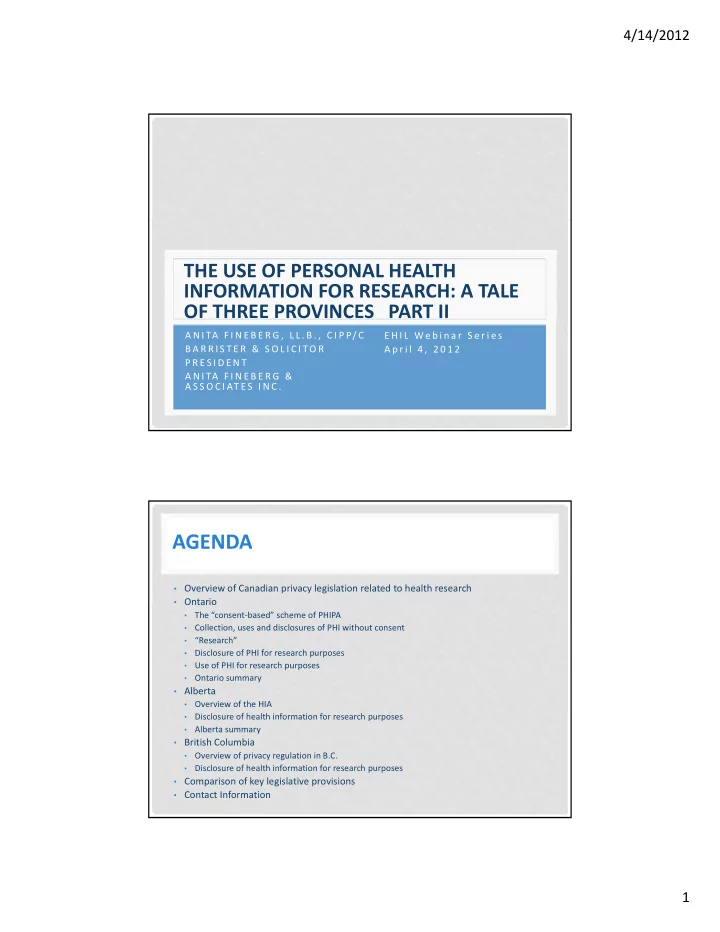
THE USE OF PERSONAL HEALTH INFORMATION FOR RESEARCH: A TALE OF THREE PROVINCES PART II

A N I TA F I N E B E R G , L L . B . , C I P P/ C B A R R I S T E R & S O L I C I TO R P R E S I D E N T A N I TA F I N E B E R G & A S S O C I AT E S I N C . E H I L We b i n a r S e r i e s A p r i l 4 , 2 0 1 2

AGENDA

  • Overview of Canadian privacy legislation related to health research
  • Ontario
  • The “consent‐based” scheme of PHIPA
  • Collection, uses and disclosures of PHI without consent
  • “Research”
  • Disclosure of PHI for research purposes
  • Use of PHI for research purposes
  • Ontario summary
  • Alberta
  • Overview of the HIA
  • Disclosure of health information for research purposes
  • Alberta summary
  • British Columbia
  • Overview of privacy regulation in B.C.
  • Disclosure of health information for research purposes
  • Comparison of key legislative provisions
  • Contact Information
slide-2
SLIDE 2

4/14/2012 2

MAP OF CANADIAN PRIVACY LEGISLATION

P H I PA

THE PERSONAL HEALTH INFORMATION PROTECTION ACT, 2004

slide-3
SLIDE 3

4/14/2012 3

THE ‘CONSENT‐BASED’ SCHEME OF PHIPA

PHIPA is ‘consent‐based’ legislation:

l ll d l f f

  • HICs may only collect, use or disclose PHI if one of

two conditions are met:

  • 1. if they have the individual’s consent under the Act

OR

  • 2. the collection, use or disclosure of the PHI is

permitted or required under the Act

  • The ‘consent‐based’ scheme of PHIPA is one of the

characteristics that has lead to its designation as being ‘substantially‐similar’ to PIPEDA

THE ‘CONSENT‐BASED’ SCHEME OF PHIPA

Consent may be:

  • Express
  • Implied
  • Assumed implied

The type of consent required by PHIPA depends upon:

1 the purpose for which the PHI will be collected

  • 1. the purpose for which the PHI will be collected,

used or disclosed and/or

  • 2. the nature of the entity that will be collecting,

using or disclosing the information

slide-4
SLIDE 4

4/14/2012 4

THE ‘CONSENT‐BASED’ SCHEME OF PHIPA

Some examples:

E i i d h HIC PHI f

  • Express consent is required when a HIC uses PHI for

marketing

  • Implied consent may be relied upon whenever a HIC

uses PHI for most purposes under PHIPA

  • Assumed implied consent allows a HIC to disclose PHI

to another HIC within the patient’s ‘circle of care’ for healthcare purposes healthcare purposes

Regardless of the type of consent, the consent must be: (i) that of the individual; (ii) knowledgeable; (iii) relate to the information; and (iv) not be

  • btained through deception or coercion

COLLECTION, USE AND DISCLOSURES OF PHI WITHOUT CONSENT

Where the activity is permitted or required by PHIPA PHIPA Policy decision based on an assessment that the importance of the activity ‘trumps’ an individual’s right to privacy The right to access PHI without consent in these circumstances is accompanied by corresponding circumstances is accompanied by corresponding responsibilities set out as legislative requirements The collection, use or disclosure of PHI for research is one of these activities

slide-5
SLIDE 5

4/14/2012 5

COLLECTION, USE AND DISCLOSURES OF PHI WITHOUT CONSENT

General limiting principles of PHIPA:

ll d l f h

  • 1. Do not collect, use or disclose PHI if other

information would serve the purpose

  • 2. Do not collect, use or disclose more PHI than is

necessary to serve the purpose of the collection, use or disclosure

If the information is not identifiable, it is not PHI and the research requirements in PHIPA do not apply

RESEARCH

Defined in PHIPA as:

A i i i i d i d d l A systematic investigation designed to develop or establish principles, facts or generalizable knowledge,

  • r any combination of them, and includes the

development, testing and evaluation of research

Must be distinguished from other, sometimes similar activities such as program evaluation, monitoring quality improvement or risk monitoring, quality improvement or risk management These other activities may also be undertaken without the individual’s consent, but only research requires that the conditions in PHIPA be met

slide-6
SLIDE 6

4/14/2012 6

DISCLOSURE OF PHI FOR RESEARCH PURPOSES

Requirements for researchers:

b h

  • 1. Submit to the HIC
  • a. A written application;
  • b. A written plan; and
  • c. A copy of the decision of the REB that approves

the research plan

  • 2. Enter in a research agreement with the HIC
  • 2. Enter in a research agreement with the HIC

[s.44(1)]

DISCLOSURE OF PHI FOR RESEARCH PURPOSES

Information that must be included in the research plan:

1

th ffili ti f h i l d i th h

  • 1. the affiliation of each person involved in the research
  • 2. the nature and objectives of the research and the public
  • r scientific benefit of the research that the research

anticipates

  • 3. a description of the research proposed to be conducted

and the duration of the research

  • 4. a description of the PHI required and the potential
  • 4. a description of the PHI required and the potential

sources

  • 5. a description of how the PHI will be used in the

research, and if it will be linked to other information, a description of the other information as well as how the linkage will be done

slide-7
SLIDE 7

4/14/2012 7

DISCLOSURE OF PHI FOR RESEARCH PURPOSES

Information that must be included in the research plan:

6

l ti t h th h t bl

6.

an explanation as to why the research cannot reasonably be accomplished without the PHI and, if it is to be linked to

  • ther information, an explanation as to why this linkage is

required

7.

an explanation as to why consent to the disclosure of the PHI is not being sought from the individuals to whom the information relates

8

d i ti f th bl f bl h d

8.

a description of the reasonably foreseeable harms and benefits that may arise from the use of the PHI and how the researchers intend to address those harms

9.

a description of all persons who will have access to the information, why their access is necessary, their roles in relation to the research, and their related qualifications

DISCLOSURE OF PHI FOR RESEARCH PURPOSES

Information that must be included in the research plan:

10 the safeguards that the researcher will impose to protect the

  • 10. the safeguards that the researcher will impose to protect the

confidentiality and security of the PHI, including an estimate of how long information will be retained in an identifiable form and why

  • 11. information as to how and when the PHI will be disposed of or

returned to the HIC

  • 12. the funding source of the research
  • 13. whether the researcher has applied for the approval of another
  • 13. whether the researcher has applied for the approval of another

research ethics board and, if so the response to or status of the application

  • 14. whether the researcher’s interest in the disclosure of the PHI or

the performance of the research would likely result in an actual

  • r perceived conflict of interest with other duties of the

researcher [s.44(2); s.16, O.Reg.329/04]

slide-8
SLIDE 8

4/14/2012 8

DISCLOSURE OF PHI FOR RESEARCH PURPOSES

Requirements that must be met by a REB:

1

The board must have at least five members including

1.

The board must have at least five members, including,

a.

at least one member with no affiliation with the person or persons that established the research ethics board,

b.

at least one member knowledgeable in research ethics, either as a result of formal training in research ethics, or practical or academic experience in research ethics,

c.

at least two members with expertise in the methods or in the areas

  • f the research being considered, and

d

at least one member knowledgeable in considering privacy issues

d.

at least one member knowledgeable in considering privacy issues

2.

The board may only act with respect to a proposal to approve a research plan where there is no conflict of interest existing or likely to be perceived between its duty to consider certain matters before approving the plan and any participating board member’s personal interest in the disclosure of the PHI or the performance

  • f the research

[s.15, O.Reg.329/04]

DISCLOSURE OF PHI FOR RESEARCH PURPOSES

Consideration by the REB and its decision:

1

When deciding whether to approve a research plan the REB shall

1.

When deciding whether to approve a research plan, the REB shall consider matters it considers relevant, including:

a.

whether the objectives of the research can reasonably be accomplished without using the PHI that is to be disclosed;

b.

whether, at the time the research is conducted, adequate safeguards will be in place to protect the privacy of the individuals whose PHI is being disclosed and to preserve the confidentiality of the information;

c.

the public interest in conducting the research and the public interest in protecting the privacy of the individuals whose PHI is being disclosed; d and

d.

whether obtaining the consent of the individuals whose PHI is being disclosed would be impractical

2.

The REB must provide the researcher with a written decision with reasons setting out whether it approves the research plan and. If so, whether the approval is subject to any conditions [s.44(3), (4)]

slide-9
SLIDE 9

4/14/2012 9

DISCLOSURE OF PHI FOR RESEARCH PURPOSES

Provisions generally included in the research agreement: agreement:

  • the researcher agrees to comply with the conditions

and restrictions, if any, that the HIC imposes relating to the use, security, disclosure, return or disposal of the information

  • typical provisions include those that are set out in

PHIPA regarding the compliance obligations of the PHIPA regarding the compliance obligations of the researcher in the Act [s.44(6)]

  • this is done so that in the event that something

untoward happens to the PHI disclosed by the HIC, the researcher will have been in breach of contract, not just the Act

DISCLOSURE OF PHI FOR RESEARCH PURPOSES

Provisions generally included in the research agreement – the researcher agrees to: agreement – the researcher agrees to:

  • 1. s.44(6) requirements:

a.

comply with the conditions, if any, specified by the REB in respect of the research plan

b.

use the information only for the purposes set out in the research plan as approved by the REB

c.

not publish the information in a form that could reasonably enable a person to ascertain the identity of the individual

d.

not disclose the information except as required by law or to a: (i) prescribed entity; (ii) prescribed person with respect to a registry; or (iii) another researcher if the requirements for such disclosures are met

slide-10
SLIDE 10

4/14/2012 10

DISCLOSURE OF PHI FOR RESEARCH PURPOSES

Provisions generally included in the research agreement – the researcher agrees to: agreement – the researcher agrees to:

  • 1. s.44(6) requirements:

e.

not make contact or attempt to make contact with the individual, directly or indirectly, unless the HIC first obtains the individual’s consent to being contacted

f.

notify the HIC immediately in writing if the researcher becomes aware of any breach of the Act or the research

R i t i l d d b th HIC

  • 2. Requirements included by the HIC:

a.

detailed provisions re: the type of administrative, technical and physical safeguards that must be applied to the PHI

b.

access controls re: who may access the PHI

c.

the length of time that the researcher may retain the PHI and whether it is to be returned to the HIC or destroyed

DISCLOSURE OF PHI FOR RESEARCH PURPOSES

Provisions generally included in the research t th h t agreement – the researcher agrees to:

  • 2. Requirements included by the HIC:
  • d. how to manage any requests for access to PHI
  • e. more specific timelines for notification of the HIC

in the event of a breach

f.

description of the PHI p

slide-11
SLIDE 11

4/14/2012 11

DISCLOSURE OF PHI FOR RESEARCH PURPOSES

Further disclosures of PHI by the researcher: “The researcher agrees not disclose the information except as required by law The researcher agrees not disclose the information except as required by law

  • r to a (i) prescribed entity; (ii) prescribed person with respect to a registry;
  • r (iii) another researcher if the requirements for such disclosures are met”

1.

Prescribed entities: CCO, CIHI, ICES and POGO

2.

Prescribed persons /registry: Prescribed Person Registry

Cardiac Care Network Registry of Cardiac Services INSCYTE Cytobase Canadian Stroke Network Registry of the Canadian Stroke Network Hamilton Health Sciences Corporation Critical Care Information System Cancer Care Ontario Ontario Cancer Screening Registry Children’s Hospital of Eastern Ontario Better Outcomes Registry and Network Ontario Institute for Cancer Research Ontario Tumour Bank

DISCLOSURE OF PHI FOR RESEARCH PURPOSES

Further disclosures of PHI by the researcher: h The requirements:

  • 1. The disclosure must be part of the approved

research plan; or

  • 2. The disclosure is necessary to verify or validate

the PHI or the research [s.17, O.Reg.329/04] [ , g / ]

slide-12
SLIDE 12

4/14/2012 12

DISCLOSURE OF PHI FOR RESEARCH PURPOSES

Outside of Ontario

PHIPA t i i i di th i t i

  • PHIPA contains provisions regarding the circumstances in

which a HIC may disclose PHI about an individual collected in Ontario to a person outside of the province

  • If this Act permits the disclosure [s.50(1)(b)]
  • Accordingly, as long as all of the requirements related to

disclosure of PHI for research have been satisfied, the HIC may disclose the PHI to a researcher located outside of the province or the country

  • Pay careful attention to the terms included in the research

agreement

  • Those related to the safeguards to be applied to the PHI
  • May wish to prohibit further disclosures to researchers to

maintain control of the PHI

USE OF PHI FOR RESEARCH PURPOSES

Within the HIC itself – by an agent of the HIC

h d f

  • Because the HIC is permitted to use PHI for

research as long as certain conditions are met, so too are its agents

  • The conditions are generally the same as those

required if the HIC is disclosing the PHI for research in that a research plan must be prepared d d b REB and approved by a REB

  • No research agreement is required
slide-13
SLIDE 13

4/14/2012 13

USE OF PHI FOR RESEARCH PURPOSES

Within the HIC itself – by an agent of the HIC

b f h h h

  • However, before the HIC turns to the research

provisions of the Act, it should consider whether

  • ther permitted uses without consent would

cover the analysis being contemplated

  • Activities to improve or maintain the quality of care
  • r to improve or maintain the quality of related

i f th HIC programs or services of the HIC

  • Planning or evaluation of services provided by the

HIC

  • Investigations to justify the introduction,

continuation, elimination or modification of a health service

DATABASES/DATA WAREHOUSES

  • The establishment and creation of these within

HIC ld b “ ” f PHI d PHIPA a HIC would be a “use” of PHI under PHIPA

  • Recall the “consent‐based” scheme of PHIPA
  • The consent of the individual must be obtained
  • the collection, use or disclosure of the PHI is

permitted or required under the Act

  • PHIPA does not speak to the creation of
  • PHIPA does not speak to the creation of

databases or data warehouses by a HIC

slide-14
SLIDE 14

4/14/2012 14

DATABASES/DATA WAREHOUSES

  • Therefore two methods by which these may be

created: created:

  • Consent of the individual whose PHI will be included
  • uses of the PHI will have to be clearly defined

particularly if the data will be used for multiple and future applications

  • requirements for consent under PHIPA must be

met met

  • Permitted by PHIPA
  • numerous permitted uses without consent
  • Safeguards provisions will apply

CHART PRE‐SCREENING TO IDENTIFY POTENTIAL RESEARCH INFORMATION

  • Include as part of research plan presented for

REB l REB approval

  • Secure approval for this first phase of the

protocol to proceed with a waiver of individual consent for the chart pre‐screening

  • If REB approves this process, can proceed with

what is approved for the use/disclosure of the what is approved for the use/disclosure of the PHI as described in the research plan

slide-15
SLIDE 15

4/14/2012 15

ONTARIO SUMMARY

  • HICs may use or disclose PHI without the consent of the

individuals to whom the information relates for the purposes individuals to whom the information relates for the purposes

  • f research as long as the requirements of PHIPA are met
  • The Act is very prescriptive with respect to:
  • The contents of the research plan
  • The composition of the REB that must approve the research

plan

  • The factors that the REB must take into account in considering

whether to approve the research plan whether to approve the research plan

  • The requirements with which the researcher must comply
  • There are no requirements re: data matching or provision of

any information to the Information and Privacy Commissioner The terms of the research agreement are critical

H I A

THE HEALTH INFORMATION ACT

slide-16
SLIDE 16

4/14/2012 16

OVERVIEW OF THE HIA

Terminology

  • “custodian”=HIC
  • custodian =HIC
  • “data matching” = the creation of individually identifying health

information by combining individually identifying or non‐identifying health information or other information from 2 or more electronic databases, without the consent of the individuals who are the subjects of the information

  • “health information” = diagnostic, treatment and care information

and registration information “i di id l id if i ” h id i f h i di id l h i h

  • “individual identifying” = the identity of the individual who is the

subject of the information can be readily ascertained from the information

  • “health information repository” = agency etc. designated by the

minister as such

  • “research” = academic, applied or scientific research that

necessitates the use of individually identifying health information

OVERVIEW OF THE HIA

Terminology

“ h hi b d” ( hi i )

  • “research ethics board” (ethics committee)
  • Designated in the regulations

ENTITY COMMITTEE/BOARD Alberta Cancer Board Research Ethics Committee College of Physicians and Surgeons of Alberta Research Ethics Review Committee Alberta Heritage Foundation Community Health Ethics Alberta Heritage Foundation for Medical Research Community Health Ethics Research Review Committee University of Alberta Health Research Ethics Board University of Calgary Conjoint Health Research Ethics Board University of Lethbridge Human Subject Research Committee

slide-17
SLIDE 17

4/14/2012 17

DISCLOSURE OF HEALTH INFORMATION FOR RESEARCH PURPOSES

A custodian may use or disclose health information for research to conduct data matching or services to facilitate research, to conduct data matching or services to facilitate another’s research if the following conditions are met:

1.

if the custodian or researcher has submitted a proposal to a REB in accordance with the Act

2.

if the REB is satisfied as to the matters set out in the Act

3.

if the custodian or researcher has complied with or undertaken to comply with the conditions, if any, t d b th REB d suggested by the REB, and

4.

where the REB recommends that consents should be

  • btained from the individuals who are the subjects of the

health information to be used in the research, if those consents have been obtained [s.27(1)(d); Division 3]

DISCLOSURE OF HEALTH INFORMATION FOR RESEARCH PURPOSES

Obligations of researchers:

b h l l

  • 1. Submit research proposals involving use or

disclosure of health information to a designated HIA ethics committee

  • 2. Proposal to include the following:
  • a. consent considerations

i.

if proceeding on a consent basis for use or p g disclosure, include the consent form which meets the consent requirements in the Act

ii.

if seeking a waiver, provide a rationale for why

  • btaining consent is unreasonable, impractical or

not feasible

slide-18
SLIDE 18

4/14/2012 18

DISCLOSURE OF HEALTH INFORMATION FOR RESEARCH PURPOSES

Obligations of researchers:

P l i l d h f ll i

  • 2. Proposal to include the following:
  • b. rationale for how the importance of the public

interest in the proposed research substantially

  • utweighs the public interest in protecting individual

privacy by explaining to what degree the proposed research may contribute to the following:

i.

identification, prevention or treatment of illness or , p disease

ii.

scientific understanding relating to health, promotion and protection of the health of individuals and communities, improved delivery of health services, or improvements in health system management

DISCLOSURE OF HEALTH INFORMATION FOR RESEARCH PURPOSES

Obligations of researchers:

l l d h f ll

  • 2. Proposal to include the following:
  • c. provide qualifications to demonstrate the

researcher is qualified to carry out the research

  • d. document adequate safeguards to protect

individual privacy and confidentiality by providing detail for administrative, technical and h i l f d physical safeguards

  • 3. May approach custodians for disclosure of

health information upon receipt of approval letter from REB

slide-19
SLIDE 19

4/14/2012 19

DISCLOSURE OF HEALTH INFORMATION FOR RESEARCH PURPOSES

Obligations of researchers:

l f d l f h l h f f

  • 4. Apply for disclosure of health information from

custodians by submitting:

  • a. REB response letter to the researcher and
  • b. written application for disclosure of health

information

  • 5. Anticipate costs set by the custodian to:

p y

  • a. obtain consents, if applicable,
  • b. prepare information for disclosure, and
  • c. make copies of the health information
  • 6. Ensure research provisions are complied with

before data matching is performed

DISCLOSURE OF HEALTH INFORMATION FOR RESEARCH PURPOSES

7.

Enter into a research agreement with the custodian which must include agreement g

a.

to comply with:

i.

HIA and regulations,

ii.

any conditions imposed by the custodian relating to the use, protection, disclosure, return or disposal of the health information, and

iii.

any requirement imposed by the custodian to provide safeguards against the identification, direct or indirect, of an individual who is the subject of the health information

b.

to use the health information only for the purpose of conducting h f hi h it t d research for which it was requested,

c.

not to publish the health information in an identifiable form,

d.

not to contact the research subjects to obtain additional health information unless the individual has provided the custodian with consent,

e.

to allow custodians access to the researcher’s premises to confirm HIA compliance and any other conditions or requirements,

f.

to pay costs set out by the custodian

slide-20
SLIDE 20

4/14/2012 20

DISCLOSURE OF HEALTH INFORMATION FOR RESEARCH PURPOSES

Obligations of REBs

R i h l h i l i

  • 1. Review research proposals that involve using or

disclosing health information

  • a. review must look at:

i.

whether consent from individuals is needed before disclosing the health information

ii.

whether getting such consent would be unreasonable, impractical or not feasible p

iii.

whether the public interest in the proposed research substantially outweighs the public interest in protecting individuals privacy

iv.

the researchers’ qualifications

v.

safeguards (administrative, technical and physical) to protect individual privacy and confidentiality and whether they are adequate

DISCLOSURE OF HEALTH INFORMATION FOR RESEARCH PURPOSES

Obligations of REBs

I ki h b h hi

  • 2. In making the above assessment, the ethics

committee must consider the degree to which the proposed research would contribute to:

  • a. identification, prevention or treatment of illness or

disease,

  • b. scientific understanding relating to health,

c

promotion and protection of the health of

c.

promotion and protection of the health of individuals and communities,

  • d. improved delivery of health services, or
  • e. improvements in health system management
slide-21
SLIDE 21

4/14/2012 21

DISCLOSURE OF HEALTH INFORMATION FOR RESEARCH PURPOSES

Obligations of REBs

h h

  • 3. The ethics committee must prepare a response

setting out:

  • a. its decision regarding consent
  • b. a summary of the review assessment
  • c. any other conditions the ethics committee

decides to impose on the researcher

  • 4. The ethics committee must forward the

response to the researcher and a copy to the Information and Privacy Commissioner

DISCLOSURE OF HEALTH INFORMATION FOR RESEARCH PURPOSES

Obligations of Custodians

f d f h

  • 1. Ensure receipt of documents from researcher

wishing to access health information for the purpose of research which must include:

  • a. REB response letter to the researcher and
  • b. written application for disclosure of health

information

  • 2. Decide on whether to disclose the health

information to the researcher

slide-22
SLIDE 22

4/14/2012 22

DISCLOSURE OF HEALTH INFORMATION FOR RESEARCH PURPOSES

Obligations of custodians:

f d d l h

  • 3. If decision is to disclose, then
  • a. impose any REB conditions
  • b. impose any other conditions set out by the

custodian, e.g. submission to a custodian ethics committee

  • c. obtain consents if researcher wishes to contact

individuals for additional health information,

  • d. set costs, if applicable
  • e. sign research agreement with researcher

DISCLOSURE OF HEALTH INFORMATION FOR RESEARCH PURPOSES

Obligations of custodians:

f h d d l

  • 3. If the decision is to disclose

f.

if consent based disclosure, verify consent has been obtained

  • g. ensure data prepared for disclosure is the least

amount, at the highest level of anonymity, based

  • n the need to know
  • h. must ensure sections of the Act are complied

with before data matching is performed

i.

if the agreement is breached the agreement is cancelled

j.

if researcher denies access to premises, custodian can obtain a Court Order

slide-23
SLIDE 23

4/14/2012 23

DISCLOSURE OF HEALTH INFORMATION FOR RESEARCH PURPOSES

Obligations of custodians:

If h d i i i di l

  • 3. If the decision is to disclose

k.

if researcher denies access to premises, custodian can obtain a Court Order

  • Court may order a researcher to comply with the

research agreement

  • Court may authorize custodian to:
  • enter and search research premises

enter and search research premises

  • operate any computer system and produce documents
  • seize and make copies of any documents relevant to the

investigation

l.

custodian must return seized documents within 60 days after conclusion of investigation

DISCLOSURE OF HEALTH INFORMATION FOR RESEARCH PURPOSES

Disclosures outside of Alberta

Are permitted if the custodian enters into an agreement with

  • Are permitted if the custodian enters into an agreement with

the researcher that

1.

provides for the custodian to retain control over the health information

2.

adequately addresses the risks associated with the storage, use

  • r disclosure of the health information

3.

requires the person to implement and maintain adequate safeguards for the security and protection of the health g y p information

4.

allows the custodian to monitor compliance with the terms and conditions of the agreement, and

5.

contains remedies to address any non‐compliance with or breach of the terms and conditions of the agreement by the

  • ther person
  • Can be incorporated into the research agreement itself
slide-24
SLIDE 24

4/14/2012 24

ALBERTA SUMMARY

  • Custodians may use or disclose health information without the

consent of the individuals to whom the information relates for consent of the individuals to whom the information relates for the purposes of research as long as the requirements of the HIA are met

  • There are six designated provincial REBs that have the

authority to approve research plans under the HIA

  • REB responses must be submitted to the Alberta Privacy

Commissioner

  • The HIA specifies that the custodian may require the

The HIA specifies that the custodian may require the researcher to pay for the data on a ‘cost recovery’ basis

  • Provisions specifically address requirements for data matching
  • Legislative provisions address custodian remedies in the event

that the researcher declines to allow inspection of premises in accordance with the terms of the research agreement

F O I PA , P I PA a n d t h e E H e a l t h A c t THE FREEDOM OF INFORMATION AND PROTECTION OF PRIVACY ACT THE PERSONAL INFORMATION PROTECTION ACT E‐HEALTH (PERSONAL HEALTH INFORMATION ACCESS AND PROTECTION OF PRIVACY) ACT

slide-25
SLIDE 25

4/14/2012 25

OVERVIEW OF PRIVACY REGULATION IN B.C.

  • Unlike in Ontario (PHIPA) and Alberta (HIA) there is no one

piece of legislation that applies to personal health piece of legislation that applies to personal health information regardless of the entity that controls it

  • FOIPA
  • Applies to personal information, including personal health

information, held by public bodies and health care bodies

  • Includes the Ministry of Health, public hospitals, mental health

facilities and universities

  • PIPA
  • PIPA
  • Applies to personal information, including personal health

information, held by organizations

  • Includes physician offices, pharmacies, private labs

OVERVIEW OF PRIVACY REGULATION IN B.C.

  • E‐Health (Personal Health Information Access

d P t ti f P i ) A t and Protection of Privacy) Act

  • Applies to designated health information banks
  • A designation order may authorize the collection

and use of PHI for purposes including research into health issues, as well as disclosure for research purposes

Accordingly, the rules with respect to research depend upon the source of the information that a researcher wishes to access

slide-26
SLIDE 26

4/14/2012 26

DISCLOSURE OF HEALTH INFORMATION FOR RESEARCH PURPOSES

FOIPA

P bli b di di l l i f i

  • Public bodies may disclose personal information

without consent if:

  • 1. the research purpose cannot reasonably be

accomplished unless that information is provided in individually identifiable form or the research purpose has been approved by the commissioner,

  • 2. the information is disclosed on condition that it not be
  • 2. the information is disclosed on condition that it not be

used for the purpose of contacting a person to participate in the research,

  • 3. any data linking is not harmful to the individuals that

information is about and the benefits to be derived from the data linking are clearly in the public interest,

DISCLOSURE OF HEALTH INFORMATION FOR RESEARCH PURPOSES

  • 4. the head of the public body concerned has approved

conditions relating to the following: conditions relating to the following:

a.

security and confidentiality;

b.

the removal or destruction of individual identifiers at the earliest reasonable time;

c.

the prohibition of any subsequent use or disclosure of that information in individually identifiable form without the express authorization of that public body; and and

  • 5. the person to whom that information is disclosed has

signed an agreement to comply with the approved conditions, this Act and any of the public body’s policies and procedures relating to the confidentiality

  • f personal information

[s.35]

slide-27
SLIDE 27

4/14/2012 27

DISCLOSURE OF HEALTH INFORMATION FOR RESEARCH PURPOSES

  • Note that the Commissioner may approve:

th h

  • the research purpose
  • the use of the disclosed information to contact the

individual and

  • the manner in which the contact is to be made,

including the information to be made available to the individuals contacted [s.35(2)]

  • There were restrictions on disclosing information

There were restrictions on disclosing information

  • btained from public bodies outside of Canada or

enabling access to the information from outside of the country [s.33.2]

  • The Act does not require that the research be

approved by a REB but public bodies may implement a policy requiring this in certain circumstances

DISCLOSURE OF HEALTH INFORMATION FOR RESEARCH PURPOSES

Amendments in Bill 3

f d l k [ ]

  • New requirements for data linking [s.36.1]
  • But note the key exclusion:
  • If all of the participants in a new or significantly

revised data‐linking initiative are a health care body, the ministry of the minister responsible for the administration of the Ministry of Health Act or a h lth l t d i ti ib d th health‐related organization as prescribed, then subsection (1) does not apply to the participants

  • Personal information may now be disclosed
  • utside of Canada if it meets the requirements in

s.35 [ [s.33.1(s)]

slide-28
SLIDE 28

4/14/2012 28

DISCLOSURE OF HEALTH INFORMATION FOR RESEARCH PURPOSES

Amendments in Bill 3 (cont’d)

l f h b News Release of the Commissioner: October 4, 2011 “I am concerned that new data linking rules do not apply to the health sector. We recognize the unique needs within the sector, but rules for linking personal health information are needed, perhaps in stand‐ alone health information legislation,” said Commissioner Denham “During further consultations Commissioner Denham. During further consultations with government, I will push for the highest standards

  • f health privacy, and will report publicly on our

progress.”

DISCLOSURE OF HEALTH INFORMATION FOR RESEARCH PURPOSES

Amendments in Bill 3 (cont’d)

h f b ’ d Letter to the Minister of Labour, Citizens’ Services and Open Government: October 4, 2011 “I have concerns that new regulations for data linking would not apply to the integrated health sector but I have a commitment from the Ministry of Health to discuss rules for data linking that would apply, as well as the possibility of new stand‐alone health as the possibility of new stand alone health information legislation. I will push for the highest standards of health privacy and will report publicly on the outcome of these discussions.”

slide-29
SLIDE 29

4/14/2012 29

DISCLOSURE OF HEALTH INFORMATION FOR RESEARCH PURPOSES

PIPA

Ph i i di l i f i f h if h

  • Physicians may disclose information for research if the

following conditions are met:

  • 1. The research purpose cannot be accomplished unless

the personal information is provided in an individually identifiable form.

  • 2. The disclosure is on condition that it will not be used

to contact persons to ask them to participate in the to contact persons to ask them to participate in the research.

  • 3. Linkage of the personal information to other

information is not harmful to the individuals identified by the personal information and the benefits to be derived from the linkage are clearly in the public interest.

DISCLOSURE OF HEALTH INFORMATION FOR RESEARCH PURPOSES

  • 4. The organization to which the personal information is

to be disclosed has signed an agreement to comply to be disclosed has signed an agreement to comply with:

a.

PIPA

b.

The policies and procedures relating to the confidentiality of personal information of the

  • rganization that collected the personal information

c.

Security and confidentiality conditions A i t t d t i di id l

d.

A requirement to remove or destroy individual identifiers at the earliest reasonable opportunity

e.

Prohibition of any subsequent use or disclosure of that personal information in individually identifiable form without the expressed authorization of the organization that disclosed the personal information

slide-30
SLIDE 30

4/14/2012 30

DISCLOSURE OF HEALTH INFORMATION FOR RESEARCH PURPOSES

  • 5. It is impracticable for the organization to

k th t f th i di id l f th seek the consent of the individual for the disclosure [s.21(1)]

  • If the research could not reasonably be

accomplished without identifiable data, the approval and review of an approved REB is required [Joint Guidelines of the BCMA and th OIPC] the OIPC]

  • There are no restrictions on disclosures to

researchers outside of the province

DISCLOSURE OF HEALTH INFORMATION FOR RESEARCH PURPOSES

E‐Health (Personal Health Information Access d P t ti f P i ) A t and Protection of Privacy) Act

  • A Data Stewardship Committee (DSC) is solely

responsible for managing the disclosure of PHI for research purposes [s.11]

  • Applies to designated health information banks

(HIBs)

slide-31
SLIDE 31

4/14/2012 31

DISCLOSURE OF HEALTH INFORMATION FOR RESEARCH PURPOSES

E‐Health (Personal Health Information Access and Protection of Privacy) Act Protection of Privacy) Act

  • Requests for disclosure for research purposes have to

meet the following criteria:

a.

the health research purpose cannot reasonably be accomplished unless personal health information is disclosed;

b.

personal health information is disclosed on condition that it not be used for the purpose of contacting a person to participate in the health research unless the commissioner approves the health research, unless the commissioner approves

i.

the health research purpose,

ii.

the use of disclosed personal health information for the purpose

  • f contacting a person to participate in the health research, and

iii.

the manner in which contact is to be made, including the information to be made available to persons contacted;

DISCLOSURE OF HEALTH INFORMATION FOR RESEARCH PURPOSES

E‐Health (Personal Health Information Access and Protection of Privacy) Act Protection of Privacy) Act

  • c. any data linking is not harmful to the individuals

who are the subjects of the personal health information and the benefits to be derived from the data linking are clearly in the public interest;

  • d. the DSC has imposed conditions relating to

i

security and confidentiality

i.

security and confidentiality,

ii.

the removal or destruction of individual identifiers at the earliest reasonable time, and

  • iii. the prohibition of any subsequent use or disclosure of

personal health information without the express authorization of the DSC

slide-32
SLIDE 32

4/14/2012 32

B.C. SUMMARY

  • Different rules and processes apply depending

h th th PHI ht t b d f

  • n whether the PHI sought to be accessed for

research purposes is held by a public body (FOIPA), private sector organization (PIPA) or HIBs (eHealth Act)

  • Future possibility of consolidated health

information privacy legislation? p y g

COMPARISON OF KEY LEGISLATIVE PROVISIONS

Element Ontario Alberta B.C. FOIPA PIPA EHEALTH Use and disclosure of identifiable information permitted without consent √ √ √ √ √ Research plan required to be submitted by researcher to “data steward” √ √ no no

Form required by the DSC

Research proposal required to be submitted to a REB √ √ no √ no Designation of “authorized” REBs √ √ no no no

composition named in the regulation

Specification of REB considerations √ √ no no

Criteria in the Act

Agreement required between the “data steward” and the researcher √ √ √ √

If required by the DSC

Disclosure permitted outside of the province √ √

If agreement includes certain provisions

√ √

Individual consent required

slide-33
SLIDE 33

4/14/2012 33

COMPARISON OF KEY LEGISLATIVE PROVISIONS

Element Ontario Alberta B.C. EHEALTH FOIPA PIPA FOIPA PIPA Requirements if data matching/linkage is to be undertaken

no described in research plan

√ √ √ no Provision of information to the Information and Privacy Commissioner no √

in certain cases in certain cases

no Ability of researcher to contact individuals without prior consent of the individual

  • btained by the custodian

no no no

If approved by the C i i

no no

If approved by the C i i

  • btained by the custodian

Commissio ner Commissioner

Obligation to notify custodian in the event of a data breach √ no no no no

CONTACT INFORMATION

Anita Fineberg, LL.B., CIPP/C l Barrister & Solicitor President Anita Fineberg & Associates Inc. 416.762.4583 (B) 416.565.5007 (C) 877.475.7096 (F) afineberg@sympatico.ca http://www.linkedin.com/in/anitafineberg