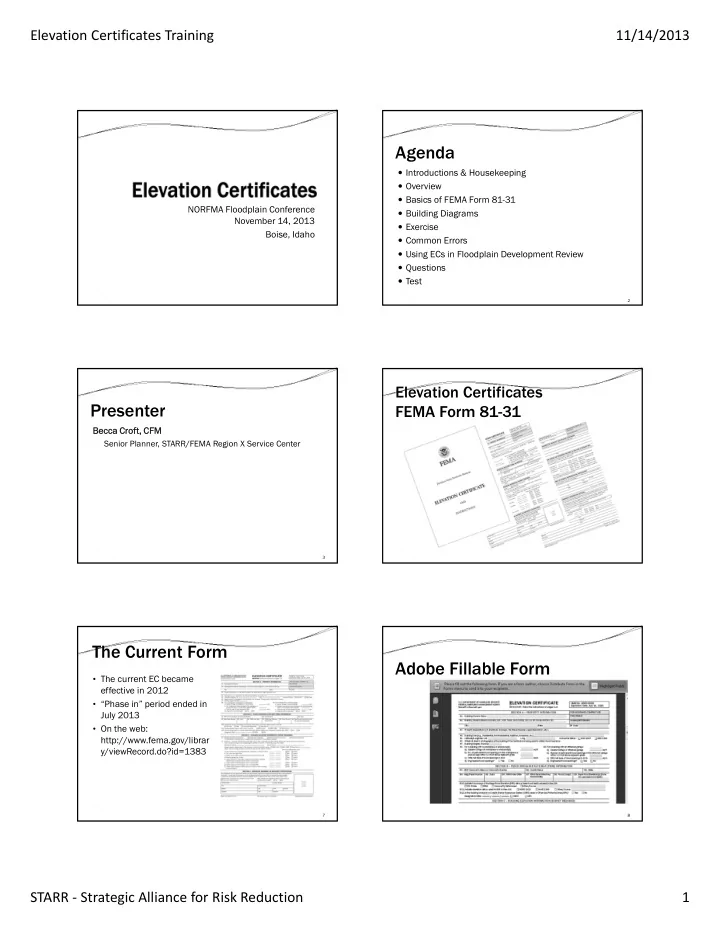
Agenda Introductions & Housekeeping Overview Basics of FEMA - - PDF document

agenda
SMART_READER_LITE
LIVE PREVIEW

Agenda Introductions & Housekeeping Overview Basics of FEMA - - PDF document

Elevation Certificates Training 11/14/2013 Agenda Introductions & Housekeeping Overview Basics of FEMA Form 81-31 NORFMA Floodplain Conference Building Diagrams November 14, 2013 Exercise Boise, Idaho Common Errors


slide-1
SLIDE 1

Elevation Certificates Training 11/14/2013 STARR ‐ Strategic Alliance for Risk Reduction 1

NORFMA Floodplain Conference November 14, 2013 Boise, Idaho

Agenda

 Introductions & Housekeeping  Overview  Basics of FEMA Form 81-31  Building Diagrams  Exercise  Common Errors  Using ECs in Floodplain Development Review  Questions  Test

2

Presenter

Becc Becca Cr Crof

  • ft, CFM

CFM

Senior Planner, STARR/FEMA Region X Service Center

3

Elevation Certificates FEMA Form 81-31

The Current Form

  • The current EC became

effective in 2012

  • “Phase in” period ended in

July 2013

  • On the web:

http://www.fema.gov/librar y/viewRecord.do?id=1383

7

Adobe Fillable Form

8

slide-2
SLIDE 2

Elevation Certificates Training 11/14/2013 STARR ‐ Strategic Alliance for Risk Reduction 2

Purpose of the Elevation Certificate

  • Required to rate

insurance for Post-FIRM (and some Pre-FIRM) buildings

  • Determines compliance

with building codes/local

  • rdinance
  • Supports LOMA/

LOMR-F

  • Prerequisite for CRS

9

Who uses the EC?

Elevation Certificate LOMA/LOMR Planning Department Developer/ Builder Insurance Agent FEMA/State CAV Building Department

10

Does the community have to require an Elevation Certificate?

 The primary purpose of the EC is to rate a flood insurance policy.  CRS communities must collect and retain ECs for all Post-FIRM structures inside the SFHA.  Building/Planning officials are required to obtain certified elevations of certain floodplain development in 44 CFR 60.3 (b) (5) (i)— the EC is the EC is the the logic logical l meth method (check your local ordinance).

11

Does the EC certify a building as “compliant”?

The Elevation Certificate is a report of existing

  • conditions. The surveyor/engineer’s stamp does

not certify that the structure complies with federal, state, or local regulations; it only certifies the elevations in Section C. THE COMMUNITY must review the certificate for completeness and accuracy, and determine if the structure is compliant!

12

Completing the EC Key Terms

 FIRM = Flood Insurance Rate Map  FIS = Flood Insurance Study  BFE = Base Flood Elevation  SFHA = Special Flood Hazard Area (1% ACF)  LAG = Lowest adjacent grade  HAG = Highest adjacent grade  Lowest Floor  Bottom Floor

14

slide-3
SLIDE 3

Elevation Certificates Training 11/14/2013 STARR ‐ Strategic Alliance for Risk Reduction 3

Section A – Property Information

 Property description  Latitude/Longitude  Horizontal datum (NAD)  Building diagram number  Photographs, two required for flood insurance rating  Measurements of crawl spaces, enclosures, attached garages, and flood

  • penings

15

Section A – Property Information

 Can be completed by the community or homeowner  Verify property description/use and building diagram  Review number of flood openings for compliance

16

A7 – Building Diagram

 Proper building diagram selection is essential for determining the elevations that must be measured to properly complete the EC  Take photographs that capture the characteristics that support the building diagram

17

Flood Openings

 A flood opening is a permanent opening that allows for the free passage of water automatically in both directions without human intervention.  Under the NFIP, a minimum of two openings are required for every enclosed area or crawlspace.  The openings shall provide a total net area of not less than one square inch for every square foot area enclosed, excluding any bars, louvers, or other covers

  • f the opening.

18

Flood Openings Engineered Flood Openings

 Individual Engineered Flood Openings Certification or an Evaluation Report issued by the International Code Council Evaluation Service (ICC ES) must be submitted to document that the design of the openings will allow for automatic equalization of hydrostatic flood forces

  • n exterior walls.

20

slide-4
SLIDE 4

Elevation Certificates Training 11/14/2013 STARR ‐ Strategic Alliance for Risk Reduction 4

More About Flood Openings

 A window, a door, or a garage door is not considered an

  • pening; but openings may be installed in doors.

 Subtract area of grates, louvers, or grills

21

More About Flood Openings

 The bottom of the openings must be no higher than one foot above the higher of the exterior or interior grade or floor immediately below the opening.  For more guidance on openings, see NFIP Technical Bulletin 1 – ‘Openings in Foundation Walls and Walls of Enclosures.’”

22

Attached Garages

Common wall Single structure One insurance policy Separate foundations Can be considered a separate structure Can be insured separately Could also have a separate EC

Section B – FIRM Information

 Can be completed by the community or homeowner  Verify ALL FIELDS, especially Community Number, Map/Panel numbers/dates and BFE  Check elevation datum used (NGVD29/NAVD88)

24 25

B1 B1 B4 & B4 & B5 B5 B7 B7 B6 B6 B2 & B2 & B3 B3

27

slide-5
SLIDE 5

Elevation Certificates Training 11/14/2013 STARR ‐ Strategic Alliance for Risk Reduction 5

Section B – FIRM Information

 Base Flood Elevation (BFE) to the tenth (0.1) of a foot.  Zone AE or A1-99—Use Flood Insurance Study  Zone AO—Use depth number on the FIRM/FIS  Zone A—if no BFE available, enter “N/A” and complete Section E, unless applying for a LOMA or LOMR-F  Zone VE—Use the FIRM and FIS

28

Common Errors in Section B

 Wrong Community Number

 Very common after new maps or annexations

 Wrong Index date  Wrong Panel date  Item B-10: Where did the BFE come from, especially in unnumbered “A” zones  Estimating BFE’s between the wavy lines on the FIRM

29

Section C – Building Elevations

 MUST be completed by a surveyor or engineer  “Finished construction” means all machinery and equipment are installed and final grading is completed  NO Blanks – use “N/A” if there is nothing to measure

31

 Indicate if elevations are  From construction drawings  For building under construction  Finished construction – only after all machinery and equipment are installed and grading around structure is complete

C1 – Basis for Elevations

32

Ne New! w!

 Enter measurements to nearest tenth of a foot  This section is required for Zones A1-30, AE, AH or A (with BFE) and for VE zones  This section is not required for Zones AO or A (without BFE), except to support an application for LOMA or LOMR-F

N/A

Section C – Building Elevations

33

Section C - Benchmarks

  • Each benchmark in a

network has a unique identifier

  • The National Geodetic

Survey uses the Permanent Identifier (PID) to uniquely identify each benchmark.

  • Most other networks will

assign a similar identifier

34

slide-6
SLIDE 6

Elevation Certificates Training 11/14/2013 STARR ‐ Strategic Alliance for Risk Reduction 6

N/A

 It may be necessary to enter the building to ensure that all required elevations are obtained  Use the same datum as was used in B9

Section C - Building Elevation Data

35

N/A

 “Top of bottom floor” elevation depends on construction and diagram number indicated in Section A.  Slab foundation  Basement floor  Elevated floor  Enclosure floor  Crawlspace floor

C2 a – Top of Bottom Floor

36

Top of Bottom Floor

37

Top of Bottom Floor

38

Bottom Floor vs. Lowest Floor

Bo Bott ttom Floor Floor Lo Lowest st Floor Floor

 Objective  Measured by the surveyor  The floor with the lowest elevation

 Assumed to be level  If sloped, use lowest point of

the floor  C2.a on the EC  Interpreted by the community

floodplain administrator  Based on multiple factors  Used for rating insurance  Determines whether structure is compliant with local floodplain ordinance

39

C2 d – Attached Garage

 An attached garage means the garage is beside the building, not underneath or separate  Record the elevation for attached garages only, otherwise enter “N/A”

40 40

slide-7
SLIDE 7

Elevation Certificates Training 11/14/2013 STARR ‐ Strategic Alliance for Risk Reduction 7

Attached Garages

Common wall Single structure One insurance policy Separate foundations Can be considered a separate structure Can be insured separately Could also have a separate EC

C2 e – Machinery and Equipment

 Machinery and equipment servicing the building includes those located in an attached garage, enclosure, or on an open utility platform

42

Lo Lowest of

  • f *all

*all*

42 43

Yes, ductwork counts.

Machinery & Equipment

43

Machinery & Equipment

44 44

Machinery & Equipment

BFE BFE C2e C2e

45

N/A

C2f & C2g – Lowest & Highest Adjacent Grade

 Measure the grade immediately adjacent to the building

46 46

slide-8
SLIDE 8

Elevation Certificates Training 11/14/2013 STARR ‐ Strategic Alliance for Risk Reduction 8

 Enter value only if stairs or deck are attached to the structure; if freestanding or it doesn’t exist, enter “N/A”  C2h required (if applicable) if EC will support a LOMA or LOMR-F

C2 h – Lowest Grade Elevation at Deck Support or Stairs

47

Common Errors in Section C

 Surveying for Finished Construction too early  Information certified in C2(a-g) does not support Building Diagram used  Datum not converted to that of B9 (BFE)  No entry for C2e (machinery and equipment)  Leaving field blank or entering “0” instead of using “N/A” when there is nothing to measure

Section D - Surveyor Certification

The ce e certifi ification ation b box x mu must st inclu clude the ce the certifie ifier’s r’s se seal if Sect Sectio ion C n C was co was comple leted by a a su surveyor o

  • r en

engi gine neer er

49

Who can certify elevations?

Surveyor Engineer Architect

No Not a t allo llowed in m in many sta states Check w k with y ith your ur S Stat ate N NFIP C IP Coord

  • ordinat

nator

50

Section D - Comments

  • Location of mechanical
  • Engineered flood openings
  • Benchmarks
  • Building characteristics
  • Anything that needs

explanation

51

Section E - Survey not required

 Used in AO Zones and Approximate A Zones where there is no established BFE  Certified by homeowner or community official  Elevations should be relative to highest or lowest NATURAL GRADE whenever available; indicate that elevations E1 – E4 are based on natural grade in “Comments” area of Section F

52

slide-9
SLIDE 9

Elevation Certificates Training 11/14/2013 STARR ‐ Strategic Alliance for Risk Reduction 9

Notes on Section E

 In Zones without a BFE, Section E is all that is required to obtain flood insurance

 Section E may be completed by a property owner or

  • wner’s representative

 May also be completed by a surveyor or community

floodplain manager

 To support a LOMA or LOMR-F

 Section C must also be completed and elevations

certified by a licensed surveyor, architect, or engineer

53

More Notes on Section E

 For Floodplain Management compliance:

 To determine compliance in Zone AO or A without BFE,

elevations E1 – E4 must be based on NATURAL GRADE

 If filling or grading will occur, stake levels of highest and lowest natural grade prior to construction  Then measure NATURAL GRADE from staked locations after final construction, during final survey

Building el ding elevat atio ions ns m must be be bas based d on final c l constr truct uction t

  • n to

docum document com complian ance

54

Section F Property Owner Certification

 Certifies measurements in Section E taken by a property owner (or owner’s representative)  The address entered in this section must be the mailing address

  • f the property owner or property owner’s representative who

provided the information on the certificate

55

Section G - Community Information

 The community official who completes Section C or E must complete this section

  • Must attach certified documentation with EC

56

Section G - Community Information

 Use Section G to document corrections or changes  Enter permit information  Community determined BFE  Community identified Design Elevation  Identify attachments  Comments, or anything that requires explanation

57

Suggestions for Surveyors

 The EC is used to communicate important information to many different audiences for many different reasons; accuracy is key  Read the Instructions , they are detailed and helpful  Refer to FEMA 467-1, Floodplain Management Bulletin Elevation Certificate, May 2004 for further instruction  Selecting the correct Building Diagram is very important

58

slide-10
SLIDE 10

Elevation Certificates Training 11/14/2013 STARR ‐ Strategic Alliance for Risk Reduction 10

Suggestions for Surveyors

 The community floodplain administrator can help you determine the correct flood zone or use FEMA’s Map Service Center  When determining BFEs in AE zones, use the flood profiles in the FIS, not the FIRM panel alone  The floodplain administrator may call you to clarify information on the EC or to ask you to correct it if necessary

59

Suggestions for Community Officials

 Do not cross out or make corrections on the EC!  Use Section G – It’s there for a reason  Call the surveyor for clarification or corrections  Require a Finished Construction EC before issuing the Certificate of Occupancy  Require photographs of all sides of the building to document compliance and conditions at the time of approval (especially the vents and machinery)

60

Building Photographs

 Photographs are optional unless the Elevation Certificate is being used to obtain flood insurance  The certifier must provide at least two photographs showing the front and rear of the building taken within 90 days from the date of certification  Date must be included on photo  Photographs should capture key elements, such as flood

  • penings, mechanical and

building diagram.

61 63

Diagram 1A (Slab on grade)

Not allowed in any flood zone as new construction or substantial improvement because it is insufficiently elevated

If C2.a = C2.g and C2.h or E1.a and E1.b = 0 above LAG/HAG You have a diagram 1A building C2.a = lowest floor when a BFE is available; E1.a is lowest floor if no BFE

64

C2.a – Top of bottom floor C2.f – Lowest adjacent (finished) grade next to building (LAG) C2.g – Highest adjacent (finished) grade next to building (HAG)

Diagram 1A (Without Garage)

65

slide-11
SLIDE 11

Elevation Certificates Training 11/14/2013 STARR ‐ Strategic Alliance for Risk Reduction 11 Diagram 1A Slab-on-grade, multiple-floors

C2.a – Top of bottom floor C2.b – Top of next higher floor C2.f – Lowest adjacent (finished) grade next to building (LAG) C2.g – Highest adjacent (finished) grade next to building (HAG)

66

Diagram 1A

67

Diagram 1B (Raised slab)

Distinguishing Feature – the bottom floor is at

  • r above ground level (grade) on at least one

side.*

68

Diagram 1B

 Thick slab or inside of foundation is filled  C2.a = lowest floor when a BFE is available; E1.a is lowest floor if no BFE

Filled Foundation 69

Diagram 2 - Basement

Not allowed in any flood zone as new construction or substantial improvement

If C2.a is less than C2.f or C2.g or E1.a and E1.b is below HAG/LAG You have a basement.

C2.a = lowest floor when a BFE is available; E1.a is lowest floor if no BFE

70

Basement

Any area of the building having its floor below ground level on all sides.

71

slide-12
SLIDE 12

Elevation Certificates Training 11/14/2013 STARR ‐ Strategic Alliance for Risk Reduction 12

Diagram 3 – Split level

72

Diagram 3 (no flood openings)

 Not allowed in any SFHA unless bottom floor has sufficient flood vents (next slide)  C2.a = lowest floor when a BFE is available; E1.a is lowest floor if no BFE No flood openings

73

Diagram 3 – with flood openings

 Bottom floor may only be used for parking and storage  C2.b = lowest floor when a BFE is available; E2 is lowest floor if no BFE

Flood openings

74

Diagram 4 (Split level, basement)

Not allowed in any flood zone as new construction or substantial improvement

If C2.a is less than C2.f or C2.g or E1.a and E1.b is below HAG/LAG You have a basement.

C2.a = lowest floor when a BFE is available; E1.a is lowest floor if no BFE

75

Diagram 5 – Posts & Piers

76

Diagram 5

  • In A Zones, C2.a is the

lowest floor when a BFE is available; E1.a is lowest floor if no BFE

  • In V Zones, C2.c is the lowest

floor

77

slide-13
SLIDE 13

Elevation Certificates Training 11/14/2013 STARR ‐ Strategic Alliance for Risk Reduction 13

Diagram 5

C2.f C2.f C2.h C2.h C2.c C2.c (V Zone (V Zone) C2.a C2.a

78

C2.a

C2.a – Top of bottom floor C2.h – Lowest adjacent grade at lowest elevation of deck or stairs, including structural support

Diagram 5 with Breakaway Walls

79

C2.h

Diagram 5 - Manufactured Dwellings

  • Manufactured dwellings

installed on piers would be considered Diagram 5

  • Skirting , non-structural

screening, or lattice can be ignored.

  • C2.a = lowest floor when

a BFE is available; E1.a is lowest floor if no BFE

80

Diagram 5 – Manufactured w/breakaway skirting

C2.a C2.h C2.e

81

Diagram 6

82

Diagram 6

Not allowed in any flood zone as new construction or substantial improvement unless e ss enclosure h ure has suf suffic icie ient flood flood openi

  • penings

83

slide-14
SLIDE 14

Elevation Certificates Training 11/14/2013 STARR ‐ Strategic Alliance for Risk Reduction 14

Diagram 6

  • Enclosure may only be

used for parking and storage

  • In SFHA, flood openings

necessary in lower enclosure

  • Lowest floor is the first

floor without flood

  • penings (C2.a or C2.b)

84

Diagram 7 (Full-story foundation)

  • Walk-out enclosure may only

be used for parking and storage

  • C2.b = lowest floor when a BFE

is available

85

Diagram 7

A8.b‐c C2.a C2.e C2.b

86

Diagram 8 (Crawlspace)

87

Diagram 8

  • Crawlspace height must

not exceed 4 feet

  • Attached garage must be

used only for parking and storage

  • C2.b = lowest floor

88

Diagram 9 (Below-grade crawlspace)

89

slide-15
SLIDE 15

Elevation Certificates Training 11/14/2013 STARR ‐ Strategic Alliance for Risk Reduction 15

Diagram 9

  • Crawlspace height must

not exceed 4 feet high, 2 feet deep

  • Attached garage must be

used only for parking and storage

  • C2b = lowest floor

90

More on Diagram 9

  • Look carefully at building plans
  • C2a must be no more than 2 feet

below LAG on all sides

  • C2b minus C2a must not exceed 5

feet

  • If these conditions are not met, you

have a Diagram 2 (basement)

Diagram 9 only allowed if local

  • rdinance allows below grade

crawlspaces; otherwise a below grade crawlspace is Diagram 2

91

Check the Diagram number!

92

Notes for the Surveyor

 You may need to enter the structure and/or look into the crawlspace to select the correct building diagram and take all required measurements  The use of the building’s bottom floor enclosure can change the Building Diagram  Measure bottom of flood openings relative to interior or exterior grade, whichever is higher; explain in comments  Remember, you are just there to report what you see.

93

Notes for the Community Official

 Ensure that the EC makes sense  Verify that the correct building diagram has been selected  Verify that all necessary data has been collected to determine building compliance  Only use an EC based on finished construction to determine building compliance

94

Find the error…

96

slide-16
SLIDE 16

Elevation Certificates Training 11/14/2013 STARR ‐ Strategic Alliance for Risk Reduction 16

Find the error…

97 110

Counti Counting bloc blocked d flood

  • od
  • penin
  • penings

gs

111

Counti Counting flood

  • od
  • penin
  • penings

gs that are that are too

  • high

high

112

Missed Machinery--Go Inside!

113

Common Surveyor Errors

 Assuming that a structure built on fill or natural ground above BFE is “above the floodplain” and therefore in Zone X  Using the wrong datum, not converting to the one used

  • n FIRM

 Leaving fields blank  NO COMMENTS!

114

slide-17
SLIDE 17

Elevation Certificates Training 11/14/2013 STARR ‐ Strategic Alliance for Risk Reduction 17

Top Community Errors

 Not requiring a “Finished Construction” EC for final review  Crossing out entries to make corrections  Not using Section G to make comments, modifications (e.g. added flood vents), or to enter permit information  Accep Accepting ing El Elevation ion C Certificat ificates w withou thout re t revie viewin ing g for r accuracy o racy or f for c r complian mpliance ce with local cal regu gulation lations. s.

115

Helpful Hints for Reviewers

  • Make a “complete and correct” finished

construction EC a condition for Certificate of Occupancy

  • Never assume the EC was filled out correctly

because it has the “professional's” seal on it

  • Establish a review process that determines if

the EC is complete and correct

  • Fill out as much of the EC as you can at the

time of permit application (Section A and B)

116

Using Elevation Certificates in the Development Review Process

117

8 Steps to Plan Review

 1) Is it “Development”?  2) Is it in the Special Flood Hazard Area?  3) Permits  4) Substantial Improvement  5) Base Flood Elevation Require an Elevation Certificate  6) Lowest Floor Elevation  7) Inspections  8) Record Keeping

118

Step 3: Permits

  • Floodplain Development Permit (FDP) application

– Fees as required by your ordinance – A location or plat map – Plans showing existing and proposed conditions – Pre-constru

e-construction Ele tion Elevation Ce ion Certif ificat icate

  • Additional state or federal permits

– Wetlands, below ordinary high water line, in a scenic

corridor, or adjacent to a fish-bearing stream, etc.

119

Step 5: BFE – Require EC

 Inform the applicant of the need for an Elevation Certificate and the need to hire a surveyor.  Surveyor should include at least three visits:

 Pre-construction  Mid-construction  Finished construction (As-Built)

120

slide-18
SLIDE 18

Elevation Certificates Training 11/14/2013 STARR ‐ Strategic Alliance for Risk Reduction 18

Step 6: Lowest Floor Elevation

Lowest floor of the building must be built to, or above BFE

 Check your local ordinance for additional freeboard

requirements

Flood protection methods:  Elevate on piers, posts, columns or walls  Elevate on fill  Floodproofing (non-residential buildings only) Verif rify the the Buildin ilding D Diagram o agram on the the El Elevatio ation C n Certifi ificat ate

121

Permit Approval/Denial

  • If the development complies with floodplain regulations

and i d is re reasona asonably ly sa safe fr from

  • m fl

floodi

  • oding, approve it and

issue the permit

– Conditional approval – Flag for inspection as floodplain development – Ent

Enter the perm the permit it int into a a log log of

  • f floodp

floodplai ain de develo lopment per permits and in Secti and in Section G4 of

  • f the

the Ele Elevati ation n Cer Certifi ificate

  • If the proposed development does not comply, deny the

permit application with a written explanation of the denial

122

Step 7: Inspections

Site inspections ensure that the project is built according to the plans

  • After the foundation is staked out, but before construction begins
  • When the foundation is complete
  • (U

(Und nder er C Constructi tion

  • n EC

EC Requir ired)

  • When construction is completed
  • After ALL mechanical and building utilities installed

– After final grading completed – Verify flood-resistant materials below BFE – Count flood vents in lower enclosures – Verify comple

mpleted d Fi Finished C Cons nstruct truction El Elevatio ion C n Certifica ificate

Issue t sue the Ce Certif ifica icate o e of O Occupa cupancy o ncy only a after f r full compli liance ance i is demonst monstrat ated a ed and the f final E l Elevat ation ion Cer Certifi ificate is is subm submitted.

123

Step 8: Record Keeping

Keep all pertinent records, for completed projects and denied permits, fo forever:

– Permit application/review checklist – Engineering data (plans, specifications, hydraulic and

hydrologic analyses, No-Rise Analyses)

– Correspondence relating to the project – Variance or appeals proceedings – Inspection documentation – BFE data for subdivisions of at least 5 acres or 50 lots – Fi

Finished shed Co Construct truction E

  • n Elevation Ce

ation Certif ific icat ates es

– Certificate of occupancy – Floodproofing Certificate (non-residential structures)

124

Ask the Help Desk

 The Region X Help Desk is available for all your questions about Elevation Certificates.

Region gionXHel XHelpDesk@sta pDesk@starr-team.c .com

  • m

Contact Information

Becca Croft, CFM – STARR, FEMA RSC X Becca.Croft@STARR-Team.com (425) 329-3699

130