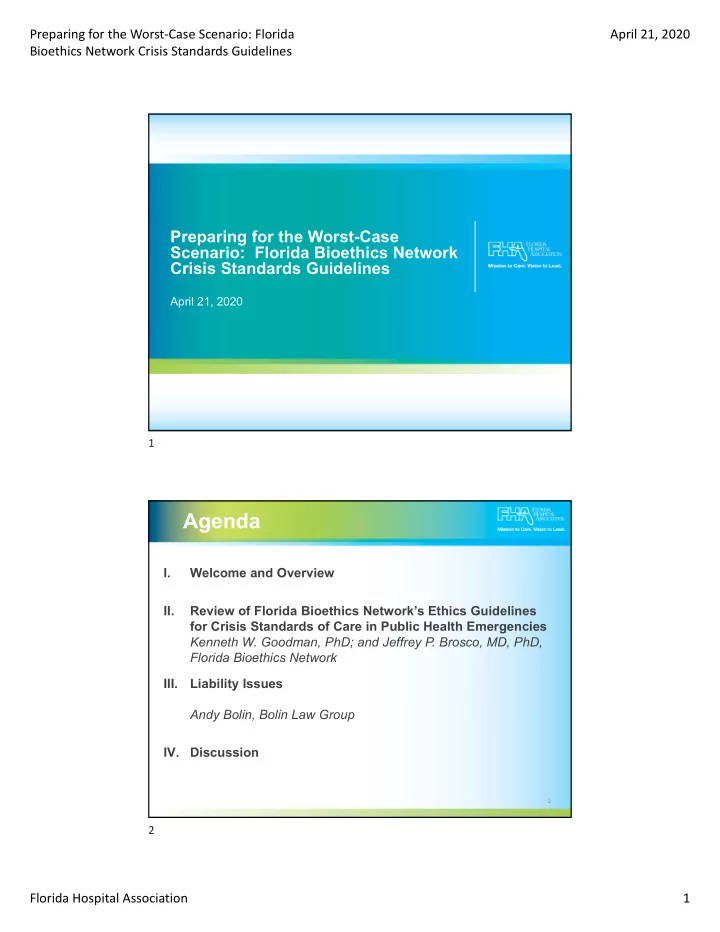
Agenda I. Welcome and Overview II. Review of Florida Bioethics - - PDF document

agenda
SMART_READER_LITE
LIVE PREVIEW

Agenda I. Welcome and Overview II. Review of Florida Bioethics - - PDF document

Preparing for the Worst Case Scenario: Florida April 21, 2020 Bioethics Network Crisis Standards Guidelines Preparing for the Worst-Case Scenario: Florida Bioethics Network Crisis Standards Guidelines April 21, 2020 1 Agenda I. Welcome


slide-1
SLIDE 1

Preparing for the Worst‐Case Scenario: Florida Bioethics Network Crisis Standards Guidelines April 21, 2020 Florida Hospital Association 1

Preparing for the Worst-Case Scenario: Florida Bioethics Network Crisis Standards Guidelines

April 21, 2020

Agenda

I. Welcome and Overview II. Review of Florida Bioethics Network’s Ethics Guidelines for Crisis Standards of Care in Public Health Emergencies Kenneth W. Goodman, PhD; and Jeffrey P. Brosco, MD, PhD, Florida Bioethics Network III. Liability Issues Andy Bolin, Bolin Law Group IV. Discussion

2

1 2

slide-2
SLIDE 2

Preparing for the Worst‐Case Scenario: Florida Bioethics Network Crisis Standards Guidelines April 21, 2020 Florida Hospital Association 2

3

500 1,000 1,500 2,000 2,500

3/26 3/27 3/28 3/29 3/30 3/31 4/1 4/2 4/3 4/4 4/5 4/6 4/7 4/8 4/9 4/10 4/11 4/12 4/13 4/14 4/15 4/16 4/17 4/18 4/19 4/20

Patients

COVID‐19 Impact on Florida Hospitals

COVID Patients COVID Pts in ICU COVID Pts on Vents

States with Crisis Standards of Care

  • Arizona
  • California
  • Colorado
  • Illinois
  • Kansas
  • Kentucky

Adopted March 31, 2020

  • Louisiana
  • Michigan
  • Minnesota
  • Nevada
  • New Mexico
  • New York
  • Oregon
  • Pennsylvania
  • Utah
  • Vermont
  • Virginia
  • Washington

4

3 4

slide-3
SLIDE 3

Preparing for the Worst‐Case Scenario: Florida Bioethics Network Crisis Standards Guidelines April 21, 2020 Florida Hospital Association 3

Background: Crisis Standards in Florida

  • Completed in 2011 but not formally

approved or adopted.

  • Included many of the same components

that are incorporated in the other state plans reviewed.

  • The adoption of a statewide crisis

standard of care plan is important to:

 Ensure inter-institutional consistency  Enable advanced training of clinical staff  Support a standard methodology for clinical decision making  Provide an ethical foundation for crisis standards  Preserve health care worker’s well being

5

Associated Industries of Florida Community Health Systems Florida Bioethics Network Florida Chamber of Commerce Florida College of Emergency Physicians Florida Justice Reform Institute Florida Nurse Practitioners Network Florida Society for Respiratory Care Florida Society of Anesthesiologists Florida Society for Healthcare Risk Management

6

Support for Ethics Guidelines

5 6

slide-4
SLIDE 4

Preparing for the Worst‐Case Scenario: Florida Bioethics Network Crisis Standards Guidelines April 21, 2020 Florida Hospital Association 4

Proposed Liability Protections

1. Time Limited. Expires on October 1, 2020, unless further extended. The time limitation ensures that the effect of the executive order does not extend beyond the time period necessary to address the COVID-19 crisis. 2. Limited in Scope. Does not apply to willful misconduct by a health care provider. 3. Protects providers who follow standards of care. Health care providers who provide care and treatment consistent with standards of care, specifically developed for use in a crisis (discussed further, below), are provided temporary and limited immunity from civil liability and criminal prosecution. 4. Protects providers who comply with EO 20-72. Protection is provided to health care providers who in good faith endeavor to make decisions that will comply your Executive Order 20-72. 5. Extends immunity afforded to “Good Samaritans”. Immunity already afforded to “Good Samaritans” is extended to health care providers who would not otherwise have that immunity because they are compensated for their services or they otherwise do not meet requirements of Section 768.13, Florida Statutes, which are ordinarily appropriate but are not appropriate during a crisis.

7 8

Florida Bioethics Network Ethics Guidelines for Crisis Standards of Care in Public Health Emergencies

Kenneth Goodman, PhD; and Jeffrey Brosco, MD, PhD Florida Bioethics Network 7 8

slide-5
SLIDE 5

Preparing for the Worst‐Case Scenario: Florida Bioethics Network Crisis Standards Guidelines April 21, 2020 Florida Hospital Association 5

Florida Bioethics Network

  • Established in 1990 at University of Florida, now

based at University of Miami

  • Leaders in ethical issues related to public health,

clinical practice and biomedical research

  • Composed of physicians, ethicists, nurses, health

care attorneys, social workers and clergy

9

Framework

  • Updated April 2020
  • Strengthens protections

for disabled patients

  • Ethically optimized care
  • Deactivation of the triage
  • Prioritization status

10

9 10

slide-6
SLIDE 6

Preparing for the Worst‐Case Scenario: Florida Bioethics Network Crisis Standards Guidelines April 21, 2020 Florida Hospital Association 6

Principles and Values

  • Fairness
  • “Duty to treat”
  • No duty to provide treatment if not beneficial, not

effective or contrary to clinical judgment

  • Not on a “first-come, first served”
  • Ineffective intervention is not quality care
  • Guidelines for clinician decision-making
  • Palliative care

11

Examples of Care Standards

Medical or Hospital Standard Alternative Direct or face-to-face clinician-patient interaction Telehealth interaction Mechanical ventilation with a particular device Ventilation with another kind of device, e.g., use of a transport ventilator when the standard is an intensive- care ventilator. In cases of device shortages, triage might be necessary to allocate available tools. One ventilator for each patient Use of ventilator to support more than one patient Each patient in a bed in a standard hospital room Patients in beds placed in other venues Critically ill patients in critical care units Critical care patients in other units refitted to extent possible Cardio-pulmonary resuscitation No CPR Extracorporeal membrane oxygenation No ECMO First-come, first-served access to treatment and resources Triage standard of saving as many lives as possible 12

11 12

slide-7
SLIDE 7

Preparing for the Worst‐Case Scenario: Florida Bioethics Network Crisis Standards Guidelines April 21, 2020 Florida Hospital Association 7

Framework

  • Triage Evidence Support Teams
  • Review Process
  • Ethics Committees
  • Ventilator Allocation and Re-allocation

Guidelines

  • Evidence-based, objective criteria for patient

triage

  • Support for health care workers

13

Ventilator Allocation and Re-Allocation Guidelines

  • Resource Triage Protocol

– Triggers for ventilator triage – Activation of ventilator triage – Mortality risk assessment and triage – Triage Evidence Review Team to monitor evolving situation and support clinicians

14

13 14

slide-8
SLIDE 8

Preparing for the Worst‐Case Scenario: Florida Bioethics Network Crisis Standards Guidelines April 21, 2020 Florida Hospital Association 8

Triage Scoring

15 16

15 16

slide-9
SLIDE 9

Preparing for the Worst‐Case Scenario: Florida Bioethics Network Crisis Standards Guidelines April 21, 2020 Florida Hospital Association 9

Legal and Liability Issues

Andy Bolin, Bolin Law Group

Crisis Standard of Care Adoption

  • 1. Adopts a community standard
  • Provides better protections than having no standard in place
  • Prevents patchwork of standards by systems that may be used

against each other

  • Lessons Learned from H1N1 pandemic
  • 2. Reduces arguments of alleged bias against protected

classes

  • 3. Supports clinicians by better defining the standard of care

as opposed to making those decisions in the midst of a crisis.

  • 4. Prevents delays in decision making

18

17 18

slide-10
SLIDE 10

Preparing for the Worst‐Case Scenario: Florida Bioethics Network Crisis Standards Guidelines April 21, 2020 Florida Hospital Association 10

Lawsuit Concerns Following Covid-19 Crisis

1. Not having guidelines that anticipated the need for crisis standards of care. 2. Not having guidelines that anticipated a critical shortage of medical equipment or supplies. 3. Not treating patients who allegedly were injured or expired because resources were directed towards other patients that likely would not survive 4. Placing liability concerns ahead of patient welfare 5. Placing liability concerns ahead of sound, evidence-based decision making

19

Lawsuit Concerns Following Covid-19 Crisis

1. Delay of testing or other elective procedures that the Plaintiff will later claim should not have been considered "elective." 2. Testing delays or division making 3. Discharging known or presumed positive patients to treat mild symptoms 4. Failure of hospitals to insure adequate staffing (claims against hospital v. provider) OR relaxed standards for privileges or credentialing. 5. Failing to repeatedly test/take temps of providers caring for patients 6. MANY providers are posting things on social media during this

  • time. Be aware of privacy violations related to photos and posts

and also the optics of these videos.

20

19 20

slide-11
SLIDE 11

Preparing for the Worst‐Case Scenario: Florida Bioethics Network Crisis Standards Guidelines April 21, 2020 Florida Hospital Association 11

Current Florida Law Does Not Address this Crisis

  • 1. Current protections for “good Samaritans” or other

emergency situations do not cover decision making during this time.

  • 2. Protections related to advanced directive decision

making do not apply.

  • 3. HHS Declaration provides protections for use of

“countermeasures” only and not broader protections for all care and treatment.

21

Documentation

  • 1. Documenting decision making will be especially

important

  • 2. Likewise, document awareness of any guidelines in

place

  • 3. Give thought to documenting the inability to consult

with proxies or other caregivers during a crisis situation

22

21 22

slide-12
SLIDE 12

Preparing for the Worst‐Case Scenario: Florida Bioethics Network Crisis Standards Guidelines April 21, 2020 Florida Hospital Association 12

Discussion

Preparing for the Worst-Case Scenario: Florida Bioethics Network Crisis Standards Guidelines

April 21, 2020 23 24