Agenda Sep temb e r 10 th 2020 Kicko ff Meeti ng Anti-trust - - PDF document

agenda
SMART_READER_LITE
LIVE PREVIEW

Agenda Sep temb e r 10 th 2020 Kicko ff Meeti ng Anti-trust - - PDF document

9/10/2020 TMA-AVS-01 Scoring Standards Committee Alarm Validation Scoring Kickoff Presentation Mar k M cC all S t a n l e y S e c u r i t y, C h a i r David Holl L o w e r A l l e n To w n s h i p , C o - C h a i r Lar r y Fo lsom I -


slide-1
SLIDE 1

9/10/2020 1

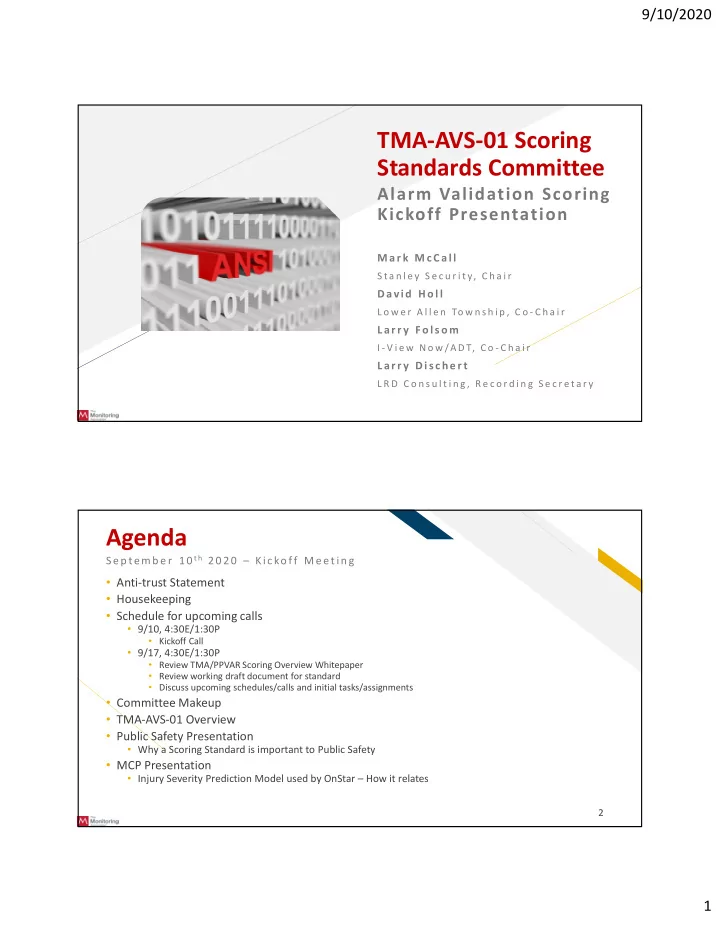
TMA-AVS-01 Scoring Standards Committee

Alarm Validation Scoring Kickoff Presentation

Mar k M cC all

S t a n l e y S e c u r i t y, C h a i r

David Holl

L o w e r A l l e n To w n s h i p , C o - C h a i r

Lar r y Fo lsom

I - V i e w N o w /A D T, C o - C h a i r

Lar r y Disc he rt

L R D C o n s u l t i n g , R e c o r d i n g S e c r e t a r y

Sep temb e r 10 th 2020 – Kicko ff Meeti ng

  • Anti-trust Statement
  • Housekeeping
  • Schedule for upcoming calls
  • 9/10, 4:30E/1:30P
  • Kickoff Call
  • 9/17, 4:30E/1:30P
  • Review TMA/PPVAR Scoring Overview Whitepaper
  • Review working draft document for standard
  • Discuss upcoming schedules/calls and initial tasks/assignments
  • Committee Makeup
  • TMA-AVS-01 Overview
  • Public Safety Presentation
  • Why a Scoring Standard is important to Public Safety
  • MCP Presentation
  • Injury Severity Prediction Model used by OnStar – How it relates

2

Agenda

slide-2
SLIDE 2

9/10/2020 2

Sep temb e r 10 th 2020 – Kicko ff Meeti ng

3

Housekeeping

TMA-AVS-01 Kickoff

Committee Makeup

Al ar m Ind ustry Member Na me a nd A ffi l i at io n s

Name Company Name Company

Anita Ostrowski Vector Security, Inc. Morgan Hertel Rapid Response Monitoring Anthony Iannone Affiliated Monitoring Noe Avalos G4S Secure Integration Anthony Sharpy Guardian Alarm Sean Githens Redwire Chris Newhook American Alarm and Communications, Inc. Shane M. Clary, Ph.D. Bay Alarm Company JoeAllen Gentry Washington Alarm Inc Stan Martin SIAC Joey Rao-Russell Kimberlite Steve Butkovich CPI Security Systems Larry Robert Dischert LRD Consulting-JCI/Tyco Suzie Nye AvantGuard Monitoring Center Lucinda Guerrero Bay Alarm Company Teresa Gonzalez Lydia Security Monitoring, Inc. dba: COPS & UCC Mark E McCall (Chair) Stanley Security Thomas Nakatani ADT

4

slide-3
SLIDE 3

9/10/2020 3

Committee Makeup

Ma nu fac tu re / S o ft wa re / S e r vi ce Pro vider s Member N ame a nd A ffil ia t io n s

Name Company Name Company

Alison Chase Alarm.com Randall Gellens Core Technology Consulting Bob Finocchioli Evolon Rick Denos MAS Chris Brown Immix Ryan Fouts RapidDeploy John Romanowich SightLogix Sascha Kylau OneTel Jon Adams Digital Monitoring Products Stephen Aponte Resideo Technologies, Inc. Kevin Stadler Evolon Technology Stephen Tapper Immix Software (Formerly SureView Systems) Larry Folsom (Co-Chair) I-View Now Thom Meyer Bold Group Mark Skeen JCI/Qolsys Tim Tracy Resideo Technologies, Inc.

5

Committee Makeup

Pu bl ic Sa fety Memb er N ame a nd Affi li a t ion s

Name Company Name Company

Andy King City of Franklin Fire Department Nicola Tidey Mission Critical Partners, Inc. David Holl (Co-Chair) Lower Allen Dept of Public Safety Kirk MacDowell MacGuard Security Advisors Inc Frank Fernandez Miami Police (Ret.) Reserve Officer Sam Bauder Intrado Jay English APCO Steve Schmit UL LLC Michael Brown National Sheriffs Association Tony Dunsworth City of Alexandria

6

NRTL a nd S pecia lty E xper ts Member Na me a nd A ffili at i o n s

slide-4
SLIDE 4

9/10/2020 4

Alarm Activated Alarm Signal Sent to Monitoring Center* Alarm Received by the Monitoring Center Alarm Processed by Monitoring Center Software Monitoring Center Agent Receives and Processes the Alarm

Standard Monitoring Center Workflow

Agent Calls Responsible Parties Monitoring Center Agent calls the ECC admin line to report the alarm

Monitoring Center PSAP

TMA-AVS-01 Overview

OnStar Model

TMA-AVS-01 Overview

Advanced Automatic Collision Notification (AACN) to ECC/PSAP Workflow AACN-equipped vehicle voice comms VEDS Telematics Service Provider (TSP) call center 911 Emergency Communications Center (ECC) voice comms ONLY

  • Upon crash, vehicle initiates a wireless call to the TSP, transmits VEDS data
  • TSP assesses the situation, predicts injury severity, notifies 911 by phone
  • TSP operator verbally transmits select data to the 911 call taker
  • 911 continues caller interrogation, uses CAD to dispatch responders
slide-5
SLIDE 5

9/10/2020 5 Potential Data Sources

TMA-AVS-01 Overview

Weather heard, thunder, etc. Breaking or destruction Voices heard Elevated conversation heard No audio Audio of activity (walking, doors, etc.) Occupants phones not on site Occupants phone on site at alarm Other phones (keyholder list) on site at alarm GPS shows occupants not home GPS show occupants at home Event initiated Event confirmed Other end user/customer input

Personal Data Audio Data

Twitter, Nextdoor, etc. (social media) feeds with key word RSS feeds, utility companies, etc. PD alerts, broadcasts live Crime reports Crime index for location Customer specific/environmental Predictive analytics, fire equipment fails Floor plans Facial recognition, friend seen Facial recognition, foe seen Facial recognition, no match Voice match, friend Voice match foe Voice match unknown

Biometric Data Other Data Source

Weather harsh Weather good Interior temperature normal Interior temperature high/low CO level high CO level normal Power outage

Environmental Data

Any burglar alarm Multiple trips same zone Multiple trips different zone Recent closing/opening Perimeter alarm Interior alarm Perimeter, followed by Int Glass break Smoke alarm Schedule exceptions Abort/cancel Time of event People seen People have weapons People have burglary tools Vehicles seen, recognized or not License Plate Readers, unknown plate People remaining, loitering Vandalized property Severe weather seen Smoke/Fire

Panel Data Video Data

Adding Alarm Event Scoring to Alarm Agent Workflow

TMA-AVS-01 Overview

Monitoring Platform Data Elements Additional Data Source Examples

1.

Interactive service platforms

2.

End user interactive Notifications

3.

Video

4.

Data / video analytic sources

5.

IoT platforms

6.

There are many potential data sources

Agent transmits the alarm event score during the course of the dispatch process

Monitoring Center

ECC call taker receives the score as part of the alarm processing Additional Data Sources Monitoring Platform Data Source Examples

1.

Alarm zones

2.

Account schedule

3.

Account history

4.

Account responsible parties

5.

Account address

PSAP

Alarm Event Scoring Using the TMA Standard the available alarm event data elements are scored and an alarm event confidence score is calculated by and / or is made available to the monitoring center agent Alarm Activated

slide-6
SLIDE 6

9/10/2020 6 Threat Level Determination

TMA-AVS-01 Overview

For illustration purposes only Standards committee to define terminology, Scoring metric methodology, actual number of event assessment levels , etc.

TMA-AVS-01 Scoring Standards Committee

Public Safety

Why a Scoring Standard is important to Public Safety

David Holl

L o w e r A l l e n D e p t o f P u b l i c S a fe t y J a y E n g l i s h A P C O ( A s s o c i a t i o n o f P u b l i c - S a f e t y C o m m u n i c a t i o n s O f f i c i a l s ) F ra n k F e r n a n d e z

Mia mi Po lice (Ret .) Reser ve Offic er

slide-7
SLIDE 7

9/10/2020 7

Dave Holl

Background in Brief

  • Life safety for owners and occupants – Both

commercial and residential

  • Officer Safety Enhanced – Prearrival Info
  • Situational Awareness - Ongoing Updates
  • Response Intel - Verified and Validated
  • Response Logistics
  • Enhanced Apprehension Potential

WHY this standard is critical!

Public Safety

slide-8
SLIDE 8

9/10/2020 8

FR

Yamaha Burglary – Real Case Study

  • Call Received by Alarm Company (Unknown time)
  • Alarm Company notifies Emergency Communications Center (ECC) (0320 hrs.)
  • ECC dispatched to police as general nonspecific alarm – no additional information

provided (0327 hrs.)

  • Police arrive and find no vehicles on premise with front door glass shattered (0332 hrs.)
  • Video on premise hard drive storage only – not transmitted/streamed to Alarm

Company

  • Owner arrives on premise and officers view video from back office - officer realizes…
  • While responding, she passed the white car and pick up with trailer not realizing it was

the suspects leaving the burglary scene

  • Suspect vehicles freely leave area southbound on Interstate 83 to Baltimore
  • Motorcycles never recovered, no one arrested, and burglary never solved

Yamaha Burglary – 9 motorcycles removed in 00:02:50

slide-9
SLIDE 9

9/10/2020 9

FR

Yamaha Burglary – Replay with standards-based protocols

  • Call Received by Alarm Company (Unknown time)
  • Alarm Company notifies ECC of active video verified burglary (High score: Threat to

Property) (0320 hrs.)

  • ECC dispatches alarm to police with standards-based protocols by 0321 hrs.
  • Advising of the white car and pickup pulling a trailer involved and leaving scene.
  • While responding, police officer passes the white car and pick up with trailer observed

at the scene and leaving by the alarm company.

  • Officer does a U-turn, requests backup for a felony stop of suspect vehicles.
  • Additional officers respond to scene and physically verify business entry and thefts.
  • Motorcycles all recovered, perpetrators arrested, and burglary solved.
  • Alarm company, ECC, and police officers working together in a collaborative partnership!

Jay English

Background in Brief

slide-10
SLIDE 10

9/10/2020 10

FR

  • Dispatched Standard Code-2 call, two units.
  • Time was some time after midnight.
  • Secondary unit arrives at same time as primary.
  • On arrival ECC advised units on scene and will be checking the front door and advise the address appears to be a gun store,

not a pawn store.

  • Before the officers get very far from their cars, dispatch advises to stand by.
  • The ECC has re-contacted the alarm company who confirms this is a gun store, and that this gun store also deals in

high- powered weapons.

  • The ECC has now now received information from the alarm company that it appears to be an interior trip, not an exterior
  • trip. Almost immediately, the ECC advises officers that they are now being told that there are multiple interior trips and that

they are to stand by and “do not approach”.

  • As the officers are standing by, dispatch initiates the alert tones (we referred to them as the hot tones) and sounds three loud

beeps on the radio.

  • They then advise the entire sector that 4-Adam 81 and 4-Adam 83 are on scene of a gun store burglary in progress, and that

the alarm company is indicating that the suspects have breached the inner perimeter of the high-powered, and semi automatic weapons vault, and the alarm company is stating there is also a ceiling sensor “trip”, and the suspects may be in the ceiling of the multi-unit shopping center the gun store is located in.

  • We are ordered to quad off the entire shopping center and wait for additional units.

Audible Alarm, perimeter sensor tripped, pawn store

FR

High Risk Pawn Store Burglary

  • This is just an example of how a standardize approach to alarms will

help the alarm companies ask the right questions, and make the right determination as to what type of call and situation they are relaying to ECCs.

  • Also, how ECCs can do the same in asking the right questions of the

alarm companies, based on this standardized, prioritized approach being proposed by the working group.

  • Standardization, uniform interrogation based on it, and a clear

understating of what the priority levels mean, on both sides of this equation, will result in better information to responders, hopefully BEFORE they arrive on scene, and will enhance both situational awareness and officer safety.

slide-11
SLIDE 11

9/10/2020 11

FR

Problem to be Solved

  • There is not a Standard on how the myriad of Alarm Companies across the nation

provide information to the Emergency Communication Centers (ECCs) regarding alarm information and severity of alarms received.

  • An alarm is not just an alarm. It has many intricacies and complexities, which can

mean life or death to occupants and to responding officers.

  • Standard protocols that can be implemented to provide timely information to

responding officers is ESSENTIAL!

  • Standards that can be trained and implemented in alarm company central stations

and ECCs and police academies across the country are critical!

  • Public Safety is in need of this, and has been, for many, many years.
  • We have the opportunity to create a new paradigm and public-private

PARTNERSHIP!

COMMENTS Frank Fernandez & Bob Finney III Chief of Police & ECC Director

Backgrounds Brief

slide-12
SLIDE 12

9/10/2020 12

TMA-AVS-01 Scoring Standards Committee

N ic o la C. Tidey, RPL , EN P Co mmun i cat io n co nsu lta nt

A s a f o r m e r E C C / P S A P D i r e c t o r 2 0 y e a r s v o l u n t e e r i n g a s a f i r e f i g h t e r / E M T M a j o r c o n t r i b u t o r t o A P C O s t a n d a r d s , c h a i r i n g v a r i o u s s t a n d a r d s d e v e l o p m e n t c o m m i t t e e s a s w e l l a s b e i n g a t r a i n e d o c c u p a t i o n a l a n d p r o c e s s f a c i l i t a t o r .

24

If you are severely injured, care at a Level I trauma center lowers the risk of death by 25%

slide-13
SLIDE 13

9/10/2020 13

25

Improving Car Crash Outcomes

Advanced Automatic Collision Notification (AACN)

  • Vehicle Emergency Data Set (VEDS)
  • Primary data elements:
  • Delta V (maximum change in velocity)
  • Principal direction of force (PDOF)
  • Seatbelt usage (potential ejection)
  • Crash with multiple impacts
  • Rollover status
  • Vehicle type / description / location

26

Using Data to Effect Response

AACN provides foundation for decision schemes:

  • Computer aided dispatch (CAD) incident type

code

  • Incident location / responder agencies
  • Quantity and types of first responder resources

to dispatch (basic / advanced life support, heavy rescue, air ambulance, etc.)

  • Local and regional field triage protocols
  • Hospital transport destination (trauma center
  • vs. non-trauma center)
slide-14
SLIDE 14

9/10/2020 14

27

Predicting Injury Severity

A decade of data from National Automotive Sampling System Crashworthiness Data System (NASS CDS) used to create and validate the Injury Severity Prediction algorithm Examples: Criteria Data Delta V 12 MPH Seatbelts In Use Multiple Impacts NO Rollover NO Injury Severity NORMAL Criteria Data Delta V 35 MPH Seatbelts Not in use Multiple Impacts YES Rollover YES Injury Severity HIGH

slide-15
SLIDE 15

9/10/2020 15

29

AACN to PSAP Workflow (Today)

  • Upon crash, vehicle initiates a wireless call to the TSP, transmits VEDS data
  • TSP assesses the situation, predicts injury severity, notifies 911 by phone
  • TSP operator verbally transmits select data to the 911 calltaker
  • 911 continues caller interrogation, uses CAD to dispatch responders

AACN-equipped vehicle voice comms VEDS Telematics Service Provider (TSP) call center 911 Emergency Communications Center (ECC) voice comms ONLY

30

AACN to PSAP Workflow (Next Generation 911)

  • Upon crash, vehicle initiates a wireless call to the TSP, transmits VEDS data
  • TSP assesses the situation, predicts injury severity, notifies 911 electronically
  • VEDS data is automatically shared with 911 (potentially bypassing the TSP)
  • 911 continues caller interrogation, uses CAD to dispatch responders
  • VEDS data is shared electronically with responders

AACN-equipped vehicle voice comms VEDS Telematics Service Provider (TSP) call center 911 Emergency Communications Center (ECC) voice comms data / VEDS voice and VEDS

slide-16
SLIDE 16

9/10/2020 16

31

Alarm Industry Opportunity

  • Use predictive analytics to establish, validate,

and constantly improve a scoring model for alarm data

Criteria Data Temp Sensor 140° F Video Fire visible Multiple Alarms 3 interior Location Commercial Status VERIFIED Criteria Data Temp Sensor 76° F Video Nothing seen Multiple Alarms NO Location Residential Status Low Priority

32

ASAP to PSAP Workflow (Next Generation 911)

  • Upon alarm activation, alarm data is transmitted to alarm monitoring center
  • Alarm company verifies alarm, notifies 911 electronically using ASAP-to-PSAP
  • Alarm data with high priority verification score is automatically entered into CAD

and responders are dispatched with high priority

  • Alarm data affecting verification score is shared electronically w/ responders

fire alarm system alarm data alarm subscriber monitoring center 911 Emergency Communications Center (ECC) alarm data via ASAP

slide-17
SLIDE 17

9/10/2020 17

Sep temb e r 10 th 2020 – Kicko ff Meeti ng

  • September 17th, 4:30PM Est/1:30PM Pst
  • Deep Dive into TMA/PPVAR Scoring Overview Whitepaper
  • Review working draft document for standard
  • Discuss upcoming schedules/calls and initial tasks/assignments

33

Q&A and Next Call