Agenda Introductions Definitions Using Direct Mail Effectively as - - PDF document

agenda
SMART_READER_LITE
LIVE PREVIEW

Agenda Introductions Definitions Using Direct Mail Effectively as - - PDF document

9/8/2016 Agenda Introductions Definitions Using Direct Mail Effectively as Context A Key to Sustainability Recruitment Systems Using Direct Mail to Recruit Members David Allen, Development for Conservation Metrics Pam


slide-1
SLIDE 1

9/8/2016 1

Using Direct Mail Effectively as

A Key to Sustainability

David Allen, Development for Conservation Pam Geary, Western Pennsylvania Conservancy September 2016

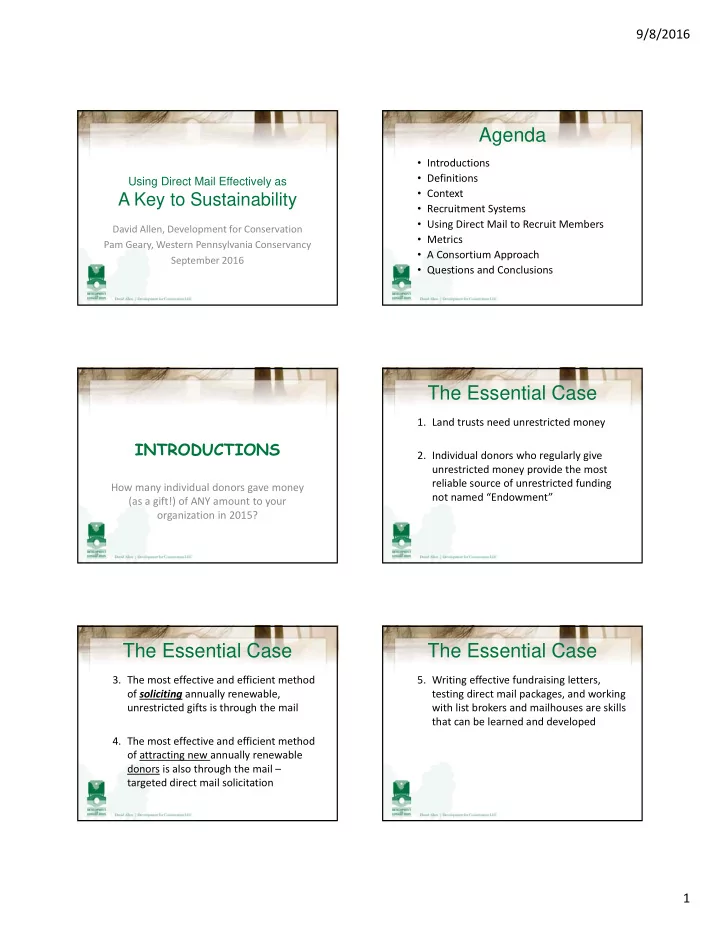
Agenda

  • Introductions
  • Definitions
  • Context
  • Recruitment Systems
  • Using Direct Mail to Recruit Members
  • Metrics
  • A Consortium Approach
  • Questions and Conclusions

INTRODUCTIONS

How many individual donors gave money (as a gift!) of ANY amount to your

  • rganization in 2015?

The Essential Case

  • 1. Land trusts need unrestricted money
  • 2. Individual donors who regularly give

unrestricted money provide the most reliable source of unrestricted funding not named “Endowment”

The Essential Case

  • 3. The most effective and efficient method
  • f soliciting annually renewable,

unrestricted gifts is through the mail

  • 4. The most effective and efficient method
  • f attracting new annually renewable

donors is also through the mail – targeted direct mail solicitation

The Essential Case

  • 5. Writing effective fundraising letters,

testing direct mail packages, and working with list brokers and mailhouses are skills that can be learned and developed

slide-2
SLIDE 2

9/8/2016 2

Context

  • By “members” we mean:

Donors whose annual (or more often) gifts are both expected and unrestricted

  • Membership (renewal) money is the

easiest money to raise and the hardest to screw up

Context

  • Year 0

12,000 Prospects (Letters)

  • Year 1

100 New Members

  • Year 2

45 First Year Renewals

  • Year 10

15‐25 Remain

Context

  • So…..

– Recruitment mail rarely breaks even – You raise money from people who already give you money – from renewals

Context

WHY Do You Want Members?

Strategic Planning

Mission Strategy (Direction, Activities) Plans (Measurable in Time & Scope) Budget Fundraising Goal Strategy (Direction, Activities) Plans (Measurable in Time & Donors) Budget

Total expenses less $$ from other revenue sources.

Planning

Imagine that your Strategic Plan requires you to increase annual funding by 50-100% within the next 5 years. What would you do?

slide-3
SLIDE 3

9/8/2016 3

Planning

How do you recruit new donors now?

  • Direct Mail
  • Email
  • Social Media
  • On‐Line – People find us
  • Table/Booth
  • Member‐get‐a member campaigns
  • Gift Memberships
  • Door‐to‐door
  • Other?

Direct Mail

Pros

  • Predictable
  • Individuals tend to renew in

response to the same media in which they were recruited

  • Well‐studied and understood
  • Scalable

Cons

  • Expensive
  • Intimidating and not intuitive
  • No experience
  • Waste of resources
  • Unseemly

MECHANICS – The Process

Lists

  • List of your current donors
  • House list
  • Lists you trade for
  • Lists you purchase (rent)

What the Broker does

  • Research lists that might be available
  • Suggest lists that you might consider
  • Negotiate terms with list sellers

What the Mailhouse does

  • NCOA scrubbing
  • Current member and DONOTMAIL

scrubbing

  • Merge/Purge
  • Coded List and Second List
slide-4
SLIDE 4

9/8/2016 4

What the Mailhouse does

  • Merges the Name/Address data into the

letter and envelope files

  • Seals the envelopes
  • Sorts the mail for the post office to get

the lowest available postage

MECHAN MECHANICS ICS – – The Letter he Letter

Rule #1

If you’re not testing, you’re not learning.

Testing

  • A/B Tests – make sure everything else is

held constant

  • Code the response cards
  • Make sure each test group is

demographically identical

Rule #2

The secret to good writing is in the editing.

Editing

  • Every number in your draft letter is
  • suspect. Take ‘em out.
  • Use the we/us/our filter: do these

pronouns include the reader?

slide-5
SLIDE 5

9/8/2016 5

Editing

  • Use the Flesch‐Kincaid reading ease tool

and write letters at the 6th grade level (OK, maybe 8th)

  • Is there an ask on each page? Is the ask

clear and obvious?

Rule #3

Don’t tell me, SHOW me.

Tell a Story

  • Stories convey emotion
  • Stories stimulate the imagination
  • Stories move us to action
  • Make it a story about one person
  • Make it first person
  • Make the donor the hero

Rule #4

Technique matters.

(Don’t trust yourself and don’t trust your donors when it comes to technique.)

Useful Techniques

  • Write longer letters
  • Include a PS Note
  • Communicate urgency
  • Tell a story, or several
  • Be corny, be obvious
  • Clearly ask for a specific amount of money

Rule #5

Design for older, female eyes.

slide-6
SLIDE 6

9/8/2016 6

Design

  • 13 pt type
  • 1.15 pt line spacing
  • Double space between paragraphs
  • 1.25 inch margins
  • Serif font
  • High contrast paper
  • Minimal graphics; no print over graphics

Rule #6

Have a Call to Action. Make it urgent. Make it specific. BARRIERS

WHY AREN’T WE ALL DOING THIS?

Metrics

How much I like Vanity Graphics TIME

Measuring Your Results

Keep track of:

  • Where donors come from (Sourcecode)
  • How much they give, cumulatively, each

year (I use January 9 – January 8)

  • How much it cost to recruit them and how

much it costs to “serve” them each year

slide-7
SLIDE 7

9/8/2016 7

Derivative Information

  • # individual donors who give (any

amount) of money each year

  • Renewal rate
  • Cost to raise one dollar
  • Cost to recruit one member
  • Net present value
  • Comparative information by source
  • Comparative information by year

Net Present Value

  • NPV is the value of each member over time.
  • NPV is the sum of all of their gifts (x) minus

the cost of maintaining their membership (initial mailing costs, renewal mailing costs, newsletters, benefits, premiums, and so on) (y), divided by the number of recruited members (N)

  • (x‐y)/N

Net Present Value

For Example

  • Say you mail 12,000 letters for $8,500 to get

100 new members

  • Say they give you $40 each on average =

$4,000

  • First year’s worth of newsletters, event

invitations, and renewal notices cost $2,000, and

  • 45 renew at $80 = $3,600
  • 2‐year NPV = ($7,600‐10,500)/100 = ‐$29

Net Present Value

For Example

  • 3‐year NPV = $12
  • 5‐year NPV = $109
  • 10‐year NPV = $800+

Net Present Value

For Example

  • Say you mail 12,000 letters for $8,500 to get

100 new members

  • Say they give you $40 each on average =

$4,000

  • First year’s worth of newsletters event

invitations and renewal notices cost $2,000, and

  • 45 renew at $80 = $3,600
  • 2‐year NPV = ($7,600‐10,500)/100 = ‐$29

The Importance of the 2nd Gift

First Year Renewals (Second Gifts)

  • Direct Mail = 40‐45%
  • They find you & mail a check = 40‐45%
  • They find you on‐line = 35‐40%
  • Project Appeals = 25‐30 %
  • Social Media/Email = 15‐20%
  • Special Events = 15‐20%
  • Gift Memberships = 5‐10%
  • Tabling = 5‐10%
slide-8
SLIDE 8

9/8/2016 8

HUH?

THANK YOU!

Services

Assessment, Planning, Training, Coaching

You can raise more money for your organization – I can help.

fundraisinghelp@sbcglobal.net

608/239‐5006

slide-9
SLIDE 9

DAVID ALLEN

I am a non-profit organizational development consultant. I work with organization boards to help their members learn how to be better leaders and advocates. My background includes 30 years working in membership fundraising, major donor development, communications, and marketing. I worked for about half that time for Nature Conservancy (TNC) chapters in Oregon, Texas, and Wisconsin. In addition to my duties for the individual chapters, I served TNC as an internal fundraising consultant and major donor development trainer. In 2000, served as the vice-president of

  • perations for the Wisconsin-based,

international conservation organization Sand County Foundation, a position I held through mid-2009. Gathering Waters Conservancy, a land trust service agency based in Wisconsin, called me in 2002 to ask whether I would be interested in teaching a seminar for Wisconsin land trusts on major donor development. From 2002, then, through 2009, I consulted on a nights and weekends basis with just a few clients each year. In March of 2009, I launched my consulting business full-time using the name Development for Conservation. Also in 2009, I partnered with Peter McKeever and Nancy Moore to form Conservation Consulting Group. Together we help land trusts prepare for accreditation by providing assessment, planning, and leadership coaching services. I consider myself a strategic thinker, problem solver, facilitator, educator, and program developer who brings a particular passion for conservation and the environment. Practice Competencies Fundraising Organizational Development

  • Development Audit
  • Strategy Development
  • Staff/Board Training and Development
  • Practice & Process Assessment
  • Major Gift Coaching
  • Problem Solving Facilitation
  • Capital Campaigns
  • Marketing
slide-10
SLIDE 10

David Allen Development for Conservation

fundraisinghelp@sbcglobal.net 608-239-5006 608 West Dean Avenue Monona, WI 53716

www.developmentforconservation.com