Agenda International Standard Setting for Financial Reporting - - PDF document

agenda international standard setting for financial
SMART_READER_LITE
LIVE PREVIEW

Agenda International Standard Setting for Financial Reporting - - PDF document

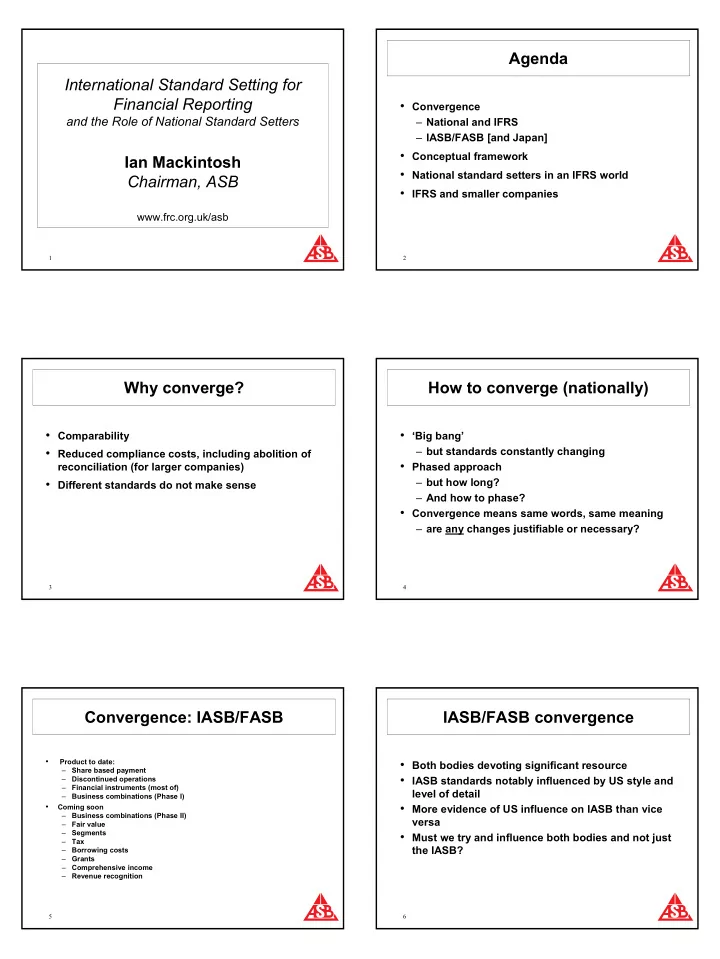
Agenda International Standard Setting for Financial Reporting Convergence and the Role of National Standard Setters National and IFRS IASB/FASB [and Japan] Conceptual framework Ian Mackintosh National standard setters in an


slide-1
SLIDE 1

1

International Standard Setting for Financial Reporting

and the Role of National Standard Setters

Ian Mackintosh Chairman, ASB

www.frc.org.uk/asb

2

Agenda

  • Convergence

– National and IFRS – IASB/FASB [and Japan]

  • Conceptual framework
  • National standard setters in an IFRS world
  • IFRS and smaller companies

3

Why converge?

  • Comparability
  • Reduced compliance costs, including abolition of

reconciliation (for larger companies)

  • Different standards do not make sense

4

How to converge (nationally)

  • ‘Big bang’

– but standards constantly changing

  • Phased approach

– but how long? – And how to phase?

  • Convergence means same words, same meaning

– are any changes justifiable or necessary?

5

Convergence: IASB/FASB

  • Product to date:

– Share based payment – Discontinued operations – Financial instruments (most of) – Business combinations (Phase I)

  • Coming soon

– Business combinations (Phase II) – Fair value – Segments – Tax – Borrowing costs – Grants – Comprehensive income – Revenue recognition

6

IASB/FASB convergence

  • Both bodies devoting significant resource
  • IASB standards notably influenced by US style and

level of detail

  • More evidence of US influence on IASB than vice

versa

  • Must we try and influence both bodies and not just

the IASB?

slide-2
SLIDE 2

7

Conceptual framework

  • Fundamental importance
  • Fresh work is overdue
  • Frameworks are incomplete:

– Measurement – Presentation

Convergence!

8

Conceptual framework: two camps

Important Not very important Transactions Imperfect Perfect Markets Not meaningful Meaningful Comprehensive income Cost (but not nec historical) ‘Fair value’ Measurement basis’ Reliability Relevance Primary qualitative characteristic Historic Forward looking Perspective of financial statements Assist decisions by portraying financial performance and position Make buy/sell/hold decisions Future cash flows Objective of financial statements

9

Conceptual framework

  • This is a summary and a caricature
  • No-one knows all the right answers
  • Debate tends to be polarised—thoughtful people will

do better!

10

Conceptual framework : Particular Matters

  • Objectives
  • Users
  • Qualitative Characteristics
  • Due Process
  • User Needs in Different Types of Entities
  • Standard Setters/Preparers

11

National standard setters in an IFRS world

  • Communication

– With constituents – With IASB and FASB – With other standard setters (and EFRAG)

  • Interpretations
  • Thought leadership
  • ‘Domestic issues’ (including smaller companies and

public benefit sector)

12

National standard setters : Working Together

  • NSS
  • WSS
  • Europe
slide-3
SLIDE 3

13

IFRS and smaller companies

  • IFRS focus needs of investors in large, listed

companies—especially international companies

  • Costs of preparation may be too great for smaller

companies

  • User needs may be different
  • IASB SME project still at an early stage—few specific

proposals

  • Can smaller companies wait?
  • May have a major effect on national convergence

14

International Standard Setting for Financial Reporting

and the Role of National Standard Setters

Ian Mackintosh Chairman, ASB

www.frc.org.uk/asb