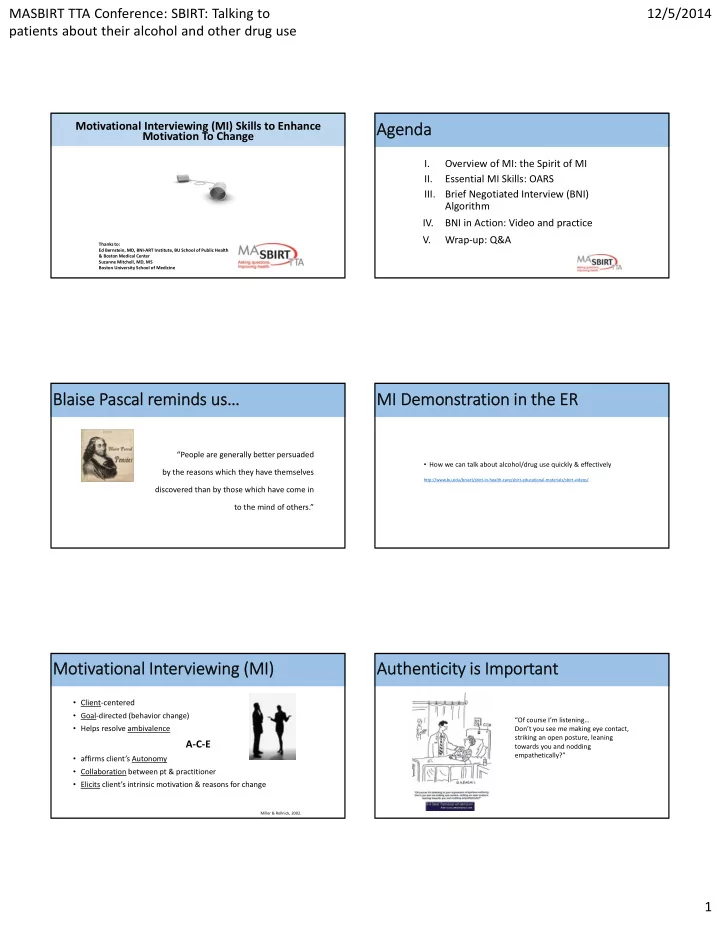
Agenda Ag enda Motivation To Change I. Overview of MI: the Spirit - - PDF document

agenda ag enda
SMART_READER_LITE
LIVE PREVIEW

Agenda Ag enda Motivation To Change I. Overview of MI: the Spirit - - PDF document

MASBIRT TTA Conference: SBIRT: Talking to 12/5/2014 patients about their alcohol and other drug use Motivational Interviewing (MI) Skills to Enhance Agenda Ag enda Motivation To Change I. Overview of MI: the Spirit of MI II. Essential MI


slide-1
SLIDE 1

MASBIRT TTA Conference: SBIRT: Talking to patients about their alcohol and other drug use 12/5/2014 1

Thanks to: Ed Bernstein, MD, BNI‐ART Institute, BU School of Public Health & Boston Medical Center Suzanne Mitchell, MD, MS Boston University School of Medicine

Motivational Interviewing (MI) Skills to Enhance Motivation To Change

Ag Agenda enda

I. Overview of MI: the Spirit of MI II. Essential MI Skills: OARS III. Brief Negotiated Interview (BNI) Algorithm IV. BNI in Action: Video and practice V. Wrap‐up: Q&A

“People are generally better persuaded by the reasons which they have themselves discovered than by those which have come in to the mind of others.”

Bl Blaise aise Pa Pascal re reminds us… us…

  • How we can talk about alcohol/drug use quickly & effectively

http://www.bu.edu/bniart/sbirt‐in‐health‐care/sbirt‐educational‐materials/sbirt‐videos/

MI MI De Demons monstration in in the the ER ER

  • Client‐centered
  • Goal‐directed (behavior change)
  • Helps resolve ambivalence

A‐C‐E

  • affirms client’s Autonomy
  • Collaboration between pt & practitioner
  • Elicits client’s intrinsic motivation & reasons for change

Miller & Rollnick, 2002.

Mo Motivational In Interv rvie iewing (M (MI) I) Authen Authenticity ticity is is Im Important

“Of course I’m listening… Don’t you see me making eye contact, striking an open posture, leaning towards you and nodding empathetically?”

slide-2
SLIDE 2

MASBIRT TTA Conference: SBIRT: Talking to patients about their alcohol and other drug use 12/5/2014 2

Mo Motivati tiona

  • nal In

Interv rviewing

Motivational Interviewing was developed from the rather simple notion that the way clients are spoken to about changing addictive behavior affects their willingness to talk freely about why and how they might change.

Stephen Rollnick, PhD Addiction 2001; 96:1769‐70.

Mo Motivational In Interv rvie iewing (M (MI) I)

  • assumes motivation is fluid and can be

influenced in the context of a relationship

  • Principle task: to guide conversation towards

eliciting motivation for change

  • Goal: to influence change in the direction of

health

Mo Motivational In Interv rvie iewing (M (MI) I)

Ambivalence is normal to the change process Asking permission can decrease defensiveness and increase patients being more open The patient is the active decision‐maker Reflective listening is key to helping a patient consider change

A Fe Few MI MI Pr Principles

  • 1. Express empathy
  • 2. Resolve ambivalence
  • 3. Avoid arguments
  • 4. Support self‐efficacy
  • 5. Roll with resistance

Fi Five Gener General Pr Principles of

  • f MI

MI

......NOT

Mo Motivational In Interv rvie iewing (M (MI) I)

slide-3
SLIDE 3

MASBIRT TTA Conference: SBIRT: Talking to patients about their alcohol and other drug use 12/5/2014 3

O = open‐ended questions A = affirm R = reflection S = summarize

The The Skills Skills: “OA “OARS”

OPEN

  • What worries you most about

your current situation?

  • What changes have you noticed?
  • How so?
  • How important is your health to

you?

CLOSED

  • Are you worried about

your current situation?

  • Have you noticed

changes?

  • Do you care

about your health?

Open Open Ques Questions tions

Statements and gestures that recognize strengths and acknowledge behaviors that lead in the direction of positive change

  • I am really impressed with the way you….
  • That’s great how you’ve reached your goal of cutting back on

your drug use.

  • Using protection shows that you have real respect for

yourself and your partners.

  • Be genuine and specific
  • Only say it when you really mean it.

Af Affirm rmations ns

The process of reflective listening involves hearing what the client says and

simple reflection: either repeating or paraphrasing back to the client or… complex reflection: reflecting the feeling you believe is behind what the client says.

Refle flections

Ty Types of

  • f Re

Reflections

“I have been to treatment six times. Nothing is going to work for

  • me. I just can’t stop drinking.”
  • Simple Reflection:
  • “You’ve been to treatment before and it hasn’t worked.”
  • Complex Reflection:
  • “You’ve tried to quit drinking in the past and it hasn’t worked. You’re

wondering if it’s going to be different this time.”

Ty Types of

  • f Refle

flections

  • Divide into pairs. One person starts as the Speaker; the other as the

Listener/reflector. Switch roles after completing the exercise.

  • Speaker: Choose a statement about yourself‐
  • I don’t like conflict

….or

  • I have a sense of humor

….or

  • I let things bother me more than they should

….or

  • I am loyal

…or

  • One thing I like about myself is that I…” (not on handout)
  • Listener offers a reflection of what the speaker might mean
  • Speaker tells the Listener whether the reflection is accurate after each

reflection

  • After the Listener/Reflector has offered 4‐5 reflections, switch roles. New

Speaker chooses a different statement.

Re Reflective Li Listening ening Ex Exer ercise cise

slide-4
SLIDE 4

MASBIRT TTA Conference: SBIRT: Talking to patients about their alcohol and other drug use 12/5/2014 4

Captures both sides of the ambivalence (…AND…)

“On one hand, you think everyone is over reacting and on the other hand you can understand why your family is so upset.”

Doubl Double‐si sided ded Re Reflection

“I’m not sure what I’ll do. I really like drinking, but it’s becoming a hassle now.”

MI skill – Double Sided Reflection

Pr Practice:

Re Reflecting

  • I’ve been depressed lately. I keep trying things other than

drinking to help myself feel better, but nothing seems to work

  • ther than having a couple of drinks.
  • In spite of the lack of success, you keep looking for ways to feel better

besides drinking.

  • You’ve been feeling down
  • Drinking works in the short term
  • You’d be happy to find something other than drinking to work.

Re Reflecting Summ Summariz arize: e:

  • Hypothesize with client:

“Let’s see if I have this right…”

“Here’s what I heard. Tell me if I missed anything…” “Anything you want to add or change?”

  • Highlight statements indicating motivation to

change

  • Accomplishes 2 goals:
  • Communicates to patient that you are genuinely

interested in what s/he is saying

  • Gives yourself a chance to get the facts straight!

The Art of Active Listening. (2005). National Aging Information & Referral Support Center, Washington D.C.

  • Take some time to think about a

difficult change that you had to make in your life.

  • How much time did it take you to

move from considering that change to actually taking action.

Activity Activity: Re Reflection

A collaborative conversation about health promotion (Shared agenda)

  • Clients as experts in their lives
  • Listening, not telling
  • Practicing silence
  • Active listening skills

Client Voice and Choice

Bri Brief Ne Nego goti tiated ated In Interview

slide-5
SLIDE 5

MASBIRT TTA Conference: SBIRT: Talking to patients about their alcohol and other drug use 12/5/2014 5

Silence

  • Allow for comfortable silences to give person time to think and

talk

  • Slows conversation; no one feels rushed

Body language cues

  • Eye contact, head nodding, empathic facial expressions
  • Body opened (no crossed arms), turned towards person

The Art of Active Listening. (2005). National Aging Information & Referral Support Center, Washington D.C.

Acti Active Li Listening ening Str Strategies gies

  • 1. Build Rapport
  • 2. Pros & Cons
  • 3. Feedback/Information
  • 4. Readiness Ruler / Confidence Ruler
  • 5. Action Plan

Br Brie ief Negotia Negotiated ed In Interv rview (B (BNI) Al Algorith gorithm: 5 St Step eps

Would you mind taking a few minutes to talk about your [X] use? Before we go further, I’d like to learn a little more about you. What is a typical day like for you? Where does your [X] use fit in? Ask permission Day in the life Substance use

St Step ep 1: 1: Build ild Rapport Rapport

St Step ep 2: 2: Pro Pros & Cons Cons

Help me understand through your eyes the good things about using [X]? What are some of the not so good things about using [X]? So, on the one hand you said [PROS], and on the other hand [CONS].

Pros

  • “good things”
  • “things it does for you”
  • “things you like about it”

Cons

  • “not so good things”
  • “things you don’t like as much”
  • “the downsides, or drawbacks”

Summary

St Step ep 1: 1: Pr Pros & Cons Cons

St Step ep 3: 3: Feedback edback & In Information

I have some information on [X] use—would you mind if I shared it with you? We know that drinking / using… [insert alcohol / drug information here] …can put you at risk for illness and injury. It can also cause health problems like… [insert relevant health issues here]. What are your thoughts on that?

Ask permission Provide information Ask for thoughts

St Step ep 3: 3: Feedback eedback & In Informatio ion

Given what you mentioned, on a 1‐10 scale, with one being not ready/important at all and 10 being completely ready/important to make any change about your use of X, where would you put yourself? You marked ___. That’s great. That means you’re ___% ready to make a change. Why did you choose that number and not a lower number, like a 1 or 2? What would it take to go from 4 to 7?

Ruler Affirmation

  • Reinforce positives

Lower number

St Step ep 4: 4: Readi adiness/Im ess/Import portance ance Rul Ruler

slide-6
SLIDE 6

MASBIRT TTA Conference: SBIRT: Talking to patients about their alcohol and other drug use 12/5/2014 6

  • On that 1-10 scale, how confident are you

that you could ……..?

  • How come you are a ___ and not a ___?

What would it take to go from __ to __?

Confidence Confidence Rul Ruler

St Step ep 5: 5: Ac Action tion Pl Plan an

What are some options/steps that will work for you? What do you think you can do to stay healthy and safe? What will help you to reduce the things you don’t like about using [X]? Tell me about a time when you overcame challenges in the past. What kinds of resources did you call upon then? Which of those are available to you now?

Create action plan

  • Ask client for ideas first

Identify strengths & supports

St Step ep 5: 5: Acti Action

  • n Pl

Plan an

Affirm ideas Ask permission Write down action plan Summary of action steps / ideas

  • Those are great ideas! Is it okay for me to

write down your plan, your own prescription for change, to keep with you as a reminder?

  • Will you summarize the steps you will take

to change your [X] use?

  • I’ve written down your plan, a prescription

for change, to keep with you as a reminder.

St Step ep 4: 4: Readi adiness/Im ess/Import portance ance Rul Ruler

Seal the Deal

  • Suggest other services that

might be useful

  • Make an “active referral”

Thank client

Give referrals if appropriate: Thank you for sharing with me today.

St Step ep 5: 5: Acti Action

  • n Pl

Plan an (con

  • ntinued)

tinued)

  • Patients are more likely to change their

drinking behavior when they are involved in goal setting.

  • The drinking goal is negotiated between the

patient and clinician and may be presented in writing as a prescription or as a contract signed by the patient.

Es Establis lishin hing a Dr Drinking ng Goal Goal

www.MASBIRT.org Video

  • follow‐up visit to see PCP following ER visit several days ago,

due to fall in kitchen after drinking, hit head

  • husband recently retired
  • increased drinking: 1‐2 glasses of wine/night, more on w/e’s
  • hx of cutting back when sons were in the house
  • hypertension

Vi Video deo De Demons monstration

slide-7
SLIDE 7

MASBIRT TTA Conference: SBIRT: Talking to patients about their alcohol and other drug use 12/5/2014 7

  • Not to eliminate resistance,

but to minimize it.

  • Less resistance more likely to change
  • Turn a wrestling match into a dance

What What is is the the goa goal?

  • 1. Patient: be as “real” as you can; don’t be mute
  • r refuse to answer any questions
  • 2. Practitioner: take a risk. Try something you

might not ordinarily say

  • 3. Observer /Coach: note what goes well as well

as opportunities for improvement. Help the provider, if s/he gets stuck

Pr Practicing the the BNI BNI

Brie Brief Neg Negotiated In Interv rvie iew

TASK Suggested Script

Introduction: Get to know the pt. Thanks for answering all of those questions. In order to get to you know better, would you tell me what a typical day is like for you?

Explore PROS & CONS Develop discrepancy

“I’d like to know more about your use of [X]. Help me to understand what you enjoy about using [X]?” “Now tell me what you enjoy less about [X] or regret about your use.” “So, on the one hand you say you enjoy [X] because… and on the other hand you said….Where does this leave you?” Summarize negative consequences

Feedback / Safety risks

“Are you aware of health/safety concerns related to using X?” If YES: “What do you think about it in terms of your own use?” If NO: indicate any general medical problems associated with unhealthy substance use

Explore readiness to change & confidence to change

On a 1-10 scale: “How ready are you to change your use of X?” “Why did you choose X and not a lower number?” “If you were to make a change, how confident are you that you would be successful?” “What needs to happen to help you feel more confident?” “How have you made changes in the past?” 1 2 3 4 5 6 7 8 9 10

Negotiate goal/plan Seal the deal

“Where do you go from here?” “What can you do to stay healthy & safe?” “What challenges can you anticipate/imagine?” Adapted from BNI‐ART Institute,@ BU.edu and The Yale Brief Negotiated Interview Manual. D’Onofrio, et al. New Haven CT: Yale Univ. School

  • f Med. 2005
  • Motivational interviewing is an evidence‐based, non‐

confrontational approach to behavior change counseling.

  • Empathic partnership is essential. (OARS)
  • Meet the patient where he/she is at.
  • Elicit Change Talk
  • Roll with Resistance, Avoid Argumentation

Summ Summary ary Thank Thank yo you!