Agenda 9 th User Group meeting in Brussels* 21/11/2018 12:30 16:00 - - PowerPoint PPT Presentation

agenda 9 th user group meeting in brussels 21 11 2018 12
SMART_READER_LITE
LIVE PREVIEW

Agenda 9 th User Group meeting in Brussels* 21/11/2018 12:30 16:00 - - PowerPoint PPT Presentation

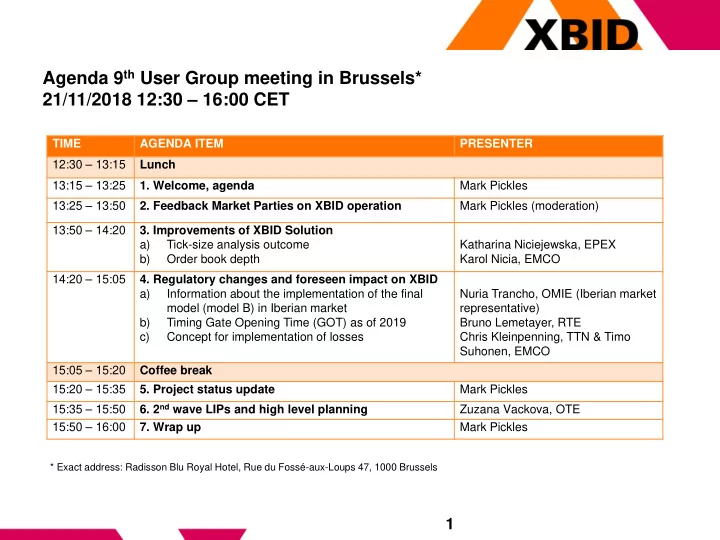
Agenda 9 th User Group meeting in Brussels* 21/11/2018 12:30 16:00 CET TIME AGENDA ITEM PRESENTER 12:30 13:15 Lunch 13:15 13:25 1. Welcome, agenda Mark Pickles 13:25 13:50 2. Feedback Market Parties on XBID operation Mark


slide-1
SLIDE 1

Agenda 9th User Group meeting in Brussels* 21/11/2018 12:30 – 16:00 CET

1

TIME AGENDA ITEM PRESENTER 12:30 – 13:15 Lunch 13:15 – 13:25

  • 1. Welcome, agenda

Mark Pickles 13:25 – 13:50

  • 2. Feedback Market Parties on XBID operation

Mark Pickles (moderation) 13:50 – 14:20

  • 3. Improvements of XBID Solution

a) Tick-size analysis outcome b) Order book depth Katharina Niciejewska, EPEX Karol Nicia, EMCO 14:20 – 15:05

  • 4. Regulatory changes and foreseen impact on XBID

a) Information about the implementation of the final model (model B) in Iberian market b) Timing Gate Opening Time (GOT) as of 2019 c) Concept for implementation of losses Nuria Trancho, OMIE (Iberian market representative) Bruno Lemetayer, RTE Chris Kleinpenning, TTN & Timo Suhonen, EMCO 15:05 – 15:20 Coffee break 15:20 – 15:35

  • 5. Project status update

Mark Pickles 15:35 – 15:50

  • 6. 2nd wave LIPs and high level planning

Zuzana Vackova, OTE 15:50 – 16:00

  • 7. Wrap up

Mark Pickles

* Exact address: Radisson Blu Royal Hotel, Rue du Fossé-aux-Loups 47, 1000 Brussels

slide-2
SLIDE 2

Agenda 13:25 – 13:50

  • 1. Welcome, agenda
  • 2. Feedback Market Parties on XBID operation –

Mark Pickles

  • 3. Improvements of XBID Solution
  • 4. Regulatory changes and foreseen impact on XBID
  • 5. Project status update
  • 6. 2nd wave LIPs and high level planning
  • 7. Wrap up

2

slide-3
SLIDE 3
  • 2. Feedback Market Parties on XBID operation

General Overview

3

  • XBID went live on 12th June with first deliveries on 13th June
  • The project parties consider Go-live as a significant success with all 1st go-live

parties/ Local Implementation Projects (LIPs) able to operate as planned

  • XBID has been stable since go-live
  • Average trading volumes show growth from Go-Live to a new high of 1.4 million

trades in the month of October 2018

  • Some minor incidents have occurred (as expected) but these have been

managed/ resolved without significant impacts in the market

  • Project Parties are focussing on 2nd wave go-live (planned for summer 2019) and

the future development of the XBID solution.

  • Analysis is also underway on performance improvements which are expected to

result in developments to build on the successful 1st go-live

  • OPSCOM – the body that monitors operational activities - is fully established. A

fundamental revision of the current organisational structure was implemented in September 2018 to reflect the move from project to operational/development status

  • IDSC recognised that XBID is running with stability and therefore, in line with

IDOA, the rollback systems were not kept available after XBID had been running for more than 2 months (communicated by a press release on 6th September)

slide-4
SLIDE 4
  • 2. Feedback Market Parties on XBID operation

Development orders and trades since XBID go-live

4

5.000 10.000 15.000 20.000 25.000 30.000 35.000 40.000 45.000 50.000 100.000 200.000 300.000 400.000 500.000 600.000 700.000 800.000

Orders: Daily total

Orders Order transactions Trades

Trades: daily total

Term Description Definitions and computation details Orders Total daily number of Orders (incl. Block Orders) and total daily number

  • f Order Transactions (including

Block Order Transactions) per given day.

  • Order is defined as order entry.
  • Order Transaction - means the Order entry (including activation of new iceberg slice), Order

modification (including Order activation and deactivation) and Order deletion (excluding Order deletions due to contract expiration); partial matches as well as full Order executions are not to be considered as Order Transaction. Events triggered by or during MA/DA halt, Market Halt, Suspend user, activation of dispute state are not counted as Order Transaction; Trades Total daily number of Trades (incl. Block Trades) per given day as well as hourly number per given hour. Daily Trades - means the Transactions concluded after the matching of two (2) Orders within one (1) Trading Day;

slide-5
SLIDE 5
  • 2. Feedback Market Parties on XBID operation

Development block orders and trades since XBID go-live

5

Term Description Definitions and computation details Block orders Total daily number of Block

  • rders and total daily number of

Block Order Transactions per given day.

  • Block Order is defined as order entry placed on the Block Contract.
  • Block Order Transaction means order entry, order modification (including order activation and

deactivation) and order deletion (excluding order deletions due to contract expiration) for a Block

  • Contract. Full and partial executions are not considered as Block Order Transaction; Events

triggered or during MA/DA halt, Market Halt, Suspend user, activation of dispute state are not considered as Block Order Transaction; Block trades Total daily number of Block Trades per given day as well as hourly number per given hour. Daily Block Trades means the Transactions concluded after the matching of two (2) Block Orders within one (1) Trading Day;

50 100 150 200 250 300 350 400 450 500 2.000 4.000 6.000 8.000 10.000 12.000 Block trade: Daily total Block orders: Daily total Block orders Block order transactions Block trades

slide-6
SLIDE 6
  • 2. Feedback Market Parties on XBID operation

Development of explicit allocations since XBID go-live

6

Term Description Definitions and computation details Explicit capacity allocation requests (EARs) Total daily number of Explicit capacity allocation requests per given day as well as hourly number per given hour. EARs are basically any requests which are non-implicit, i.e. not coming from the SOB:

  • Allocation request made by an Explicit Participant (or TSO Admin acting on its behalf) via the GUI (entering the

values in the fields)

  • Special kind of such allocation requests are Balancing Mechanism and GenOutage

− Allocation request made by an Explicit Participant (or TSO Admin acting on its behalf) via the GUI by uploading an allocation request file (BG request file or BID file)

  • Special kind of such allocation requests are Balancing Mechanism and GenOutage

− Allocation request made by an Explicit Participant (or TSO Admin acting on its behalf) via API – AllocationReq − Submitting a valid CAS/CBS file (via a communication channel) which adheres to an existing file transfer configuration Explicit capacity allocation Total daily number of Explicit capacity allocation requests per given day as well as hourly number per given hour. Explicit Allocations (EAs) are EARs which are granted, i.e. successfully carried out. Allocations from CAS/CBS files are specific kind of allocations counted as EAs.

50 100 150 200 250 300 350 5000 10000 15000 20000 25000 EA requests: Daily total EA: Daily total EA EA requests

slide-7
SLIDE 7

Agenda 13:50 – 14:05

  • 1. Welcome, agenda
  • 2. Feedback Market Parties on XBID operation
  • 3. Improvements of XBID Solution

a) Tick-size analysis outcome - Katharina Niciejewska b) Order book depth – Karol Nicia

  • 4. Regulatory changes and foreseen impact on XBID
  • 5. Project status update
  • 6. 2nd wave LIPs and high level planning
  • 7. Wrap up

7

slide-8
SLIDE 8

3.a) Tick-size analysis outcome Tick size of submitted orders – history/description

8

  • Background:

− Following Member Associations letter received in H1 2018 by XBID project, the Commission took following decision during a meeting in April 2018: “XBID will undertake an interim assessment by mid-August to see if there are any significant detrimental impacts of the tick size on the single intraday

  • market. In this case, the concerned NEMOs will take the necessary
  • perational measures to mitigate those negative impacts”.

− As a consequence, project parties were assigned AP to analyze impact of the price tick on the operation of XBID and share the results of the elaboration with the market parties − NEMOs performed an analysis based on first month of operations

  • The analysis executed on the data for the 1st operational month shows that

majority of the monitored parameters are within the agreed systems boundaries though some measured parameters were breached and are subject of further analysis (e.g. Order transaction peak load)

  • None of the breaches identified during analysis indicated an immediate

need for proposing to change the tick size

slide-9
SLIDE 9

3.a) Tick-size analysis outcome Tick size of submitted orders – next steps

9

  • As highlighted previously the XBID platform proved to run very smoothly over

the last months. At the same time the averaged daily number of submitted

  • rders has been increased by a factor > 2 between June and September
  • 2018. Some of the contractual boundaries are breached.
  • NEMOS and TSOs are still investing massively to guarantee good level of

performance.

  • Please note that there is an ongoing activity under the umbrella of ACER

which focuses on the harmonization of various market parameters. Tick size is one of the parameters which may be considered as a part of this process.

slide-10
SLIDE 10

Agenda 14:05 – 14:20

  • 1. Welcome, agenda
  • 2. Feedback Market Parties on XBID operation
  • 3. Improvements of XBID Solution

a) Tick-size analysis outcome - Katharina Niciejewska b) Order book depth – Karol Nicia

  • 4. Regulatory changes and foreseen impact on XBID
  • 5. Project status update
  • 6. 2nd wave LIPs and high level planning
  • 7. Wrap up

10

slide-11
SLIDE 11

3.b) Order book depth limitations relaxation – history/description

11

  • Before the XBID BGL 30th May DBAG was requested to analyse possible removal of
  • rderbook depth (OBD) visibility limitations
  • Supplier results from performed analysis on orderbook depth and SLAs validity,

connected to extra hardware purchase for these tests, pointed out that the full removal is not possible, however considerable ‘relaxation’ can be done

  • Possible implementation of order book depth limitation relaxation would be connected

to additional investment

  • Summary table:

Products Current order book depth limitations Proposed relaxation of order book depth limitations* All products but blocks Max OBD 31 if ≥ sum of 600 MW Max OBD up to 100 orders All products but blocks Max OBD up to 50 orders, ≤ sum of 600 MW Block products Max OBD up to 2 block orders Max OBD / contract length rounded down (reflecting limit of 100), Examples:

  • 2-hour block =>Max OBD is 50 orders
  • 10-hour block =>Max OBD is 10 orders
  • 24-hour block =>Max OBD is 4 orders

* Parameters specified in the Proposed relaxation of order book depth limitations are subject of the implementation and XBID performance retest.

slide-12
SLIDE 12

3.b) Order book depth limitations relaxation Feedback from Market Participants

12

XBID project parties would appreciate feedback from Market participants if the results from analysis on order book depth relaxation meet Market participants expectations.

slide-13
SLIDE 13

Agenda 14:20 – 14:25

  • 1. Welcome, agenda
  • 2. Feedback Market Parties on XBID operation
  • 3. Improvements of XBID Solution
  • 4. Regulatory changes and foreseen impact on XBID

a) Information about the implementation of the final model (model B) in Iberian market – Nuria Trancho b) Timing Gate Opening Time (GOT) as of 2019 – Bruno Lemetayer c) Concept for implementation of losses - Chris Kleinpenning & Timo Suhonen

  • 5. Project status update
  • 6. 2nd wave LIPs and high level planning
  • 7. Wrap up

13

slide-14
SLIDE 14

4.a) Information requested in the previous UG about the implementation of the Enduring Iberian Hybrid Model

14 1. Iberian NRA’s requested from:

  • REE and REN as Iberian System Operators,
  • OMIE as Iberian Market Operator,

the updating of the current Iberian Hybrid Model, defined in the Iberian Market Rules approved in May 2018, from the initial interim solution (implemented at the date of the XBID Go-live), to an enduring and final solution before the end of November, 2018. 2. REE, REN and OMIE have been working in the implementation of this enduring hybrid model. 3. OMIE has imparted three webinar sessions, in order to keep Market Participants informed and updated about the new features and characteristics of the model. 4. During the first three weeks of November (starting on November the 7th till November the 23rd) it is possible for the Iberian Market Participants to join the testing phase and experience the upcoming model. 5. The Go-live date of the new and enduring Iberian Model will take place next 27th of November (as it is stipulated in the current Iberian Market Rules).

slide-15
SLIDE 15

Agenda 14:25 – 14:35

  • 1. Welcome, agenda
  • 2. Feedback Market Parties on XBID operation
  • 3. Improvements of XBID Solution
  • 4. Regulatory changes and foreseen impact on XBID

a) Information about the implementation of the final model (model B) in Iberian market – Nuria Trancho b) Timing Gate Opening Time (GOT) as of 2019 – Bruno Lemetayer c) Concept for implementation of losses - Chris Kleinpenning & Timo Suhonen

  • 5. Project status update
  • 6. 2nd wave LIPs and high level planning
  • 7. Wrap up

15

slide-16
SLIDE 16

4.b) Timing Gate Opening Time (GOT) as of 2019

  • A. Background

16

  • ACER’s decision of April 2018 defines IDCZGOT as 15:00 D-1 from

01.01.2019 onwards − Deadline postponed until 30 days after approval of intraday capacity calculation methodology for CCRs where such approval isn’t made before 30.11.2018

  • Effective implementation is managed on each relevant border
  • XBID project is providing MPs with a detailed overview on GOT timings for

borders in operation − Effective GOT in place as of 01.01.2019 and application of ACER’s decision − Corresponding capacity available, especially for borders where no cross- border capacity can be published at Effective GOT

slide-17
SLIDE 17

4.b) Timing Gate Opening Time (GOT) as of 2019

  • B. Details / Baltic CCR

17

Bidding zone border Effective GOT as of 01.01.2019 Cross-border capacities published at Effective GOT Point in time cross-border capacity is made available after Effective GOT EE-FI 15:00, D-1 CET Calculated cross-border capacity N/A EE-LV 15:00, D-1 CET Calculated cross-border capacity N/A LT-SE4 15:00, D-1 CET As soon as possible after Effective GOT LV-LT 15:00, D-1 CET Calculated cross-border capacity N/A

  • Baltic CCR’s intraday capacity calculation methodology has been approved
slide-18
SLIDE 18

4.b) Timing Gate Opening Time (GOT) as of 2019

  • B. Details / Core CCR

18

Bidding zone border Effective GOT as of 01.01.2019 Cross-border capacities published at Effective GOT Point in time cross- border capacity is made available after Effective GOT DE-NL 15:00 CET, D-1 (*) 22:00 CET, D-1 (**) FR-BE 15:00 CET, D-1 (*) 22:00 CET, D-1 (**) BE-NL 15:00 CET, D-1 (*) 22:00 CET, D-1 (**) DE-FR 15:00 CET, D-1 (*) 22:00 CET, D-1 (**) DE-AT 15:00 CET, D-1 (*) 22:00 CET, D-1 (**) Notes (*) Implementation date will be 30 days after NRAs’ approval (**) At the latest

  • Core CCR’s intraday capacity calculation methodology is currently under

approval (ACER decision not expected before mid-February 2019)

slide-19
SLIDE 19

4.b) Timing Gate Opening Time (GOT) as of 2019

  • B. Details / Hansa CCR

19

Bidding zone border Effective GOT as of 01.01.2019 Cross-border capacities published at Effective GOT Point in time cross-border capacity is made available after Effective GOT DE-DK1 15:00, D-1 CET (*) 18:00 CET (**) DE-DK2 15:00, D-1 CET (*) 18:00 CET (**) NO2-NL 15:00, D-1 CET 18:00 CET (***) Notes (*) Implementation date will be 30 days after NRAs’ approval (**) Approximate timing (***) At the latest

  • Hansa CCR’s intraday capacity calculation methodology is currently under

approval (NRAs’ decision not expected before mid-December 2018)

slide-20
SLIDE 20

4.b) Timing Gate Opening Time (GOT) as of 2019

  • B. Details / Nordic CCR

20

Bidding zone border Effective GOT as of 01.01.2019 Cross-border capacities published at Effective GOT Point in time cross- border capacity is made available after Effective GOT

DK1-DK2, DK1-NO2, DK1-SE3, DK2-SE4

15:00, D-1 CET (*) Calculated cross-border capacity N/A

FI-SE1, FI-SE3

15:00, D-1 CET Calculated cross-border capacity N/A

NO1-NO2, NO1-NO3, NO1-NO5, NO1-SE3, NO2-NO5, NO3-NO5, NO3-SE2, NO4-SE1, NO3-SE4, NO4SE2, SE1-SE2, SE2-SE3, SE3-SE4

15:00, D-1 CET Calculated cross-border capacity N/A

NO3-NO4

15:00, D-1 CET 18:00 CET (**) Notes (*) Already in place today (**) At the latest

  • Nordic CCR’s intraday capacity calculation methodology has been approved
slide-21
SLIDE 21

4.b) Timing Gate Opening Time (GOT) as of 2019

  • B. Details / SWE CCR

21

Bidding zone border Effective GOT as of 01.01.2019 Cross-border capacities published at Effective GOT Point in time cross-border capacity is made available after Effective GOT FR-ES 15:00, D-1 CET (*) Under NRAs’ assessment Under NRAs’ assessment ES-PT 15:00, D-1 CET (*) Calculated cross-border capacity N/A Notes (*) Implementation date under NRAs’ assessment

  • SWE CCR’s intraday capacity calculation methodology has been approved
slide-22
SLIDE 22

Agenda 14:35 – 15:05

  • 1. Welcome, agenda
  • 2. Feedback Market Parties on XBID operation
  • 3. Improvements of XBID Solution
  • 4. Regulatory changes and foreseen impact on XBID

a) Information about the implementation of the final model (model B) in Iberian market – Nuria Trancho b) Timing Gate Opening Time (GOT) as of 2019 – Bruno Lemetayer c) Concept for implementation of losses - Chris Kleinpenning & Timo Suhonen

  • 5. Project status update
  • 6. 2nd wave LIPs and high level planning
  • 7. Wrap up

22

slide-23
SLIDE 23

Agenda 14:35-15:05

I. Introduction

  • II. Losses on HVDC interconnectors
  • III. Implicit losses in DA Market Coupling
  • IV. Implicit losses in XBID
  • V. BACK-UP: NRAs questions and NEMOs/TSOs

answers

23

slide-24
SLIDE 24
  • I. Introduction

24

  • In 2012-13 a consultancy study was carried out to analyse the effects of implement

losses for the DA timeframe. The conclusion was a net welfare gain by implement loss factors on DC interconnectors

  • NWE price coupling started in Feb 2014
  • NRAs raised several questions to TSOs. One of these was related to only have

losses in DA and not in ID trade.

  • The reply from TSOs and NEMOs was:

− "As a conclusion: in the worst case a positive day ahead welfare effect from inclusion of a loss factor can be reduced by intraday trade if the intraday trading mechanism does not take the loss factor into account but it cannot lead to a negative net welfare effect over both markets. For the worst case to occur the DC interconnector which was not used to "carry" DA flow, must be completely utilized for ID trade."

  • By introducing losses in ID the risk of losing the benefit from having losses in DA

allocation disappears

slide-25
SLIDE 25

Agenda 14:35-15:05

I. Introduction

  • II. Losses on HVDC-interconnectors
  • III. Implicit losses in DA Market Coupling
  • IV. Implicit losses in XBID
  • V. BACK-UP: NRAs questions and NEMOs/TSOs

answers

25

slide-26
SLIDE 26
  • II. Losses on HVDC-interconnectors (1)

26

  • Actual losses are a combination of converter losses (transport independent losses) and cable

losses (transport dependent losses).

slide-27
SLIDE 27
  • II. Losses on HVDC-interconnectors (2)

27

  • Implicit Market Losses are a linear approach of the polynomial
slide-28
SLIDE 28
  • The linear approach of Implicit Market losses only partly covers the actual losses
  • II. Losses on HVDC-interconnectors (3)

28

slide-29
SLIDE 29
  • II. Losses on HVDC-interconnectors (4)

29

  • The Implicit Market Losses create a difference between the allocated capacity at sending end and

the allocated capacity at receiving of the interconnector.

slide-30
SLIDE 30
  • II. Losses on HVDC-interconnectors (5)

30

  • Several options to handle losses on HVDC-interconnectors:

− Point of control at receiving end (pulling the energy into an area)

  • Schedule at receiving end must take in account losses, so the market cannot utilize full

capacity

  • Losses are to be compensated by the TSO at sending end as far as not taken in account by

the market to avoid imbalances in the exporting area. − Point of control at sending end (pushing the energy out of an area)

  • Schedule at sending end does not need to consider losses, so the market can utilize full

capacity

  • Losses are to compensated by the TSO at receiving end as far as not taken in account by the

market to avoid imbalances in the importing area.

  • The costs for losses as far as not taken in account by the market:

− are on the account of the TSO(s) for commercial interconnectors. − are taken into the local tariffs for socialized interconnectors.

  • Losses which are taken in account by the market contribute to cost-efficiency.
slide-31
SLIDE 31

Agenda 14:35-15:05

I. Introduction

  • II. Losses on HVDC-interconnectors
  • III. Implicit losses in DA Market Coupling
  • IV. Implicit losses in XBID
  • V. BACK-UP: NRAs questions and NEMOs/TSOs

answers

31

slide-32
SLIDE 32
  • III. Implicit losses in DA Market Coupling (1)

32

Possibilities by the PCR algorithm Linear losses are allowed, i.e the losses is a fixed percentage of the flow Deciding the loss factor Necessary analysis will define the percentage TSOs specify losses percentage based on actual losses for individual DC line(e.g. IFA ~2%, NorNed~4%) Price Properties mcpto (1-loss) - mcpfrom = 0 when no congestion (no congestion rent), mcpto (1-loss) - mcpfrom > 0 when line is congested The price difference will be sufficient to cover the costs of losses when the cable is uncongested Energy Balance The sum of net positions plus losses is equal to zero

slide-33
SLIDE 33
  • III. Implicit losses in DA Market Coupling (2)

33

Interconnector Loss factor up / down Capacity* (MW) Possible energy loss (MWh/h) NorNed 3,2 % 700 23 Storebælt 1,5 % 600 9 Skagerak 3,6 % 1700 61 Kontek 2,5 % 600 15 Kontiskan 2,6 % 650 17 IFA 2,3 % 2000 46 Estlink 5,1 % 600 31 Fennoskan 2,4 % 1350 32 Baltic 2,4 % 600 14 BritNed 3,0 % 1000 30 SwePol 2,6 % 600 16 Cobra estimated 2,3% 700 18 NordLink TBC 1400 TBC NordBalt TBC 700 TBC NSL TBC 1400 TBC Nemo Link 2.6% (TBC) 1000 23 ElecLink Estimated 3% 1000 TBC *For some interconnectors the capacity is released at receiving end and for some at sending end. NorNed = 723 MW at sending end or 700 at receiving end BritNed = 1000 MW receiving end

slide-34
SLIDE 34

Agenda 14:35-15:05

I. Introduction

  • II. Losses on HVDC-interconnectors
  • III. Implicit losses in DA Market Coupling
  • IV. Implicit losses in XBID
  • V. BACK-UP: NRAs questions and NEMOs/TSOs

answers

34

slide-35
SLIDE 35
  • IV. Implicit losses in XBID (1)

35

  • TSOs and NEMOs made the request for offer (RFO) for XBID in 2012

− Losses was not included as an initial requirement (also other significant functionalities such as shipping module were left out)

  • In 2016 TSOs and NEMOs started to work on a solution of how losses could be implemented

− TSOs and NEMOs have jointly drafted a list of requirements which has been provided to DBAG − TSOs, NEMOs and DBAG have jointly been working on the concept.

  • Two main models were considered

1. Trade related losses where a fixed loss factor is applied to each trade regardless of the direction. 2. Flow related losses where a fixed loss factor is applied for the total netted allocated capacity which implies that actual loss percentage included in each trade may vary. TSOs and NEMOs agreed on model 2 due to both simplification and that it would be within CACM.

slide-36
SLIDE 36
  • IV. Implicit losses in XBID (2)

36

Loss factor per interconnector:

  • The areas in XBID are connected by interconnectors

− Interconnectors will be configured with a loss factor (percentage). − Loss factor is the linear approach of the polynomial − Where no losses are taken in account, the loss factor will be 0%. − Loss factor different from 0% only to be applied to HVDC-interconnectors.

  • On an interconnector where the loss factor differs from 0%:

− Capacity allocated in all Market Time Frames are to be taken in account. − The total capacity allocated at the exporting area (sending end) of an interconnector will be higher than the total capacity allocated at the importing area (receiving end) of an interconnector. − After each allocation in XBID the difference between the total capacity allocated at the exporting area (sending end) and the total capacity allocated at the importing area (receiving end) is equal to the loss factor.

  • As a consequence:

− Increasing the flow on an interconnector with losses will increase losses − Decreasing the flow on an interconnector will decrease losses.

slide-37
SLIDE 37
  • IV. Implicit losses in XBID (3)

Impact on local views:

  • Market parties are submitting their order to the NEMO indicating the Quantity (MW) and the Price

(€/MWh) and the area where they are located.

  • Presentation of a single order in the shared order book will differ across the local views. The order is

presented in all local views with the same trade amount (Q * P) but quantity and price in the local view are calculated (corrected for losses). − The Quantity presented will be lower and the Price presented will be higher when the path which maximizes economic welfare is a lossy path. − The Quantity presented will be higher and the Price presented will be lower when the path which maximizes economic welfare is a gainy path.

  • Orders which would lead to switch of the direction of the flow on an interconnector, are presented as

two orders, one for the part which reducing existing losses and one for the part creating new losses.

37

slide-38
SLIDE 38
  • IV. Implicit losses in XBID (4)

Example of the Local views on the shared order book

38

ES FR GB NL DE DK NO SE FI

2.5% 5% 5% 2.5% 5%

Local view in FI

sell 15.129 MW @ 14.41€ sell 5.128 MW @ 13.57€ sell 0.259 MW @ 12.07€ sell 5 MW @ 13.39€ sell 14.751 MW @ 14.78€ sell 5 MW @ 13.92€ sell 0.253 MW @ 12.36€ sell 4.875 MW @ 13.73€

Local view in DE

sell 14.751 MW @ 14.78€ sell 5 MW @ 13.92€ sell 0.253 MW @ 12.36€ sell 4.875 MW @ 13.73€ Local view in SP buy 30.258 MW @ 25.13€ buy 26.957 MW @ 24.75€ buy 16.54 MW @ 26.64€ buy 30.258 MW @ 25.13€ buy 26.957 MW @ 24.75€ buy 16.54 MW @ 26.64€ buy 28.745 MW @ 26.45€ buy 25.609 MW @ 26.05€ buy 15.713 MW @ 28.04€

slide-39
SLIDE 39
  • IV. Implicit losses in XBID (5)

39

Losses in the matching:

  • Market parties are submitting their order to the NEMO indicating the Quantity (MW) and the Price

(€/MWh) and the area where they are located.

  • Buy and sell orders which are matched in the Shared Order Book have the same trade amount (Q *

P).

  • Due to the losses, quantities (QS and QB) will not be the same and the prices (PS and PB) will be

corrected accordingly to keep the same trade amount (QS x PS = QB x PB).

  • Allocations on interconnectors along the path which maximizes economic welfare may differ at both

sending end and receiving end. For transfer areas the change of Net Position is zero.

  • The path which maximizes economic welfare may contain a combination of lossy parts and gainy

parts.

  • The path which maximizes economic welfare may contain loops. Endless looping is prevented by

the limited cross border capacity and the allocation constraints.

slide-40
SLIDE 40
  • IV. Implicit losses in XBID (6)

40

  • Assume the following simple order book
  • Buy order 100MW@50€ in NO2
  • 200MW Receiving end ATC NL->NO2
  • 4% losses

NO2 Buy 100MW@50€

NL NO2

200 MW

  • Assume this NO2 buy order is the best ranked

buy in NL

  • Assume that a trader in NL hits this buy order
  • Then the system creates a sell order against

the buy order: this sell order is the copy of the buy order after the “loss filter”

NO2 Buy 100MW@50€

200 MW

NL Sell 104.17MW@48€ NO2 Buy 100MW@50€

200 MW

NL Sell 104.17MW@48€ NL Sell 100MW@50€

NO2 Buy 104.17MW@48€

  • The trade is made as follows
  • The sell order in NL is executed

104.17MW@48€

  • The buy order in NO2 is executed

100MW@50€

  • Cash paid by buyer: 100 x 50 = 5000€
  • Cash received by seller: 104.17x48 = 5000€
  • New receiving end capacity: 200 – 100 = 100

100

NL NO2

104.17

AFTER TRADE COMPLETED

Example of regular matching, taking additional losses

slide-41
SLIDE 41

Example of order matching triggered by release of additional capacity

  • IV. Implicit losses in XBID (7)

41

  • Assume the following simple order book
  • Buy order 100MW@50€ in NO2
  • Sell order 80MW@40€ in NL
  • 0MW Receiving end ATC NL->NO2
  • 4% losses

NO2 Buy 100MW@50€ NL Sell 80MW@40€

NL NO2

  • Assume capacity is now released to the

market by the TSO  Then the orders can match because the price difference is sufficient to cover losses

NO2 Buy 100MW@50€

200 MW

NL Sell 80MW@40€

  • Assume that the buy order has the oldest

time-stamp. The trade is made as follows*

  • The sell order in NL is executed

80MW@48€

  • The buy order in NO2 is (partially)

executed 76.8MW@50€

  • Cash paid by buyer: 76.8 x 50 = 3840€
  • Cash received by seller: 80 x 48 = 3840€
  • New receiving end capacity: 200 - 76.8

=123.2

NO2 Buy 23.2MW@50€

123

NO2 Buy 24.17MW@48€ NL NO2

128

AFTER TRADE COMPLETED NL Sell 76.8MW@41.67€ NO2 Buy 104.17MW@48€

slide-42
SLIDE 42
  • IV. Implicit losses in XBID (8)

42

Single sided trades - Lossy loop:

  • Conditions to create a lossy loop resulting in a single sided trade:

− no buy orders in the Shared Order Book (or orders cannot be reached due to lack of capacity somewhere in the grid) − A market party has entered a sell order with a negative price (€/MWh) − Sufficient capacity must be available (and reachable) on lossy interconnectors to create a lasso path where the volume of the order is consumed in the grid.

  • The algorithm finds a path (in the direction of existing flows) where the sell order is consumed in the grid

Example:

  • Assume a sell order of 10 MW in Norway
  • Assume a loop of interconnectors

Norway – Netherlands – Germany – Denmark – Norway

  • Assume 5% losses on interconnectors

Norway – Netherlands and Denmark – Norway

  • When increasing the flow by 103 MW the sell order can be matched with additional losses

In Out In Out In Out In Out In Out In Out In Out In Out 103 97,85 97,85 97,85 97,85 97,85 97,85 92,9575 NO NL Border: Loss factor: NO-NL 5% Border: DE-NL Loss factor: 0% NL DE Border: DE-DK Loss factor: 0% DE DK Border: DK-NO Loss factor: 5% DK NO Flows per iteration

slide-43
SLIDE 43
  • IV. Implicit losses in XBID (9)

43

Single sided trades - Gainy loop:

  • Conditions for a gainy loop resulting in a single sided trade :

− no sell orders in the Shared Order Book (or orders cannot be reached due to lack of capacity somewhere in the grid) − A market party has entered a buy order with a positive price (€/MWh). − Sufficient capacity must be already been allocated (and reachable) on lossy interconnectors to create a lasso path where the volume of the order is gained from the grid.

  • The algorithm finds a path (in opposite direction of existing flows) where the buy order is delivered by the

grid Example:

  • Assume a buy order of 1 MW in Norway
  • Assume a loop of interconnectors

Norway – Netherlands – Germany – Denmark – Norway

  • Assume 5% existing losses on interconnectors

Norway – Netherlands and Denmark – Norway When reducing the flow by 10 MW the requested buy order can be matched with reduced losses

slide-44
SLIDE 44

Questions

44

slide-45
SLIDE 45

Agenda 14:35-15:05

I. Introduction

  • II. Losses on HVDC-interconnectors
  • III. Implicit losses in DA Market Coupling
  • IV. Implicit losses in XBID
  • V. BACK-UP: NRAs questions and NEMOs/TSOs

answers

45

slide-46
SLIDE 46
  • V. NRAs questions and NEMOs/TSOs answers (1)

46

  • What are the target function(s) and constraints related to this solution?

In accordance with the CACM regulations, the objective function is maximizing economic welfare under given constraints. The constraints to the model are − available capacity and loss factors relating in and out flows on interconnectors, − order quantity execution ranges, − flow balance conditions per delivery area and period, and − a cash value condition relating execution prices at the in and out ends of interconnectors. The unavoidable consequence of adding the losses constraint is that cycles have to be included to secure the maximum economic welfare. In addition, the model − automatically minimizes the overall losses (by netting) so as not to unnecessarily waste power, and − guarantees that the local (views) order books are not crossed, thus there are no misleading price signals.

slide-47
SLIDE 47
  • V. NRAs questions and NEMOs/TSOs answers (2)

47

  • Will there be price difference between areas (bidding zones) even in the absence of congestion?

Just like in day ahead auctions, losses will result in price differences between bidding zones even in the absence of congestion and lack of alternative paths without losses. This is not a specific characteristic of this solution but of implementing losses in a market based solution in general In case pre-existing losses are reverted the price difference would be negative.

  • How does the matching (of single sided trades) against the ‘grid interconnector’ work from a

trading perspective? How would the money flows look like? Single sided trade is always executed with zero price, so there is no financial flow.

  • Will the solution mix genuine XBID orders and losses mitigation?

Yes, those will be in same Shared Order Book. In trading screens the virtual loop orders will be displayed mixed with genuine XBID orders in a price ranking order.

  • E.g.: What happens if the flow goes 1000 MW A>B from an exchange in DA and 1000 MW B>A in
  • ID. No losses would have occurred in reality. Will the system take this into account?

Yes, the model differentiates between already existing flows (whatever is allocated from whatever relevant past on the interconnector) and the so-called shift (i.e. that particular part of flow that we are dealing with in the moment of calculation). Rules for parallel and antiparallel netting respecting the losses are then applied.

  • Does the losses solution only include single sided trades or are they just a little part of it?

Single sided trades are just a part of the solution. Market conditions will determine how significant part the single sided trades are. Due to rare circumstances required for single sided trades we do not expect single sided trades to occur very often.

slide-48
SLIDE 48
  • V. NRAs questions and NEMOs/TSOs answers (3)

48

  • Who decides on DC lines ‘getting’ losses? It does not make any sense since any line (also AC)

has losses and trading from Finland to Portugal over AC will have far greater losses than a simple trade over NorNed. NRA approval is required for TSOs to expose losses to market parties on a DC line. In the single day-ahead coupling losses are already exposed to market parties for a range of DC links and market parties should in general face the same conditions in the single intraday coupling. For DC links where losses are exposed to market parties in the single day-ahead coupling and losses are not exposed to market parties in the single intraday coupling there is basically no equal treatment

  • f market parties.
  • What about the physical reality? Losses on DC already are accounted for in DA (and LT?). Does

the solution prevent double-counting? DA uses losses for DC interconnectors where it has been defined. XBID gets the DA final flows for interconnectors and will use the information on calculations. There is no double-counting. The solution ensures that a fixed percentage of loss of the final flow is exposed to market participants, irrespective whether intraday trading increases flows, decreases flows or even changes the flow direction.

  • How is the direction of the flow determined at all times? E.g.: How is it defined at the beginning of

ID trading? How is it updated? Initial interconnector capacities (NTC & AAC) are provided by TSOs on daily basis based on DA

  • results. During the intraday trading the system keeps itself up-to-date. The scheduled

flow/exchanges are calculated / updated based on agreed model for routing of each trade

slide-49
SLIDE 49

Agenda 15:20 – 15:35

  • 1. Welcome, agenda
  • 2. Feedback Market Parties on XBID operation
  • 3. Improvements of XBID Solution
  • 4. Regulatory changes and foreseen impact on XBID
  • 5. Project status update – Mark Pickles
  • 6. 2nd wave LIPs and high level planning
  • 7. Wrap up

49

slide-50
SLIDE 50
  • 5. Project status update

Activity since Go-Live

50

  • Scoping, testing and deployment of Release 1.5

− Entered into production on 30th October − This release implemented: Software Corrections; Third party software upgrades; An upgrade of the AlarmTILT software (automated notifications); A change to the RabbitMQ cluster setup; and Introduction of a dedicated mail server for XBID Production

  • Introduction of the Austrian/German Bidding Zone Split in XBID
  • Resettlement of historical and quarterly costs across all parties (IDOA

signatories)

  • Undertaking performance testing on a range of scenarios
  • Testing in advance of the Long Clock change (no issues were experienced on

28th October)

  • Evaluating aspects such as Tick Size and Orderbook depth
  • Scoping Release 2.0
  • Agreeing 2019 budget and roadmap through to 2021
slide-51
SLIDE 51
  • 5. Project status update

Scope of Release 2.0

51

Results of ASR014 Analysis on the Removal of Orderbook Limitations Functional features 18, 19, 45, 83 FIXIT of Bugs from previous releases, IMTs Database HW and optimization; performance improvements RTS3 Slice B/ readiness for Accession Extension of SLAs and readiness for Accession

Functional Perfor- mance Contr- actual

slide-52
SLIDE 52
  • 5. Project status update

High Level Plan

52

Oct 18

In progress Planned Completed

LIP Testing Preparations LIP Testing Execution

LIP scope

Dec 18

Development LTSs and interface to XBID

?? 19 ?? 19 Summer 19

Go-Live Window 2nd wave Go-Live Preparation 2nd wave

Testing R 2.0 Development R 2.0 Micro-release/hot fixes Agree planning 2nd wave

Agree planning R 2.0 Specification R 2.0

R 2.0 scoping R 1.5 Testing Go-live June 2018 Release 2.5 Extended ACER Reporting Release 3.0 Losses, Shipping Module 2.0? [TBC] 2020-2021

Longer term

slide-53
SLIDE 53

Agenda 15:35 – 15:50

  • 1. Welcome, agenda
  • 2. Feedback Market Parties on XBID operation
  • 3. Improvements of XBID Solution
  • 4. Regulatory changes and foreseen impact on XBID
  • 5. Project status update
  • 6. 2nd wave LIPs and high level planning – Zuzana

Vackova

  • 7. Wrap up

53

slide-54
SLIDE 54
  • 6. 2nd wave LIPs and high level planning

Overview 2nd wave LIPs and parties involved

54

15 16 LIP Participants AT-CZ, AT-SI, AT-HU, BG-RO, CZ-DE, CZ-PL, DE-PL, HR-SI, HR-HU, HU-RO NEMOs: BSP, Cropex, EPEX, HUPX, IBEX, Nord Pool, OPCOM, OTE TSOs: 50Hertz, APG, CEPS, ELES, ESO, HOPS, MAVIR, PSE, Transelectrica, TTG LT-PL, PL-SE NEMOs: EPEX, Nord Pool, TGE TSOs: Litgrid, PSE, Svk

15 16

Operational Operational, part of 2nd wave 2nd wave

slide-55
SLIDE 55

Objectives of the 2nd wave

55

  • So far XBID platform has been stable and reliable tool for

traders

  • Trading participation as well as trading values are

constantly increasing on XBID platform

  • General aim of the 2nd wave is to:

− further integrate Member States in order to achieve single integrated intra-day market − increase liquidity of ID volumes in single markets − improve ID trading opportunities across Europe

  • “Establish a common cross border implicit continuous

Intraday trading solution across Europe, where all the cross border capacities are allocated...” Quote from Request for Offer

(RFO)

15 16

slide-56
SLIDE 56

Geographical scope

  • Austria, Bulgaria, Croatia, Czech Republic, Germany, Hungary, Poland*, Romania,

Slovenia − 9 bidding zones − 10 borders Involved parties (TSO/PXs) in the project NEMOs TSOs Foreseen type of allocation

  • Implicit
  • Implicit & Explicit for HR-SI border
  • 6. 2nd wave LIPs and high level planning

Overview of LIP 15

56

15

* TGE‘s participation yet to be officially confirmed

slide-57
SLIDE 57
  • 6. 2nd wave LIPs and high level planning

Overview of LIP 16

57 Geographical scope

  • Lithuania, Poland, Sweden

− 3 bidding zones − 2 borders Involved parties (TSO/PXs) in the project NEMOs TSOs Foreseen type of allocation

  • Implicit

16

slide-58
SLIDE 58
  • 6. 2nd wave LIPs and high level planning

Project setup

58

15 16

Joint Steering Committee Project Team

Procedures Subgroup Shared Testing Subgroup TSO Subgroup

Joint Steering Committee Project Team

SPOC of LIP 15

LIP Testing Task Force

SPOC of LIP 16

XBID Project ID SC TSO ID SC NEMO ID SC

slide-59
SLIDE 59
  • 6. 2nd wave LIPs and high level planning

LIP Testing Planning (tentative and not a defined outcome)

59

2018 2019

October November December January February March April May Jun-Jul 2nd wave LIPs Testing

2nd wave - SIT Run1 (Procedures) All parties – SIT Run 2 All parties – SIT Run 3

29 15 26 13 24 3 12 14

2nd wave - FIT – Run 2 (R1.5) 2nd wave - FIT – Run1 (R1.5)

28

2nd wave - FIT – Run 3 (R2.0)

18 1 11 Today

Integration test

So far all Parties of the LIP 15 and LIP 16 are tentatively confident to go-live and be connected to the XBID platform by the Q3 of the 2019 latest.

* TGE is in the process of development of its LTS system and plans to join the LIP Parties in XBID R 2.0 tests in February 2019 to meet the deadline

slide-60
SLIDE 60

60

Thank you for your attention

* Countries in operation after the 2nd go-live (tentative)

slide-61
SLIDE 61

Agenda 15:50 – 16:00

  • 1. Welcome, agenda
  • 2. Feedback Market Parties on XBID operation
  • 3. Improvements of XBID Solution
  • 4. Regulatory changes and foreseen impact on XBID
  • 5. Project status update
  • 6. 2nd wave LIPs and high level planning
  • 7. Wrap up – Mark Pickles

61

slide-62
SLIDE 62

Thank you very much for your attention! A safe journey home…