Agenda 8/20/2020 Topic Presenter/Facilitator Global / National / - - PowerPoint PPT Presentation

agenda 8 20 2020
SMART_READER_LITE
LIVE PREVIEW

Agenda 8/20/2020 Topic Presenter/Facilitator Global / National / - - PowerPoint PPT Presentation

Agenda 8/20/2020 Topic Presenter/Facilitator Global / National / State Epidemiology Update Evelyn Cook Infection Prevention Key Recommendations Associate Director NC SPICE Guidance Updates Kimberly Clements Staffing Update Program


slide-1
SLIDE 1

Agenda 8/20/2020

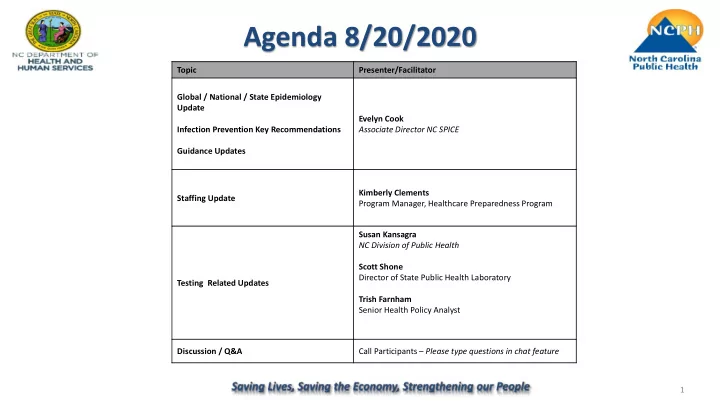
1 Topic Presenter/Facilitator Global / National / State Epidemiology Update Infection Prevention Key Recommendations Guidance Updates Evelyn Cook Associate Director NC SPICE Staffing Update Kimberly Clements Program Manager, Healthcare Preparedness Program Testing Related Updates Susan Kansagra NC Division of Public Health Scott Shone Director of State Public Health Laboratory Trish Farnham Senior Health Policy Analyst Discussion / Q&A Call Participants – Please type questions in chat feature

slide-2
SLIDE 2

RCC (Relay Conference Captioning) Participants can access real-time captioning for this webinar here:

https://www.captionedtext.com /client/event.aspx?EventID=454 6194&CustomerID=324

2

slide-3
SLIDE 3

Epidemiology

  • Epidemiology Update

– Global – National – State

3

slide-4
SLIDE 4
  • Coronavirus Disease (COVID-19)-When to Quarantine

− Quarantine is used to keep someone who might have been exposed to COVID-19 away from others. − Helps prevent the spread of disease that occur before a person knows they are sick (not to be confused with isolation) − People who have tested + for COVID-19 do not need to quarantine or get tested again for up to 3 months unless they develop symptoms again − Even if you test negative for COVID-19 and feel healthy you should quarantine for 14 days after last contact with a person who has COVID-19

https://www.cdc.gov/coronavirus/2019-ncov/if-you-are-sick/quarantine.html

4

CDC Updates

slide-5
SLIDE 5
  • Duration of Isolation and Precautions for Adults with COVID-19 (August 16, 2020):

− Discontinue 10 days after first symptom AND resolution of fever for at least 24 hours AND improvement

  • f symptoms

− Asymptomatic individuals: discontinue 10 days after the date of first positive PCR test − Extend to 20 days for persons with severe illness

  • Persons previously diagnosed with symptomatic COVID-19 who remain asymptomatic after

recovery, retesting is not recommended within 3 months after the date of symptom onset for the initial infection

  • Use date of first positive test in persons who never develop symptoms
  • Persons who develop new symptoms within the 3 months may warrant retesting if

alternative etiology cannot be identified

https://www.cdc.gov/coronavirus/2019-ncov/hcp/duration-isolation.html

5

CDC Updates

slide-6
SLIDE 6

Infection Prevention Recommendations

  • New Admissions-Re-admissions

– Residents-COVID status known – Residents-COVID status unknown

  • Personal Protective Equipment

– Conventional capacity: measures/controls already implemented – Contingency capacity: temporary measures during periods of anticipated shortage – Crisis capacity: not commensurate with U.S. standards but may need to be considered during unknown periods of PPE shortages.

  • Return to Work-Asymptomatic HCP

6

slide-7
SLIDE 7
  • COVID-19 Guidance for Shared or Congregate Housing-updated August 3, 2020

−Created to help owners, administrators, or operators of shared (also called “congregate”) housing facilities-working together with residents, staff and public health officials- prevent the spread of COVID-19

https://www.cdc.gov/coronavirus/2019-ncov/community/shared-congregate-house/guidance-shared-congregate- housing.html

  • This is in addition to the May 29, 2020 Considerations for Preventing Spread of COVID-19 in

Assisted Living Facilities

https://www.cdc.gov/coronavirus/2019-ncov/hcp/assisted-living.html

7

CDC Updated Interim Guidance

slide-8
SLIDE 8

Federal Announcement on SNF Point of Care Testing

  • Facilities are prioritized to receive a Point of Care testing device based on

the following criteria:

– Nursing Homes that are identified as being in “Hotspots” – "Nursing homes nationwide that have reported any of the following:

  • Three or more confirmed or suspected new cases of COVID-19 in the last week
  • At least one new COVID-19 case in the last week after having zero previous COVID-19 cases
  • Inadequate access to testing in the last week or at least one new resident death due to COVID-19 in

the last week

  • At least one new confirmed or suspected COVID-19 case among staff in the last week”
  • Nursing homes must also have an eligible CLIA Certificate of Waiver as outlined by CMS
  • 65 Nursing Homes from North Carolina thus far receiving machines
  • New federal rules are pending but will tie frequency of testing to state

and local metrics

– https://covid19.ncdhhs.gov/dashboard

UNCLASSIFIED

8

slide-9
SLIDE 9

Secretarial Order #2

Follow up to select questions raised

9

To clarify, are you using the NC definition of an outbreak which is 2 cases related to the facility? Under CDC reporting requirements, weekly testing should begin with the identification of one positive case. Weekly reporting requirements apply regardless if there is one or two newly identified positive cases. To clarify, reporting requirements will refer to “Newly Identified Positive Case/Outbreak Status” to cover both scenarios. If we have had no staff test positive, however have had 2 residents test positive does staff have to be tested weekly or can we just test residents weekly and staff biweekly? If two residents have tested positive, the facility has an Outbreak and required to conduct weekly testing of both staff and residents for the duration of the Outbreak. If a facility had a staff member test positive prior to the mandatory reporting period and followed their health department guidance

  • are they required to begin with weekly testing on 8/17/20 or do they base frequently of testing from results on 8/17/ 20 forward?

Staff or residents who previously tested positive within the past three months (regardless of whether they were asymptomatic or symptomatic), and are now asymptomatic, do not need to be retested as part of PPS testing. Residents and HCPs who had a positive viral test at any time and become symptomatic after recovering from the initial illness should be evaluated by their medical provider. If the positive test result is over three months old, the staff member should be reintegrated into the biweekly staff testing. What about prn staff or staff who are on leave who may not be working in the facility on the during that 2-week period - do they need to be tested or only the staff working during those 2 weeks? Facilities may adopt a more rigorous strategy for testing PRN staff and staff who otherwise miss the testing cycle, but minimally:

  • PRN staff should be included in any testing activity occurring on the week they work but do not otherwise need to be included in testing

activity.

  • Staff on leave should be reintegrated into the next testing cycle upon their return.
slide-10
SLIDE 10

Antigen Testing

  • Antigen testing is best when there is a high pre-test

probability of SARS-CoV-2 infection

10 https://files.nc.gov/covid/documents/guidance/healthcare/Antigen-Provider-Update.pdf

Antibody

Antigen

POC/Near-Patient

Antigen

POC/Near-Patient

► Less Sensitive ► Specific ► Minutes ► Low throughput

slide-11
SLIDE 11

CDC Antigen Testing Guidance

  • The use of devices is allowable for testing in high risk settings, such as nursing homes.
  • The two rapid antigen tests that have received EUAs from FDA are limited to diagnostic

testing on symptomatic persons within the first five days of symptom onset

– Diagnostic testing for SARS-CoV-2 is intended to identify current infection in individuals and is performed when a person has signs or symptoms consistent with COVID-19, or when a person is asymptomatic but has recent known or suspected exposure to SARS-CoV-2.

  • When used for screening testing in congregate settings, test results for SARS-CoV-2

should be considered presumptive. Confirmatory nucleic acid testing following a positive antigen test may not be necessary when the pretest probability is high, especially if the person is symptomatic or has a known exposure. When the pretest probability is low, those persons who receive a positive antigen test should isolate until they can be confirmed by RT-PCR.

– Screening testing for SARS-CoV-2 is intended to identify infected persons who are asymptomatic and without known or suspected exposure to SARS-CoV-2. Screening testing is performed to identify persons who may be contagious so that measures can be taken to prevent further transmission.

11 https://www.cdc.gov/coronavirus/2019-ncov/lab/resources/antigen-tests-guidelines.html
slide-12
SLIDE 12

Antigen Testing Guidance

  • Using point of care antigen testing devices to conduct testing under

Secretarial Order #2 is most appropriate for testing HCPs with symptoms or asymptomatic HCPs with known exposure, like working in a nursing facility with an Outbreak.

  • If a nursing home has established a vendor-based testing

arrangement for its bi-weekly testing that is providing timely results, it is encouraged to maintain this testing practice.

  • Antigen testing devices are not advised for bi-weekly testing when

there are no known positive cases or suspected exposure. However, if a facility’s lab-based testing strategy cannot produce timely results point of care antigen testing devices are considered a reasonable alternative.

UNCLASSIFIED

12

slide-13
SLIDE 13

To support COVID-related response and needs among facility-based and community LTSS providers, by leveraging Medicaid resources to: −Effectively support the care of COVID+ residents. −Accommodate needs related to hospital discharge surge. −Reduce transmission through effective infection management and prevention. −Increase service flexibility for provider networks impacted by crisis.

13

NC Medicaid’s Goals Related to Congregate Care/LTSS COVID-19 Response

slide-14
SLIDE 14

14

Secretarial Order #2

  • Nursing homes regulated by NC Division of Health Services

Regulations’ Nursing Home Licensure and Certification section.

  • This includes:
  • Facilities that do not participate in Medicaid and/or Medicare

programs.

  • Combination facilities that have HAL/ACH licensed beds within

the same building as nursing home licensed beds.

  • Hospital-affiliated nursing homes and rehabilitation centers.
  • State neuro-medical centers under Division of State Operated

Healthcare Facilities (DSOHF).

slide-15
SLIDE 15

15

slide-16
SLIDE 16

16

Secretarial Order #2 and Related Guidance Posted Here

https://covid19.ncdhhs.gov/information/health-care/long-term-care-facilities

slide-17
SLIDE 17

17

Reminder: 2nd of 2 Training Series for Nursing Homes Tomorrow

  • Additional detail related to payment

processing and related documentation.

  • Including launch process
  • “Tour” of Reporting Tool
  • Registration information in included

in the Guidance referenced on prior slide.

  • If facilities registered for Monday’s

session, should be registered for both.

slide-18
SLIDE 18

18

Office Hours

  • DHHS will host voluntary “Office Hours” to provide reporting guidance and technical

assistance.

  • Occur Thursdays, 10:30-11:30a

−8/27/2020 −9/3/2020 −9/10/2020 −9/17/2020

  • To register, please visit:

https://attendee.gotowebinar.com/register/6373135940969598219

slide-19
SLIDE 19

19

COVID Special Bulletins Released since Last Webinar (through 8/20/2020)

All available at: https://medicaid.ncdhhs.gov/about- us/covid-19-guidance-and-resources/providers

slide-20
SLIDE 20

20

Questions from this Medicaid Update?

About Hardship Advancements Medicaid.Hardships@dhhs.nc.gov About COVID-related Rate Increases NCTracks Contact Center: 800-688-6696 About Reports Required

  • f Outbreak and

Response Facilities Medicaid.ProviderReimbursement@dhhs.nc.gov About COVID-related flexibilities in Medicaid Policy Medicaid.covid19@dhhs.nc.gov Reporting under Secretarial Order #2 Medicaid.ProviderReimbursement@dhhs.nc.gov

slide-21
SLIDE 21

Immunization Requirements

§ 131D-9 and § 131E-113

  • All residents and employees (full and part-time) of adult care homes & nursing homes licensed under

these articles (respectively) are required to be immunized against influenza virus and pneumococcal disease

  • Adult care & nursing homes shall notify residents and employees of the immunization requirements of

the section and shall request that the residents and employees agree to be immunized against influenza virus and pneumococcal disease

  • Adult care & nursing homes shall document the annual immunization against influenza virus and

pneumococcal disease for each resident and each employee

  • If documentation is lacking for either of these immunizations for various reasons, the facility shall provide
  • r arrange for immunization of the resident or employee
  • Documentation must be provided before November 30th of the current year. For new residents or

employees after that date, documentation is required by March 30th of the next year

  • *Medical contraindications, religious beliefs, and/or safety restrictions may exempt residents or

employees from receiving the immunizations

21

This Photo by Unknown Author is licensed under CC BY-ND
slide-22
SLIDE 22

Q & A

Please type questions in the chat box. We will call on you for clarification if needed.

22