After a Fashion: Kays Catalogue, Modernism and Fashion Persuasion - - PowerPoint PPT Presentation

after a fashion kays catalogue modernism
SMART_READER_LITE
LIVE PREVIEW

After a Fashion: Kays Catalogue, Modernism and Fashion Persuasion - - PowerPoint PPT Presentation

After a Fashion: Kays Catalogue, Modernism and Fashion Persuasion According to The Observer's Lauren Laverne, Nothing beats leafing through the pages of the latest thriller especially when it's a posh clothing catalogue. In its infancy,


slide-1
SLIDE 1

After a Fashion: Kays Catalogue, Modernism and Fashion Persuasion

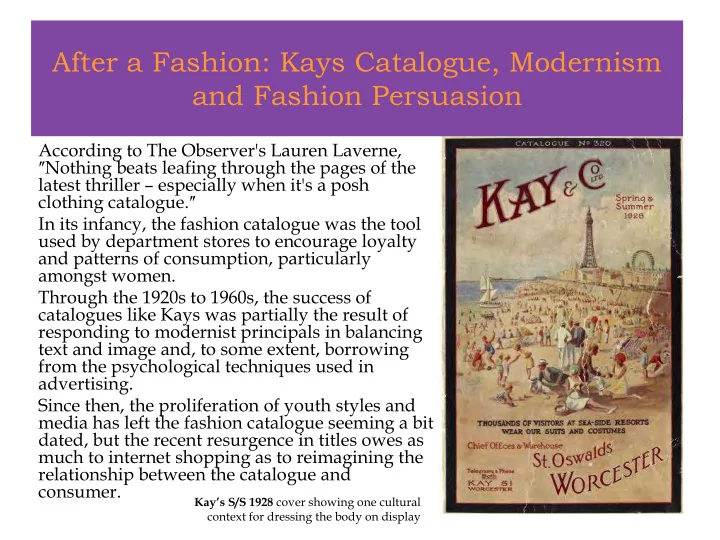
According to The Observer's Lauren Laverne, ʺNothing beats leafing through the pages of the latest thriller – especially when it's a posh clothing catalogue.ʺ In its infancy, the fashion catalogue was the tool used by department stores to encourage loyalty and patterns of consumption, particularly amongst women. Through the 1920s to 1960s, the success of catalogues like Kays was partially the result of responding to modernist principals in balancing text and image and, to some extent, borrowing from the psychological techniques used in advertising. Since then, the proliferation of youth styles and media has left the fashion catalogue seeming a bit dated, but the recent resurgence in titles owes as much to internet shopping as to reimagining the relationship between the catalogue and consumer.

Kay’s S/S 1928 cover showing one cultural context for dressing the body on display

slide-2
SLIDE 2

The Sleep of Reason Produces Monsters Francisco Goya circa 1797 – 1799 rue du Chat-qui-pêche à Paris, 1900 Parisians walking down Boulevard des Italiens by Maynard Owen Williams, National Geographic, 1936

slide-3
SLIDE 3

Kay’s 1933 repeating the rhetoric of body management: inner (moral) health is confirmed by outer appearance

slide-4
SLIDE 4

Kay’s S/S 1963: how is the moral imperative of inner health and outer looks expressed here?

slide-5
SLIDE 5

Kay's A/W 1963: What modernist appropriations are deployed

  • ver the next pages?
slide-6
SLIDE 6

Kay's S/S 1959: two-piece suits Kay's 1950 cover

slide-7
SLIDE 7

Kay's S/S 1940: Hosiery Kay's A/W 1947: Leisure wear

slide-8
SLIDE 8

Kay's A/W 1940: underwear

slide-9
SLIDE 9

Kay's 1933 Men's business suits

slide-10
SLIDE 10

Kay's S/S 1967

slide-11
SLIDE 11

Kay's A/W 1937 Men's business suits

slide-12
SLIDE 12

Kay's 1933suiting patterns

slide-13
SLIDE 13

Kay's A/W 1960: outerwear: use this page to discuss how taste historically and culturally contingent?

slide-14
SLIDE 14

Savile Lumley commissioned by The British Parliamentary Recruiting Committee,1915 From Kay’s 1931

the next few slides are about interpellation and the use of the look / ‘gaze’. In what way do the images report on these theories?

slide-15
SLIDE 15

Kay's S/S 1940: men’s outer wear: patriotic moral coding: “be prepared for unsettled weather”

slide-16
SLIDE 16

Arrow Shirts c1920 Kay's S/S 1940: business wear

slide-17
SLIDE 17

Kay's A/W 1957: Men’s business wear

slide-18
SLIDE 18

Kay's S/S 1933: sports and leisure wear

slide-19
SLIDE 19

Kay's A/W 1937: nightwear

slide-20
SLIDE 20

Kay's S/S 1940: underwear

slide-21
SLIDE 21

Kay's S/S 1940: Ladies’ night wear

slide-22
SLIDE 22

Kay's S/S 1963: Leisure wear

slide-23
SLIDE 23

Kay's A/W 1958: Outerwear

slide-24
SLIDE 24

Kay's S/S 1940: How is the page encoded to provide meaning to the reader? sans serif justified (rational) type for specific details with salience of type (bold and weighting); use of breathing space to box brand message; use of script to reinforce the casual gender imperative: Like Father Like Son! (note the exclamation!)

slide-25
SLIDE 25

Kay's A/W 1954: underwear – use the terms salience; information value; framing and structure

slide-26
SLIDE 26

Kay's A/W 1970: footwear – here the catalogue editorialises the subtext of competition with the boutique by envisaging the double page spread as an ersatz shop window

slide-27
SLIDE 27

Kay's A/W 1960: How does this page spread male assumptions about the reader?

slide-28
SLIDE 28

Kay's S/S 1967: women’s suits – what are the assumptions made about the singularity of fashion in this spread?

slide-29
SLIDE 29

Kay's S/S 1953: household and bridal – how is the spread encoded to provide meaning while making assumptions about the reader?