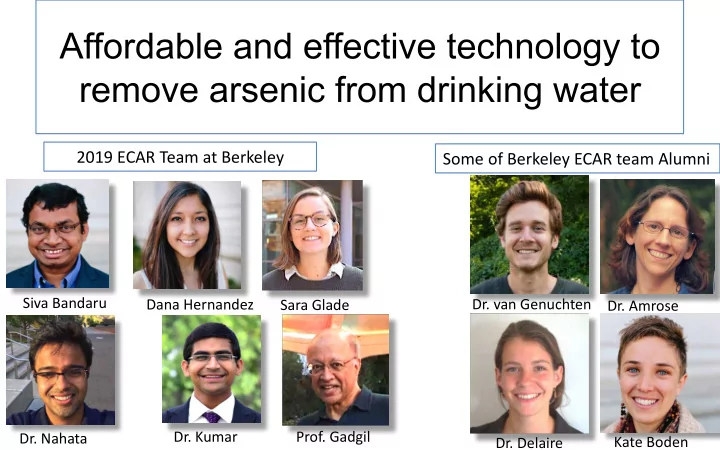
SLIDE 1 Affordable and effective technology to remove arsenic from drinking water
1
2019 ECAR Team at Berkeley Some of Berkeley ECAR team Alumni
Siva Bandaru Dana Hernandez
- Dr. Nahata
- Dr. Kumar
- Dr. van Genuchten
- Dr. Amrose
- Dr. Delaire
Kate Boden Sara Glade
SLIDE 2 Why is it important to urgently address arsenic in drinking water on a massive scale?
2
Global climate change, increasing populations, and increasing prosperity, all drive water demand, causing increasing reliance on groundwater. Arsenic is a far more potent carcinogen than any other regulated carcinogen, at their respective MCLs, in drinking water.
World map of groundwater arsenic
SLIDE 3
MCL == Maximum (permitted) Contaminant Level allowed in drinking water, e.g., by US EPA. Only showing water-borne regulated carcinogens, excluding arsenic (which we will include next). Risks compilation taken from Smith et al (2002), Science, Vol. 296, pp.2145-2146.
SLIDE 4
Risk references: US EPA (2010), “Toxicological Review of Inorganic Arsenic (Cancer).” EPA/635/R-10/001. Smith et al (2002), Science, Vol. 296, pp. 2145-2146. Cancer risk from Arsenic at its MCL (10 ppb). Note vertical scale. Arsenic cancer risk is ~0.7 per 100. Note risk for other carcinogens at their MCL shown in blue columns (near the X-axis) from the previous slide.
SLIDE 5 Arsenicosis causes painful skin lesions, IQ decrease in children, gangrene and amputation, cancers, (+ other effects), and death
5
Arsenicosis started appearing in early 1990s in West Bengal and Bangladesh, and there is still no solution!
SLIDE 6 Technology, “ECAR”, was invented for affordable and robust removal of
- Arsenic. Research started in Berkeley with small seed-funding in 2005
testing at Jadavpur University, 2012 invented at Berkeley Lab 2006
SLIDE 7 ECAR was designed to fit within a sustainable and scalable system, with zero liquid discharge
ECAR = Electro-Chemical Arsenic Remediation P, Si, and As-V chemically sorb to HFO Fe-II is produced,
precipitates as Hydrated Fe-III-OxyHydroxides (“HFO”) Then settle out as sludge All of As-III is
V; much easier to adsorb and remove. How does ECAR work? The Big Picture
7
SLIDE 8 8
Field Site is at Dhapdhapi High School, outside Kolkata, India Pilot Plant designed to treat 10,000 L /day; consumables cost: 1/20 cent/L
2016. Team photo in front
reactors at the field site in West Bengal.
SLIDE 9 2 4 6 8 10 12 1 1
p r 2 5
p r 9
a y 2 3
a y 6
u n 2
u n 4
u l 1 8
u l 1
u g 1 5
u g 2 9
u g 1 2
e p 2 6
e p 1
c t 2 4
c t 7
2 1
5
e c 1 9
e c 2
a n 1 6
a n 3
a n
Arsenic Concentration (ppb)
Initial Arsenic Concentration 252 ± 29 parts per billion (ppb)
World Health Organization’s Guideline Value 10 ppb
Average 2.9 ppb
ECAR reduces Arsenic from groundwater to safe levels
Arsenic in treated water. April 11, 2016 to January 30, 2017. Dhapdhapi High School, West Bengal, India
ECAR: ElectroChemical Arsenic Remediation
SLIDE 10
- 2017. Students and staff use electronic cards to
access safe water from water dispensing kiosk
SLIDE 11
Lifetime cancer risk from drinking water with arsenic at 250 ppb, (typical of groundwater in arsenic-affected areas). 18 per 100.
60-X Reduction in risk at affordable price: Safe Water sells at 1 cent US / Liter
arsenic at 10 ppb. Lifetime risk is ~0.7 per 100.
SLIDE 12 ECAR technology is successfully field-tested, piloted, and shown commercially viable. It is operating since 2016 at one site in India, serving thousands of people daily
12
Two Indian firms have licensed the technology from University of California, LBNL For our journal publications, news, and videos, please visit: GadgilLab.Berkeley.edu