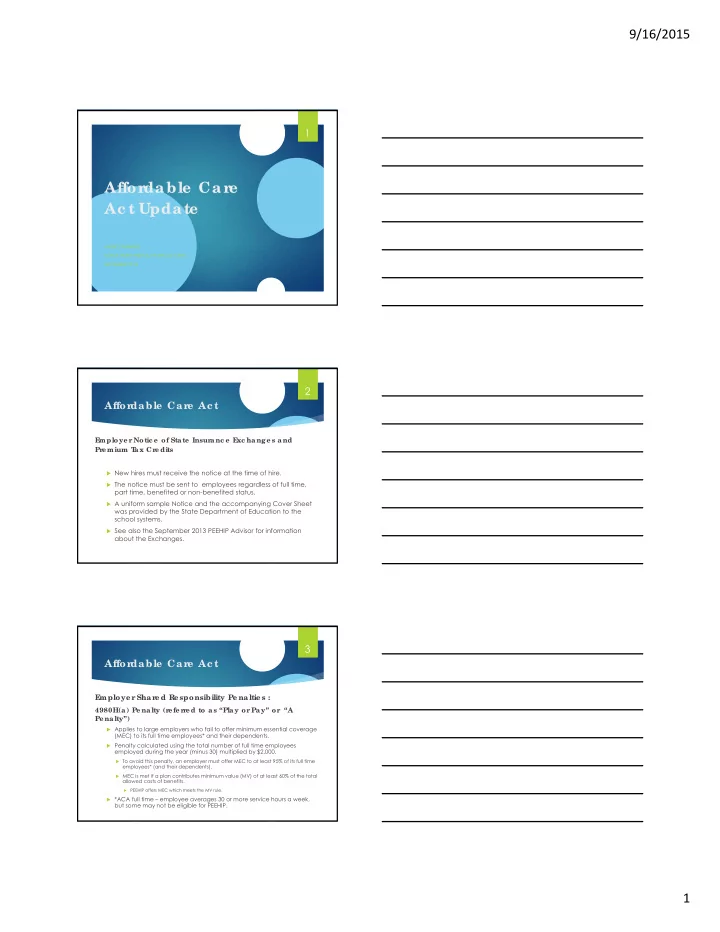
Affor dable Car e Ac t Update AASBO TRAINING SONJA PEASPANEN - - PDF document

affor dable car e ac t update
SMART_READER_LITE
LIVE PREVIEW

Affor dable Car e Ac t Update AASBO TRAINING SONJA PEASPANEN - - PDF document

9/16/2015 1 Affor dable Car e Ac t Update AASBO TRAINING SONJA PEASPANEN & VIVIAN LOVORN SEPTEMBER 2015 2 Affor dable Car e Ac t E mploye r Notic e of Sta te Insur a nc e E xc ha ng e s a nd Pr e mium T a x Cr e dits


slide-1
SLIDE 1

9/16/2015 1

Affor dable Car e Ac t Update

AASBO TRAINING SONJA PEASPANEN & VIVIAN LOVORN SEPTEMBER 2015

1 Affor dable Car e Ac t

E mploye r Notic e of Sta te Insur a nc e E xc ha ng e s a nd Pr e mium T a x Cr e dits

 New hires must receive the notice at the time of hire.  The notice must be sent to employees regardless of full time,

part time, benefited or non-benefited status.

 A uniform sample Notice and the accompanying Cover Sheet

was provided by the State Department of Education to the school systems.

 See also the September 2013 PEEHIP Advisor for information

about the Exchanges.

2 Affor dable Car e Ac t

E mploye r Shar e d R e sponsibility Pe naltie s :

4980H(a ) Pe na lty (r e fe r r e d to a s “Pla y or Pa y” or “A Pe na lty”)

 Applies to large employers who fail to offer minimum essential coverage

(MEC) to its full time employees* and their dependents.

 Penalty calculated using the total number of full time employees

employed during the year (minus 30) multiplied by $2,000.

 To avoid this penalty, an employer must offer MEC to at least 95% of its full time

employees* (and their dependents).

 MEC is met if a plan contributes minimum value (MV) of at least 60% of the total

allowed costs of benefits.

PEEHIP offers MEC which meets the MV rule.  *ACA full time – employee averages 30 or more service hours a week,

but some may not be eligible for PEEHIP.

3

slide-2
SLIDE 2

9/16/2015 2

Affor dable Car e Ac t

E mploye r Shar e d Re sponsibility Pe naltie s :

E xample : 

A school system has 1800 PEEHIP-covered full time employees and

100 full time substitutes that ave r

age of 30 or more hours of service a

week 100 . 1800 + 100 = 5.26% In this example, the “A Penalty” WOULD apply because coverage is not offered to at least 95% of the FTEs: 100% – 5.26% = 94.74%. T he pe na lty would be : $3,740,000.00 (1900 – 30 = 1870 X $2,000)

4 Affor dable Car e Ac t

E mploye r Shar e d Re sponsibility Pe naltie s :

  • 1. 4980H(a) Pe nalty (r

e fe r r e d to as “Play or Pay” or “A Pe nalty”)

T his pe nalty has the pote ntial of having the most signific ant financ ial impac t on e mploye r s if le ss than 95% of its total full time e mploye e s ar e not offe r e d PE E HIP c ove r age .  Examples of employees not eligible for PEEHIP can be:

 substitutes,  after school workers,  temporary contract employees.

5 Affor dable Car e Ac t

E mploye r Shar e d Re sponsibility Pe naltie s :

  • 1. 4980H(a) Pe nalty (r

e fe r r e d to as “Play or Pay” or “A Pe nalty”)

 Under the ACA Definition of Full Time Employee:  What other types of employees does your school system employ that are not considered eligible for PEEHIP coverage?  Common-law employees are generally individuals directed and controlled by an employer for whom an employer would be required to report and pay employment taxes.  But leased employees, sole proprietors, partners in a partnership and 2% S corporation shareholders are not considered employees.

6

slide-3
SLIDE 3

9/16/2015 3

Affor dable Car e Ac t

E mploye r Shar e d R e sponsibility Pe naltie s :

  • 2. 4980H(b) Pe na lty (r

e fe r r e d to a s “Pla y a nd Pa y” or “B Pe na lty”)

 Penalty calculated as the number of full time employees*

who enroll in Exchange coverage and receive a premium tax credit multiplied by $3,000 (indexed annually).

 This penalty may be unavoidable in certain situations:  SO EVEN IF YOU HAVE LESS THAN 5% OF FULL TIME EMPLOYEES*

NOT ELIGIBLE FOR PEEHIP YOU COULD STILL HAVE A PENALTY.

*ACA full time – employee averages 30 or more service hours a week, but some may not be eligible for PEEHIP.

7 Affor dable Car e Ac t

E mploye r Shar e d Re sponsibility Pe naltie s :

How c an e mploye r s avoid the “A Pe nalty”?

Make sure your full time employees* not eligible for PEEHIP coverage represent less than 5% of your total full time employees*. How c a n you de te r mine the %?

Use the equation: # full time employees* not eligible for PEEHIP #full time employees * (eligible and not eligible for PEEHIP)

T his pe nalty is avoidable but e mploye r s MUST take appr

  • pr

iate ste ps NOW to e nsur e that at le ast 95% of full time e mploye e s* ar e offe r e d PE E HIP c ove r age .

Some employees eligible for PEEHIP coverage (such as bus drivers) may not meet the ACA definition of full time e mploye e.

8 Affor dable Car e Ac t

E mploye r Sha r e d Re sponsibility Pe na ltie s :

 PEEHIP will not be changing its eligibility policies. Full time employees and

permanent part time employees are eligible for coverage with PEEHIP. Unde r c ur r e nt PE E HIP polic y, the following e mploye e s ar e not e lig ible to pa r tic ipa te in PE E HIP:

A seasonal, transient, intermittent or adjunct employee who is hired on an

  • ccasional or as needed basis.

An adjunct instructor who is hired on a quarter-to-quarter or semester-to- semester basis and/or only teaches when a given class is in demand.

Board attorneys and local school board members if they are not permanent employees of the institution.

Contracted employees who may be on the payroll but are not actively employed by the school system.

Extended day workers hired on an hourly or as needed basis.

9

slide-4
SLIDE 4

9/16/2015 4

10

Test of Full Time Employees for Compliance with Penalty Provisions of the Affordable Care Act Results of Monthly Monitoring for the ACA Compliance Test for the Two Month Period January and February, 2014 The formula for this test: non- PE E HIP e mploye e s working 30 or more (ave ra g e ) hours a we e k A F ull- time with PE E HIP B minus bus dr ive r s/ aide s C plus non- PE E HIP working 30 or more (ave rage ) hours a we e k A

A

equals ______ %

B minus C plus A AStep 1: Enter the number of non-PE E HIP e mploye e s working an average of 30 or more hours per week for the 2 months. BStep 2: Enter the number of full time employees covered (or offered) PEEHIP coverage. C Ste p 3: E nte r the numbe r of e mploye e s fr

  • m Ste p 2 tha t do not work 30 or more hours pe r we e k. (bus drive rs, e tc .)

The test for the two month period of January and February, 2014 reveals that the percentage of full time employees (as defined by the Affordable Care Act) that are not eligible for PEEHIP coverage is ______ %. Begin Date: January 5, 2014 End Date: March 1, 2014 Payroll Officer: CSFO:

Affor dable Car e Ac t

Bus drivers and aides that are full-time for PEEHIP coverage but work less than 30 hours per week are NOT treated as a full time employee for the calculation of the ACA penalty.

Retirees with PEEHIP coverage working for the LEA are treated by ACA regulations as employees with NO PEEHIP coverage.

 The LEA (Employer) does not provide them PEEHIP coverage. Retiree

PEEHIP is provided by RSA.

11 Affor dable Car e Ac t

 L

  • ok- bac k Me asur

e me nt Pe r iod: A period of time to determine

if an employee is full-time (paid for service that averages 30 hours or more per week or 130 hours per month.) i.e ., c ale ndar ye ar. For an ongoing employee this is the Standard Measurement Period and for a new employee this is the Initial Measurement Period.

 Alabama sc hool boar ds should use a c ale ndar ye ar as the Standar d Me asur e me nt Pe r iod for

  • ngoing e mploye e s and a 12

month pe r iod for ne w e mploye e s.  Ongoing E mploye e: An employee who has been employed for

at least one complete standard measurement period.

 Ne w E mploye e s: An employee who has been employed for less

than one complete standard measurement period.

12

slide-5
SLIDE 5

9/16/2015 5

Affor dable Car e Ac t

 Stability pe r iod: The period of time following the measurement

period during which the employer must treat an employee as full- time if the employee was determined to be full-time during the measurement period. Even if the employee is working less than full- time during the stability period, the employee is treated as working full-time until the end of the stability period, if still employed.

If an ongoing employee (start date before January 2, 2014 for this first standard measurement period) averages 30 hours or more per week from January 1, 2014 through December 31, 2014 and is still employed in 2015, then the employee is treated as a full-time employee for the entire 2015 calendar year. If the employee averages less than 30 hours per week in 2015, the employee is treated as not full time for the entire 2016 calendar year, if still employed.

13 Affor dable Car e Ac t

Va r ia ble Hour E mploye e s

 If a ne w employee with a start date after January 1, 2014 for this first

standard measurement period, averages 30 hours or more per week from January 1, 2014 through December 31, 2014 and is still employed in 2015, then the employee is not treated as a full-time employee for the 2015 calendar year. At least not until the new employee’s 12 month employment anniversary ends, because:

 If the ne w employee averages 30 hours or more per week during the

12 month initial measurement period after the employee’s start date (or the first day of the first month after the start date), then the employee is treated as a full-time employee for the following 12

  • months. (Even if the new employee does not average 30 hours or

more per week during that stability period.) After the end of the 12 months following the initial measurement period for the ne w employee ends, then the employee is treated as an ongoing employee and the average weekly hours are measured on the calendar year standard measurement period.

14 Affor dable Car e Ac t

Employee begins August 12, 2014:

 Initial Measurement Period - September 1, 2014 to August 31, 2015.  Standard Measurement Period – January 1, 2015 to December 31, 2015.

15

slide-6
SLIDE 6

9/16/2015 6

Affor dable Car e Ac t

E mploye e be g ins Aug ust 12, 2014:

 Initia l Me a sur e me nt Pe r iod - September 1, 2014 to August 31,

2015.

If full time during this measurement period then treated as full time until August 31, 2016. If not full time during this Initial Measurement Period then look at the hours worked during the

 Standar d Me asur e me nt Pe r iod – January 1, 2015 to December 31,

2015. The new employee’s hours are measured on both measurement periods.

16 Affor dable Car e Ac t

Since an e mplo yme nt bre ak pe rio d for educational employees is a period of at least four consecutive weeks (summer break for substitutes), we can include the weeks of the other break periods in calculating the average weekly hours. We only have to exclude the weeks of summer break in calculating the average working hours for substitutes during the measurement period.

If an employee is not paid (such as termination, resignation or unpaid leave) for at least 26 c onse c utive we e ks (excluding summer break) when the employee returns to work the employee is treated as a new employee.

17 Affor dable Car e Ac t

Form 1094-B Transmittal of Health Coverage Information Returns Form 1095-B Health Coverage Inst 1094-B and 1095-B Instructions for Forms 1094-B and 1095-B

L E A’s

Form 1094-C Transmittal of Employer-Provided Health Insurance Offer and Coverage Information Returns Form 1095-C Employer-Provided Health Insurance Offer and Coverage Inst 1094-C and 1095-C Instructions for Forms 1094-C and 1095-C

18

slide-7
SLIDE 7

9/16/2015 7

Affor dable Car e Ac t

 1094-C – Reports to the IRS summary information for

employer & to transmit Forms 1095-C to IRS

 1095-C – Reports information about each employee. Used

to determine eligibility of employees for premium tax credits. Copy furnished to employee.

 These forms are used in determining whether an employer owes

payment under the employer shared responsibility provision.

 Filing in 2016, for 2015

19 Affor dable Car e Ac t

1095-C

Part I – Employee & Employer Information

 Similar to information on the W-2 (Name & Address) 

Part II – Employee Offer & Coverage

Part III – Covered Individuals (N/A)

 Complete ONLY if the employer offers employer-sponsored self-insured

health coverage and

 PE E HIP is NOT an e mploye r

  • sponsore d se lf-insur

e d plan

SDE, Harris, & PEEHIP are coordinating the information to be included in Part II

20 Ne xtGe n Code Se tup 21

A validation table has been added to the system so that the various codes for “Offer of Coverage” can be defined. Only codes 1A and 1H will be used for 2015 Reporting for Alabama School Boards.

slide-8
SLIDE 8

9/16/2015 8

Ne xtGe n Code Se tup 22

The default value for Offer of Coverage can be entered on each employee type record.

Ne xtGe n Code Se tup 23

The Update Summer Pay Flag transaction (this transaction allows the user to update many default values on the Employee Type records) has been modified to allow for mass updating of employee type records with default Offer of Coverage Code values.

Ne xtGe n Code Se tup 24

The Mass Change Employee Jobs transaction has been modified to provide the ability to update the Offer of Coverage Code from the Employee Type record to the employee’s Personnel Data record.

slide-9
SLIDE 9

9/16/2015 9

Ne xtGe n Pe r sonne l Data 25

The Offer of Coverage code has been added to the employee’s Personnel Data

  • screen. This will be used when producing the 1095‐C form.

Ne xtGe n ACA Pr

  • c e dur

e s 26

A new transaction will be added in the Application Center which will allow the district to build the ACA work file month‐by‐month for 2015.

Ne xtGe n ACA Pr

  • c e dur

e s 27

After generating the ACA data for a month or for a series of months, the information can be reviewed in report form and can be exported to Excel. The Excel file can be edited and the data imported back into the work file.

slide-10
SLIDE 10

9/16/2015 10

F

  • r

m 1095-C 28

► Line 14 Options For 2015, only 2 codes will be utilized

  • 1A – Qualifying Offer
  • 1H – No offer of coverage (employee not offered any

health coverage or employee offered coverage that is not minimum essential coverage)

F

  • r

m 1095-C 29

► Line 15

  • In accordance with IRS regulations, line 15 will only contain a

dollar amount when line 14 has codes 1B, 1C, 1D, or 1E.

  • Sc hool distr

ic ts will be using only c ode 1A or 1H in line 14 for

  • 2015. T

he r e for e , nothing will be r e c or de d on line 15.

F

  • r

m 1095-C 30

► Line 16

  • If 1A is recorded on line 14, nothing is required on line 16
  • If 1H is recorded on line 14, the following options are

available for line 16:

  • 2A- Employee not employed during month
  • 2B- Employee not a full-time employee
  • 2D- Employee is in a 4980H(b) Limited Non-Assessment

Period (first month of employment when first day is not the first day of month)

slide-11
SLIDE 11

9/16/2015 11

Ne xtGe n ACA Pr

  • c e dur

e s 31

After exporting the ACA data to Excel and making the necessary modifications, import the data back into the 2015 work file.

F

  • r

m 1095-C Boxe s 14, 15, and 16

32

E mploye e is full- time unde r ACA dur ing e ntir e c ale ndar ye ar

  • f 2015

F

  • r

m 1095-C Boxe s 14, 15, and 16

33

E mploye e hir e d 3/ 16/ 2015 a nd is F T unde r ACA

slide-12
SLIDE 12

9/16/2015 12

F

  • r

m 1095-C Boxe s 14, 15, and 16

34

E mploye e is de e me d F T unde r ACA for e ntir e c ale ndar ye ar 2015, but is not c ove r e d for insur anc e (substitute , for e xample ).

Assumption- Employee is not eligible for PEEHIP and is not entered in the PEEHIP employer portal.

F

  • r

m 1095-C Boxe s 14, 15, and 16

35

E mploye e is par t- time until June 2015, the n is F T unde r ACA

Assumption - Employee is eligible for PEEHIP and is entered in the PEEHIP employer portal.

F

  • r

m 1095-C Boxe s 14, 15, and 16

36

E mploye e is F T unde r ACA r ule s and te r minate s or r e tir e s on Se pte mbe r 20, 2015

slide-13
SLIDE 13

9/16/2015 13

F

  • r

m 1095-C Boxe s 14, 15, and 16

37

► Using 1H in line 14 with nothing in line 16

  • Use of 1H in line 14 indicates the employee was

deemed FT by ACA Rule

  • If line 16 is blank when line 14 carries 1H, that indicates:
  • That health coverage should have been extended

to the employee, but was not AND

  • The employer has no remedy or transitional relief

Make sur e to c he c k c ar e fully in situations suc h as this!

F

  • r

m 1095-C E xample 38 F

  • r

m 1094-C E xample 39

slide-14
SLIDE 14

9/16/2015 14

F

  • r

m 1094-C E xample 40 Affor dable Car e Ac t

F iling Re quir e me nts

March 31 if filing electronically

Form 1095-C must be furnished to the individual by January 31st.

41 Affor dable Car e Ac t

Othe r Conside rations

Employers with >= 250 forms required to file electronically

AIR system: Affordable Care Act Information Returns system

Review draft Publication 5165, Guide for Electronically filing ACA Information Returns

For returns required to be filed after December 31, 2015, the penalty for failure to file an information return generally is increased from $100 to $250 for each return for which such failure occurs. The total penalty imposed for all failures during a calendar year after December 15, 2015 cannot exceed $3,000,000.

The penalty for failure to provide a correct payee statement is increased from $100 to $250 for each statement for which the failure occurs, with the total penalty for a calendar year not to exceed $3,000,000. The increased penalty amount applies to statements required to be provided after December 31, 2015.

Special rules apply that increase the per-statement and total penalties if there is intentional disregard of the requirement to furnish a payee statement.

42

slide-15
SLIDE 15

9/16/2015 15

Affordable Care Act

Que stions?

Sonja Pe aspane n spe aspane n@alsde .e du 334- 353- 9886 Vivia n L

  • vor

n vlovor n@har r isc ompute r .c om 251- 544- 4863

43