Aerosol effects on cloud cover as determined by ground- and - - PowerPoint PPT Presentation

aerosol effects on cloud cover as determined by ground
SMART_READER_LITE
LIVE PREVIEW

Aerosol effects on cloud cover as determined by ground- and - - PowerPoint PPT Presentation

Aerosol effects on cloud cover as determined by ground- and space-based sensors John E. Ten Hoeve 1 and John A. Augustine 2 1 National Weather Service, SSMC2, Silver Spring, MD 2 Earth System Research Laboratory, Global Monitoring Division,


slide-1
SLIDE 1

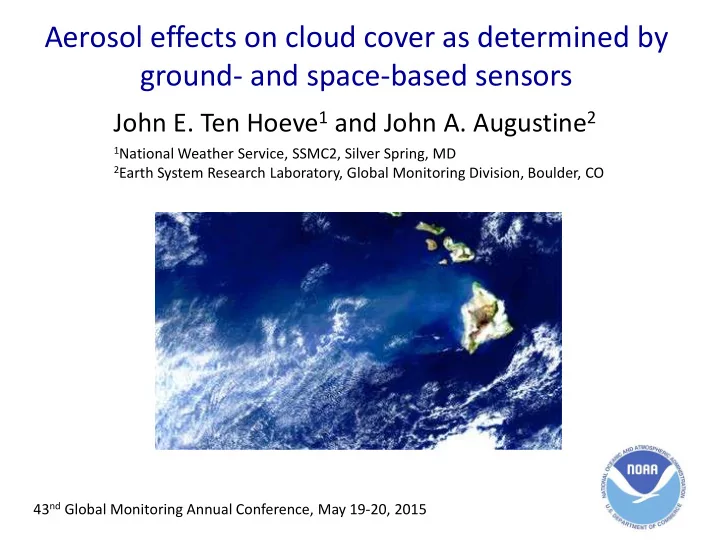
Aerosol effects on cloud cover as determined by ground- and space-based sensors

John E. Ten Hoeve1 and John A. Augustine2

1National Weather Service, SSMC2, Silver Spring, MD 2Earth System Research Laboratory, Global Monitoring Division, Boulder, CO

43nd Global Monitoring Annual Conference, May 19-20, 2015

slide-2
SLIDE 2
  • The effect of aerosols on the extent of clouds (2nd indirect

effect) remains one of the largest uncertainties in climate science

  • From satellites, the detection of the collective impact of the

microphysical and dynamical effects of aerosols on the macroscopic properties of clouds is possible, but…

  • Neither satellites nor models can resolve the microphysical

processes that contribute to the cloud fraction - aerosol

  • ptical depth (fc-AOD) relationship

The problem

slide-3
SLIDE 3
  • Many studies have shown an increase in cloud fraction

with AOD, particularly for AOD < 0.3 (beyond 0.3 AOD, the effect

  • f AOD on cloud fraction approaches 0)
  • However, part of that relationship could be from

confounding effects:  Scattered radiation off of the sides of clouds  Aerosol humidification in the cloud’s environment  Cloud contamination in the AOD retrievals  Vertical overlap of aerosols and clouds  Meteorological covariation

  • It is difficult to separate out these effects with satellite

data alone

  • We believe that surface measurements are better

poised to remove some of the confounding effects

slide-4
SLIDE 4

We approached the 2nd indirect effect from the top and bottom

MODIS level 2 AOD and cloud

fraction data

SURFRAD

Desert Rock, NV

slide-5
SLIDE 5

Data

  • 2006 through 2011
  • MODIS 10-km resolution 550-nm AOD retrievals over a 50

km2 area centered on each SURFRAD site

  • MODIS 5-km cloud fraction retrievals averaged over each

10-km AOD pixel

  • SURFRAD cloud screened 500-nm AOD, interpolated to

550-nm using the Angstrom relationship, and cloud fraction from the Total Sky Imager

  • AOD was restricted to values < 0.3, and only opaque cloud

fractions were considered

slide-6
SLIDE 6

Sun photometer measurements are sensitive to the transition zone near cloud edges

  • Aerosols swell near cloud edges due to humidification
  • There can be 3-D effects from scattered photons off of the

sides of clouds

slide-7
SLIDE 7

Aerosol Optical Depth Cloud screening

Table Mountain SURFRAD 26 June 2014

500-nm Aerosol optical depth SURFRAD solar measurements

slide-8
SLIDE 8

Composite AOD sorted by “time-to-cloud” for all SURFRAD sites considered (2006-2011)

C L O U D E D G E

18 min. from cloud 6%-11% AOD enhancement near cloud

slide-9
SLIDE 9

Quantification of the 2nd indirect effect

Corrected fc-AOD slope is 58% of the uncorrected slope ∆fc/∆τ 0.50 ∆fc/∆τ 0.33 ∆fc/∆τ 0.12 ∆fc/∆τ 0.59 ∆fc/∆τ 0.24 ∆fc/∆τ 0.54 ∆fc/∆τ 0.37

slide-10
SLIDE 10

Quantification of aerosol forcing at the surface

Data used: AOD < 0.3 and corrected for near-cloud effects

slide-11
SLIDE 11

Summary

  • All stations show cloud fraction increasing with AOD:

∆fc/∆τ ranges from 0.12 to 0.59, mean 0.37 (AOD < 0.3)

  • The cloud fraction-AOD relationship is ~42% greater when

confounding effects in AOD retrievals are not removed.

  • Satellite data gives the same result as cloud-contaminated

AODs, therefore satellite-based studies may overestimate the magnitude of the 2nd indirect effect by ~42%

  • On average, aerosols over the U.S. reduce surface net solar

radiation by 51 Wm-2 and surface total net radiation by 19 Wm-2 , and therefore have an overall cooling effect

slide-12
SLIDE 12

Meteorological covariation

RH SLP Tested: Air temperature Wind speed Relative humidity Sea level pressure

slide-13
SLIDE 13

C L O U D E D G E

Composite Angstrom exponent sorted by “time-to-cloud”