Advancing Addiction Science to Address the Opioid Crisis National - - PowerPoint PPT Presentation

advancing addiction science to address the opioid crisis
SMART_READER_LITE
LIVE PREVIEW

Advancing Addiction Science to Address the Opioid Crisis National - - PowerPoint PPT Presentation

Advancing Addiction Science to Address the Opioid Crisis National Institute on Drug Abuse Bringing the full power of science to bear on drug abuse and addiction Nora D. Volkow, M.D. Director National Institute on Drug Abuse Science =


slide-1
SLIDE 1

National Institute on Drug Abuse Bringing the full power of science to bear on drug abuse and addiction Nora D. Volkow, M.D. Director National Institute on Drug Abuse

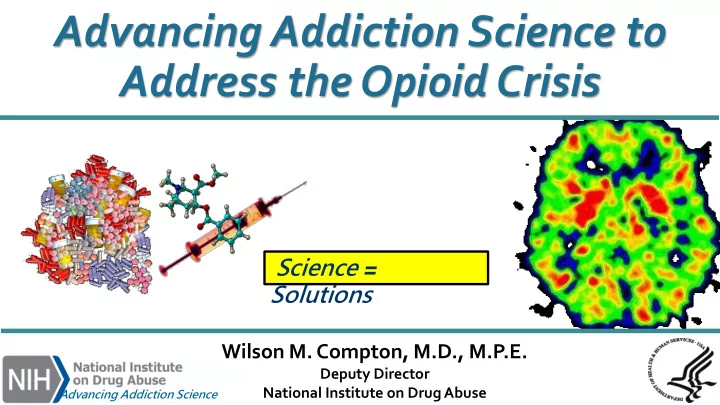
Advancing Addiction Science to Address the Opioid Crisis

Advancing Addiction Science

Wilson M. Compton, M.D., M.P.E.

Deputy Director National Institute on Drug Abuse

Science = Solutions

slide-2
SLIDE 2

52,404 Overdose Deaths in 2015 (33,091 from Rx and Illicit Opioids

Estimated Age-adjusted Death Rates for Drug Poisoning by County

Geographic and Temporal Variation:

2015

https://www.cdc.gov/nchs/data-visualization/drug-poisoning-mortality/

1999

slide-3
SLIDE 3

Analgesic Mechanisms of Mu Opiate Drugs (Heroin, Vicodin, Morphine)

Thalamus (pain) ACC (pain) PAG (pain) Accumbens (reward)

slide-4
SLIDE 4

ENVIRONMENTAL AVAILABILITY: Current Opioid Crisis Originated with Prescribing Increases

Opioid prescriptions Tripled to MORE THAN 200 MILLION prescriptions in recent years

50 100 150 200 250

Opioid Prescriptions in MILLIONS

slide-5
SLIDE 5

People Misusing Analgesics Obtain them Directly & Indirectly by Prescription

Source where pain relievers obtained for most recent misuse

10% 36% 87% 10% 3% 54% Friend/ Relative Prescription Other

Their Prescription Their Friend/Relative Other

Source: Han, Compton, et al. Annals of Internal Medicine 2017;167(5):293-301

Source where pain relievers obtained for most recent misuse

10% 36% 87% 10% 3% 54% Friend/ Relative Prescription Other

Their Prescription Their Friend/Relative Other

Source: Han, Compton, et al. Annals of Internal Medicine 2017;167(5):293-301

slide-6
SLIDE 6

Inadequate Pain Treatment as a Driver?

1.9 million adults had prescription opioid use disorders (0.8%

  • f the U.S. adult

population) 91.8 million adults used prescription opioids (37.8% of the U.S. adult population) 11.5 million adults misused prescription

  • pioids (4.7% of the

U.S. adult population)

48.7 8.9 16.2 7.0 12.0 7.2 66.3 11.2 2.2 10.8 4.6 2.4 0.9 0.6 1.0 relieve physical pain relax or relieve tension experiment get high or feel good help with sleep help with emotions or feelings increase/decrease effects of other drugs hooked or have to misuse

  • ther reason

Source: Han, Compton, et al. Annals of Internal Medicine 2017 (epubAug 1, 2017)

slide-7
SLIDE 7

ECONOMICS: Heroin Increases Due to Lower Price and Greater Availability

$- $500 $1,000 $1,500 $2,000 $2,500 $3,000 $3,500

"Retail" Price Per Pure Gram

National Drug Control Strategy--Data Supplement 2014. https://www.whitehouse.gov/sites/default/files/ondcp/policy-and-research/ndcs_data_supplement_2014.pdf

slide-8
SLIDE 8

ECONOMICS: CHEAP Fentanyl Precursor Chemicals

slide-9
SLIDE 9

Graphs from NY Times Article based on CDC MMWR Report 2017

2016 Fentanyl-Related Deaths Surpassed Heroin or Rx

slide-10
SLIDE 10

Using Research to End the Opioid Crisis

NIH Opioid Research Initiative

PAIN MANAGEMENT Safe, effective, non-addictive strategies OPIOID ADDICTION TREATMENT New, innovative medications and technologies OVERDOSE REVERSAL Interventions to reduce mortality and link to treatment

Non-Opioid Analgesics Biomarkers For Pain Opioid Vaccines Nonpharmacological Treatments (e.g. TMS) Respiratory Stimulation Devices

slide-11
SLIDE 11

Multiple Potential Targets for Pain Medication but Multiple Challenges

  • Regulatory high safety & labeling hurdles
  • Poor predictive power of preclinical models
  • Heterogeneous patient population
  • Multiple pain conditions; wide variation in individual

response

  • Lack of biomarkers in pain studies
  • Limited clinical research resources No clinical trials

network to coordinate pain treatment

  • Limited cohorts of more homogeneous pain syndromes

(trigeminal neuralgia, CRPS,..)

slide-12
SLIDE 12

Public Private Partnership (PPP) Projects in Pain

  • Data Sharing Consortium: share data on successful & failed drug development
  • Coordinated Clinical Testing of Novel Treatments for Select Pain Conditions in a Pain

Research Network : Develop deeply phenotyped cohorts with select pain conditions

  • Develop and Validate Biomarkers:
  • Stratify pain populations
  • Predict clinical outcomes/response to treatment
  • Provide precise, objective measures of nociception (“pain-o-meter”)
  • Re-engineer the Pre-Clinical Platform : Improve success of analgesic development through

new pain models (including pluripotential cell models/organoids)

  • Prevention of Chronic Pain
  • Applying new technologies to discover

novel pain targets

slide-13
SLIDE 13

Effective Medications for Opioid Addiction

Full Agonist: Methadone (daily dosing) Partial Agonist: Buprenorphine (3-4X week, or implant) Antagonists: Naltrexone (monthly extended release)

effect no effect agonist antagonist Binds to the receptor and activates it; Full agonists have maximal effect. Partial agonist have intermediate effect. Prevent Heroin from binding. Binds to receptor but has no effect. Prevents heroin from binding. Opioid Effect Full Agonist (Methadone) Partial Agonist (Buprenorphine) Antagonist (Naltrexone) Log Dose Science = Solutions

slide-14
SLIDE 14
  • Probuphine: buprenorphine implant; releases sustained dose for up to 6

months (FDA Approval May 26, 2016)

  • Initiating buprenorphine treatment in the emergency department improves

treatment engagement and reduces illicit opioid use

  • Extended release naltrexone initiated in criminal justice settings lowers

relapse rates and overdoses

  • Abstinence from opioids over 12 Weeks with interim buprenorphine

Science Driven Solutions: Improving Addiction Treatment

Lee JD, et al., Addiction 2015;100:1005-1014 and New Eng J Med 2016;374:1232-1242

Abstinence with Interim Buprenorphine

Sigmon SC et al. N Engl J Med 2016.

slide-15
SLIDE 15

Two studies found that once inducted onto medication outcomes were comparable. However, relapse rates were high for both medications.

Relapse-Free Survival

Lee J et al., Lancet November 14, 2017. Tanum L et al., JAMA Psych. October 18, 2017.

XR-Naltrexone and Buprenorphine-Nx Equally Safe and Effective In Preventing Relapse (After Induced to Medication)

slide-16
SLIDE 16

Monoclonal Antibodies and Vaccines to Treat OUD and Prevent Overdose

  • Heroin vaccine validated in

primate model in 2017

  • First vaccine for fentanyl and

fentanyl analogs reported in a mouse model in 2016

  • Reduces drug reaching the brain
  • Protect high-risk individuals

against overdose

Bremer et al, 2017; Bremer et al, 2016; Janda and Treweek, 2012.

slide-17
SLIDE 17

Non-Pharmacological Treatments for Addiction

Salling and Martinez, 2016.

Transcranial Direct Current Simulation (tDCS) Deep Brain Stimulation (DBS)

Implanted electrodes emit electrical stimulation to targeted brain region

Transcranial Magnetic Stimulation (TMS)

slide-18
SLIDE 18

PPP for Opioid Use Disorder

  • Medications for OUD
  • Extended release formulations buprenorphine, naltrexone
  • Drug combinations
  • Alternative therapeutics (i.e. new targets, vaccines)
  • Targeting endophenotypes/circuits
  • Medications for overdose prevention and reversal
  • Stronger formulations of Naloxone or alternative antagonists to

reverse OD from synthetic opioids like fentanyl, carfentanil

  • Vaccines and antibodies against fentanyl and analogs
  • Devices to prevent opioid misuse, overdose prevention
  • Devices to administer buprenorphine or methadone safely at home
  • Naloxone autoinjectors
  • Stimulation devices (TMS, DECT, Ultrasound, Peripheral stimulation)
slide-19
SLIDE 19
  • Biological, developmental, and social

complexities of substance use and addiction suggest multipronged responses.

  • Medication development is key.

Summary:

Advancing Addiction Science

www.drugabuse.gov

Science = Solutions