Disparities in Opioid Addiction, Treatment and Policy Differences - - PDF document

disparities in opioid addiction treatment and policy
SMART_READER_LITE
LIVE PREVIEW

Disparities in Opioid Addiction, Treatment and Policy Differences - - PDF document

2/14/2018 Disparities in Opioid Addiction, Treatment and Policy Differences in Opioid Addiction 2015: 622 opioid overdose deaths in Wisconsin 511 or 82% white non-Hispanic 77 or 12% African-American 21 or 3% Hispanic Kaiser


slide-1
SLIDE 1

2/14/2018 1

Disparities in Opioid Addiction, Treatment and Policy

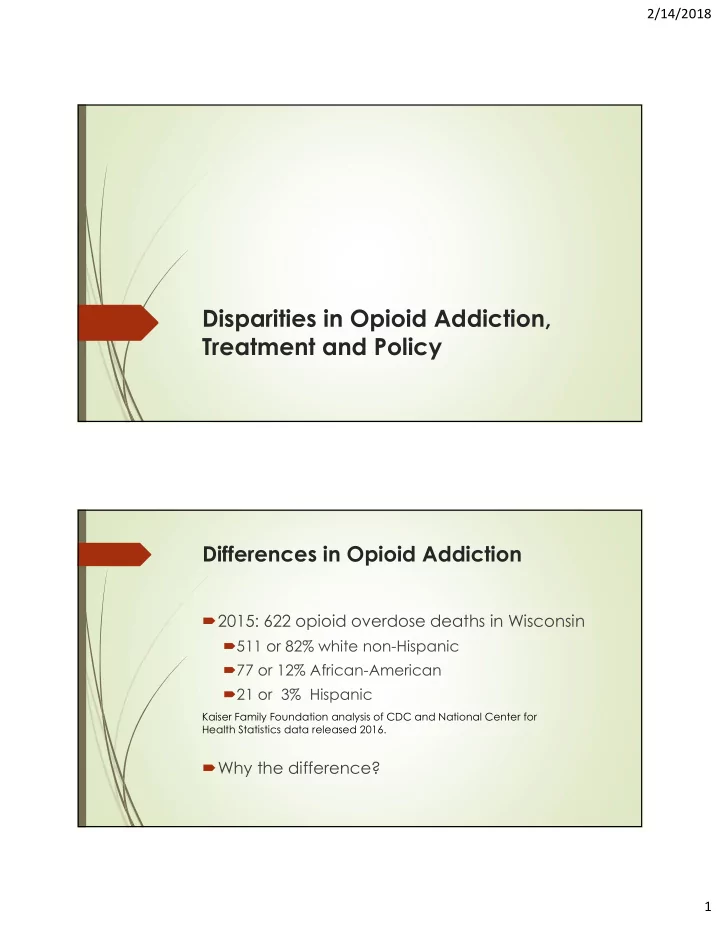
Differences in Opioid Addiction

2015: 622 opioid overdose deaths in Wisconsin

511 or 82% white non-Hispanic 77 or 12% African-American 21 or 3% Hispanic

Why the difference?

Kaiser Family Foundation analysis of CDC and National Center for Health Statistics data released 2016.

slide-2
SLIDE 2

2/14/2018 2

History of Opioid Prescription

1990s Major campaigns by JCAHO and VHA* Established new standards for monitoring and treatment of pain in 2000 Pain management became important quality improvement initiative DEA shows marked quantitative increases in

  • pioid prescriptions every year since 1990

* Joint Commission on Accreditation of Healthcare Organizations and Veterans Health Administration

Theory for Racial Disparities

Doctors prescribed narcotics more cautiously to their non-white patients Unconscious bias related to:

Concern about patients becoming addicted Concern patients might sell their pills Less concern about pain levels in non-white population

Racial stereotyping is having a protective effect

  • n non-white populations.

Andrew Kolodny, MD, co-director of Opioid Policy Research Collaborative, Brandeis University

slide-3
SLIDE 3

2/14/2018 3

The Evidence

Comprehensive pain study from University of Michigan Medical School:  Health care disparities, racial and ethnic disparities in pain perception, assessment and treatment were found in all settings

Emergency Department Hospital (post-operative) Outpatient

 and across all types of pain

 Acute  Cancer  Chronic nonmalignant

Disparate Treatment of Pain

 In Emergency Rooms:

1993 Todd et al study found 55% of Hispanics with isolated humerus, radius, ulna, femoral shaft, tibia and fibula fractures went without pain medication compared to 26% of white non-Hispanic patients 2000 Todd et al study found 57% of African-American patients with acute, isolated long-bone fractures received pain medication compared to 74% of white non-Hispanic patients.

slide-4
SLIDE 4

2/14/2018 4

Disparate Treatment of Pain

 Post-operative pain management

 1996 Ng et al study found patients received on average different daily does of morphine White non-Hispanic received 22mg/day African-Americans received 16mg/day Hispanics received 13mg/day

 Cancer pain

 1997 Cleeland et al study found that centers that predominantly treat racial and ethnic minorities were less likely to follow WHO recommend levels of pain management 74% of Hispanic patients did not receive adequate pain management 59% of African-American patients did not receive adequate pain management

Chronic Pain Management

2005 Chen et al study found:

African-Americans had significantly higher pain scores than white patients 6.7 versus 5.6 White patients were prescribed opioid analgesics more frequently than African-Americans 45.7% versus 32.2% No difference by race in the use of other treatment modalities Racial disparity not due to problems of access

slide-5
SLIDE 5

2/14/2018 5

Policy Disparities

 Opioids not the first drug epidemic  1980s and 1990s crack cocaine epidemic predominantly affected African-American communities  Policy stance:

 No government declaration of a public health crisis War on drugs; we could potentially arrest our way out of the problem

 Today’s policy stance:

Declaration by Trump administration of a public health crisis We can’t arrest our way out of the problem Need for effective treatment and prevention