Advances in T elluric Characterization for Precision Spectroscopy - - PowerPoint PPT Presentation

advances in t elluric characterization for precision
SMART_READER_LITE
LIVE PREVIEW

Advances in T elluric Characterization for Precision Spectroscopy - - PowerPoint PPT Presentation

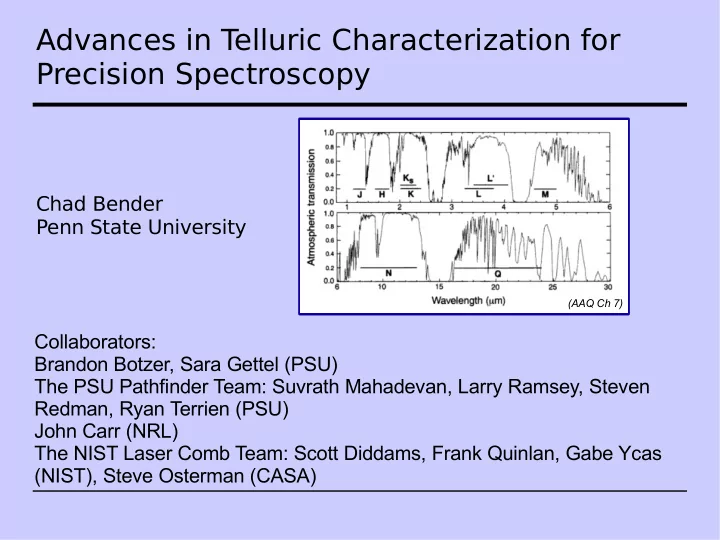
Advances in T elluric Characterization for Precision Spectroscopy Chad Bender Penn State University (AAQ Ch 7) Collaborators: Brandon Botzer, Sara Gettel (PSU) The PSU Pathfinder Team: Suvrath Mahadevan, Larry Ramsey, Steven Redman, Ryan


slide-1
SLIDE 1

Advances in T elluric Characterization for Precision Spectroscopy

Chad Bender Penn State University Collaborators: Brandon Botzer, Sara Gettel (PSU) The PSU Pathfinder Team: Suvrath Mahadevan, Larry Ramsey, Steven Redman, Ryan Terrien (PSU) John Carr (NRL) The NIST Laser Comb Team: Scott Diddams, Frank Quinlan, Gabe Ycas (NIST), Steve Osterman (CASA)

(AAQ Ch 7)

slide-2
SLIDE 2
  • C. Bender: Advances in T

elluric Correction for Precision Spectroscopy August 18, 2010

Outline

  • Motivation & traditional telluric correction techniques
  • TERRASPEC: Synthetic forward modeling
  • Examples

– Keck + NIRSPEC (L-band) – HET + HRS (R-band) – HET + Pathfinder (Y-band, H-band)

slide-3
SLIDE 3
  • C. Bender: Advances in T

elluric Correction for Precision Spectroscopy August 18, 2010

Motivation

Near-IR observations

1) offer significant potential for increased sensitivity to low- mass planets 2) facilitate a vast amount of important non-exoplanet astronomy.

slide-4
SLIDE 4
  • C. Bender: Advances in T

elluric Correction for Precision Spectroscopy August 18, 2010

Motivation

Near-IR observations:

1) offer significant potential for increased sensitivity to low- mass planets 2) facilitate a vast amount of important non-exoplanet astronomy.

Consequently:

– many new near-IR spectrographs are planned, being built,

  • r being commissioned (Barnes, Mahadevan, Martin,

Quirrenbach)

– existing facilities are being re-examined and upgraded

(Figueira, Plavchan).

slide-5
SLIDE 5
  • C. Bender: Advances in T

elluric Correction for Precision Spectroscopy August 18, 2010

Motivation

(AAQ Ch 7, pg 145)

T elluric absorption in the spectrum is a significant problem in the infrared and must be precisely corrected!

slide-6
SLIDE 6
  • C. Bender: Advances in T

elluric Correction for Precision Spectroscopy August 18, 2010

Motivation

(AAT Ch 7, pg 145)

Y-Band

Very few observing bands are actually “clean” of tellurics!

slide-7
SLIDE 7
  • C. Bender: Advances in T

elluric Correction for Precision Spectroscopy August 18, 2010

Motivation

(AAT Ch 7, pg 145)

H-Band

slide-8
SLIDE 8
  • C. Bender: Advances in T

elluric Correction for Precision Spectroscopy August 18, 2010

Traditional telluric correction procedure

1)Observe “telluric standard” star(s) (e.g. w/out stellar features in waveband of interest) 2)Scale (1) to air-mass of target spectrum 3)Divide (2) into target spectrum 4)Plug the resulting perfectly corrected target spectrum into the next step in your data analysis pipeline.

slide-9
SLIDE 9
  • C. Bender: Advances in T

elluric Correction for Precision Spectroscopy August 18, 2010

Traditional telluric correction procedure

1)Observe “telluric standard” star(s) (e.g. w/out stellar features in waveband of interest) 2)Scale (1) to air-mass of target spectrum 3)Divide (2) into target spectrum 4)Plug the resulting perfectly corrected target spectrum into the next step in your data analysis pipeline. 5)Iterate (2) & (3) until you get tired and give up.

slide-10
SLIDE 10
  • C. Bender: Advances in T

elluric Correction for Precision Spectroscopy August 18, 2010

Why doesn't this work?

  • Atmosphere columns (particularly H2O) are highly

dependent on where and when you are looking.

– Rarely are telluric standards spatially close to target stars. – Even if they are, observing them coincidentally with target

  • bservations adds overhead and complication
  • Correct airmass scaling requires multiple telluric

standards

– Expensive in observing time – or specialized instrumentation (e.g. MOS)

slide-11
SLIDE 11
  • C. Bender: Advances in T

elluric Correction for Precision Spectroscopy August 18, 2010

Why doesn't this work?

  • Atmosphere columns (particularly H2O) are highly

dependent on where and when you are looking.

– Rarely are telluric standards spatially close to target stars. – Even if they are, observing them coincidentally with target

  • bservations adds overhead and complication
  • Correct airmass scaling requires multiple telluric

standards

– Expensive in observing time – or specialized instrumentation (e.g. MOS)

  • Without heroic effort, observational correction typically

good to a few percent.

slide-12
SLIDE 12
  • C. Bender: Advances in T

elluric Correction for Precision Spectroscopy August 18, 2010

How to do we obtain a more precise correction? Get Help!

slide-13
SLIDE 13
  • C. Bender: Advances in T

elluric Correction for Precision Spectroscopy August 18, 2010

LBLRTM – A line-by-line radiative transfer model of the Earth's atmosphere

6 built-in atmospheres (or custom): column profiles for P, T, 38 species example: 1976 Standard US Atmosphere A public release RT code from Atmospheric and Environmental Research, Inc., (Clough et al. 2005) (FASCODE heritage)

slide-14
SLIDE 14
  • C. Bender: Advances in T

elluric Correction for Precision Spectroscopy August 18, 2010

HITRAN Line Database

slide-15
SLIDE 15
  • C. Bender: Advances in T

elluric Correction for Precision Spectroscopy August 18, 2010

Outline

  • T

raditional telluric correction techniques

  • TERRASPEC: Synthetic forward modeling
  • Examples

– Keck + NIRSPEC (L-band) – HET + HRS (R-band) – HET + Pathfinder (Y-band, H-band)

slide-16
SLIDE 16
  • C. Bender: Advances in T

elluric Correction for Precision Spectroscopy August 18, 2010

The TERRASPEC Algorithm

(T errestrial Absorption Spectrum Corrector)

Observing hot stars is not practical because of H2O variability &

  • bserving time constraints

Forward model telluric absorption using Line-By-Line RT Model

Standard Atmosphere (Tropical, US1976, etc) + Current Ozonesonde + Current Radiosonde + Observing conditions (ZA range, altitude, summit temperature, airmass range) LBLRTM

(Clough et al. 2005)

Non-linear least-squares minimization

(MPFIT, Markwardt 2008)

⇨ ⇨ ⇦

Synthetic telluric absorption function (R~500K) Wavelength dependent instrument profile Continuum normalization corrections

⇘ ⇙

slide-17
SLIDE 17
  • C. Bender: Advances in T

elluric Correction for Precision Spectroscopy August 18, 2010

The TERRASPEC IDL wrapper

slide-18
SLIDE 18
  • C. Bender: Advances in T

elluric Correction for Precision Spectroscopy August 18, 2010

The TERRASPEC IDL wrapper

slide-19
SLIDE 19
  • C. Bender: Advances in T

elluric Correction for Precision Spectroscopy August 18, 2010

The TERRASPEC IDL wrapper

slide-20
SLIDE 20
  • C. Bender: Advances in T

elluric Correction for Precision Spectroscopy August 18, 2010

Outline

  • T

raditional telluric correction techniques

  • TERRASPEC: Synthetic forward modeling
  • Examples

– HET + Pathfinder T

elluric Standard

– Keck + NIRSPEC (L-band) – HET + HRS (R-band) – HET + Pathfinder (Y-band, H-band)

slide-21
SLIDE 21
  • C. Bender: Advances in T

elluric Correction for Precision Spectroscopy August 18, 2010

HET + PATHFINDER (H-band) T elluric Std:

(Brandon Botzer)

slide-22
SLIDE 22
  • C. Bender: Advances in T

elluric Correction for Precision Spectroscopy August 18, 2010

HET + PATHFINDER (H-band):

(Brandon Botzer)

slide-23
SLIDE 23
  • C. Bender: Advances in T

elluric Correction for Precision Spectroscopy August 18, 2010

Keck + NIRSPEC @ L-band:

A worst case scenario (hopefully)

Observed Spectrum

slide-24
SLIDE 24
  • C. Bender: Advances in T

elluric Correction for Precision Spectroscopy August 18, 2010

Keck + NIRSPEC @ L-band:

A worst case scenario (hopefully)

Observed Spectrum T elluric Correction × Optical Fringing

slide-25
SLIDE 25
  • C. Bender: Advances in T

elluric Correction for Precision Spectroscopy August 18, 2010

Keck + NIRSPEC @ L-band:

A worst case scenario (hopefully)

Observed Spectrum ÷ ( T elluric Correction × Optical Fringing )

slide-26
SLIDE 26
  • C. Bender: Advances in T

elluric Correction for Precision Spectroscopy August 18, 2010

Keck + NIRSPEC @ L-band:

A worst case scenario (hopefully)

Derived instrument profile (aka. Valenti, Butler, & Marcy 1995)

slide-27
SLIDE 27
  • C. Bender: Advances in T

elluric Correction for Precision Spectroscopy August 18, 2010

HET + HRS @ R:(Sara Gettel)

slide-28
SLIDE 28
  • C. Bender: Advances in T

elluric Correction for Precision Spectroscopy August 18, 2010

HET + HRS @ R:(Sara Gettel)

slide-29
SLIDE 29
  • C. Bender: Advances in T

elluric Correction for Precision Spectroscopy August 18, 2010

HET + PATHFINDER (H-band):

(Brandon Botzer)

slide-30
SLIDE 30
  • C. Bender: Advances in T

elluric Correction for Precision Spectroscopy August 18, 2010

HET + PATHFINDER (H-band):

(Brandon Botzer)

slide-31
SLIDE 31
  • C. Bender: Advances in T

elluric Correction for Precision Spectroscopy August 18, 2010

HET + PATHFINDER (H-band):

(Brandon Botzer)

slide-32
SLIDE 32
  • C. Bender: Advances in T

elluric Correction for Precision Spectroscopy August 18, 2010

HET + PATHFINDER (H-band):

(Brandon Botzer)

slide-33
SLIDE 33
  • C. Bender: Advances in T

elluric Correction for Precision Spectroscopy August 18, 2010

Some comments...

  • The telluric absorption function can be forward modeled

with sufficient precision to remove it from spectra, without the aid of a telluric standard.

  • The achieved correction can be at the S/N of the target

spectrum, considerably better than possible with

  • bserved tellurics.
  • The modeling procedure can use the synthetic telluric

solution to derive the instrument profile.

slide-34
SLIDE 34
  • C. Bender: Advances in T

elluric Correction for Precision Spectroscopy August 18, 2010

Future efforts

  • Improve correction speed to enable use by large surveys
  • Multi-order corrections that automatically derives species

information over full spectrograph bandwidth

  • Explore limits on velocity precision of near-IR, telluric

corrected spectra