Advanced Geometry Topics 1. Automatic content creation [Liu et - - PowerPoint PPT Presentation

advanced geometry topics
SMART_READER_LITE
LIVE PREVIEW

Advanced Geometry Topics 1. Automatic content creation [Liu et - - PowerPoint PPT Presentation

Advanced Geometry Topics 1. Automatic content creation [Liu et al. Eurographics 2015] 2. Level-of-detail representations 2 Content creation 3 Traditional manual approach Use of 3D modeling software Manually define geometry and


slide-1
SLIDE 1

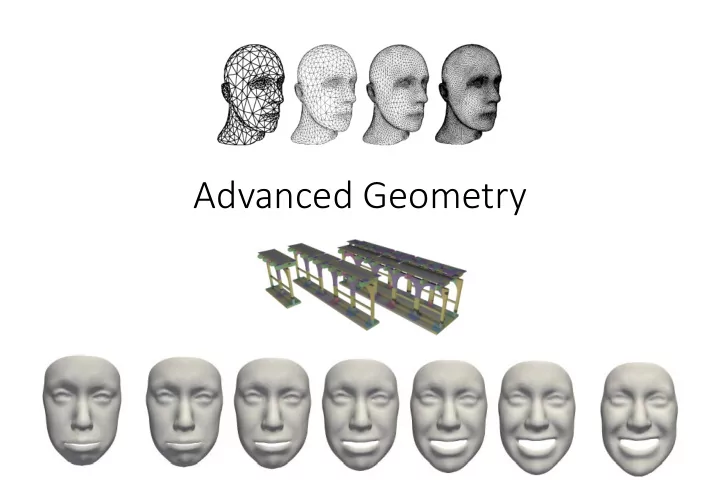
Advanced Geometry

slide-2
SLIDE 2

Topics

1. Automatic content creation 2. Level-of-detail representations

2

[Liu et al. Eurographics 2015]

slide-3
SLIDE 3

Content creation

3

slide-4
SLIDE 4

Traditional manual approach

  • Use of 3D modeling software
  • Manually define geometry and

materials

  • Compose model of multiple

primitives

  • Requires expertise and time,

expensive

4

Example image of modeled fish from Wikipedia.

slide-5
SLIDE 5

Automatic content creation

Main idea

  • Generate 3D models without manual modeling
  • Two options
  • 1. Measuring real-world objects
  • 2. Modifying existing 3D models

5

slide-6
SLIDE 6

Measuring real-world objects

6

slide-7
SLIDE 7

Traditional Acquisition Techniques

  • Small set of discrete

measurements

  • Used in different applications
  • Anthropometric measurements
  • Surveying
  • Main advantage
  • Easy to acquire and process

measurements

  • Main disadvantage
  • Impossible to get a detailed

shape description

slide-8
SLIDE 8

3D Scanners

  • New technology
  • 3D (animation) scanners
  • Record 3D video
  • Active research area
  • Powerful tool
  • Preserve artwork / historic artifacts
  • Acquire populations of 3D shapes for analysis

[P. Jenke, WSI/GRIS Tübingen]

slide-9
SLIDE 9

Types of 3D Scanners

Scanning Techniques:

  • Time-of-flight
  • Time-of-flight laser scanner
  • Time-of-flight depth cameras (dynamic)
  • Triangulation
  • Laser line sweep
  • Structured light
  • Stereo / computer vision
  • Passive stereo
  • Active stereo / space time stereo
  • Other techniques
slide-10
SLIDE 10

Example Scan (time of flight laser scanner)

[data set: University of Hannover]

slide-11
SLIDE 11

Example scan (structured light scanner)

color-coded structured light courtesy of Phil Fong, Stanford University motion compensated structured light courtesy of Sören König, TU Dresden

slide-12
SLIDE 12

Example scan (active stereo scanner)

slide-13
SLIDE 13

Example scan (stereo reconstruction)

multi view matching (6 cameras)

(photo-consistent space carving) [Data set: Christan Theobald, MPII, 2006]

multi view matching (8 cameras)

(piecewise smooth variational surface

  • n presegmented images

solved with Bayesian belief propagation) [Data set: Zitnick et al., Microsoft Research, Siggraph 2004]

slide-14
SLIDE 14

Processing the scans

To be useful, the scans need to be processed

  • Hole filling
  • Outlier removal
  • Many methods and software

libraries available

14

slide-15
SLIDE 15

Allows for direct content creation

15

slide-16
SLIDE 16

Modifying existing 3D models

16

slide-17
SLIDE 17

Possibilities

  • Common possibilities
  • Extrapolation
  • Interpolation
  • Structure-aware modification
  • Many possibilities, active area of research

17

slide-18
SLIDE 18

Exercise

Propose a way to interpolate and extrapolate between two 3D shapes

  • How do you represent the shapes?
  • What interpolation / extrapolation equation to use?
  • What are the advantages and disadvantages of the method?

18

slide-19
SLIDE 19

Shape interpolation and extrapolation

  • Possible in shape space using correspondence information

19

slide-20
SLIDE 20

Statistical shape spaces possible

  • Learn statistical distribution of geometry of shape
  • Use this information for synthesis

20

slide-21
SLIDE 21

Structure-aware modification

Challenge

  • Direct point-to-point correspondence cannot be established
  • Point-wise or triangle-wise modification not meaningful
  • Active area of research

21

Liu et al. Eurographics 2015

slide-22
SLIDE 22

Take advantage of symmetry information

22

Kalojanov et al. SGP 2012

slide-23
SLIDE 23

Decompose into basic building blocks

23

Liu et al. Eurographics 2015

slide-24
SLIDE 24

Level-of-detail representations

24

slide-25
SLIDE 25

Key idea

25

Distance from camera = less geometric detail required

slide-26
SLIDE 26

Subdivision surfaces

  • We saw them already
  • Advantages
  • Very strong geometric compression (4 triangles become 1)
  • Theoretical convergence properties
  • Disadvantages
  • Not applicable to downsample shapes that do not have this structure

26

slide-27
SLIDE 27

Edge collapse

  • Models can be downsampled by sequence of edge collapses

27

[Hoppe, Progressive Meshes, SIGGRAPH 1996]

slide-28
SLIDE 28

Example result

28

[Hoppe, Progressive Meshes, SIGGRAPH 1996]