
SLIDE 1
ADOT Environmental Planning Group:
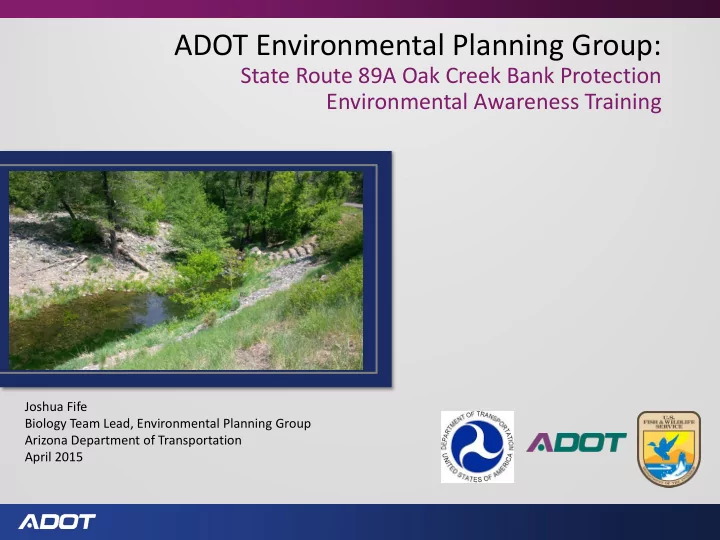
State Route 89A Oak Creek Bank Protection Environmental Awareness Training
Joshua Fife Biology Team Lead, Environmental Planning Group Arizona Department of Transportation April 2015
ADOT Environmental Planning Group: State Route 89A Oak Creek Bank - - PowerPoint PPT Presentation
ADOT Environmental Planning Group: State Route 89A Oak Creek Bank Protection Environmental Awareness Training Joshua Fife Biology Team Lead, Environmental Planning Group Arizona Department of Transportation April 2015 Environmental Awareness
Joshua Fife Biology Team Lead, Environmental Planning Group Arizona Department of Transportation April 2015
– Narrow-headed gartersnake (Thamnophis rufipunctatus) – Mexican Spotted owl (Strix occidentalis lucida)
complete the repairs.
baskets along the eastern banks of Oak Creek. High flow events in 2004 and 2005 overtopped the gabion baskets causing the baskets to slump downhill toward the active channel. Without immediate attention, ADOT Flagstaff District engineers believe the existing gabions will fail completely.
Photo: Courtesy of Coconino National Forest
– Increased flows within the entire Oak Creek watershed are anticipated
– July 2014: Due to the risk associated with increased flows, the project was fast-tracked.
– Previous designs from 2010 called for the removal of the existing gabion baskets and replacement with gabions anchored into the
Creek – Working in the wetlands would require extensive permitting for water quality and sensitive species. – The design team worked to find a solution to stabilize the bank without working in the waters of Oak Creek
– Designers came up with a design solution to install a rail bank wall with additional rock armament – New design kept work out of the active channel and adjacent wetlands – Nationwide Permit= A short review period but all construction activities must remain out of water.
– Threatened and Endangered Species
– Endangered Species Act: Listed Threatened (79 FR 38677, July 8, 2014)
– What is a threatened species?
the foreseeable future throughout all or a significant portion of its range. – Cause of decline in population
increased recreational use in riparian corridors and introduction of non-native invasive species (crayfish, bullfrogs and predatory fish).
– NOT POISONIOUS – Medium sized snake, up to 112 cm (44 in.) – Triangular head – Coloration is slightly varied – Not striped
Photo by: C. Loughran
Photo by: E. Nowak
– Conifer Woodlands – Interior Chaparral – Arizona Upland parts of Sonoran Desertscrub
Narrow-headed Gartersnake Habitat- Oak Creek
– The snake feeds underwater primarily on native fish. – Can mistaken for brown sticks when underwater – Often basks on boulders and in vegetation along stream banks (AGFD 2012). – Give birth to 8-18 live young in late July to early August. – Hibernates from November to April. Generally hibernates in well protected area above the high water mark.
– Safety is the first and foremost concern.
attempt to capture, or harass the snake.
last observed.
Photo: Bill Radke-USFWS
– Listed Threatened (58 FR 14248, March 16, 1993) with critical habitat (69 FR 53182, August 31, 2004) (FWS 2008).
– Medium-Sized owl with dark eyes and no ear tufts. – Brown plumage with various cream colored spots – Approximately 17 in. in length with a wingspan of 3.3 ft. (USFWS 2008).
– Habit varies, most commonly found in mature montane wooded forest, mixed conifer and pine-oak vegetation communities. – Prefers deep wooded canyons with high canopy closure and tree density. – Found in elevation ranges of 4,100 ft. to 9,000 ft. (USFWS 2008).
– Breeding areas are located over ¼ mile from project area. – Owls may utilize entire canyon a foraging habitat. – Still protected under the ESA.
1. STOP - Safely halt construction activity. 2. TELL - Notify the onsite biology monitor and ADOT Project Supervisor. 3. LEAVE IT ALONE - Do not approach or attempt to scare the owl away. 4. WATCH IT - Observe from a distance.
– Oak Creek Canyon is an ecologically sensitive area and a very popular tourist destination. Keep the job site clean. – If you have any questions, do not hesitate to ask an onsite biology monitor, the Flagstaff District Environmental Coordinator or EPG Biologist.
– Safety First – Stay out of the water at all times
biology monitor and ADOT project Supervisor immediately.
– Narrow-headed gartersnakes are NOT poisonous. However, there are
present within the project limits that are poisonous. BE ALERT!
Level ADOT Partner Step 1. Operation Biology Monitor Monitor escalates directly to ADOT District Environmental Coordinator Step 2. District Environmental Coordinator Rob Nelson Contractor Superintendent Step 3. Resident Engineer Steve Monroe Contractor Superintendent
Step 4. Management Chad Auker Audra Merrick Contractor Management Step 5. Senior Management Todd Emery Contractor Senior Management
Name Title Agency Telephone E-Mail
Rob Nelson Flagstaff District Environmental Coordinator ADOT 480-340-4871 Rnelson@azdot.gov Steve Monroe Resident Engineer ADOT 928-714-2290 smonroe@azdot.gov Audra Merrick Flagstaff District Engineer ADOT 928-779-7596 Amerrick@azdot.gov Joshua Fife Biologist ADOT 602-622-9622 Jfife@azdot.gov Shaula Hedwall Senior Biologist US Fish and Wildlife Service 928-556-2118 shaula_hedwall@fws.gov Chad Auker Assistant District Engineer ADOT 928-779-7551 cauker@azdot.gov